Feeds:
Posts
Comments

Archive for the ‘Quote’ Category

*********************

“And I can’t be running back and fourth forever between grief and high delight.”

J.D. SalingerFranny and Zooey

**********************

When I send a painting to a gallery it is with the expectation that it might very well sell.  As a result, I don’t usually announce or comment when a piece does actually go to a new home. I am usually very pleased when a sale of my work takes place. I mean, it’s my job and my livelihood plus the sale is a validation, in a way, that the work reached out beyond my own imagination and struck a chord with someone to the point that they chose to spend their hard earned money to obtain it.

What’s not to be happy about that?

But hearing that some paintings have been sold raises conflicting emotions. On one hand, I am thrilled to see the painting find a new home and to know that I can pay my bills for another month. That is a always a good thing.

But on the other hand, there are paintings that I see as being special, as being more significant to myself. Selling one of these paintings means that it is forever out of my hands, that it is no longer mine alone. Like a part of myself has been sheared off and sent away.

As a result, much like Salinger wrote above, I find myself running back and fourth between grief and high delight.

Such is the case with the painting at the top, Saints and Sinners. It’s a piece that I felt was personally among my best, one that was well beyond myself. I learned yesterday that it had sold and was very happy at first. Someone had seen that same special quality in it and was making it part of their life.

But after only a few moments, I had a sinking feeling in my stomach and a sense of loss came over me.

Even this morning, I am a little sad about it being gone forever.

Almost grief.

I say almost because, as grief goes, this is way down on the list of things that might cause one to grieve. For most people, especially non-artists, this sound ridiculous, I know.

So, let’s just call this artistic grief.

Don’t worry. I’m okay. I am not wearing black or tearing up this morning. I sold a painting, for chrissakes.

I am very happy about that but will still miss it, that’s all.

Okay, back to work. Maybe this next piece will be a worthy replacement.

Or better…


Read Full Post »

********************

“The hidden well-spring of your soul must needs rise and run murmuring to the sea;
And the treasure of your infinite depths would be revealed to your eyes.
But let there be no scales to weigh your unknown treasure;
And seek not the depths of your knowledge with staff or sounding line.
For self is a sea boundless and measureless.
Say not, “I have found the truth,” but rather, “I have found a truth.”
Say not, “I have found the path of the soul.” Say rather, “I have met the soul walking upon my path.”
For the soul walks upon all paths.
The soul walks not upon a line, neither does it grow like a reed.
The soul unfolds itself, like a lotus of countless petals.”

― Kahlil Gibran, The Prophet

**********************

A new painting, a 24″ by 24″ piece on canvas that I call Seeking Depths.

I am starting to make progress on  work for my two main annual shows, the first at the Principle Gallery in June and the second at the West End Gallery in July. I am working on several different modes for these shows, ranging from a series of cityscapes such as the one featured in progress here last week  to revisiting the sparse ink landscapes on paper of my early work along with new paintings that are at the current end of  my painting continuum. The overlying theme for these shows is that the work will be mainly seeking to find inward depth in the picture plane and a deeper atmospheric presence.

This piece is a pretty good example of what I am looking for in the current work. There is optical depth into the canvas. The colors are darkly deep and rich. The atmosphere that moves across the depths of the painting, from the sky to the foreground, is an essential element of the painting here with  its own weight and dimension, not just a background on which everything rests.

I am looking forward to how these groups of work progress together. Having determined a direction, I now feel refreshed and eager to move ahead at a reckless pace– my favorite way to work.

We shall see what it brings…


Read Full Post »

Stuart Davis- Swing Landscape 1938

*********************

For a number of years Jazz had a tremendous influence on my thoughts about art and life.

-Stuart Davis

**********************

I wrote yesterday about how as an artist I am influenced by many things other than the paintings of other artists. I thought I’d share some paintings from artist Stuart Davis (1892-1964) whose work itself is considered a huge influence on the Pop Art movement of the 1960’s. I’ve been a fan of his for many years, particularly after seeing how his work evolved through his career from a Robert Henri trained Modernist whose early work echoed the influence of Van Gogh through a Picasso inspired Cubist period into his own style with its own vocabulary that was largely inspired by the Jazz of the time.

I also always keep something in mind he said when I am at work: Always remember that in a painting, color has a position, and a place, and it makes space. As a result, I try to make color a vital element in my paintings, sometimes more important than the actual subject of the painting.

But, this morning let’s just look at a few of Davis’ Jazz inspired paintings and take a look and a listen to the great Duke Ellington‘s Jazz classic Take the A Train. I get the feeling Stuart Davis might have painted a bit to this track.

I am not sure but the video here looks to be a Soundie, which were short, well produced music films that were played on video jukeboxes in bars and clubs the late 1940’s. They mainly featured popular black Jazz musicians, giving these often musicians, who really didn’t have an many outlets for their music as their white counterparts, an exciting venue that really spread the popularity of their music.


Read Full Post »

*************************

For this day’s work, lords, you have encouraged treason and opened the prison doors to free the traitors. A nation can survive its fools, and even the ambitious. But it cannot survive treason from within. An enemy at the gates is less formidable, for he is known and he carries his banners openly against the city. But the traitor moves among those within the gates freely, his sly whispers rustling through all the alleys, heard in the very halls of government itself. For the traitor appears no traitor; he speaks in the accents familiar to his victims, and he wears their face and their garments, and he appeals to the baseness that lies deep in the hearts of all men. He rots the soul of a nation; he works secretly and unknown in the night to undermine the pillars of a city; he infects the body politic so that it can no longer resist. A murderer is less to be feared. The traitor is the carrier of the plague. You have unbarred the gates of Rome to him.

************************

I have seen the words above online used as a meme, attributed to the orator Marcus Tullius Cicero from the year 42 BCE. I immediately thought they described to a tee the current situation at hand here in this country, especially with the revelations of continued Russian meddling for and collusion with our president*** from the last couple of days.

These words  certainly could be applied to this president*** and his enablers and to think they came from over two thousand years ago was enlightening. The ways of treason and the traitor have not changed much over the ages.

Taylor Caldwell

Taylor Caldwell

Unfortunately, though I feel resonance between those words and these times, those are not the actual words of Cicero. They are from a 1965 novel, A Pillar of Iron, from bestselling author Taylor Caldwell. The book is a fictionalized account of the life of Cicero and his fight to save the Republic from approaching tyranny. He was assassinated for his efforts at the urging of Marc Anthony in 43 BCE.

While the words as we see them are not the actual words of Cicero at the time, much of their intent is derived from his orations of that time. Caldwell did her research and scoured the words of Cicero to create her own fictional interpretation of what Cicero may have said when he addressed the Senate then.

So, while the traitorous treachery Caldwell’s version of Cicero called out in the words at the top of the page may have come from 1965, their meaning most likely was born in some part in the words of Cicero from over 2000 years back. And whether they are from 2000 years ago or just 55 years, fact or fiction, they are words to which we should pay attention.

Read Full Post »

***********************

Watching the painter painting
And all the time, the light is changing
And he keeps painting
That bit there, it was an accident
But he’s so pleased
It’s the best mistake, he could make
And it’s my favourite piece
It’s just great…

Kate Bush, from the song “An Architect’s Dream” 

*********************

I’ve been working on a group of cityscapes recently but I am not prepared to show them yet, wanting to see what direction they are sending me first. But I thought I would share a quick photo of the one I am currently at work on.

A work in progress.

It’s at the stage that is probably my favorite of all the stages that a painting inevitably passes through on its way to becoming a finished work. It is basically done from the standpoint of its composition. All the elements are blocked in and it is already beginning to impart whatever it has to share to me, its only viewer to this point. The bits of color set against the monochromatic red oxide skeleton of the piece provide bursts of contrast and add depth into the picture plane.

This stage is, except for that final moment when the piece comes to life near the end of the process, always exciting for me. It is like a human skeleton come to life as I build it, telling me aloud where I should be working on it next. It points out how much potential the painting contains, where I should focus my attention and where it can expand its feeling with multiple layers of color.

Most of the time I quietly listen to this talking skeleton and heed its directions to me.

But sometimes I want to tell the skeleton to just shut up stand still for a minute because maybe you’re done as is, Mr. Bones.

Yeah, sometimes I like the work so much at this point I want to stop and just let it be. I worry that by adding more layers of paint that I will cover its essence as I see it at this point. Make it something less than its potential.

But I never just let it be. I don’t know that I have the guts to work that way, to show it as it stands. Or have the ability to stop seeing more in it and needing to continue working at it.

This piece may be as close to just stopping as I get. I could see it being finished with just a few touches to the sky and the moon. Maybe a little more work in leveling out some of the rough spots.

Or not.

I don’t know.

I guess we’ll have to wait and see if this skeleton gets fleshed out.

Here’s the song, An Architect’s Dream, from Kate Bush that provided the lines at the beginning of this post.

Read Full Post »

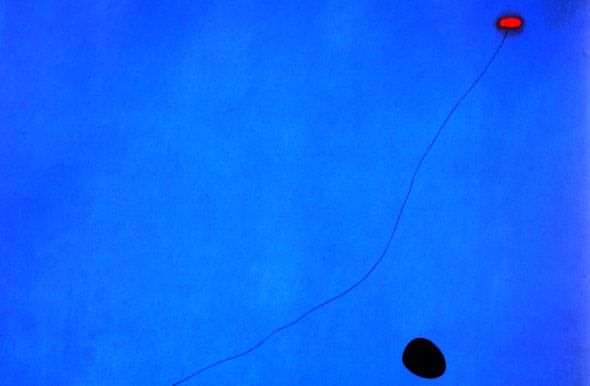
Blue II- Joan Miro

*****************

The picture should be fecund. It must bring a world to birth.

-Joan Miro

****************

This is a thought that I often keep in mind. Art succeeds when it creates its own reality, when it brings a world to birth in the mind of those who behold it. The artist’s own belief in the reality of that new world is a large determinant in whether this birth takes place.

For myself, I almost always feel like I am taken to a different world, one as real as the world I inhabit in my human skin, by whatever is on the surface before me.

That is, when it works. Sometimes it is difficult to climb into that new world and that new reality that wants to be born on the surface is nothing more than a lifeless mishmash of paint blotches and lines. That is frustrating, to say the least.

But when it works, it is an easy glide into that new world with its own atmosphere and landscape, so familiar yet new and fresh in the nose and to the eye. It’s a thrill just to be in there for that time when taking on its lifeform.

Joan Miro (1893-1983) did such a thing with such ease. I am showing his Blue triptych today. I find it interesting how intimate and alive they feel as single images on a screen where their scale fades away. These could easily be small paintings. But when you see them as they are in the two photos below, you can see their size and how it magnifies their lifeforce.

They are a world unto themselves.

Take a look for yourself. I have also included a video of Dave Brubeck’s Bluette below that is played over a slideshow of Miro’s work.

Just good stuff.


Joan Miro Blue I

Joan Miro Blue III


Read Full Post »

*********************

The writer operates at a peculiar crossroads where time and place and eternity somehow meet. His problem is to find that location.

–Flannery O’Connor

**********************

I think you could probably substitute artist in for writer in the words above from author Flannery O’Connor (1925-1964) without changing the gist of the thought too much. All art, and literature certainly falls into that category, is about transforming the now of the creation– the time and place— into something beyond that moment, into something timeless–the eternity to which O’Connor refers.

Finding that intersection where those two things come together is, as she points out, not such as easy thing to accomplish. And almost every instance the artist will never know if they have come to those crossroads that moves their work into the realm of the eternal.

I guess the finding is immaterial without the seeking. And seeking without any assurance of finding something that will ever reveal itself to you is an act of faith, a belief that there something eternal worth seeking.

I don’t know what else to call it. You keep trying. You think it is near sometimes but when you finally come to it, you’re not sure enough of what you’re experiencing to stop seeking.

Does one ever know when they have come to that crossroads?

That being said, here’s this week’s Sunday morning music from a longtime favorite of mine, Tracy Chapman. I think her body of work sometimes get overlooked in the deluge of the new but every time I come back to her, I wonder how I have let her slip out of mind. Here’s a song that fits the subject here, Crossroads, to accompany the painting at the top, Beyond the Crossroads, from back in 2004.

Have a good Sunday, okay?


Read Full Post »

*************************

Love, whether newly born, or aroused from a deathlike slumber, must always create sunshine, filling the heart so full of radiance that it overflows upon the outward world.

–Nathaniel Hawthorne

*************************

A few choice words for this Valentine’s Day from Nathaniel Hawthorne, who is not someone who normally comes immediately to mind when one thinks of love and romance. But creating sunshine and filling the heart with radiance,as he put it, is not the province of any one writer.

I have plenty to do so I am going to keep this short today. Here’s a wonderful version from the immortal Nat King Cole performing the classic Embraceable You, written by George Gershwin back in 1928. Enjoy your Valentine’s Day. Or if the holiday doesn’t really move you, enjoy your Friday. Either way, it’s a win.

**************


Read Full Post »

*****************

Artists who live and work with spiritual values cannot and should not remain indifferent to a conflict in which the highest values of humanity and civilization are at stake.

–Pablo Picasso

******************

I always worry about alienating people who come to this blog to read about art and are greeted with my opinions and beliefs on the world. But reading the words above from Pablo Picasso this morning reminds me that my art is a product of all that I am and all that I witness in this world. I like to think that the work is about the human spirit and emotion. As such, I can’t remain indifferent or ignore those things that set off my emotional alarms nor those that eat away at what I see as the collective human spirit that we all share.

Thinking this made me look for another blog entry that I wrote just a couple of years back that featured some other words from Picasso as well the painting above, his masterpiece Guernica.

Here it is:

***************

Art is a lie that makes us realize the truth.

Pablo Picasso

****************

Many of my favorite artists worked and produced their greatest works in times where the world was under great stress. Two World Wars only decades apart and– in the case of Picasso– the Spanish Civil War in between. Here, we had the Great Depression. Times of social transformation and spiritual upheaval. Even when the work didn’t overtly deal with the events of the day, much of the work reflected on the collective consciousness of that time.

I think that is so because art is, just as Picasso so succinctly states, a lie that makes us realize the truth.

Artists fabricate, often creating work that is on its surface pure fantasy with little relation to the world as others might observe it. But their fabrication is made up from everything that impacts them– their knowledge, their observations, their opinions and emotions. Artists take in the world and create something that seems like a pure fabrication.

A lie.

But what seems the lie often proves to be built of ultimate truths, just constructed in a manner that allows others to see this truth clearly.

I don’t know that we artists always succeed. I certainly don’t feel that I do as often as I would  like. But when a piece succeeds and shows us something far beyond what its surface represents, it is a true revelation.

Believing that, so long as we feel deeply and continue to create our lies, we will at some point reveal a truth.

Got to get to work now…

Read Full Post »

Peter Doig- Swamped 1990

********************

I sometimes wish I had never had to sell a painting. Every painting you make represents the time it was made and how you were feeling and what your influences were… You are never going to feel that way again, so you can never repeat it…

–Peter Doig 

*******************

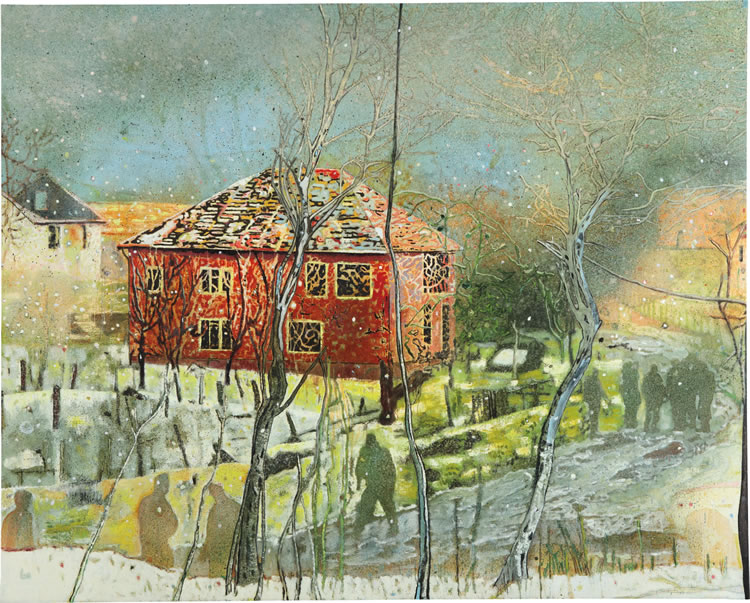
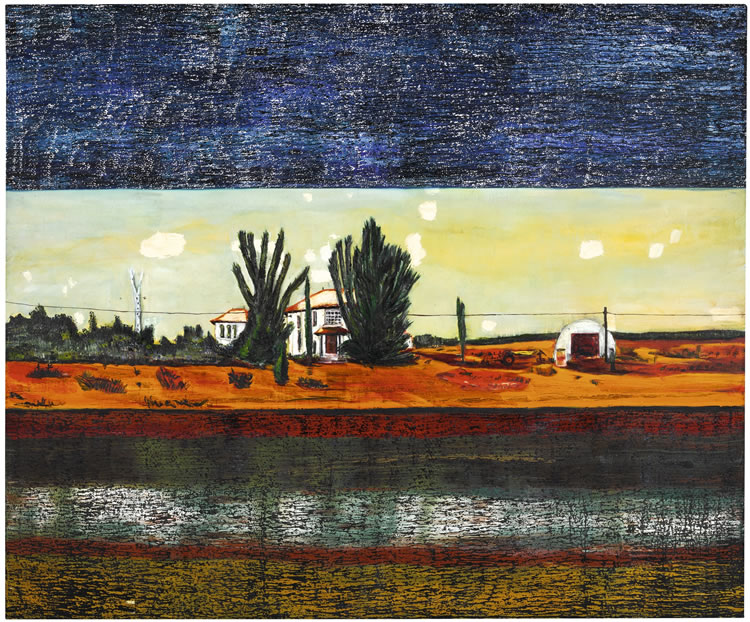
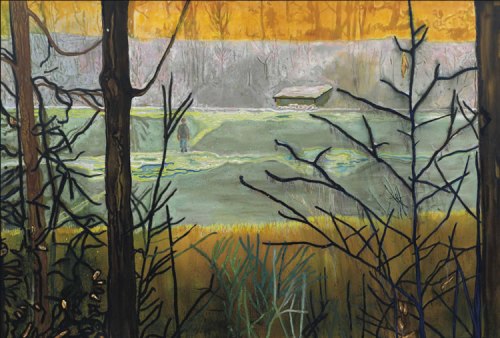
I shouldn’t make such a blanket statement but I doubt that most of you out there know the name of the contemporary artist Peter Doig. I know that I wasn’t fully aware of him until a decade or so back and even then only on a passing basis where I would stop and examine his work when I would come across it in an article. The piece at the top always made me stop and look a bit closer.

But the fact of the matter is that the Scottish born Doig (b. 1959) is perhaps the most sought after living artist working today with works selling for the tens of millions at auction. Of the 9 paintings shown here, only one sold for less than $10 million at auction. The most expensive sold for over $ 28 million. I won’t tell you which is which. There were many others on the auction sites that sold for between 1 and 4 million that I didn’t include.

These prices always open up a debate with lots of questions on the relative value of artwork. What makes a work worth $28 million? Does the auction value of the work determine its importance or does its importance determine its value? Is the working and thinking process of this artist that much different than that of an artist that sells for tremendously less?

You might think from the direction this seems to be heading that I am decrying Doig’s work selling for what I believe are ludicrous sums. I am not. I very much like and admire his work. I can see those elements in it that make it distinct. It is good and great work and might very well be among the most important work from this time. If his work can bring in that kind of money, I applaud him.

I am, if anything, criticizing myself for not having the ability– or knowledge or audacity– to command such prices. I know that the price of a piece of art sometimes determines how serious collectors view it and that a great piece can be overlooked simply because it is too inexpensive, at least by the standards of collectors.

That has happened to me at times.

In some galleries, my works sits at the top end of their market and in others, in the middle or near the bottom of their price ranges. While I am satisfied with that, I firmly believe that my work is greatly undervalued across the board, that it should be demanding much higher prices.

Now, that sounds like confidence, doesn’t it? Maybe even overconfidence?

Actually, it is the opposite of that. It is a lack of confidence and a bit of fear that keeps the prices of my work in the range where they are and have been. While I have the belief in the relative value of my work, I just don’t have the guts to make that jump.

I have been poor in my life and it wasn’t that long ago that I was dead broke and I think that tempers my ambitions, as far as pricing my work is concerned. I like to have my work sell and make a living from it. I take pride in being able to live off of the product of my own thoughts and imagination. And I find a sense of security in being able to provide what I consider high quality work at prices that make it obtainable for more people than if it were in a much higher range– it’s undervaluation generally means that the work will sell eventually.

Maybe I am too comfortable and seeing Mr. Doig’s prices just nudges me a bit, telling me to be less comfortable, to be more proactive.

I don’t know. Just thinking out loud this morning. I wrote this because much of what I have read about and from Doig jibes with my own experiences, including the quote at the top. For all the talk about prices, every real piece of art represents a certain time and place for that artist, one that is distinct and not repeatable. I know that I will sometimes look at a piece and remember the days I spent in front of it while painting it. That time, that thought process is burned into my psyche and will never happen again in the same way.

Anyway, lets’s push aside thoughts of money for now and just look at the paintings of Peter Doig a bit more.

Peter Doig- Rosedale 1991

Peter Doig– Red House 1995

Peter Doig– Island Painting 2000/01

Peter Doig– Grasshopper 1990
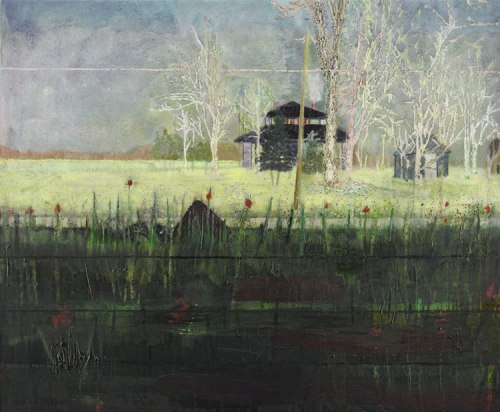
Peter Doig — Daytime Astronomy 1998/99

Peter Doig– Charley’s Space 1990

Peter Doig– Forestia 1996
Peter Doig– Almost Grown 2000


Read Full Post »

« Newer Posts - Older Posts »