Feeds:
Posts
Comments

Archive for the ‘Quote’ Category

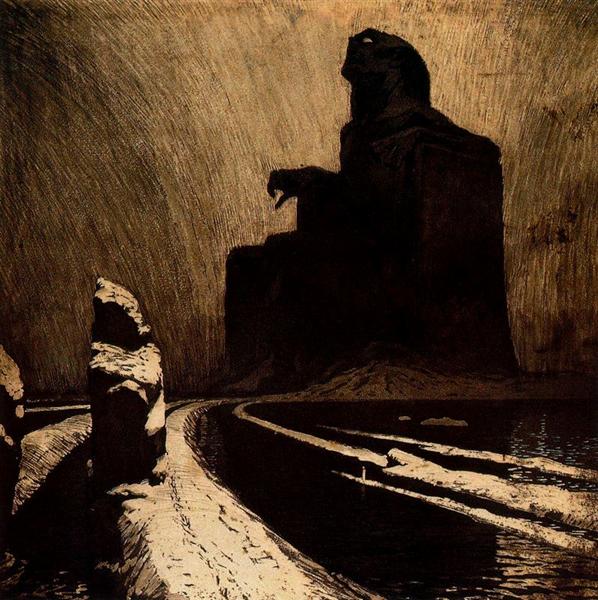
Frantisek Kupka – The Black Idol (Resistance) 1903

*************************

“In keeping silent about evil, in burying it so deep within us that no sign of it appears on the surface, we are implanting it, and it will rise up a thousand fold in the future. When we neither punish nor reproach evildoers, we are not simply protecting their trivial old age, we are thereby ripping the foundations of justice from beneath new generations.”

Aleksandr I. Solzhenitsyn, The Gulag Archipelago 1918–1956

**************************

Cautionary words from a man who experienced the results from a nation that went in the direction in which we seem to be moving. Much like yesterday’s post, a warning that we shall reap the amplified consequences from the evil we have sown with the silent compliance contained in our acceptance of it.

As they say, ’nuff said.

Read Full Post »

************************

When men sow the wind

it is rational to expect

that they will reap the whirlwind.

–Frederick Douglass

************************

Amplified consequence.

In his 1892 essay, Lynch Law in the South, Frederick Douglass used the proverb from biblical book Hosea, to illustrate how man often sets things in motion that have results that extend far beyond– and often in stark opposition to– their intended goals. Douglass wrote that the deadly violence being shown against the black citizens of the south at that time would eventually come back to haunt those that perpetrated the deed or stood idly by, complicit in their silence.

The biblical proverb in Hosea was about how the the citizens of Israel of that time ( ca 725 BC, I believe) took to idolatry, the worship of false idols, and how their actions brought down upon them the wrath of God. In that book the author uses the concept of farming to make his point, that a  a single seed of grain sowed by a farmer returns to him many times over.

An amplified consequence.

Of course, the farmer can usually tell what the result of his sowing will be. X amount of seed will allow him to reap Y amount of grain at harvest under normal circumstances. Predictable.

But that same degree of predictability doesn’t apply to all other actions man sometimes sets in motion. While we might initially think we control the outcome, we sometimes put actions into motion — sow our seed– that we cannot control, that return to us with such amplification and intensity that we are overcome and sometimes decimated by the result.

One small, seemingly insignificant action, such as not paying attention to a rising dangerous wind, can sometimes turn into a maelstrom of destruction that we never saw coming.

Take that for what it’s worth, given the events in recent days in this country.

The painting at the top is called Into the Winds of Change and is part of the West End Gallery‘s annual Little Gems show that opens tonight with an opening reception from 5-7:30 PM. Hopefully, like the Red Tree here, we can stand against and overcome the whirlwind that may soon be upon us.

Read Full Post »

**********************

I myself incline to drift, to accept a lesser situation rather than strive for a greater, and yet, I know that character in life and art is only made by an effort that is quite beyond one’s ordinary everyday acceptance of things as they are. 

–Lawren Harris, Letter to Catherine Whyte

**********************

Came across this quote from one of my favorites, the painter Lawren Harris, and it really stood out for me on a couple of fronts.

Personally, it was a reminder that an artist’s character is developed by continuing to push beyond what they know they can do. To become more and not settle for the situation as it is. It’s easy to do what you know is possible but trying to do what you are not sure is within your grasp builds confidence, builds character. That is what moves the needle.

That’s an important thing for any artist to have in mind. I know I have to kick myself on a regular basis to not lull myself to sleep by doing what I know I can do and not attempting to do that new thing that seems too much for me to handle.

But on a larger scale, Harris’ words speak to where we are as a nation at this very moment, We are in a crucial moment and what happens in the coming days and weeks will determine both where we are headed as a nation and what makes up our collective character. Do we take the easy way that just accepts things as they are? Or do we pull from deep within our character and do that which is right even though it might require true effort and perhaps even sacrifice?

I wish I could say which way it will go but I don’t know. I believe that there is so much more that will be soon uncovered that to maintain the status quo will be untenable and there will be big change.

That the character we aspire to as a nation will finally come forward.

But that’s just my belief. Like all beliefs, without effort, it’s not worth much.

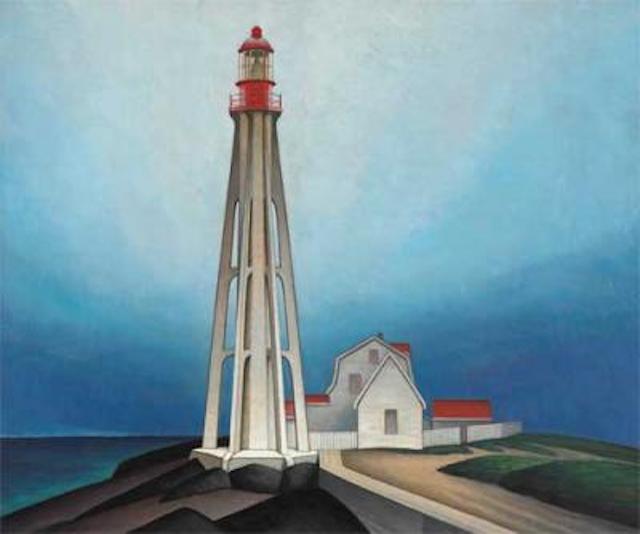
I thought the painting at the top, Light House at Father Point, was a great symbol for this post. The light house is a warning device, one that alerts sailors that they are approaching an area where they must proceed with caution.

We are at such a point as well. If we don’t pay attention we could end up on the rocks.

Let’s heed the warning from our own light house and not just take what is at hand as being the way things should be.

Let’s make an effort.

Let’s be more.

Let that define our character.

Read Full Post »

*************************

The Seven Social Sins

1- Wealth without work.
2- Pleasure without conscience.
3- Knowledge without character.
4- Commerce without morality.
5- Science without humanity.
6- Religion without sacrifice.
7- Politics without principle.

–Frederick Lewis Donaldson, Westminster Abbey sermon, March, 1925

************************

The list above has been attributed for years to Mahatma Gandhi who published this same list later in the year in 1925 but it first came from a sermon given by Anglican priest, Frederick Lewis Donaldson, at Westminster Abbey in March of that year.  Gandhi published it in his newspaper, Young India, in October, stating in a very short commentary that the list was sent to him by a “fair friend,” adding “Naturally, the friend does not want the readers to know these things merely through the intellect but to know them through the heart so as to avoid them.”

Though Gandhi may not have originated the list, his reputation sent the message worldwide.

Reading the list early this morning, I was struck that the entirety of the list could be applied to many of those who wield the power of government, most notably the person(?) who sits in our white house. He is devoid of all the positive social attributes on the right side of this list, existing without conscience, character, morality,humanity, or principle. Nor is he unwilling to work or sacrifice anything of his own to make the world better for those beneath him in the social pecking order.

Based on his comments stating that traumatic head injuries suffered by our soldiers weren’t real wounds, I think you can throw empathy and a few other positives into the list of things missing from his being.

In short, he is a hollow man.

A husk.

And the more we follow his lead, giving in to his twisted and selfish worldview, the more hollow we become as a nation. You can easily see it in the way he has affected the republican party which has many members in power who, like him, are crossing off more and more items on the list above. They have become a husk of a political party, one without conscience or principle or shame of any sort, all too willing to carry the water for the hollow man.

As a result, he is going to be acquitted in this trial. That’s a forgone conclusion.

As Marcus Tullius Cicero wrote over two thousand years ago: “Here is a man whose life and actions the world has already condemned – yet whose enormous fortune…has already brought him acquittal!

Some things remain the same. That doesn’t make it right nor does it undo the harm already done and the damage yet to come.

And the more hollow we become as a nation, the more of these sins that we normalize, the less able we will become to recover when that damage fully arrives.

We must ask more of our leaders. And ourselves.

Read Full Post »

*************************************

There is a cult of ignorance in the United States, and there always has been. The strain of anti-intellectualism has been a constant thread winding its way through our political and cultural life, nurtured by the false notion that democracy means that “my ignorance is just as good as your knowledge.

——Isaac Asimov, Newsweek interview, 1980

**********************************************

We’re on the eve of a dramatic and historic event starting tomorrow with the impeachment trial in the Senate. The stakes from this trial are as high as we have ever faced as a nation, far more than the two previous impeachment proceedings of the last fifty years, the Nixon and Clinton affairs. Neither of those had imminent national security issues. Neither had the sitting president asking for and receiving assistance from foreign nations in gaming our elections. Neither had the president using the whole power of his office and the many agencies at his disposal to obstruct and evade investigation.

As serious as those prior impeachments were, they pale in comparison to this trial and the ramifications that emerge from its outcome. With an acquittal of charges, the current president** will be totally unrestrained in his actions with, for all practical purposes, no oversight. An acquittal basically says that any president from this point forward can do whatever he desires. He can smother any investigation, refuse to release any information and persecute those who stand against him.

The president**, if you believe the hackneyed rationale of his attorney Alan Dershowitz, is unimpeachable for abuse of power or obstruction of justice.

Dershowitz has written that this president** could allow Russia to retake Alaska, in the same way it is attempting to reclaim Ukraine, without ordering resistance from our troops. As wrong as he claims it would be, Dershowitz writes that this would not constitute an impeachable offense.

As insane as that sounds, it may not be out of the realm of possibility for this president**, given his subservient stance toward Putin and Russia.

His power, according to Dershowitz–at least at this time–is near absolute. To put it plainly, he is above the law.

That is the nightmare scenario we are facing in this trial– a man with little, if any, self-restraint who may be given the green light to indulge his deepest and darkest desires. And to think that he won’t head that way with this newly found freedom is foolishness. Can you think of a single day in the past three years where he has tried to unify this nation in any way? His time in office has been a blur of self-serving actions, befuddling lies that are pawned off by his willing accomplices as truths, attacks of retribution and an almost nihilistic attack on the functional systems of our nation.

With acquittal, the last three years of madness and stupidity will be seen as the “good old days” as we go forward.

How did we get to this point? Well, it’s been heading this way for about forty years. For one thing, there is the unrestricted money in political campaigns which allows the wealthiest among us to parlay their wealth into political power that would give them even more advantages. So they can amass more wealth and more political power.

That might be the biggest contributing factor. But much of it comes down to the words at the top of the page from Isaac Asimov.

This cult of ignorance has been nurtured greatly in the past forty years. Minds that are easily distracted and lazy are easily manipulated. Those who wish to cultivate these people feed them misinformation, disinformation and outright lies, stoking their fears and angers while at the same time bringing them to the belief that their only hope lies in the very people who are fanning the flames and profiting from it.

Ignorance is a powerful force.

Ignorance becomes a belief system. It’s almost impossible to fight this belief with rational and fact based arguments. The line my ignorance is just as good as your knowledge” could easily be replaced now with “my belief, as unfounded and ridiculous as it is, is greater than your facts.

I try to maintain a sense of hopefulness in the face of the tide of ignorance that swirls around us. But today, as we wait on a trial that whose outcome seems almost preordained to hurl us into an abyss, I am not particularly filled with optimism.

I want to be wrong and hope I am proven so.

But I don’t think I am and don’t think I will be at this point.

Read Full Post »
Rene Magritte- The Empire of Light – Guggenheim Museum

*********************

Life obliges me to do something, so I paint. 

–Rene Magritte

*********************

I wasn’t sure what this post was going to be about when I started. Still don’t know, to be honest. I was simply going to put up a short quote with a painting or two by an artist, as I sometimes do. In this case the artist was the famed Surrealist Rene Magritte.

I liked the quote above. Simple. Concise. Right to the point.

Plus, I think it lines up with an answer that I sometimes give when someone asks how I became a painter. I will answer, “Hey, everybody has to do something.

That opens up what could be a whole philosophical discussion about what our obligations really are in our lives as humans.

Are we really obliged to do something?

I don’t know.

Maybe. I guess not doing something is, in it’s own way, doing something. I know that when I am not a painter I am, among many things, sometimes a lazy slob.

Life obliges me to do something, so I do nothing.

That doesn’t have quite the same cache as Magritte’s statement but it is sometimes true.

But for the most part, when life obliges me to do something, I paint.

Not like Magritte. In my own way, at my own pace and of my own choosing.

Hey, life can push me around but only so far.

**************

PS: I was going to write about the painting at the top which is one version of a painting, The Empire of Light, that Magritte painted fourteen times. The subject was not going to be about the night scene of this painting with a blue sky above. Rather, it was to be about the repetition of forms by artists, a subject to which I am well acquainted. Maybe next time.

Now, let’s look at some other Magritte paintings.

Rene Magritte- Decalcomania – 1966

Rene Magritte- The Mysteries of the Horizon 1928

Rene Magritte- The Son of Man 1964

Rene Magritte- The Beautiful Relations 1966


Read Full Post »

*********************

In my picture of the world there is a vast outer realm and an equally vast inner realm; between these two stands man, facing now one and now the other, and, according to temperament and disposition, taking the one for the absolute truth by denying or sacrificing the other.

Carl Jung

*********************

Time flies.

We’re looking at another decade slipping away. I originally didn’t give much thought to any way of marking this but in recent days began looking back at work from the past ten years, trying to to see if there was a single piece that summed it up for me.

That is really difficult. Even trying to choose a single painting that sums up a single show or year is often near impossible. There are favorites, pieces that speak to me more personally than others, but they often don’t reflect the body of work as a whole. But choosing one that stands as a symbol for ten years of hard work seems out of the question.

But I tried and came up with a few that stood out as possibilities. The painting at the top, for example. It’s The Internal Landscape from 2012. It’s a large piece, 4 1/2′ by 7′, and was the titular centerpiece of my show that year at the Fenimore Art Museum in Cooperstown, NY.

It’s a painting that has meant a lot to me, as far as building a confidence in myself that my work had lasting value that might carry it into the future somehow. I had been a full-time artist for about 14 years at the point that this was painted yet I still wasn’t confident my own evaluation of my work. I felt that it was a real expression, not mere decoration. It was my inner reality and like, Jung’s words above, I often found myself torn between this inner realm and the outer realm of the world. I knew this as a real world but I didn’t feel that I was qualified to say if this reality was enough, that it transcended what it meant for myself.

But this painting and its acceptance by the viewers of that show made me realize that my work’s effect could move beyond me.

And that was vastly important to me in doing this thing that occupies my days and nights.

Now, I can’t say this painting fully sums up the decade for me but it may come as close any other piece I might choose. It occupies a wall in my studio now and I take moments now and then to take it in. Its size makes it an embracing piece, one that makes me feel as though I am stepping into it with the warmth of the colors and shapes wrapping around me. It’s easy to spend time in front of it and let my mind wander among the fields and hills.

I don’t know that it will ever find a home outside the studio and that is fine with me. It feels like family, like a part of me now.


Read Full Post »

*********************

“Watch any plant or animal and let it teach you acceptance of what is, surrender to the Now.
Let it teach you Being.
Let it teach you integrity — which means to be one, to be yourself, to be real.
Let it teach you how to live and how to die, and how not to make living and dying into a problem.”

Eckhart Tolle, The Power of Now

********************

I have need of a little serenity this morning. It’s a crazy world out there and sometimes, when I let down my guard and let my reactions to it rule my demeanor, it gets the best of me. I find myself looking too far into the both the past and the future, seeking the causes and effects of things. While that might seem like a wise thing to do, to seek why things go a certain way and where they may lead, it often neglects the present time, the now.

That’s where I find myself this morning. Not in the past or the future but not quite fully in the now.

I try to sap some of the meaning of the words above from Eckhart Tolle. I have long found serenity in watching the forest and its inhabitants that surround the studio. There is a beauty in the witnessing the lives of the creatures of the wood.

For instance, take the common white tail deer that lives in abundance in our woods.

Their lives seem so difficult. Their existence is a constant struggle to find food, water and a tiny bit of shelter from the elements and the predators that hunt them. I used to have a doe that would snuggle up at night between the shrubs in front of my studio, laying up against the wall of the building. It was as safe and dry a place as she could possibly find.

There are few breaks for them. They are always on high alert, always skittishly scanning for danger and bolting in bursts of leaps through the forest at the slightest wrong movement.

Yes, it is a hard life.

Yet to see them have absolute moments of joy where they play and run with wild abandon around the studio makes me envious. It’s such a pure thing, their glorious reveling in the moment. In the now.

Watching them at these moments is one of the few times when I myself feel in the now. Their joy becomes my joy in that moment and the bitter world that surrounds us is gone away, if only for that brief instant. Gone are the worries of living and dying, of hardships past and to come.

Just a small yet absolute moment of joy.

That might be as close to real serenity that I ever experience. It might seem like a small thing but it feels like an immense treasure in a world that seems ready to plunge into madness.

And that’s just what I need. It’s good enough on this morning.

Read Full Post »

Wyeth/ Balance

******************

It’s all in how you arrange the thing… the careful balance of the design is the motion.

-Andrew Wyeth

******************

I read this quote from the late Andrew Wyeth then looked over a large group of his work, examining each piece with these words in mind. I could really see the importance of the placement of the elements in his work, how it was the characteristic that truly defined his work. It was this that gave his work a poetic feel.

His use of negative space is masterful, the empty areas taking on an important role in the overall feel of the work. Placing the central character, the focal point of the picture, in any in any other spot would change the whole piece, would make it feel less.

It would feel off balance, at least in the form that Wyeth defined it. That balance is his signature.

And I think that is true for many artists. This idea of balance and motion makes up the artist’s eye. Every artist has a slightly different way of seeing things which creates their own unique visual voice.

Myself, when I feel stuck or blocked or feel that I have painted myself into a creative dead end, I look back at older work. It is often the balance and motion with the composition that affect me the most. It serves as a reminder to not lose sight of this idea of balance, to not focus too  much on other parts of the painting that, while important, may not have as much effect on the overall impact of the piece.

Balance in the design creates motion. Good advice from Mr. Wyeth.

Read Full Post »

************************

“I can very well do without God both in my life and in my painting, but I cannot, suffering as I am, do without something which is greater than I, which is my life, the power to create.”

Vincent van Gogh, The Letters of Vincent van Gogh

************************

Amen.

Love the passion in the words above from Van Gogh but really just wanted to share the painting at the top of the page. It’s The Red Vineyard from 1888 and it is considered to be the only painting ever sold by Van Gogh in his lifetime.

It was bought by the Belgian Impressionist artist Anna Boch in 1890, the year of Van Gogh’s death. It was bought for what would be abut $2000 in today’s dollars. I include that because when Boch let it go to auction in 1909, its value had shot up to what would be about $150,000 today. Van Gogh’s sister-in-law, the widow of his brother Theo, wanted to get it back but the price went well past her means.

It was purchased by a Russian collector who gave up ownership of it when all private property was nationalized by the Bolsheviks after the Communist Revolution. Today, it hangs in the Pushkin Museum in Moscow.

More than likely I will never see this painting in person but it remains a peach.

Read Full Post »

« Newer Posts - Older Posts »