Feeds:
Posts
Comments

Archive for the ‘Quote’ Category

Arthur Dove- Fire at the Sauerkraut Factory

**********************

We cannot express the light in nature because we have not the sun. We can only express the light we have in ourselves.

-Arthur Dove

**********************

I liked this quote from the Modernist painter Arthur Dove (1880-1946) and while searching for an image of one of his paintings to accompany it, came across this painting. I liked the painting itself but it was the title that really caught my attention. It’s called Fire at the Sauerkraut Factory and was painted around 1936.

It made me wonder where this sauerkraut factory was and when it burned. Dove was born in Canandaigua, NY,  and raised in Geneva, NY, at the north end of Seneca Lake, whose south end is just a short drive from this studio. In those areas around Canandaigua and Geneva are large fields where cabbage is grown. There are, as a result, several factories in the area for the production of sauerkraut. I am not sure if it still applies but at one time this area and one village in particular, Phelps, was the sauerkraut capital of the world.

Just makes me wonder if Dove was basing this painting on a fire from the home of his youth. I was able to find an account of a large sauerkraut factory fire in that area in November of 1917. This story of the fire mentioned that the fire was fought solely with chemicals which might account for the multiple colors of the flames in Dove’s painting.

It also mentioned railroads tracks next to the factory which encumbered the firefighters. I believe the fence-like structures at the lower part  of the painting are actually railroad tracks.

Perhaps Dove, who was living in NYC at the time was visiting either his or his wife’s parents and witnessed the fire or was told about it, with the person telling the story mentioning the wild colors of the fire as the chemicals mixed with the flames.

It’s one of those tiny questions in small stories that may never have an answer. But I like to think that this might have been the story behind this painting that I like and chose to accompany a quote that I also like from the artist.
 

Read Full Post »

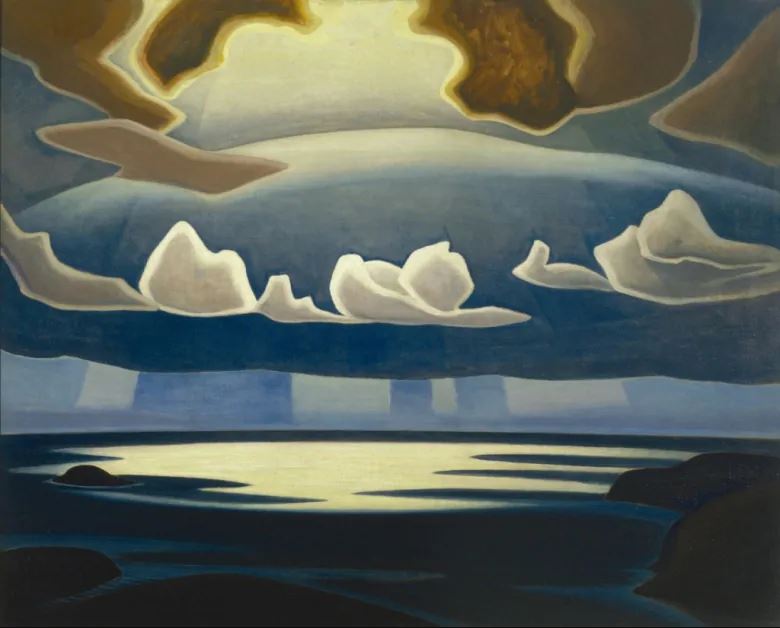
Lawren Harris- From the North Shore, Lake Superior ca 1927

*******************

Art is not an amusement, nor a distraction, nor is it, as many men maintain, an escape from life. On the contrary, it is a high training of the soul, essential to the soul’s growth, to its unfoldment.

–Lawren Harris

*******************

Whenever I need a lift or a reminder that what I am doing is more than a mere triviality, it’s always good to revisit the work and words of the late painter Lawren Harris.

Harris, who died in 1970 in his native Canada at the age of 85, had a way of capturing of grand spaces and forms and imbuing in them a sense of absolute stillness. It’s a created atmosphere that is conducive to the unfolding and growth of one’s soul.

Some might say that this in itself is an escape from life and, in the simplest terms, they would be correct. But art transcends the mere act of escape in that while doing so, it provides the space and nourishment for the growth of the soul.

I know that I have often looked to art as a safe haven, an escape from the cruelty and often illogical nature of the outside world.

But it was never just that single thing. This separation between the outer and inner world created an environment, a time and place, where lessons could be learned and insights could be formed. These lessons and insights become part of who we are and then undoubtedly travel with us back into that outer world.

No, art is not an amusement or an escape. It changes us in fundamental ways and by that, we are always made better.

I needed to write that this morning, if only for myself. Thanks, Mr. Harris, I feel a little better now.

Read Full Post »

The Loner

*************************

I was a loner, am a loner, good Lord, it’s the only way I can imagine working.

–Dorothea Tanning

*************************

I have things to do this morning and really just wanted to show the Dorothea Tanning painting, La Truite au Bleu, at the top, mainly because it pleases me very much. But I find I have to at least make a comment on the quote attached to this post.

I’ve have always worked alone as a painter and, like Tanning, can’t imagine it any other way. With only a few exceptions, when someone is in my studio, I am a bit on edge and even a little defensive. To have someone in the studio on a regular basis, say like studio assistant, would have me nervous and jerky. It would keep me from drifting off in thought when I felt like doing so or screaming in anger or crying in sad happiness.

And to do what I do, I need to do those things.

But more than that, I would have a hard time painting. At least, painting anything meaningful. There would always be something missing, as though I couldn’t commit everything because I would be distracted in maintaining a facade for the other person in my space. I would always be keenly aware of their presence.

I don’t know if that’s good or bad or if it matters in the least. I do know that Tanning lived to be 101 years old, dying in 2012. And until the end of her life, she painted and wrote , always working alone. So, maybe being a loner has it’s advantages.

I guess I will find out, one way or the other.

Read Full Post »

The Working Hands


******************

I have always regarded manual labour as creative and looked with respect – and, yes, wonder – at people who work with their hands. It seems to me that their creativity is no less than that of a violinist or painter.

-Pablo Casals

******************

I came across this shot of working hands and it made me think of how I’ve viewed hands through my life. I’ve always looked at people’s hands since I was a child. The liver spotted hands of my grandmother had thin ivory fingers that seemed like translucent china, for instance.

Growing up, the hands of our landlord Art, an old farmer [and a onetime bootlegger but that’s a story for another day], were thick and strong and missing at least one digit down to the knuckle on several fingers, the result of an ornery, impatient personality and dangerous farm machinery. Not a great match. I saw quite a few farmers with missing fingers and limbs back in the day.

Fat Jack, who I wrote about here a ways back, had hands whose nails were longer than you might expect and permanently rimmed with the black from the oil and grease of the machines on which he was always working. They were similar to the photo above. His hands were round and plump, like Jack himself, but surprisingly soft and nimble, good for manipulating the small nuts and bolts of his world.

There was a manager when I was in the world of automobiles who was a great guy and fantastic salesman who had extremely soft and damp hands. It was like handling a cool dead fish when you shook hands. A mushy, damp, boneless fish.

I admired working hands. They reflected their use so perfectly, the scars and callouses serving as badges of honor and the thick muscularity of the fingers attesting to the time spent at labor. They seemed honest with nothing to hide. They were direct indicators of that person’s life and world.

My own hands have changed over the years. They were once more like working hands, calloused and thickening from many hours spent with a shovel. There are a number of small scars from screwdrivers that jumped from the screwhead and into the flesh time and time again and another on the end of my middle finger from when I cut the very end of it off while trying to cut a leather strap with a hunting knife. Not a great idea but, hey, I never claimed to be Einstein.

I always felt confident when my hands were harder and stronger. Now, I have lost some of that thickness of strength and the fingers are thinner and a bit softer from doing less manual labor. I look at them now and wonder how I would have judged them when I was younger, when I measured a man by his hands, something that  I don’t do  now. I now know there are better ways to measure a life, that the work of the mind is now a possibility– something that seemed a million miles away then.

But when I come across working hands, strong and hard, I find myself admiring them still.

****************

This post has ran a couple of times over the years, generally around Labor Day. I have always admired hard workers, people who didn’t swerve away from having to use their hands and backs to get something done. I have been a hard worker at times though I have spent as much time, maybe more, as a bone idle slob.

I like myself a lot more when I am the hard worker.

Have a good Labor Day weekend.

Read Full Post »

*********************

Art is polymorphic. A picture appears to each onlooker under a different guise.

–Georges Braque

*********************

Polymorphic.

I like the sound of the word and the fact it describes the idea that every picture is seen by each viewer in a distinct way. Everyone responds to whatever speaks loudest to them in that picture. Some respond to the colors or forms. Some to textures or brushwork. Some to the subject represented and some to an emotion felt by them that they see in the picture.

As an artist, you often see your own work in one way which is your own personal take on a particular piece. As such, you expect others to see it in the same way. But after a while of being an artist you begin to understand that the polymorphic piece that inspires different responses and interpretations in others is what you desire for your work.

It means the work is beyond the flatness of a single unified response. It is fuller, with more levels of depth of meaning and expression. It means the work has moved beyond your control and become something more, with its own voice and message that is beyond any contrivance you might impose on it.

It’s actually an exciting thing to have others respond to your work in ways you never anticipated, even when it widely swerves from what you yourself saw in it. You know it’s alive then.

And that’s what you seek as an artist– polymorphic creations.

Read Full Post »

*******************

“The highest reward for a man’s toil is not what he gets by it but what he becomes by it.”

–John Ruskin

*******************

John Ruskin (1819-1900) was yet another of those 19th century British jack-of-all-trades. He was an accomplished artist, social commentator, philanthropist and the leading art critic of the Victorian Age. He was also a prolific writer on a wide variety of subjects, from archaeology to ornithology and everything in between. He also wrote stinging polemics calling for needed social change in Britain at that time. He was the British equivalent of a renaissance man.

Born into a wealthy merchant family, Ruskin may not have experienced much physical labor in his life but he obviously toiled in other ways to have achieved so much in his time on this planet. I think his words above on how we are changed from toil have a certain ring of truth.

I believe there are rewards for hard work that go far beyond the immediate material compensation we receive. It forms our behaviors, our tolerances and our perception of our place in the world. It teaches us what is important and what is not. It gives us focus and discipline and the experience that may one day transform into wisdom. It gives us identity and  purpose.

And it applies for everyone, from clerks to plumbers to scientists to housekeepers. Even artists.

Hard work has been a recurring theme in some of my work over the years. It’s definitely the theme of the painting at the top, Toil’s Reward, which is included in my Moments and Color show now hanging at the West End Gallery. There’s a richness and warmth in the colors of this piece that feels like a reward in itself.

If you come out this Saturday, August 17, to see it at the West End Gallery, say around 1 PM, you can take part in my annual Gallery Talk. I promise you I will be working hard. Maybe even sweating profusely. But hopefully, you will be the one being rewarded, maybe even taking home the original painting that will be given away. Even if you don’t win the big one, there are some other smaller prizes that you have a pretty good chance of getting. And besides that, it’s usually an entertaining time.

Like they say, it’s not hard work if you like what you’re doing.

See you Saturday!


Read Full Post »

**********************

The wind is blowing; those vessels whose sails are unfurled catch it, and go forward on their way, but those which have their sails furled do not catch the wind. Is that the fault of the wind? Is it the fault of the merciful Father, whose wind of mercy is blowing without ceasing, day and night, whose mercy knows no decay, is it His fault that some of us are happy and some unhappy? We make our own destiny. His sun shines for the weak as well as for the strong. His wind blows for saint and sinner alike. He is the Lord of all, the Father of all, merciful, and impartial.

–Swami Vivekananda

***********************

This new painting in my Multitudes series is a 36″ by 24″ canvas and is titled Saints and Sinners. It’s headed out to the West End Gallery this weekend to be part of my solo show, Moments and Color, that hangs there until the end of August.

I came across the words above today from Swami Vivekananda, a 19th century Hindu monk/mystic, and they seemed an appropriate fit for this painting. Looking at this piece, the faces seem to form a sail of sorts, something I hadn’t noticed before this morning.

The imagery of our lives as being boats appeals to me. Like sailors on boats, our decisions set our course. Two boats on the same body of water may react differently on the water due to the actions of the sailor aboard each. Sometimes these are small and subtle actions. Similarly, the differences between the saint and the sinner are often small and subtle.

The saint may let go of anger where the sinner holds fast to it. The saint may see hope where the sinner sees despair. The saint may give mercy where the sinner might seek vengeance. The saint bears responsibility for their own decisions while the sinner places the blame on others for their own mistakes.

Written down, the differences seem greater than they do to the eye. The saint and the sinner may be indistinguishable at first glance. And maybe that is as it should be. We have the possibility of each– saint and sinner– within us. We have all made bad decisions but we live with the hope that we may make better ones in the future.

Like Oscar Wilde said: Every saint has a past, and every sinner has a future.

Or in the words of Nelson Mandela: I am not a saint, unless you think of a saint as a sinner who keeps on trying.

Or maybe there are neither saints nor sinners. Just simple sailors in boats, some running fast and some foundering in their wake.

Hope you’ll stop out and see this new piece.

You can see it if you come to my Gallery Talk at the West End Gallery on Saturday, August 17, beginning at 1 PM. I’m sure it will be part of he discussion and maybe you’ll take home a prize! Details coming soon!

Read Full Post »

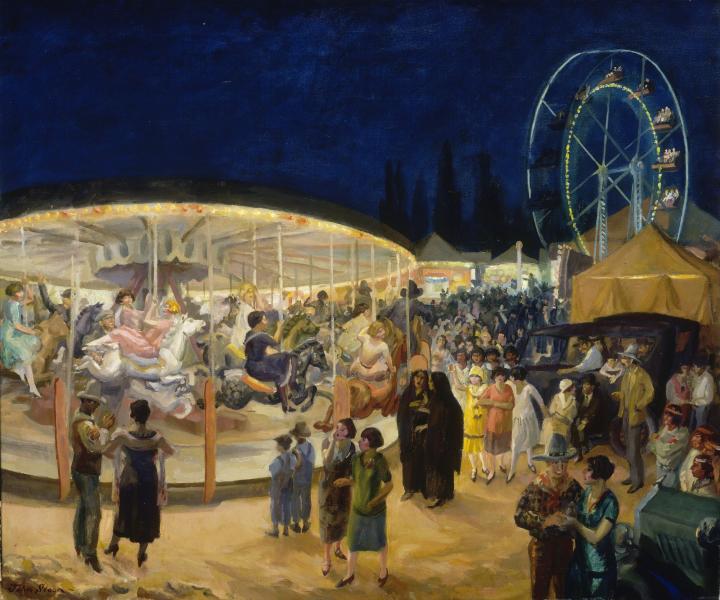
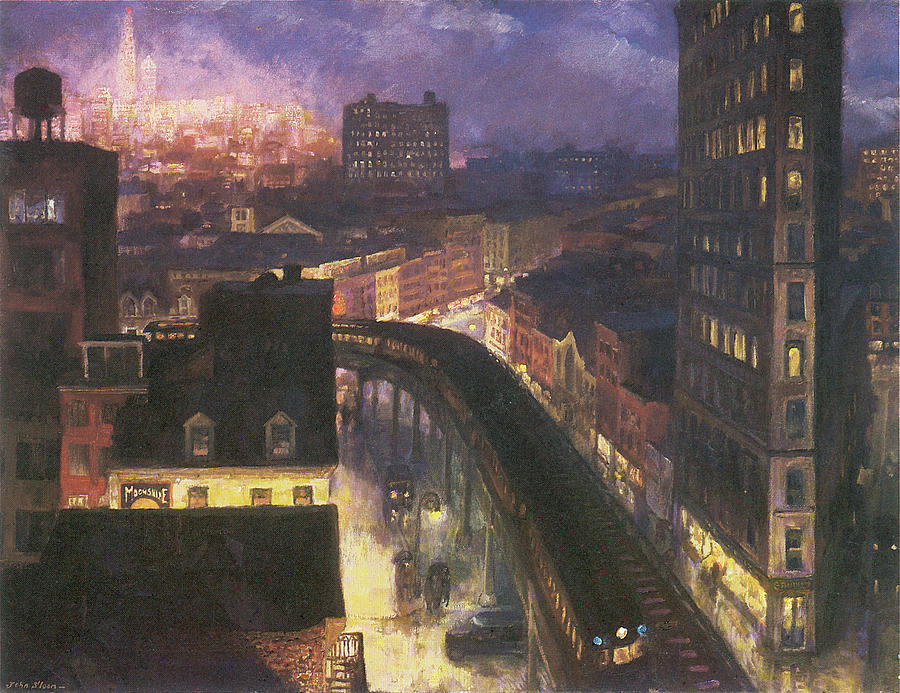
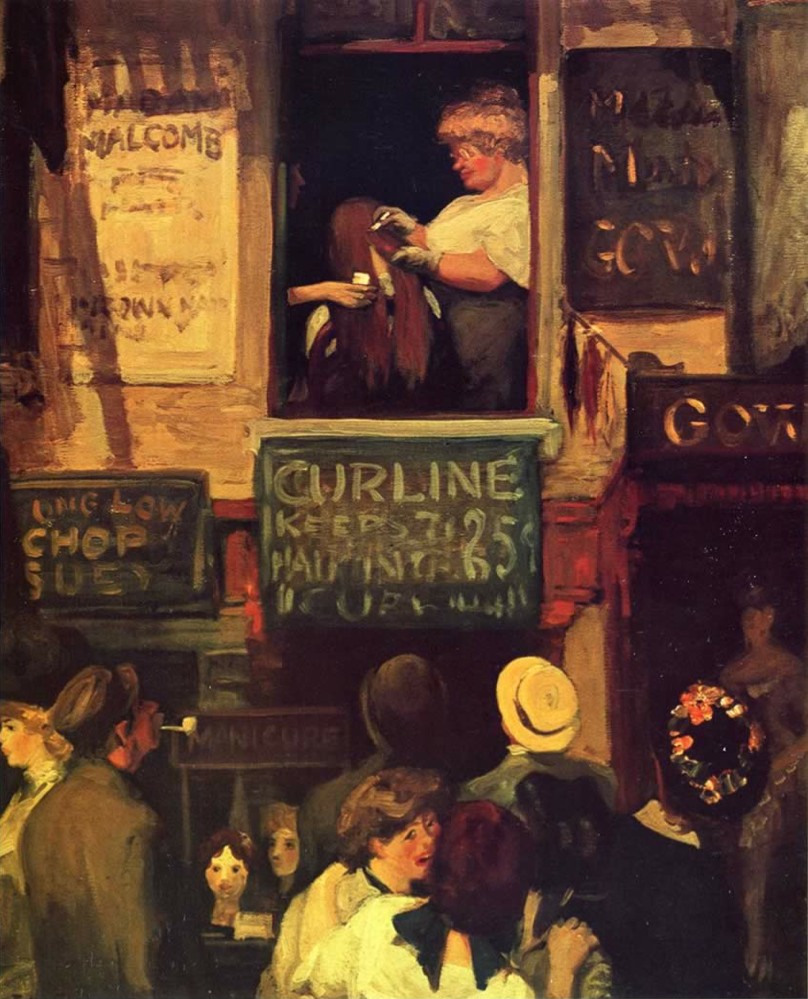
John Sloan- The Wake of the Ferry I 1907

**********************

You can be a giant among artists without ever attaining any great skill. Facility is a dangerous thing. When there is too much technical ease the brain stops criticizing. Don’t let the hand fall into a smart way of putting the mind to sleep.

John Sloan

**********************

I am a fan many of the Ashcan painters of the early 20th century, such as John Sloan, 1871-1951, whose work is shown here. The painters in this group obviously had technical prowess but you get the feeling from their work that they often operated in that danger zone outside their facilities, relying as much on instinct in the moment as their skill to create their paintings.

As Sloan points out, technical ability is a wonderful thing but also dangerous  for the artist. I love his description of the hand’s ability putting the mind to sleep.

I know that feeling.

I often feel my best work comes from not knowing exactly how the work is going to proceed or where it will end. That sense of danger, that nervous feeling the painting is in peril of becoming included in the next garbage pickup, is a great indicator for me that my instincts are engaged., that my brain is not in the off position.

This is when good things happen, when breakthroughs are achieved, where the work moves beyond you and becomes something of its own.

But it’s all too easy to fall under the spell of your ability, to let your mind doze while your hand takes over.  But obtaining that ability takes years of work and is actually a goal. Why wouldn’t you let this gained knowledge carry your work? That’s a great question and I think every artist has to look at it on their own terms.

I look at this gained ability as tool that I have learned to use. Now, even though I know how to use this tool in a normal, predictable manner, sometimes I need to use it in way for it wasn’t intended. That’s not always the safe way to go but sometimes you find a new way.

And that’s a good thing.

John Sloan- Travelling Carnival, Santa Fe

John Sloan- The Wake of the Ferry II 1907

John Sloan- The City From Greenwich Village

John Sloan- Hairdresser’s Window 1907

Read Full Post »

**************************

Joy is everywhere; it is in the earth’s green covering of grass: in the blue serenity of the sky: in the reckless exuberance of spring: in the severe abstinence of grey winter: in the living flesh that animates our bodily frame: in the perfect poise of the human figure, noble and upright: in living, in the exercise of all our powers: in the acquisition of knowledge… Joy is there everywhere.


—Rabindranath Tagore

***************************

The painting at the top is part of Moments and Color, my solo exhibit currently on display at the West End Gallery. It’s titled An Exuberant Life and is a 24″ by 24″ canvas.

I don’t know that we are living in a time of joy at this point in history. At least, not in a way where one day we as a people will look back and remember it as a golden age filled with good will and There’s certainly an abundance of anxiety, ignorance, anger and about any other negative attribute you can come up with.

I believe that in times like these, we have to actively seek and identify the joy and exuberance that exists in this world. We take so much that surrounds us for granted as we bounce along the bumpy road we’re on at the moment. We find ourselves often blinded by our outrage or so inwardly turned in a defensive pose that we lose track of our surroundings.

Forget to see simple things. A ray of sunlight. The beauty in a tiny paused moment of silence. Tasting the pleasant bitterness of coffee on the tongue.

I could do a long laundry list of my own small pleasures, things that give me a sense of the joys in this world. But they are mine alone. You must find your own. Your list of joys must be your own sanctuary in these times. You’ll know them at once from the feeling of peaceful satisfaction they instill in you.

Maybe finding the exuberance of your own life will influence others to seek their own.

That would be a good thing.

And that’s kind of what I see in this painting– finding one’s joy and affecting the world with it. That is certainly something we could use in these times.


Read Full Post »

*********************************

“And He will judge and will forgive all, the good and the evil, the wise and the meek . . . And when He has done with all of them, then He will summon us. ‘You too come forth,’ He will say, ‘Come forth ye drunkards, come forth, ye weak ones, come forth, ye children of shame!’ And we shall all come forth, without shame and shall stand before him. And He will say unto us, ‘Ye are swine, made in the Image of the Beast and with his mark; but come ye also!’ And the wise ones and those of understanding will say, ‘Oh Lord, why dost Thou receive these men?’ And He will say, ‘This is why I receive them, oh ye wise, this is why I receive them, oh ye of understanding, that not one of them believed himself to be worthy of this.’ And He will hold out His hands to us and we shall fall down before him . . . and we shall weep . . . and we shall understand all things! Then we shall understand everything! . . . and all will understand” 

Fyodor DostoyevskyCrime and Punishment

*************************************

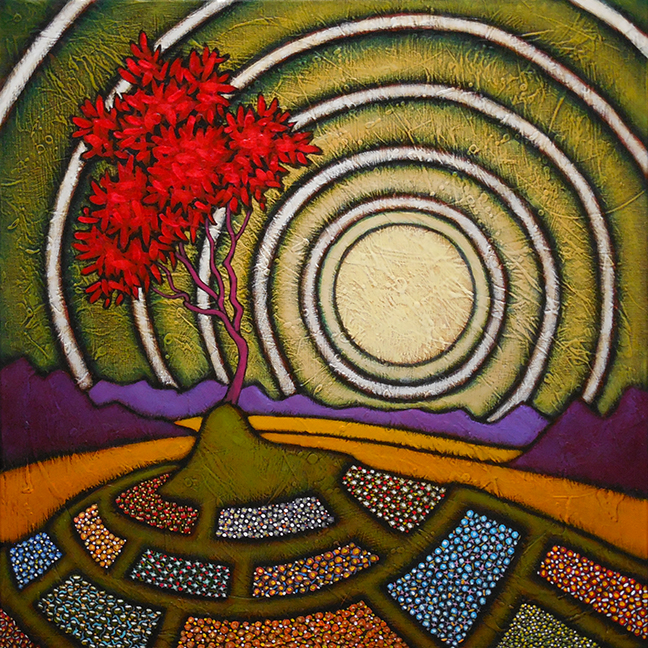
This new painting is an 18″ by 36″ canvas that is included in Moments and Color, my annual show of new work at the West End Gallery that opens this coming Friday. It was completed for quite some time before I finally settled on a title for it. Every title that came to mind seemed too trite or too well worn for this piece.

The Red Tree and its placement here give me the impression of someone standing before a group while delivering some sort of moral or spiritual instruction. Sermon on the Mount sort of stuff. The setting here has a placid feel and the location of the Red Roofed houses give the impression that they are rapt listeners.

It all gives this piece a feeling of great serenity.

With this in mind, I finally settled on The Homily as a title. A homily is a story that is often part of a religious sermon that demonstrates a moral or spiritual lesson in practical terms and contemporary settings. And I can see that here. Without it espousing the tenets of any religion, it has a spiritual feeling for me, one that serves as a practical illustration of peace and acceptance. It’s as though the Red Tree is calmly telling those around it to see the beauty and tranquility that surrounds them even in times of chaos.

There’s a sense of certainty to this piece that feels religious to me. It’s the kind of certainty I never had for myself or fully understood in others. But looking at this now, I can almost understand that certainty. Its actually beyond religious. I see it more as an inner belief that one has that allows them to remain calm in dire times, knowing that they have the ability to persist.

That even though the world around them changes, that they can adapt and prosper because their core values remains intact.

And maybe what this, a representation of those core values, whatever it is that brings us inner peace and serenity.

It’s early and my eyes and mind are still trying to focus so these few paragraphs may not be a homily. But they are an attempt, like this painting, to point out our need for peace, for those moments of tranquility that allow us to continue onward in a world that often seems out of our control.

Maybe its the understanding that Dostoyevsky speaks of at the top.

Hope you find it for yourself.

********************

This painting, The Homily, is part of Moments and Color, my exhibit of new work now hanging at the West End Gallery in Corning. There is an opening reception this Friday, July 12, running from 5-7:30 PM. Hope to see you there.


Read Full Post »

« Newer Posts - Older Posts »