Feeds:
Posts
Comments

Archive for the ‘Quote’ Category

There’s a tombstone in a local cemetery that we walk by nearly every day. I look at it nearly every time we pass and it always makes me smile. Below the name and the dates of his lifespan are the words Grade A Milkman. All I can think is what great pride this man took in his job before he passed away at an early age. It reminds me of a post from several years back that I ran for the Labor Day weekend. It fits here for this Grade A Milkman.

A little postscript: After years of walking by this grave, a bit of research revealed that this fellow was my mother’s 3rd cousin. Makes me smile even a little more.

Here’s the post from back in 2013:

***********************

If a man is called to be a street sweeper, he should sweep streets even as Michelangelo painted, or Beethoven composed music, or Shakespeare wrote poetry. He should sweep streets so well that all the hosts of heaven and earth will pause to say, here lived a great street sweeper who did his job well.

–Martin Luther King, Jr.

**********************

Another Labor Day weekend is here. On this blog in the past I have bemoaned how the general public has forgot how much it owes to the labor movement, how the middle class that was the pride of this country during the middle of the last century was a direct result of hard fought gains from workers who banded together and stood against social injustice. But today I just want to speak briefly about taking pride in one’s job, the same sentiment reflected in the quote above from Martin Luther King, Jr.

When I was a waiter in a pancake house, even after I had started showing my work in several galleries, I was always a waiter first when I was at my job. Never a painter-slash-waiter, a title which served no purpose. Circumstances had put me in this place at this time and I had determined that if I had to be there I would give it my complete attention and effort. I would make it my own. If I disliked it so much that it made me miserable, I would do something about changing my job when my day there was done and the task before me was complete.

But while I was there, I treated it as though it were my destiny because, who knew, maybe it was. I took great pride in being good at that job and some other jobs that I’ve done that could be classified as menial. What was the cost in doing this? If I had to be there then I would rather be recognized for my excellence than for my displayed misery.

Simply put, take pride in the task before you, however menial you see it. Find pride in the toil and treat it as your destiny because, in that very moment, it is.

Have a great Labor Day weekend and remember what the day stands for.

Read Full Post »

I was not sure where I was going, and I could not see what I would do when I got there. But you saw further and clearer than I, and you opened the seas before my ship, whose track led me across the waters to a place I had never dreamed of, and which you were even then preparing to be my rescue and my shelter and my home.

― Thomas Merton, The Seven Storey Mountain

+++++++++++++++++++++

Well, my annual show at the West End Gallery comes down in just a few days. This year’s edition is called The Rising and Thursday is the last day to see the show.

It is a show in which I feel a real sense of pride. When I am prepping for a show, my goals for it are often vague and undefined. I feel that I want certain things for it and from it but when I try to verbalize these goals, the words evade me. I find myself like the sailor in the Thomas Merton quote above: I was not sure where I was going, and I could not see what I would do when I got there. 

I knew it was going somewhere. I just didn’t know where. I let intuition and reaction guide me and it often worked out fine.

But this show, much like my June show at the Principle Gallery, felt more preordained and focused and less haphazard in it’s final edited version, the one that hit the walls of the galleries. I still allowed for the role of intuition and the unconscious in the process of painting each piece. That is a necessity.

But where I could make conscious decisions, I did just that. I chose to simplify forms and chop out the fussiness of detail. Deepened colors. As much as I like them and appreciate their popularity, I reduced the number of small paintings and went with works that were a bit larger. It streamlined the look of the show on the wall, made it feel less cluttered, and gave each piece a bit more room in which to expand.

They weren’t big things but enough to make the work in the exhibit to be presented with fuller impact. I felt like this and the Principle Gallery show were my most mature and complete exhibits to date.

The response to the show has been great which is gratifying on many levels. A number of the original paintings from the show have flown the coop to their new homes but there are a few replacements that I feel fill the void they leave behind. One new piece is shown above. It’s Star Navigator, a 24″ by 8″ canvas that feels very much like it jibes with the words of Merton at the top.

I hope you can make it out to the West End Gallery in the next few days, if you haven’t had a chance to see The Rising.

Read Full Post »

+++++++++++++++++

Life is very short… but I would like to live four times and if I could, I would set out to do no other things than I am seeking now to do.

William Merritt Chase
+++++++++++++++++
+
I find this to be a very interesting quote from the American master William Merritt Chase (1849-1916). I don’t think about it very often but given a choice of doing what I am doing with my life and being able to freely pursue any other life, I would continue, like Chase, on the path I am currently on.
.
I know there could be greater adventures, greater importance, greater rewards, wider travels and so on in other pursuits. But this life meshes with my character and my preferences so well that the thought of doing anything else seems almost absurd at this point. It never even enters my mind.
.
And there is something calming in the certainty of this. It’s one less thing that might gnaw at me, to make me question my own decisions. One less thing in which to find uncertainty in a world overflowing with it. When I enter my studio, I know I am in my proper place. Oh, I might question my decisions, my actions, in that space but I can no longer imagine myself being in any other place. And like Chase, I find myself wishing I could live four more of these lives.
.
And that’s a good thing.
.
Here are some more painting from William Merritt Chase. Hope his words somehow apply to you. Have a great day.
+

Read Full Post »

+++++++++++++++++++

.

It is my dream to create an art which is filled with balance, purity and calmness, freed from a subject matter that is disconcerting or too attention-seeking. In my paintings, I wish to create a spiritual remedy, similar to a comfortable armchair which provides rest from physical expectation for the spiritually working, the businessman as well as the artist.

.

–Henri Matisse

.
+++++++++++++++++
.
I have read (and shared) a different translation of the quote above from the great Henri Matisse. It aligns perfectly with my own hopes for my work and stands almost as a credo. At the end of the day, I am trying to create work that allows any viewer, no matter how much or how little they know about art, to withdraw into their own inner space while at the same time feel a sense of communion with a greater whole. To move into a place that feels safe and comforting.
.
A spiritual remedy, as he calls it.
.
It’s not something you can have in mind, however. It only comes in the process, as the thoughts that may have been pressing on my mind are set aside and my own emotions are leveled off to a state of calm. It has to be my own spiritual remedy before it becomes that of anyone else.
.
When it happens, it is a lovely thing and the world seems somewhat right.

Read Full Post »

++++++++++++

There are so many things we’ve been brought up to believe that it takes you an awfully long time to realize that they aren’t you.

–Edward Gorey
++++++++++++
.
I love the work of the late great illustrator Edward Gorey which very often took matters to dark and quirky places. His Gashlycrumb Tinies, a primer style book with small children being done in in a variety of curious ways, is a prime example. I’ve shown a few here. At face value, it’s awful yet there is a quality to it that still makes you smile at the macabre absurdity of it.
.
It’s often thought that Gorey, who passed away in 2000 at the age of 75, was English, mainly because much of his work looks very Victorian and Edwardian. Lots of well appointed gentlemen and gowned matrons brandishing cigarette holders. However, he was from Chicago and lived most of his life there, in NYC and on Cape Cod, where he died. He actually only left the USA once in his lifetime.
.
One little factoid that interested me was that one of his stepmothers was the actress who played the cabaret musician who sang and played guitar in the movie Casablanca. She was playing the guitar during one of my alltime favorite scenes which featured Resistance fighter Victor Lazlo leading the band in a rousing version of the French anthem, La Marseillaise, that drowned out the singing of the Nazis in Rick’s bar. I guess that doesn’t mean much as far as Edward Gorey’s work but I thought it was a neat little detail.
.
I also like the quote at the top from Gorey. It’s one of those realizations that come only with the passing of time, after years of trying to fit one’s self into a mode of behavior that is acceptable to others. At a certain point one realizes that they don’t have to satisfy anyone’s expectations or beliefs but their own. It’s the beginning of freedom.
.
Anyway, have a good and Gorey day.

Read Full Post »


This morning, I was looking at the wall in my studio that is directly in front of the desk where I write this as well as the easels where I paint. It’s a large stone fireplace that is about fourteen feet wide made from local creekstone. There are bookshelves built into the wall, the shelves formed by thick slabs of bluestone. There are also three half round ledges that jut out from the wall that were obviously placed to show off tchotchkes.

I have a number of personal things littering the wall. There are several of the carvings from the years before I began to paint. An old snowshoe. A carved crow from a well known regional sculptor shares one of the half round shelves with a cheap carving of Don Quixote that my sister gave me as a Christmas present when I was still a kid . There’s a Buddhist prayer wheel given to me by a friend along with a thumb piano made from koa wood, picked up on a trip to Hawaii many, many years ago.

But in the center is a painting from a few years back, an abstract comprised of colorful blocks. I knew when I did this piece that it was strictly mine and wasn’t surprised that it didn’t find a home. There are several such pieces here in my main painting space. Maybe it’s the fact that I did them just for my own satisfaction that make them favorites of mine. I know this painting catches my eye several times a day and there is definitely a sense of satisfaction in each glance.

Even with that, I don’t know that I would do such a piece again. If I did, the scale of the painting would be much larger, maybe four or five feet square, so that its colors and forms had the size to make a real statement. A bold yelp whereas this small painting is a whispered wish. But that whisper is mine and I wish on it every day.

Below is a post from back when it was made. The quote totally aligns with how I see the key to creativity– finding that medium and process that corresponds with the way one thinks and feels.

____________________

GC Myers- Jazz ( Song One)The artist is a man who finds that the form or shape of things externally corresponds, in some strange way, to the movements of his mental and emotional life.

Graham Collier 

****************

I have been working on dream inspired patterned forms, as I’ve noted here several times recently. I have been incorporating into the layers that make up my skies in simple landscapes where they serve to give added depth and texture. It works really well in that context and it would be easy to just use it in that way.

But there is something about some of them that make me just push them to the forefront alone without masking them with any representational forms over them. Something beyond narrative. Elemental. Like it is somehow tied to my own internal shapes and forms and patterns.

I was thinking this when I came across the quote at the top from the late jazz musician/composer Graham Collier. It made so much sense because I think that is, in general, the attraction of art  for me– it’s an external harmony of internal elements.

I didn’t know much about Collier who died in 2011. He was a bassist/bandleader/composer who was the first British grad of the Berklee College of Music. He played around the world and also wrote extensively on jazz but he still wasn’t on my radar. While I like jazz, my knowledge, as it is in many things, is pretty shallow. So I decided that I should listen to some of Collier’s music.

The first song I heard was titled  Song One (Seven-Four) and it just clicked for me. It was so familiar and seemed to be right in line with the piece at the top, a 12″ by 12″ painting on masonite panel. It made me think about the connection with music, how sounds often take the form of shapes and colors in the minds of both musicians and listeners.

Again, very elemental.

So I began to think of these newer pieces as music. It creates a context that makes sense for my mind, one that gives me a way of looking at the work without seeking representational forms. It’s an exciting thing for me and I look forward to some newer explorations in this realm in the near future. For Graham Collier’s clarification, I am calling the piece at the top Jazz ( Song One).  Here it is :

Read Full Post »

Kiefer Connections

++++++++++++++

What does the artist do? He draws connections. He ties the invisible threads between things. He dives into history, be it the history of mankind, the geological history of the Earth or the beginning and end of the manifest cosmos.

Anselm Kiefer
++++++++++++++
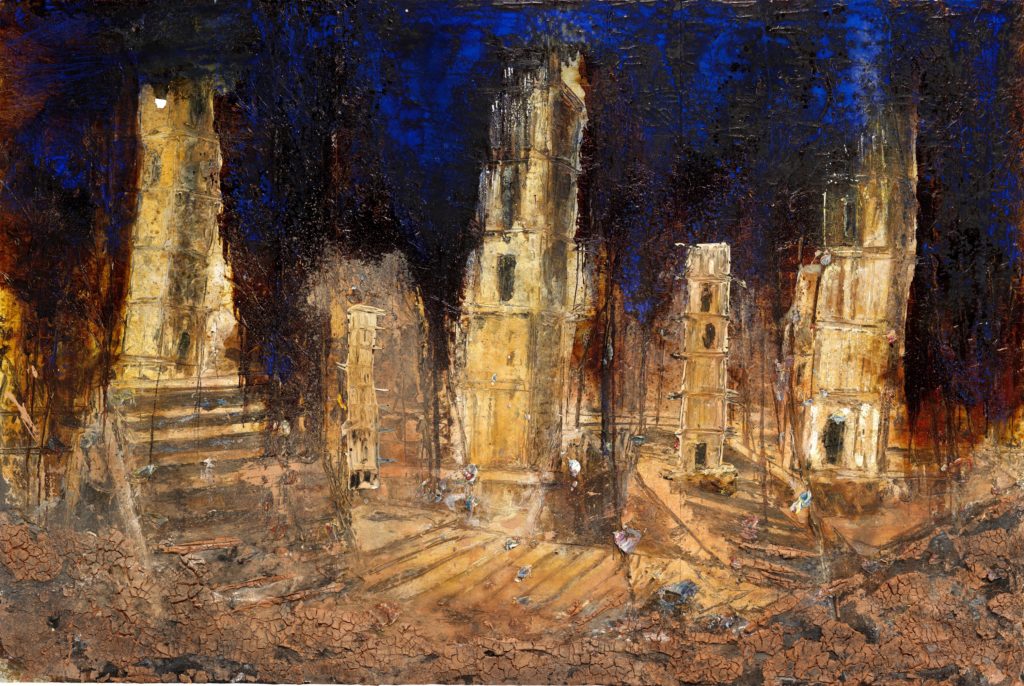
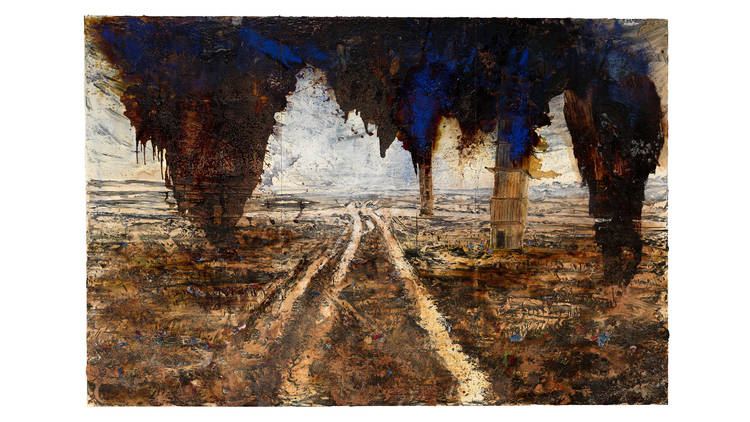
Anselm Kiefer (born 1945) is a contemporary German artist whose work is often epic in size and scale. You can see this in one of the photos below. Many of his more recent paintings use molten lead as a medium which creates these large ominous and heavy (obviously!) areas in the paintings. Over his long career he has been controversial, especially in confronting his German heritage and the events of the first half of the 20th century. But it is always interesting.
.
Several things he has written or said have really resonated with me, including one quote from which I stole a bit to use as the title of a painting, The Palace of My Memory. The quote summed up perfectly how I view the body of my work. I believe I am creating a place, a palace if you will, where my collected memory can be preserved and survive, hopefully, long after I am gone.
.
Here is that quote:
.
But I believe above all that I wanted to build the palace of my memory, because my memory is my only homeland.
.

Read Full Post »

+++++++++++++

I really just wanted to share one of my favorite Edward Hopper paintings but the message attached really speaks to my own thoughts on painting. The painting is his Early Sunday Morning from 1930.

I like that it seems so still, so static, yet it is filled–at least for me– with tensions and deep emotional content. That reaction is my own imagination reacting to the elements of the painting. Hopper created an armature, a framework, that gives shape to the emotional response of the viewer without filling out all of the details.

You look at it and there are guides in place that gently direct you to Hopper’s own emotional location. But it never spells it out in great detail, never tells you what you should feel. It relies on your imagination to fill in the voids, to fill it with details to which you can personally relate. You are no longer a mere viewer, you are an emotional participant.

That’s how I think a painting should work, as a sort of active terminus where the work of the artist and the imagination of the viewer meet.

Sometimes, it works that way. Sometimes, it doesn’t. I think this Hopper definitely works in this way.

Read Full Post »

++++++++++++++

If only someone else could paint what I see, it would be marvelous, because then I wouldn’t have to paint at all.

Alberto Giacometti
.
++++++++++++++
.
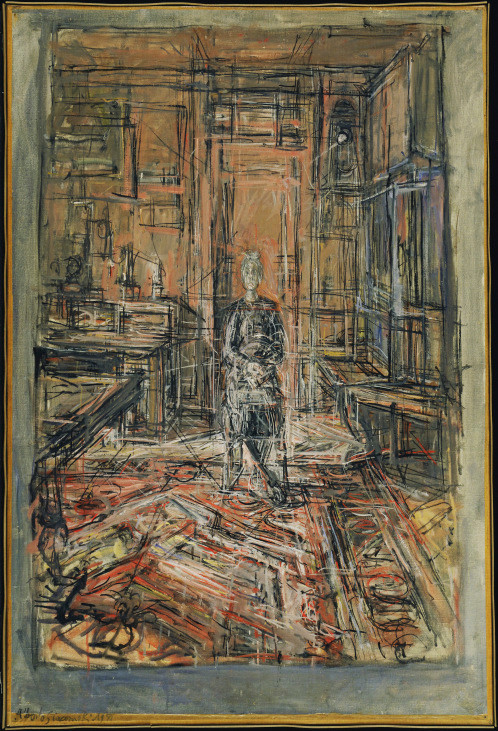
This quote from the great sculptor/painter Alberto Giacometti reminds me of a bit of advice I’ve attempted to pass on for a number of years: Paint the pictures you want or need to see.
.
This idea that I wasn’t finding what I sensed I needed to see drove me early on and still does today.
.
It makes me wonder if I had been aware of someone painting the pictures that I now paint when I was first starting out, would I be painting now? Would there be a need?
.
Even though I want to say that, yes, I would definitely still be painting, I really can’t fully say that mainly because the little spark of doubt it creates makes me think it might well be true. But, of course, it would have to fully satisfy my need and maybe no one artist could do that. Or maybe even seeing that needed work might spark a new need, a further boundary.
.
Hmm. Something to chew on this morning. Now, I best get to work. If no one else will paint the pictures I need to see, I better get going.

Read Full Post »

+++++++++++++

Art has always been the raft onto which we climb to save our sanity. I don’t see a different purpose for it now.

Dorothea Tanning
+++++++++++++
.
Doing research for this blog, I run into so many artists that work well into their nineties and beyond that I begin to get hopeful for my own longevity. I try to see if there is some sort of common denominator among them, something that might be a key to their long careers and lives.
.
There seems to be among many, at least to my eye, a constant striving for growth and change in their work. There are often new subjects, new styles, new mediums and new processes. But a constant state of wonder.
.
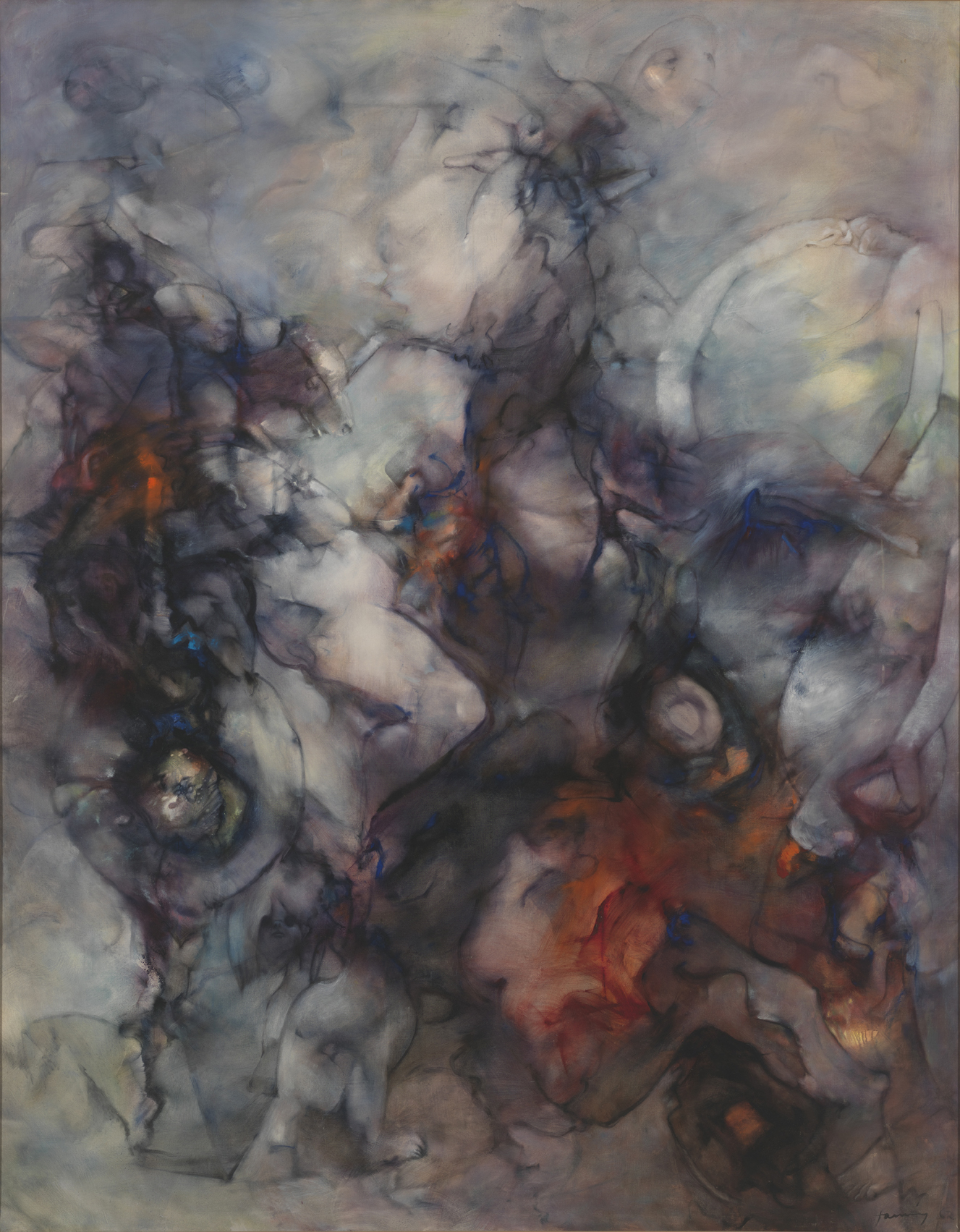
Dorothea Tanning is one such example. Born in 1910, she worked until late in her life and died at the age of 102 in 2012. Her work changed throughout her career, having multiple phases, but always remained her own. I am only showing a few of her pieces here, a few that immediately grabbed me this morning, along with a short video with a bit of an overview. Like many artists I show here, I don’t know a lot about her work but hope to use this as an introduction.
.
Hopefully, in forty years or so, I will still be following Ms. Tanning’s example. But most likely only if I try continue to attempt to grow. Because as Dorothea Tanning also said: It’s hard to be always the same person.

Tanning, Dorothea

Read Full Post »

« Newer Posts - Older Posts »