Feeds:
Posts
Comments

Archive for the ‘Quote’ Category

Art is a lie that makes us realize the truth.

Pablo Picasso

****************

Many of my favorite artists worked and produced their greatest works in times where the world was under great stress. World wars and– in the case of Picasso’s painting, Guernica, shown above– Civil Wars. The Great Depression. Times of social transformation. Even when the work didn’t overtly deal with the events of the day, much of the work reflected on the collective consciousness of that time.

I think that is so because art is, just as Picasso so succinctly states, a lie that makes us realize the truth.

Artists fabricate, often creating work that is on its surface pure fantasy with little relation to the world as others might observe it. But their fabrication is made up from everything that impacts them– their knowledge, their observations, their opinions and emotions. Artists take in the world and create something that seems like a pure fabrication.

A lie.

But what seems the lie often proves to be built of ultimate truths, just constructed in a manner that allows others to see this truth clearly.

I don’t know that we artists always succeed. I certainly don’t feel that I do as often as I would  like. But so long as we feel deeply and create our lies, we will at some point reveal a truth.

Got to get to work now…


Read Full Post »

I came across this post below from back in 2012 about my first encounter with the artist LS Lowry. Since then I’ve looked at a lot more of his work and read more on his life, all of which has made me realize how much I was missing before then. He was an interesting figure, providing me with one of my favorite responses when once asked what he was doing when he wasn’t painting: Thinking about painting.  I know all too well what he was saying.

Anyway, I thought I’d repost this if only to once again play the song about the distinct figures that populate his world, Matchstick Men. Take a look and give a listen.

***************

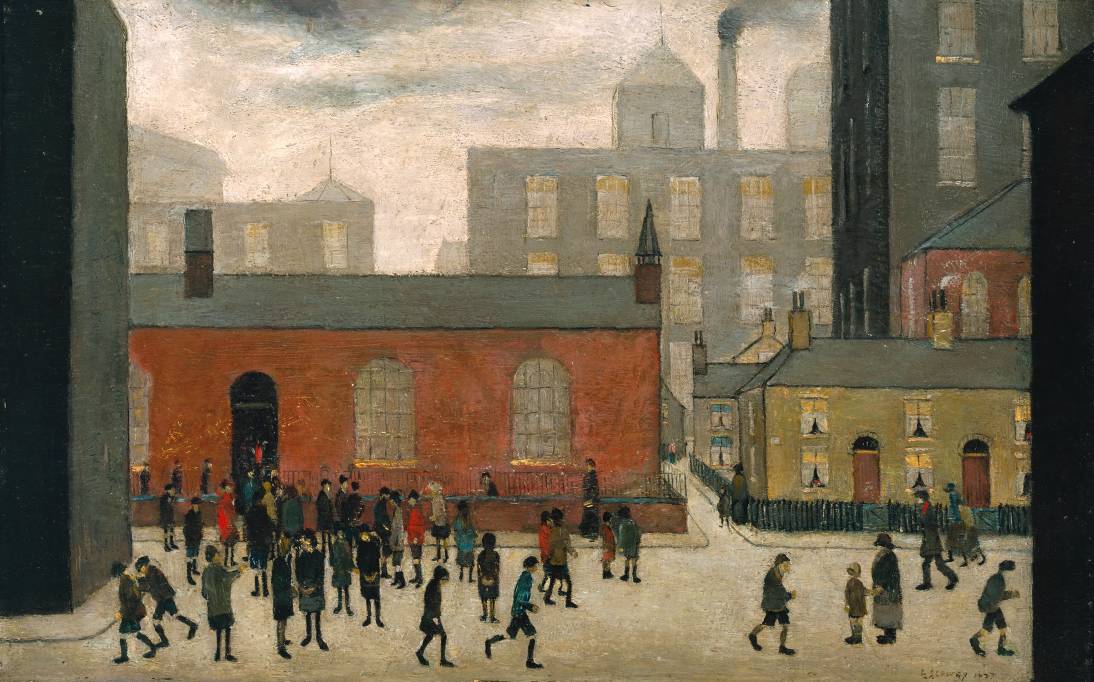
I feel sort of embarrassed to admit this but I had never heard of L.S. Lowry until I stumbled across him the other day.  I am most likely not alone in this but would have thought he would have crossed my radar screen at some point, especially given his prominence in the British art world and in British culture. Not that I know a lot about British art or pop culture. But this is a beloved painter there who has sold many works in the multi-million dollar range, one selling for a record $9+ million last last year [2011].  This is not an anonymous artist.

I am still discovering more about this  painter  with a most individual style but here is a very short summation.

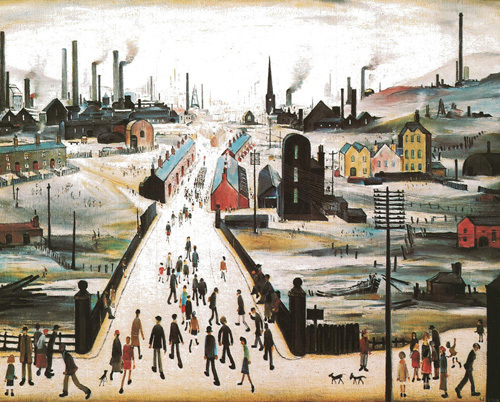
He was born in the north of England in 1887 and died in 1976, having spent most of his life as a rent collector for a property company.   Although he is often referred to as a self-taught artist, through much of his working life he studied art in the evenings at various schools. He used this study and the environment around him to find the distinctive style that marked his work, one that is populated with matchstick figures walking through   urban scenes, often heavily filled with images of  the English industrial landscape.

His work has permeated British popular culture as well. His matchstick figures were the basis for a 1967 rock song, Pictures of Matchstick Men, from Status Quo that was later became a hit  here in the States when covered by Camper Van Beethoven in the 80’s. And more recently, the British group Oasis had a video, The Masterplan, featuring the band members as matchstick men walking through animated scenes from Lowry’s paintings. In fact, Noel Gallagher, one of the leaders of  Oasis, has joined a growing chorus of fervent Lowry fans in Britain who have been calling for greater displays and recognition of the late painter’s work there.  As a result, the Tate is mounting a major retrospective of Lowry’s work for 2013.

There’s a lot for me to like about Lowry which makes just finding him now more puzzling. But I have found him and will continue to learn more.  For now, here is the both the Status Quo song and the Oasis video.

Read Full Post »

“Writers remember everything…especially the hurts. Strip a writer to the buff, point to the scars, and he’ll tell you the story of each small one. From the big ones you get novels. A little talent is a nice thing to have if you want to be a writer, but the only real requirement is the ability to remember the story of every scar.
Art consists of the persistence of memory.” 

 Stephen King, Misery

*************************

Never thought I’d be quoting Stephen King here but that final sentence above– Art consists of the persistence of memory-– rings so true for my work. Like the writers he references, I depend on my memory of every scar, every failure, every triumph, every moment of lucidity, every small revelation to give my work some meaning, if only for myself.

That’s what the piece at the top is really about. It’s a painting that has never been available for sale and only showed it in my 2012 show at the Fenimore Art Museum. It’s a keeper and hangs in my studio. The title is Persist (All That We Know) and was the winning entry in a contest I held on the blog back in 2010 when it was painted. There were a lot of great titles submitted for that contest but this one, it turns out, was dead on perfect.

At least as I see it.

I can look at that painting now as I write this and it acts as a centering device, at once bringing me back to what I am truly trying to convey in my work– my scars and how they have shaped me.

Time to get to work.

Read Full Post »

I have been living with this painting, Introspection, for several months now in the studio. It’s been in a spot where my eye regularly falls on it and it never fails to make me pause for a second or two to give it some consideration. It fulfills its title very well for me, reminding me to look inward on a regular basis while trying to shut out the noise of the world of man.

It’s leaving the studio today, heading out to California to hang at the Just Looking Gallery in San Luis Obispo. I think I am going to truly miss its gentle reminder.

Read Full Post »

It’s a busy morning with much to do so I am running the post below from several years ago that deals with the indifference that so many of us exhibit about so many things. If something doesn’t impact us directly, we tend to shrug our shoulders and say “Oh, well.” The passive acceptance of this sort of  indifference has been the great enabler of many of  history’s darkest eras. We live in a time where we cannot afford to be indifferent or we will again find ourselves in another dark place sometime soon. The anecdote I share below is no doubt trivial in the greater scheme of things but indifference is an insidious thing at any level.

A little  indifference can lead to greater sorrow…

GC Myers Memory of Night sm

“The opposite of love is not hate, it’s indifference. The opposite of art is not ugliness, it’s indifference. The opposite of faith is not heresy, it’s indifference. And the opposite of life is not death, it’s indifference.”

-Elie Wiesel

*************

I’ve been sitting here for quite some time now, staring at the quote above from Elie Wiesel. I had planned on writing about how my work evolved as a response to the indifference of others but now, looking at those words and putting them into the context of  Wiesel’s experience, I feel a bit foolish. Wiesel, who had survived the Holocaust and crusaded so that it might never happen again, was eyewitness to indifference on a grand scale, from those who were complicit or those who did not raise their voices in protest even though they knew what was happening to the personal indifference shown by his Nazi guards, as they turned a blind eye to the suffering and inhumanity directly before them on a daily basis, treating their innocent captives as though they were nothing at all.

The indifference of which he speaks is that which looks past you without any regard for your humanity. Or your mere existence, for that matter. It is this failure to engage, this failure to allow our empathy to take hold and guide us, that grants permission for the great suffering that takes place throughout our world.

So you can see where writing about showing a picture as a symbolic battle against indifference might seem a bit trivial. It certainly does to me. But I do see in it a microcosm of the wider implications. We all want our humanity, our existence, recognized and for me this was a small way of  raising my voice to be heard.

When I first started showing my work I was coming off of a period where I was at my lowest point for quite some time. I felt absolutely voiceless and barely visible in the world, dispossessed in many ways. In art I found a way to finally express an inner voice, my real humanity, that others could see and feel a reaction. So when my first opportunity to display my work came, at the West End Gallery in 1995, I went to the show with great trepidation.

For some, it was just a show of  some nice paintings by some nice folks. For me, it was a test of my existence.

It was interesting as I stood off to the side, watching as people walked about the space. It was elating when someone stopped and looked at my small pieces. But that feeling of momentary glee was overwhelmed by the indifference shown by those who walked by with hardly a glance. That crushed me. I would have rather they had stopped and spit at my work on the wall than merely walk by dismissively. That, at least, would have made me feel heard.

Don’t get me wrong here– some people walking by a painting that doesn’t move them with barely a glance are not Nazis. I held no ill will toward them, even at that moment. I knew that I was the one who had placed so much importance on this moment, not them. They had no idea that they were playing part to an existential crisis.  Now, I am even a bit grateful for their indifference that night because it made me vow that I would paint bolder, that I would make my voice be heard. Without that indifference I might have settled and not continued forward on my path.

But in this case, I knew that it was up to me to overcome their indifference.

Again, please excuse my use of Mr. Wiesel’s quote here. My little anecdote has little to do with the experience of those who suffered at the hands of evil people who were enabled by the indifference of those who might have stopped them. The point is that we all want to be heard, to be recognized on the most basic level for our own existence, our own individual selves. But too often, we all show indifference that takes that away from others, including those that we love. We all need to listen and hear, to look and see, to express our empathy with those we encounter.

We need to care.

Maybe in that small ways the greater effects of indifference of which Elie Wiesel spoke can be somehow avoided.

We can hope.

The painting at the top is a new piece [at the time this was written] that I call Memory of Night, inspired by Wiesel’s book, Night.

Read Full Post »

“What does that represent? There was never any question in plastic art, in poetry, in music, of representing anything. It is a matter of making something beautiful, moving, or dramatic – this is by no means the same thing.”

 Fernand Leger

******************

I found it hard to believe that the French artist Fernand Leger (1881-1955) hadn’t shown up on this blog before. I’ve always enjoyed his work, especially his use of simplified forms, visible line and dark-tinged color. These were qualities that I knew I wanted for my own work in the early days when I would look at his work and that of a few other artists. I liked most of his work, from his early Cubist inspired abstractions and his later more figurative work.

But I really identify with his words above. The idea of painting moving past the idea of pure pictorial representation into something more like the expressive phrasing of dance, music or poetry is an idea that has clanged around in my head for a long time.

It is to look at a painting of a cow, to use an example, and feel the same sort of response which comes with experiencing the grace of a dance or the beauty of a musical passage.  The gesture of the painting, its movement and rhythm, and the emotions that it evokes have transcended the apparent subject it portrays. The cow as the subject of the painting is replaced by the emotional response to the forms, lines and color in the painting. That response becomes the subject and that cow becomes less of a symbol for a cow and more of a representation of the emotions that the painting brings forth.

Some magical cow, huh? Don’t know why I chose a cow as an example. It was the first thing that came to mind and it is early, so bear with me.

The point is that I see often this in Leger’s work. I feel an emotional response to some of his work without even recognizing what might be considered the obvious subject on the surface.

It’s something I desire for my own work. I would imagine that most other artists do, as well. But I don’t know if there is an actual way of ensuring that it takes place within one’s work. Maybe it’s either there or it’s not. Maybe it has to come without conscious thought, from a clear and empty mind.

I don’t know. But I can hope.

Here’s video slideshow of some more of Leger’s work.

Read Full Post »

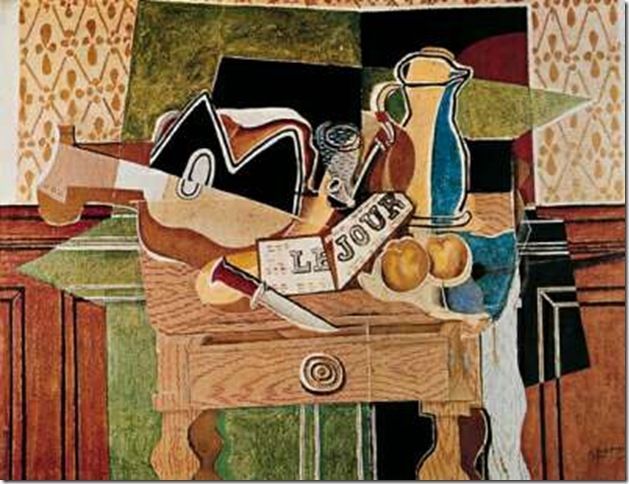
Truth exists. Only lies are invented.

Georges Braque

******************

I am in the studio, looking at a new larger painting on my easel that is nearing completion. The words above Braque clang around in my mind as I look at it.

The painting is strictly an invention, a representation of a nonexistent place.

I ask myself, “Is it therefore a lie?”

No, of course not.

The painting is a true expression of my emotion and existence. That place represented on the canvas exists within me.  And maybe within others who see its symbolic truth.

But I think I know what Braque means with his words. I have some paintings in the studio that I know are lies, not done with honest emotion. They aren’t necessarily bad. In fact, a few have a shiny appeal and have an appearance of truth in them. But there is something just a bit off in the way they come across to me, like hearing the words of a well constructed lie that you know in fact to be untrue.

And if that feeling comes across to me, it no doubt does the same for some others, as well. Not everyone. Some people don’t want to look beyond the surface and are willing to accept the lie before them because it somehow fits their own needs. For them, it is an acceptable truth.

It is a useful lie that serves a purpose to fill their personal need.

And that is okay.

Well, at least it’s okay in the realm of art which is based on personal and subjective preferences.

In other aspects of this life, I think we are finding that this casual acceptance of invented lies can have dire consequences.

Hopefully, truth prevails…


Read Full Post »

Writing, like life itself, is a voyage of discovery. The adventure is a metaphysical one: it is a way of approaching life indirectly, of acquiring a total rather than a partial view of the universe. The writer lives between the upper and lower worlds: he takes the path in order to eventually become that path himself.

Henry Miller, Reflections on Writing

********************************

This is one of my favorite passages from an essay in the Henry Miller book, The Wisdom of the Heart. I think you can easily insert any creative endeavor in place of the word writer and still be correct. The idea that the path of art concerns itself with acquiring a total view of the universe rings like absolute truth to my ears.

It’s a good thing to keep in mind on those days when you question the path you’re on and can’t recognize your purpose. Knowing that you are your own path somehow eases that anxiety.

Read Full Post »

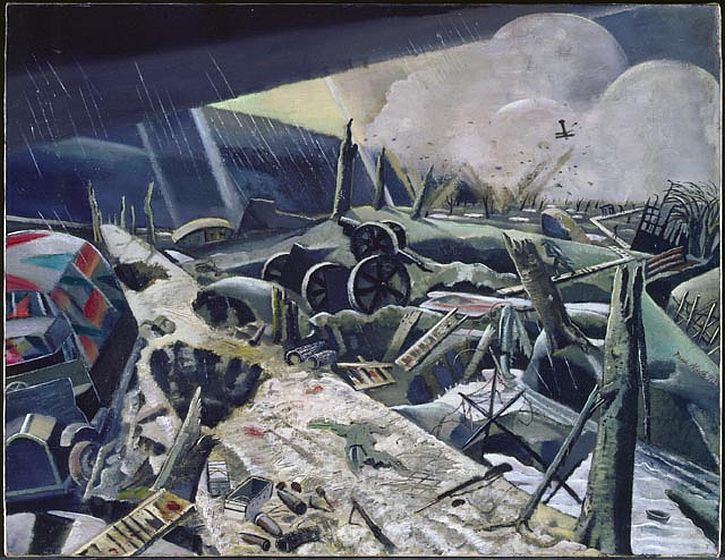
Paul Nash, Messenger

I am no longer an artist interested and curious, I am a messenger who will bring back word from the men who are fighting to those who want the war to go on for ever. Feeble, inarticulate, will be my message, but it will have a bitter truth, and may it burn their lousy souls.

Paul Nash

****************

You most likely don’t know the name of British artist Paul Nash. I wasn’t familiar with the name until just recently.

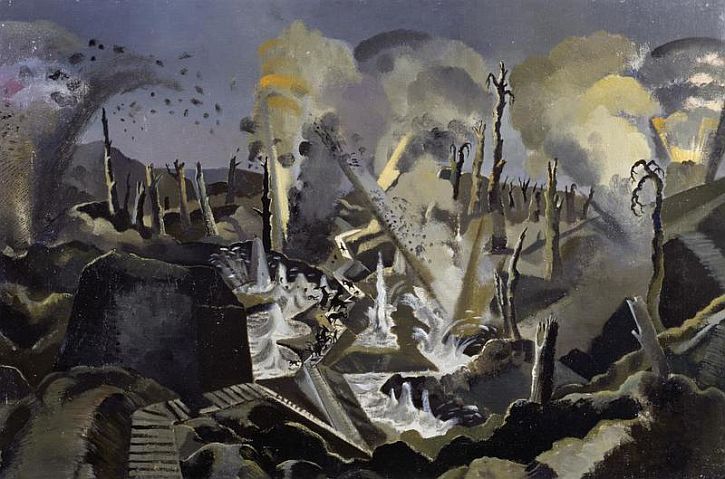
He lived from 1889 until 1946 and was a force in bringing Modernism to British painting. But perhaps he is best known for his scenes of war, primarily from WW I. They have a surreal otherworldly quality that creates a sense of disturbing unease.

As they should.

Nash knew the horror of war firsthand, fighting in the British trenches of the Great War. His quote at the top is a powerful indictment of homeland politicians, chicken hawks and war profiteers who go on and on, seemingly unaffected as others die for their words and deeds and bottom lines.

The sentiment still rings true today.

There was a tremendous amount of paintings of the time that depicted the terrible reality of the first World War. It was the first modern war that used technology that was designed to kill the enemy in mass and it left a psychic scar that still hasn’t healed to this day. Nash’s work was among the best of this work.

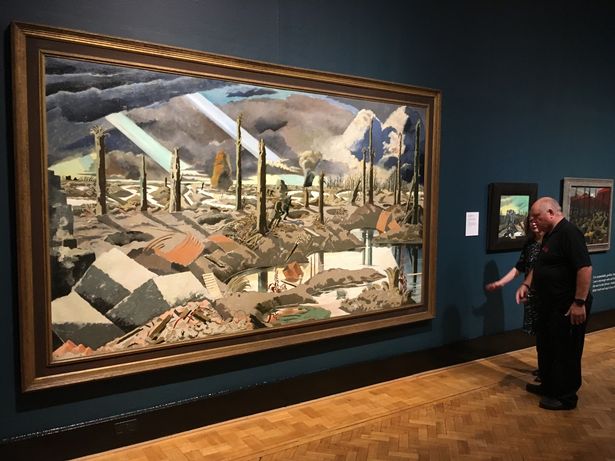
The painting at the top is The Menin Road. It’s a powerful image that is large in scale, as you can see in the photo at the bottom.

5.1.5

Read Full Post »

.

The value of the prototype does not consist in the rarity of the object, but in the rarity of the quality it represents.

–Victor Vasarely

*******************

I have to confess up front that I am not a big fan of Victor Vasarely (1906-1997) or the Op-Art movement of which he is at the forefront. It’s not that I am denigrating it. I have seen a number of pieces that I do like and I can certainly see people being intrigued by its color and forms and how it can reverberate in certain environments.

If I had a mid-century home with lots of glass and chrome, I might think about hanging this type of work. But I live in a cabin in the woods.

It’s just not to my particular taste, that’s all.

That being said, I immediately nodded in agreement when I read the quote above from Vasarely. As I read it, it jibes well with my own views on the intrinsic value of art and how the artist behind it affects the artwork’s value beyond that of a mere object.

When I have spoken with students in the past I try to impress on them that while they must learn their craft, they should also focus on making themselves fully rounded humans with an individual voice that reflects their uniqueness and individuality.

I urge them to read more, listen more, and to look at more things, all preferably outside their own known preferences.  I believe it creates a sense of fullness that will extend into their work, giving their work a greater sense of that quality that takes a piece beyond being a mere object of decoration.  And today, when there are more artists than at any other time at any point in history, its that rare sense of this quality that can make the difference in how seriously an artist’s work is viewed.

I don’t know if that ever gets through to these kids or if it even holds true in reality, but it seems right to me. I personally try to view each piece as a combination of skill, experience, acquired knowledge and influences, and the flaws and strengths of my own character–hopefully, the better parts of it.

Sometimes it works and at those times I see the quality represented by it that Vasarely described. When it doesn’t, I see a mere object that lacks the fullness that I am trying to put in it. I can see that I have somehow withheld some part of myself from that work and I try to figure out how to overcome that deficiency.

But most of all, I keep trying to find that rare quality…

Read Full Post »

« Newer Posts - Older Posts »