Feeds:
Posts
Comments

Archive for the ‘Quote’ Category

Truly, it is in darkness that one finds the light, so when we are in sorrow, then this light is nearest of all to us.

Meister Eckhart (1260-1328)

********************

In the last few days I finished a small group of paintings to add to the several I had already submitted for the West End Gallery‘s annual Little Gems show that opens on Friday. I hadn’t been planning on doing these additional pieces as I have other work that needs to be started. But there was something in the original pieces that I took out last week that lit that spark that I had been futilely searching for in the first month of the year. So, I thought I had been stick with it for a bit to see where it goes.

This piece, which I call Sorrow’s Companion, is one of the new paintings to emerge. Since it’s been done, I keep coming back to this one to just peer at it, all the while trying to discern what I am seeing and feeling in it.

There’s something very sorrowful in it’s imagery. The dark clouds in the sky. The empty chair. The dead tree with the lone crow on a branch. The empty horizon. It all point to the sorrow of loss of someone or something.

Yet, despite the sense of sorrow there is dull sunlight peeking through the gray in the sky. As the 14th century German theologian Meister Eckhart pointed out in his words at the top of the page, light is found in the darkness and is always nearest in our sorrow.

The light is sorrow’s companion.

So, I see this piece as having an air of melancholy but it is an optimistic melancholy, if there can be such a thing. Maybe this comes from understanding that true sorrow comes from knowing the feeling of true love. And there is a certain joy in just having experienced that feeling that lingers through the sorrow.

Sorrow doesn’t come without joy…

Read Full Post »

I do not believe in the art which is not the compulsive result of Man’s urge to open his heart.

–Edvard Munch

*****************

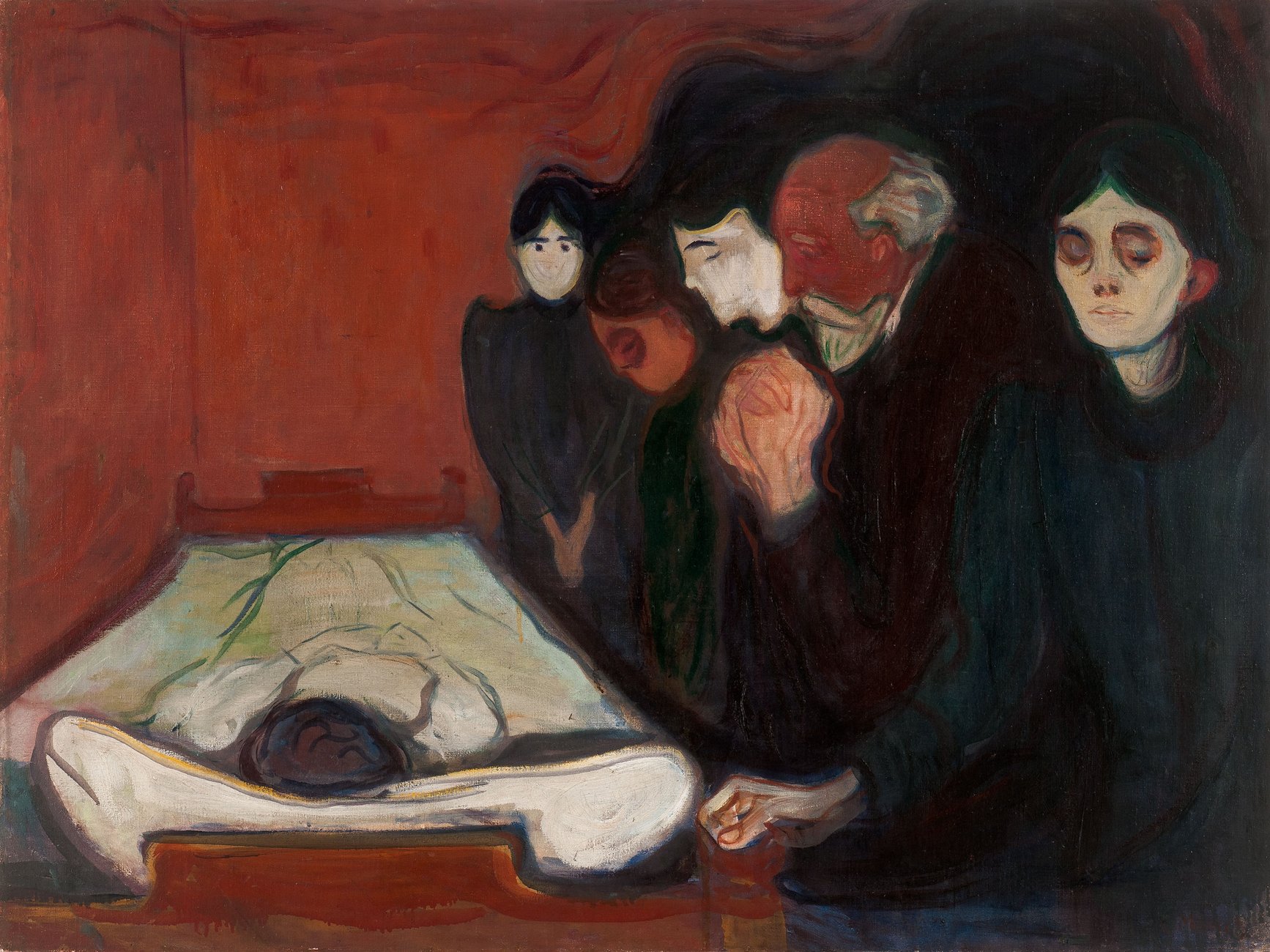
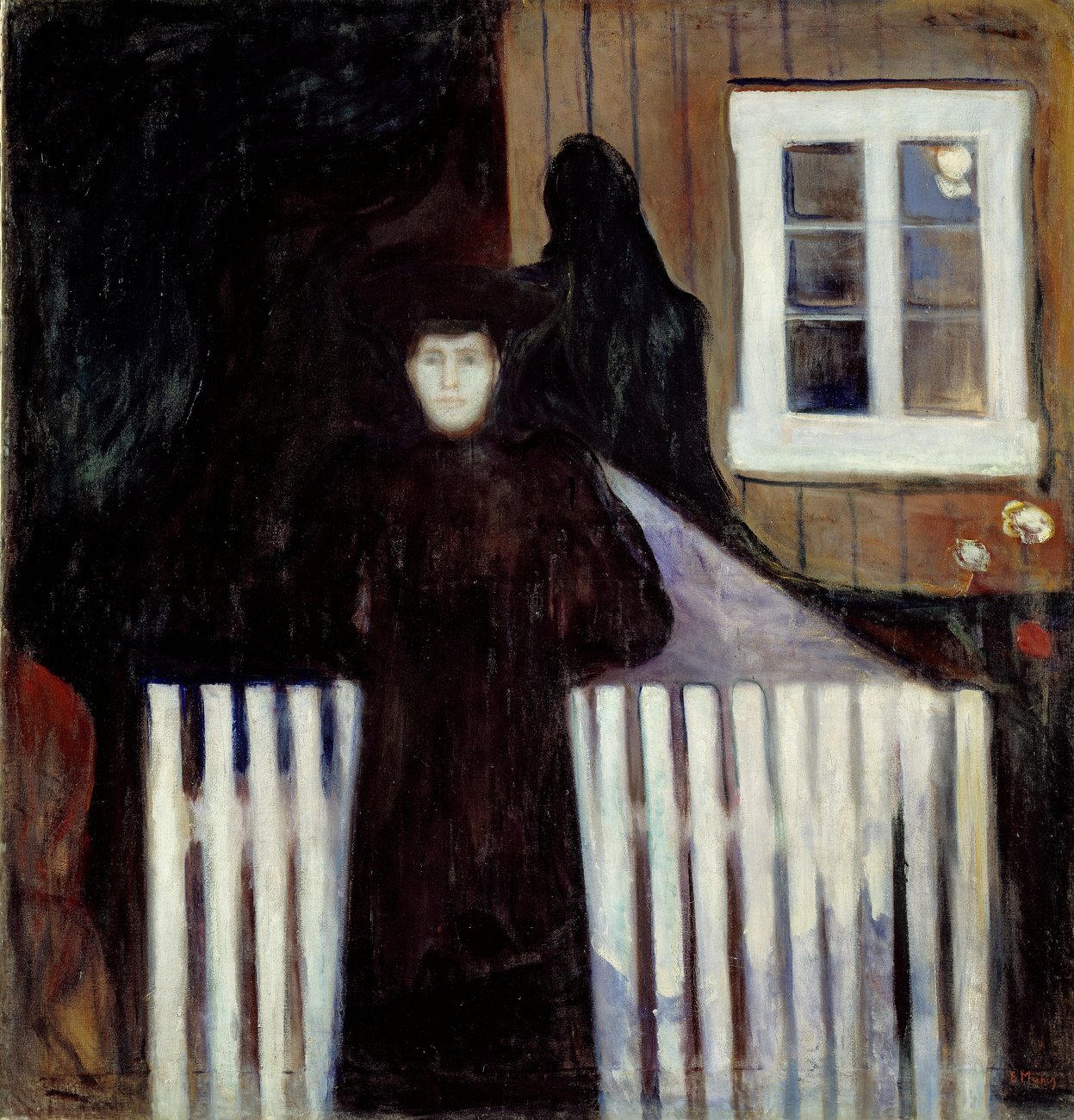
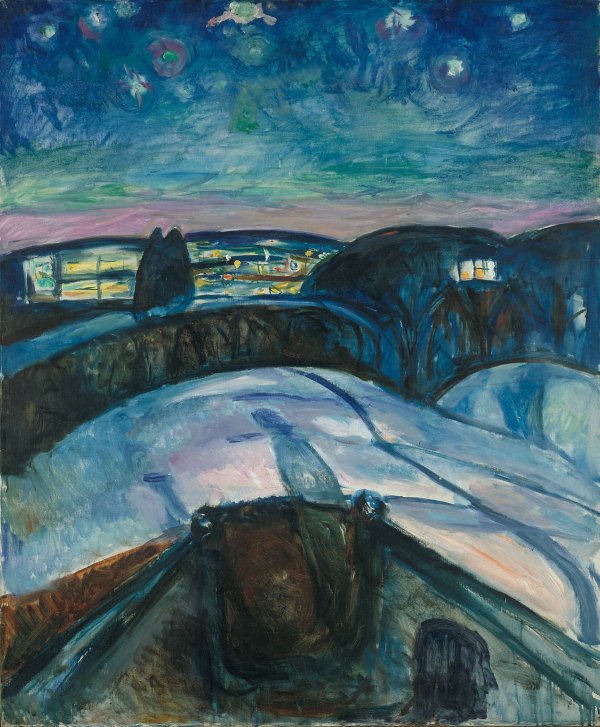
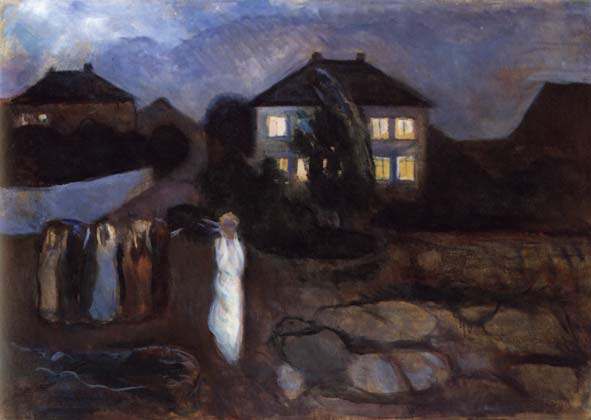
Edvard Munch, the Norwegian painter who lived from 1863 to 1944, is best known for his painting The Scream. Unfortunately, that’s the only painting of his most folks can recall. But he had a long and very productive career, creating work that was often dark and filled with anxiety. But it was always his own, pulling deeply from his own inner life and emotions.

His work may not resonate with you– not all of his work hits the mark for my own tastes–but there is no denying that it has the emotional power that can only come from an opened heart that seeks meaning in life, his ultimate goal as an artist.

Or as he said: In my art I have tried to explain to myself life and its meaning. I have also tried to help others to clarify their lives. 


Read Full Post »

Remembrance of things past is not necessarily the remembrance of things as they were.

 Marcel Proust

*********************

A few days back I featured a new small painting that is headed to the West End Gallery for next week’s opening of their annual Little Gems show. That piece, and never looked back…, was a stark image in tones of black and gray that was about the idea of being forced from your home, never to return. It’s a depiction of that moment of leaving and the sense of loss and abandonment that remains.

The new painting above, also headed to the Little Gems show, is another take on the idea of abandoning one’s home. This piece, One Last Look, speaks to the nostalgia that appears after time, as memories of bad times and the accompanying anxieties have faded and singular moments of happiness have grown to fill all the moments of that time.  Time has smoothed away the rough edges and we begin to think that that time, that place, was much more idyllic than it ever was in actuality.

To me, this painting speaks to that nostalgia and its idealized sense of home and youth. With nostalgia, the past seems more vivid and vibrant.

The grass was greener then, I guess.

I am reminded of a post I wrote back in 2009 where a large poll taken at that time throughout Russia named Joseph Stalin as the third greatest Russian of all time. I wrote: Despite the many millions, yes, millions of Russian citizens who were put to death by Stalin, despite the political purges and gulags and Soviet policies that caused a type of artificial famine that killed far more citizens than any natural famine more than once, the current populace said that this Man of Steel was their guy.

Some of those polled had lived through the Stalin era but time, and a little more food and comfort now, had eroded the memory of the hardship, the famines and the purges. In fact, Putin had began extolling the virtues of Stalin about that time and many of these people felt the country needed that type of autocratic leader again. In Putin, they– and, unfortunately, we as well– may have found him.

We all often fall prey to this sort of nostalgia, our memories holding onto a few events of happy triumph here and there through time and discarding the much more numerous days and weeks and months of chaos or drudgery that many of us live through.

Nostalgia is like a beautiful double-edged sword– both wonderful and terrible. Such things should be handled with care.


Read Full Post »

.

Visible things can be invisible. However, our powers of thought grasp both the visible and the invisible – and I make use of painting to render thoughts visible.

― René Magritte

******************

It’s an interesting thought, that our power of thought grasps both the visible and the invisible.

I, a seemingly visible thing, have sometimes felt invisible.

And I have sometimes seen things that turned out to not be there at all.

Thought is a magical thing.

And maybe that is why some folks paint, to attempt to capture those things they think they see and to take away their own invisibility.

Gotta chew on that one for a while…

Read Full Post »

Botero

An artist is attracted to certain kinds of form without knowing why. You adopt a position intuitively; only later do you attempt to rationalize or even justify it.

Fernando Botero

.
*********************
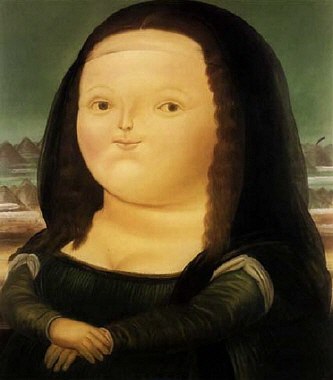
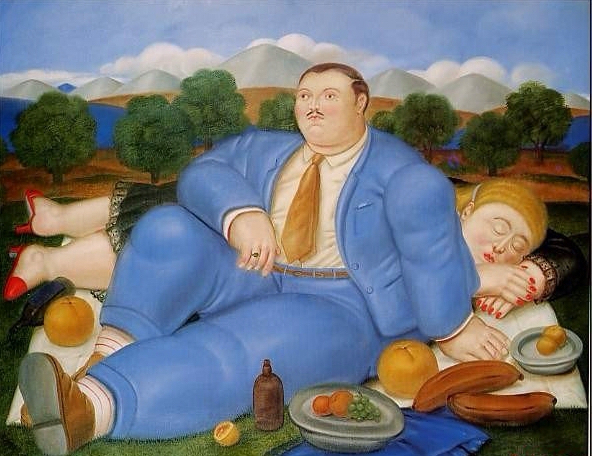
I don’t know much about artist Fernando Botero, who was born in 1932 in Medellin, Colombia. But it is obvious that his work represents his attraction to a certain kind of form– the round and the over-sized. While I would not count him among my favorites, I am impressed by the impression his work makes, how you never doubt that a painting or sculpture is his work.
.
His work is boldly and instantly identifiable. And that is saying a lot.
.
I think a lot of artists struggle in finding that certain kind of form that speaks to them intuitively, a form that becomes part of their true voice. Botero found it in the form of rotund figures and listened to his intuition. I think the impressive body of work he created over his long career justifies his decision.

Read Full Post »

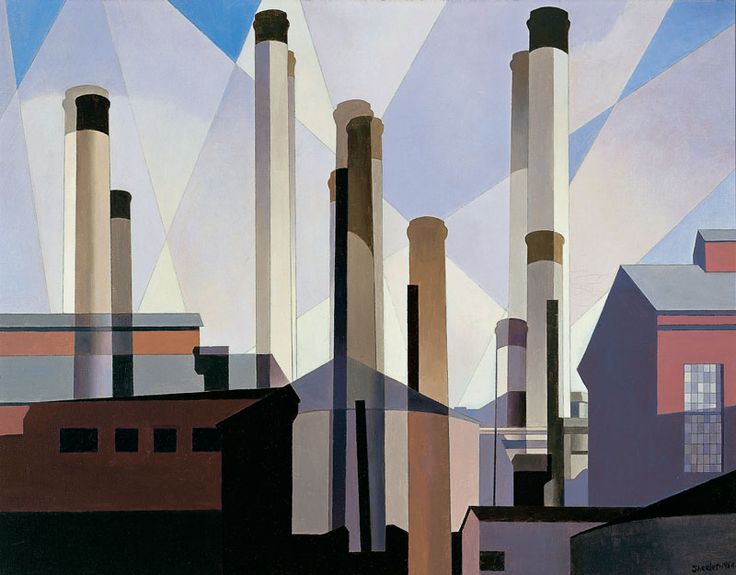
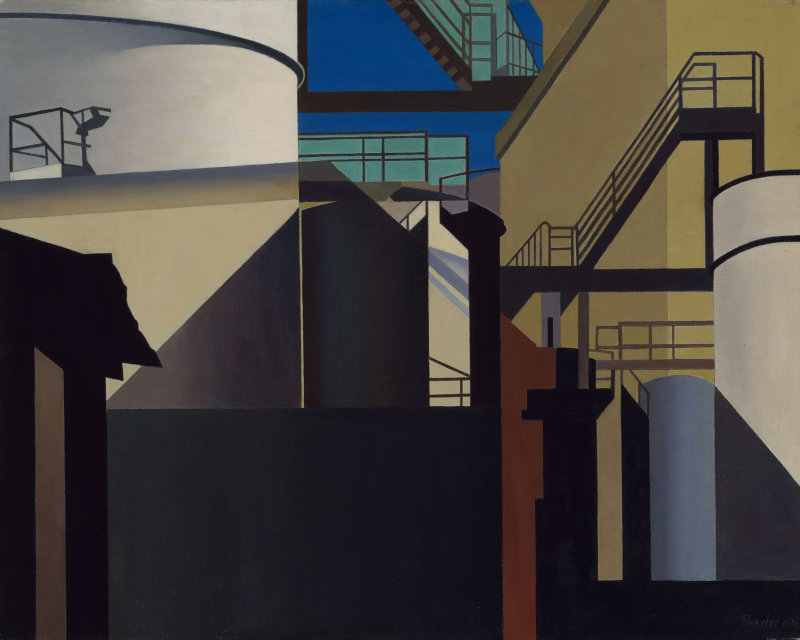
Every age manifests itself by some external evidence. In a period such as ours when only a comparatively few individuals seem to be given to religion, some form other than the Gothic cathedral must be found. Industry concerns the greatest numbers-it may be true, as has been said, that our factories are our substitute for religious expression.

Charles Sheeler
*******************
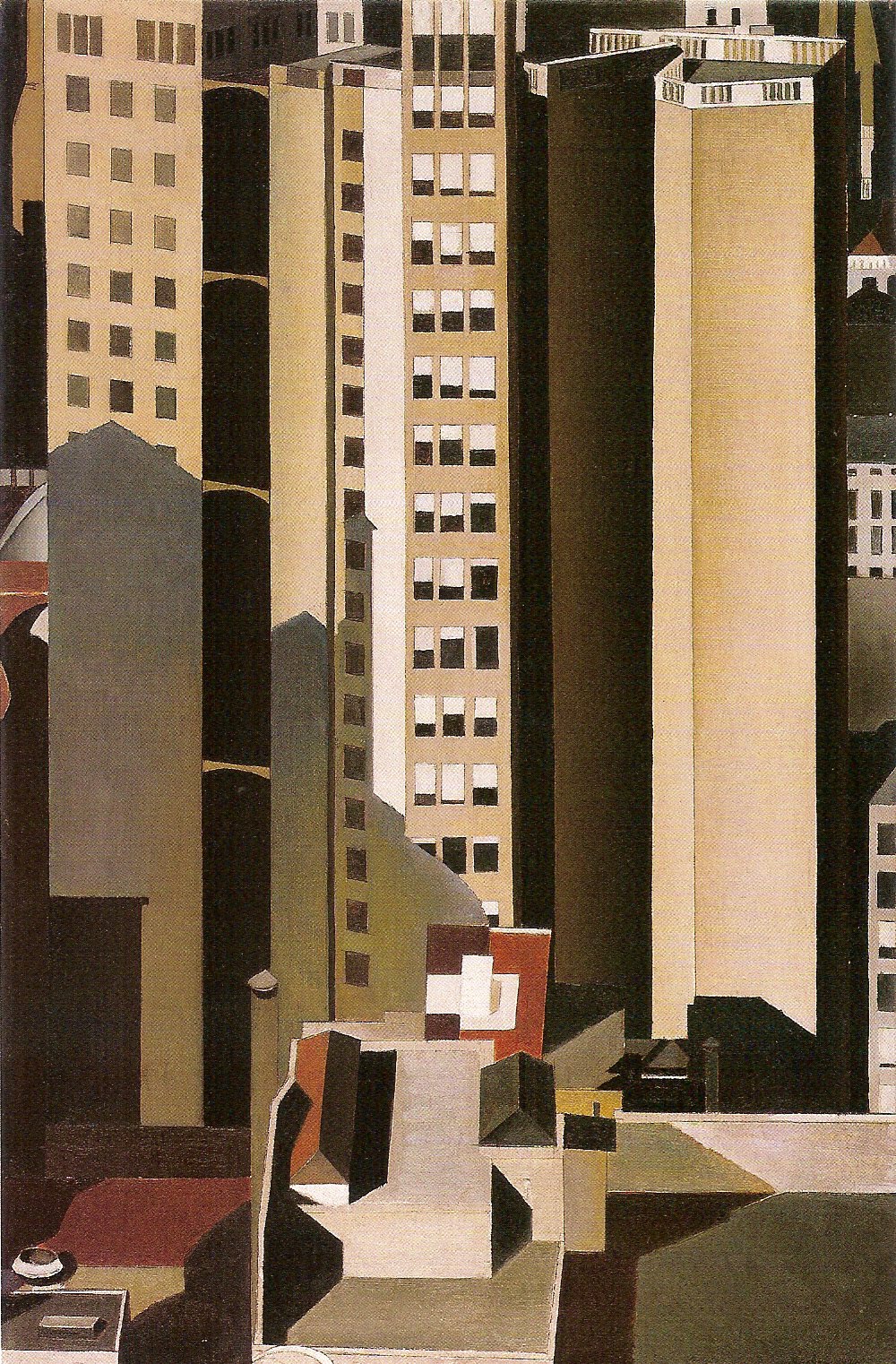
In much of his photography and painting, Charles Sheeler (1883-1965) equated the sheer mass and space of modern industry with the grandeur of medieval cathedrals. He saw in both of these environments, spaces that bring awe to the common man. These places often make one feel small and insignificant and in the presence of a powerful entity, one that dwarfed one’s own strength and power.
I think his work accurately showed the transition of our spiritual adoration from the religious to the corporate structures. It seems to me that we have bestowed a new sense of reverence on corporations, believing that they are some sort of savior and protector that will always act in the best interest of the many. When we speak of policy now, we don’t speak about how we can help people in need, we speak about how we can help large businesses. The idea there is that if they do well the benevolence they show in their hiring and acquiring will naturally take care of all ills.
If you look at that from a historical perspective, that’s not much different than the place occupied by the church throughout the ages. I know that’s not a new observation but it seems more and more obvious in recent times as so many common people have come to view capitalism in almost religious terms, with corporations deserving our veneration and protection.
And it makes me wonder if Sheeler was right, that the factories and corporations have become our substitute for religious expression? What will future generations see as the external evidence of our age? Will our perceived legacy be little more than the spaces of large corporate campuses and huge distribution centers? Is that the extent of our reach now?
Just thinking a little this morning.  Anyway, here are some other Sheeler paintings.

Read Full Post »


It is not a matter of painting life. It’s a matter of giving life to a painting.

-Richard Diebenkorn

***********************

I am going through a period where I am struggling to find focus. My ability to concentrate seems limited and everything, even small tasks, seem like huge distractions which I allow to take over much of my day. Even writing a short blog entry has become an epic struggle to complete, taking twice as long as normal to write a few lines that say little.

It’s frustrating and a little scary, with a nagging fear that this will become the new normal, that every task will become a struggle. I worry that the spark that has sustained me for the past two decades has somehow diminished.

I’ve been through these episodes before, as I’ve noted here in the past. I can’t say that this is any worse than any of those although it probably seems that way while I’m in the middle of it. I’ve always been able to muddle through it and have usually come out at the other end back in form, the spark in full blaze.

But part of me worries that this time might be a different thing. Maybe it’s watching my father living a shallow existence with his dementia in a local nursing home. I find myself worrying that my current lack of concentration might morph into the same short attention span that bedevils him.

I tell myself that this a baseless fear but when you’re running on a low spark, your confidence in your own beliefs and strengths becomes a bit strained. Fears, once unthinkable, become plausible.

So, trying to find inspiration, I spend some mornings looking at the work of other artists and reading a bit about how they perceived their work and how they coped with the struggles they faced. I’ve been a fan of Richard Diebenkorn’s work for some time, especially his Ocean Park series. Ocean Park #79 is shown at the top. I was looking at some of his work this morning and reading a few short quotes from him. The one at the top resonated because it reminds me of what I am trying to do.

Another, about the beginning of his process, also spoke to me: Of course, I don’t go into the studio with the idea of ‘saying’ something—that’s ludicrous. What I do is face the blank canvas, which is terrifying. Finally I put a few arbitrary marks on it that start me on some sort of dialogue. I need a dialogue to get going.

That is where I am right now. I am trying to start a dialogue, a conversation, with a blank surface. The problem is that on some recent mornings I feel as blank as the empty canvas. That doesn’t make for sparkling dialogue.

But I keep trying because it is what I do. And I have to believe that the spark is there, waiting to spring into a full blaze. Maybe it’s today…

Read Full Post »

If I create from the heart, nearly everything works; if from the head, almost nothing.

― Marc Chagall

********************

So true…

Read Full Post »

There can be no failure to a man who has not lost his courage, his character, his self respect, or his self-confidence. He is still a King.

Orison Swett Marden
***********************

It’s fitting that one of the only things I’ve actually finished in this new year should be a painting that I see as a personal motivator. This new piece is a 30″ by 20″ canvas that I am calling Still a King for the time being.

The title is taken from the quote at the top from Orison Swett Marden, who was a writer in the late 19th and early 20th century who focused on inspiring people to make the most of their lives in business. This was the time of Horatio Alger and many rags-to-riches stories, with the world exploding with invention and innovations. Marden was an early self-help writer, trying to motivate would-be entrepreneurs to make the most of their opportunities.

I periodically go through crises of confidence, some shallow and short-lived while others are deeper and a bit more difficult from which to escape. I have observed that when I feel my self-confidence is nowhere to be found, my courage and self-respect are also missing in action. In these deeper ruts, I can only hope my character is strong enough to carry me up and out, at least to a point where those other attributes decide to rejoin the struggle.

When they all come back together I know I will be okay.

And it is that moment that I see in this painting. The Red Tree in this piece represents the coming together of those four qualities: courage, character, self-respect and self-confidence. The path to this point winds through a landscape that goes up and down until it comes to a higher point and the realization that it is still a king , even if its realm is only its own little landscape.

Anyone with those attributes can– and should– walk as a king.

Or a queen.

There was definitely male dominance in the time of Marden and he probably gave little thought to the idea that these concepts, simple and universal as they may seem, would apply to a woman. But times have changed and are still changing, thankfully. There is still male dominance in most fields but if women can hold on to and display their  courage, character, self-respect and self-confidence, they will be queens.

I’ve been an artist long enough to see this evolution take footing in the art world. In recent years, there are more and more women artists coming to the forefront. For me, much of the most interesting work I see is created by women and, more often than not, it is the result of seeing themselves as courageous rulers of their own realm.

And that is a very good thing.

Which leads me to one last epigram from Orison Swett Marden that I think also applies to this painting and what I written here:

Nothing else so destroys the power to stand alone as the habit of leaning upon others. If you lean, you will never be strong or original. Stand alone or bury your ambition to be somebody in the world. 

Now, I only have to put these words into action. Wish me luck…

Read Full Post »

Rockwell Kent- The Trapper

****************

Force against reason: reason, because it has the power

of enlisting force to fight for it, will win.

From the recognition of that truth has come democracy.


-Rockwell Kent

***************

There are a lot of things that could be said this morning, especially with a governmental shutdown taking effect overnight. This shutdown is the symbolic culmination of the political attitudes of the past twenty years that have led us away from compromise and reason as a means of governance.

I am not going to go into my own grievances here. I’ve done that enough. But I will say that for all the anxiety this government produces as it tries to force itself closer and closer to some form of autocratic authoritarianism, I am somewhat optimistic. And that may be because I agree with the premise of the quote above from one of my favorite artists, Rockwell Kent.

I do feel that we are in struggle right now between force and reason, that the direction in which we are being directed via deception and fear-mongering– the force here–goes against the ideals and virtues that we have long professed as the basis for our democracy– reason.  The idea that reason is enduring because it has the ability to enlist those who will fight for the truth of it is reassuring to me and seems to be backed by history.

What we are experiencing is reminiscent of the way other empires have ended, when the beliefs that grew these empires are set aside by rulers who see themselves as being above those ideals and virtues. But I believe we are still a nation with enough reasonable people to resist the forces of greed and nativism that have descended upon us.

And that gives me hope, even on these days that seem so dark. So, thanks for reminding me of that, Mr. Kent.

Here’s a video of some of Kent’s landscape work, primarily of the Adirondacks, Vermont and Greenland. The format of the video is a little cutesy for my taste but it shows a lot of great work from Kent and features the music of Edgar Meyer and Joshua Bell. Have a good day and stay reasonable.

Read Full Post »

« Newer Posts - Older Posts »