Feeds:
Posts
Comments

Archive for the ‘Quote’ Category

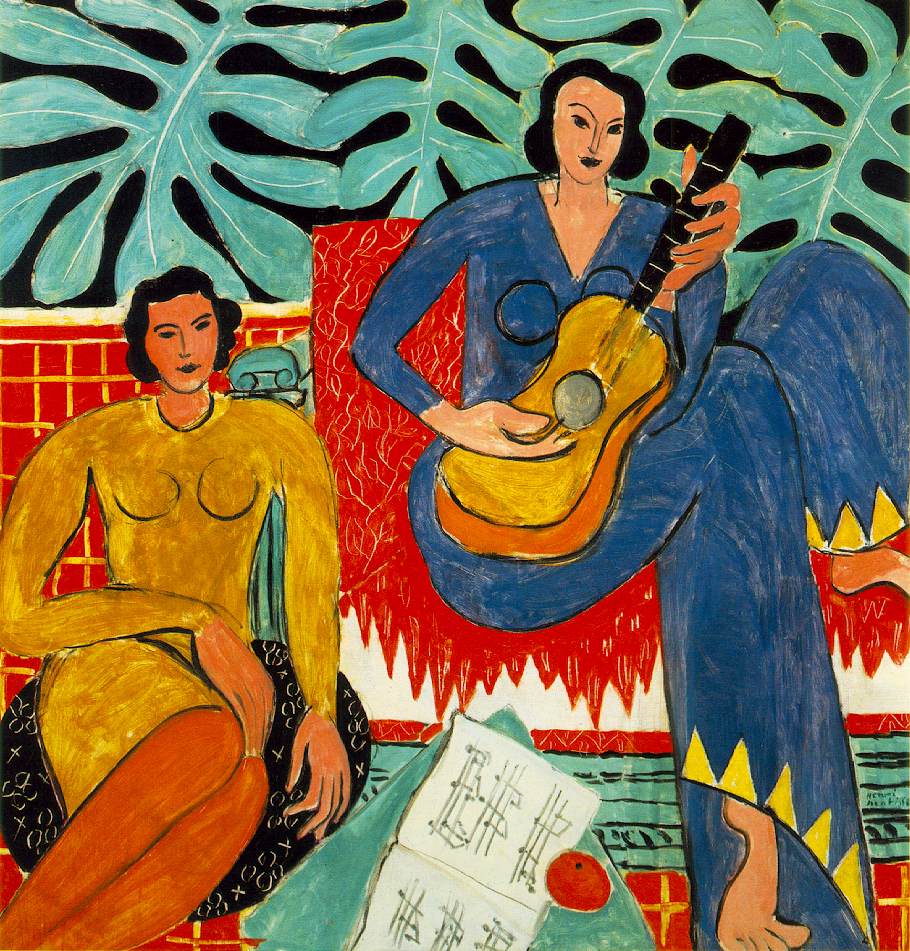
matisse.la musiqueI want to reach the state of condensation of sensations which constitutes a picture. Perhaps I might be satisfied momentarily with a work finished at one sitting, but I would soon get bored looking at it; therefore, I prefer to continue working on it so that later I may recognize it as a work of my mind…Nowadays, I try to infuse some calm into my pictures and I keep working at them until I have succeeded in doing so.

-Henri Matisse, 1908

*********************

 It seems like every artist has a different answer for the question of  when a painting is done.  Whistler and several others said it was when all traces of its creation have been concealed on the surface.   Some say it is when the artist achieves his aim and others say they are never finished.  Edward Munch ( The Scream) said that a piece is done after it has had time to mature, weathered a few showers and endured the elements, including nail scratches.

I tend to go with the never finished group although Munch’s definition is appealing to my love of weathering and patina.  My goal is to have the work complete enough that they can exist on their own,to  be alive in the outer world.  In that respect, because they are human creations, I view them  very much as I view other humans– never quite complete and always imperfect.  That’s just how we are and I am certainly no different.

 I am a collage of imperfections that is still a work-in-progress.  If I saw me hanging on the wall I might want to take a brush and soften an edge here or there and add color in certain parts of my composition.  But I probably would not do it because those imperfections actually become part of the composition, create the contrasts that give us, as a painting, life.  And that , even with the flaws and weathering exposed, pleases me.

None of us is perfectly painted.  Nor should we be.


Read Full Post »

GC Myers Worldshaker smStill affected by a lingering cold, I was struggling this morning to write about the new painting above, an 18″ by 18″ canvas titled Worldshaker.  I went back in the archives of the blog to look for inspiration and came across a term– native voice— I had used a few years back in a blog entry.

This particular blog entry used a Picasso quote– It took me four years to paint like Raphael, but a lifetime to paint like a child — to describe my own decision years before to not follow tradition in my painting.  Instead I would try to paint in a way that would be as natural to me as breathing so that whatever came from my efforts would automatically have my idiosyncrasies and my fingerprints built into them as well as the unaffected honesty of a child’s vision.

Looking around the studio now at the canvasses, some finished and some in various states of progress,  that lean against any available wall space I can see that native voice very plainly.  Looking from piece to piece, I can see that each is very much imbued with my own voice, plain and simple.  No attempts to be anything other than what they are: a testament to one person’s existence.

And maybe that’s where this painting and its message enters the conversation.  Perhaps we all have the chance to shake the world in some way, even if only a small way,  if we can all dare to speak honestly with our own voice.  We think of change as a great sea tide but it often begins as a ripple of a thought uttered by a lone voice.

Let it be your voice.  Shake the world.

Read Full Post »

GC Myers- Archaeology-Rainbows EndThe thing I am most aware of is my limits. And this is natural; for I never, or almost never, occupy the middle of my cage; my whole being surges toward the bars.

–Andre Gide

******************

I chose this week’s  quote from the late French author Andre Gide, who won the Nobel Prize for Literature in 1947, because as an artist I find myself sometimes wondering about my limits, questioning whether I am pushing myself enough into new territory.  Gide uses a cage in his metaphor with his limitations being the bars that keep him from moving forward.  He is not content to simply accept these limits sitting contentedly in the center of his cage. No, he is always pushing and pulling at the bars, seeking to get past them.

In the past, I have expressed this same desire to press past my limits with a metaphor where the artist climbs ever upward until they come to a plateau where they are comfortable and safe.  It is a place where they could easily live out the remainder of their days with little worry, living an easy life by retelling stories that made up the journey up to this point.  Many might not even notice there is still a mountain hovering above them to climb, if they just dare leave the comfort of the easy plateau.

Gide’s cage is my plateau and while he is trying to break through his bars, I find myself still questioning if I have the nerve to start climbing.  Oh, there are first steps, tentative meanders up the path but only far enough that I am within sight and  can return easily to my safe haven on the plateau.

When does the real trek upward begin?  When does one begin to thrash at their bars?

Where are you in your own cage?

******************************

I used a painting from several years,  Archaeology: Rainbow’s End, to illustrate this post.  For one thing, I just like this image.  But more importantly, looking at it seemed to remind me that one’s creative past is often buried and gone from sight.  Or at least, should be if one is going to continue growing.  Like the tree in the painting, you grow from that past existence  being nourished by it.  But you don’t live only in that past.  You must move upward like the Red Tree in this painting to find clear air.

Read Full Post »

GC Myers- Way of Peace smStop looking outside for scraps of pleasure or fulfillment,
for validation, security, or love —
you have a treasure within that is infinitely greater
than anything the world can offer.

-Eckhart Tolle

**************

I call the new painting above Way of Peace.  It is a 30″ by 40″ canvas that is now showing at the West End Gallery.

I am really drawn personally to this piece, very attracted by its peaceful quiet and the depth of its inviting warmth.  I like the way the path leading into the scene seems to transform into a stream, as though there is a moment as one struggles along the path toward their own inner reality when resistance fades and it becomes easier to proceed ahead.  Less struggle and more fluid and free flowing.  More natural.

I think the words at the top from Eckhart Tolle mesh very well with the message I find in this piece.  It is one that is a common theme in my work: that real discovery is found within our self. And I think this painting oozes with that message.  It may seem to be a representation of the outer world and if that is how you see it and that satisfies your appreciation of the piece, that is perfectly fine.  Absolutely nothing wrong in seeing it that way.

But for me, it is in fact an aspiration-based self portrait constructed on an inner landscape.

Sounds like a mouthful but it’s pretty simple at its heart.  Think of what you might picture for yourself if someone asked you to paint a picture of of who you are or hope to be. Some might paint a straight portrait.  I picture myself and my aspirations in the landscape and this piece is very much how I see it.

However, there are some miles to go before I get there…

Read Full Post »

"Mr Wyndham Lewis as a Tyro"- Wyndham Lewis

“Mr Wyndham Lewis as a Tyro”- Wyndham Lewis

For many years now, one of my favorite books to just sit and flip through is my now very worn copy of  A Dictionary of Art Quotes by Ian Crofton.  It has great quotes by artists and critics about artists, schools of art and assorted other things that have to do with art.  The thing that I like most is that Crofton keeps it subjective, often having opposing points of view under each heading.  You might read one quote praising an artist while the very next might be one that portrays him as a hack. It’s interesting to see this contrast of perceptions, often by the artist’s contemporaries.

Some artists receive no negative words against their work or personality– Henri Rousseau, for instance, who was much beloved and respected by his contemporaries.  Most have positive quotes with an occasional barb thrown in their direction.  But the section concerning one artist, Percy Wyndham Lewis, really stuck out when I read it.  There is not anything that could be perceived as positive–Ernest Hemingway even said he had the “eyes of a rapist.”  Not knowing much about this artist, it prompted to find out a little more about Wyndham Lewis, as he preferred to be called.

It didn’t take much research to discover reasons behind the vitriol directed at him.

First, a little background.  Lewis was born in Nova Scotia in 1882, educated in England, lost his eyesight in the late 1940’s and died in 1957.  He was an extraordinarily talented painter and writer and the founder of the Vorticists, an art and literary movement derived from Cubism that flourished in the years before World War I but died out in the aftermath.   He painted and drew , wrote well received novels and published a ground-breaking art magazine, Blast.  No lack of talent, that is for sure

"T.S. Eliot"- Wyndham Lewis

“T.S. Eliot”- Wyndham Lewis

But from what I can deduct, he was a very contentious and very opinionated, always seeking an argument or looking to tweak those he viewed as his intellectual inferiors.  He ruffled more than his share of feathers.  As he said, “It is more comfortable for me, in the long run, to be rude than polite.”   But his biggest offense came in the early 1930’s when he wrote in favor of Hitler and the Fascists, believing them to be the keys to maintaining peace in Europe.  That was, to be sure, not well received and was for many unpardonable even though Lewis did reverse his views later after a 1937 trip to Berlin when it became obvious to him that he had gravely misjudged the intent of Hitler.  He wrote a number of items against Hitler and Fascism and in defense of the Jews of Europe but the damage was done: he was a persona non grata.
He basically disappeared from the art scene although he continued to write prolifically, even after the loss of his sight. There was a re-interest in his painting  and Vorticism in the mid-50’s , just a year or two before his death and in subsequent years his profile as an artist has regained some of its lost stature. He is consdiered among the finest of British portrait painters.  His painting of poet T.S.. Eliot, shown here, is considered one of his finest and one of the great examples of British portrait painting.

I picked up a book on his portraiture and find it very compelling.  The self portrait at the top of the page, Mr Wyndham Lewis as Tyro, really stood out for me as did the ominous Praxitella, below.  An interesting character.  I was glad to come across his work and will continue to explore it.

Wyndham Lewis -Praxitella

Praxitella– Wyndham Lewis

A Battery Shelled- Wyndham Lewis

A Battery Shelled- Wyndham Lewis

Wyndham Lewis- Seated Figure

Seated Figure- Wyndham Lewis


Read Full Post »

GC Myers The Singular Heart smAll the knowledge I possess everyone else can acquire, but my heart is all my own.

–Goethe, The Sorrows of Young Werther  1774

**************************

One of the primary factors in my finding my way to art was the fact that whatever I created would be all my own, a reflection of what I felt was my own truth.  Art, painting in my particular case, was the one place in this world where I could have total control, the one place where I could set the rules and chose what criteria would satisfy my own needs.

I would be using materials and knowledge available to everyone else, just like the knowledge referenced in Goethe’s quote above.  But what made art so appealing was that there was the opportunity to take these materials and knowledge and transform them into something quite different than the person sitting next to you equipped with the same materials and knowledge.  For some, it is an academic exercise that uses the materials and knowledge by the book with little of their own self invested.  For others, it is a battleground in an existential struggle to be heard, to have their voice have meaning of some kind.

The real difference between these two comes from how much one is willing to totally reveal their self in this work, how they interpret the materials and knowledge they are given, and how much of their heart and soul they are willing to put on display.  For me, having my own heart evident in my art was always an existential effort– if I couldn’t make something that was uniquely my own then I would not be pursuing it for long.

You know, this is a pretty simple quote on the surface but it is one that makes me struggle in discussing my own relationship to it.  Perhaps I should just let Goethe’s few words stand as they are and let the new painting at the top of the page, a 24″ by 48″ canvas that I call The Singular Heart, speak for me.  After all, that is what the whole thing is about– a heart that is all one’s own.


Read Full Post »

GC Myers- Secret of All TriumphsPerseverance, secret of all triumphs.

–Victor Hugo

**************

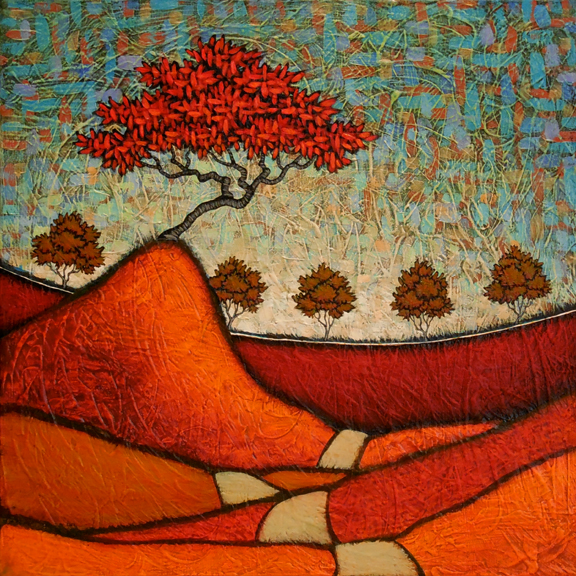
Sometimes sticking with a piece that is in trouble pays off.  The painting shown at the top, a 20″ by 20″ canvas that is yet to be titled, was started several weeks ago.  All of the major forms, including the deep blue sky, were blocked in the transparent colors that I use in my wet or reductive work–that is where the paint is put on thickly then absorbed off of the surface until it reaches a tone that fits my eye.  But it just didn’t ring out, had an awful flatness that just made the whole thing dull.  The colors in the foreground were muddied and blah.

I looked at it for weeks.  Actually, I didn’t look at it that often because it just didn’t have anything to pull me to it.  I got to the point that I avoided looking at it at all.  Finally, I decided to scrap the whole thing.  Paint it over in black and start with an empty slate.

Tabula Rasa.

So I took it down into the basement of my studio where I do apply my gesso and do other sloppy work.  I pulled out a thick brush of black paint and slapped it across the sky and worked it back a few times.  The strokes didn’t go into the lower sections of the painting, remaining only in the sky.  I stopped and took in it for a second, the black brush poised to swat across the center now.  The contrast of the black against the colors made the fields pop a bit, gave them a little life.

Just a little.  Maybe there was something there, a flower that could blossom if I just stuck with it a little longer.

So finished the sky in black and in a few days brought it back to the easel.  Each stroke of color that went against the black surface of the sky brought it more and more to life.  When the sky was close to being finished, I went back into the lower fields, glazing them with new layers of color that took away some of the dullness that had plagued them.  The sky had a pop now and the lower fields were catching up to it.  But the central field between the curved horizon and the large mound on which the Red Tree would stand was still an awfully dull green that sucked the life from both the top and bottom.  A sucking vortex.

Maybe this wasn’t going to work after all.  One element so out of kilter could kill the entire thing, break its fragile life force.

After a while I thought that the black had worked so well in the sky, why not break it out in that central field.  Go completely in a different direction with it– make it a red field that would pop in the center of the piece and give contrast to both top and bottom.  Instead of sucking life from it, it would now give it life. And sure enough, it brought everything together.  Even before the trees made an appearance, it was ebbing with life. And when they did appear, it felt complete and alive.  All that I can ask of it.

Now I can’t stop looking at this piece that once made me grimace.  Perseverance pays off in the end, as it usually does.

PS:  Now that I look at this piece after writing this, I believe I will title this painting Secret of All Triumphs. Thanks for the inspiration, Mr. Hugo.

Read Full Post »

GC Myers- Unpuzzled Hesse QuoteThis quote came from Hermann Hesse‘s most famous book, Steppenwolf. A great book but my favorite Hesse book is Demian, which I have referenced here a couple of times in the past.  It was a book that I read at a time when I was at a crossroads in my life and it was very influential in my heading in the direction which led to this point.  I think this quote very much jibes with my perception of the world portrayed in my work, that being that it is a real entity, a real place.

It has as much substance as the outer world to me.   It has depth and layers.  It has breath and light.  It has emotion and its truth comes the fact that it is a precise portrayal of itself– not a replication of the outer world.

It just is.

That may sound nutty or perhaps egotistical to some.  I get that.  But without this belief in the reality of this inner world, the validity of the work to myself comes undone.  It fades to nothingness and certainly doesn’t move across to others.  It loses all meaning for everyone, myself included, without this certainty in its being real.

I’m going to stop at this point.  I may have said too much already.  That is, too much for the outer world.  In here, in my world, it sounds right…

Read Full Post »

GC Myers - Off the MainlineIf you can see your path laid out in front of you step by step, you know it’s not your path.  Your own path you make with every step you take.  That’s why it’s your path.

–Joseph Campbell

**************************

I am running a little late this morning and have a long to-do list but still wanted to have something on the blog– I guess after six plus years of doing this it has become a habit.  I came across this quote from Joseph Campbell and painting, Off the Mainline,  from many years ago and thought it was sharing.  Plus it’s just nice to see a landscape not covered in snow and ice.  But Campbell’s words, as they often do, jibe well with my own views on our journey through this life.

We ultimately create ourselves and our paths and do have a choice in which direction they will take us.  That’s a simple concept that is easy to overlook in the crush of life.

Got to get to work.  Have a great day!

Read Full Post »

GC Myers Streaming Peaceful smHe who lives in harmony with himself lives in harmony with
the world.
    – Marcus Aurelius

************************

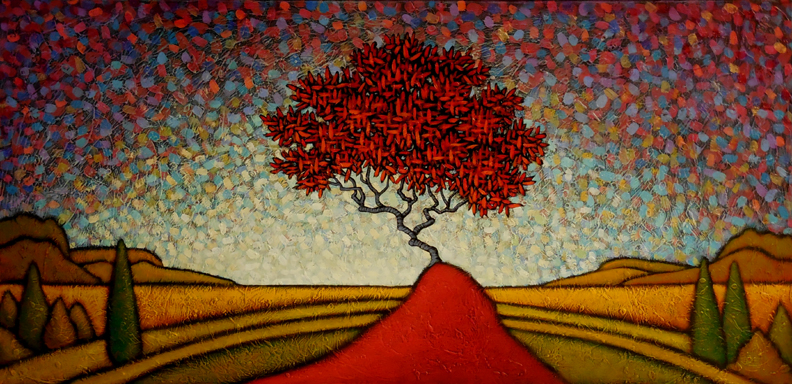
This is a new painting that is  titled Streaming Peaceful, a  24″ by 36″ canvas that is part of a group of paintings that should be arriving today at the Just Looking Gallery in San Luis Obispo on the Central Coast of California.  This very much a signature piece for my work in form and content, a deep landscape under a gradated sky with the Red Tree holding central  focus.

But for me the central aspect of this piece is the placid feel that emanates from it.  It has a rich and supple feel that I find brings immediate calm as soon as my eyes lock on to the image.  Even at this moment as I write, there is an instant sensation as though I am releasing a deep breath when I shift my gaze upward on the screen to this painting.

And that sense of being near some sort of core of peacefulness is what I am looking for in my work, at least in my own personal relationship to it.  I have maintained this quite a few times over the years here that my primary personal goal in painting is not in mere representation, not in pure design or technical prowess.  No, what I want, my ultimate goal,  is to simply move myself with the work to an inner point where I am finally calm and at peace with the world.  For me, feeling that calming envelope surround me is all I truly seek in my work.

Everything else is secondary.

And  this piece hits that mark– for me.  I can’t speak for others.   We all seek different things and have differing reactions to art.  What others see or feel in this is their experience alone and that is as it should be.

But, like it or not, I am at peace in it.

Read Full Post »

« Newer Posts - Older Posts »