Feeds:
Posts
Comments

Archive for the ‘Recent Paintings’ Category

This a new painting that I am calling Pot Luck, a 10″ by 36″ piece on paper.  The pot part of the title is referring to the several pot lakes that surround the Red Tree, a slightly different way for me to represent water in my work.  But after using the term I began to think about how it might refer in a deeper sense to this scene and to our lives.  It now normally refers to a community meal where there is no specific menu and everyone brings a dish to share. It derived from the British Isles of centuries ago, when households might have only one pot in which to cook and a meal would often consist of whatever was available being thrown into the pot.  The resulting meal was called potluck.

 It’s this meaning that sparked my interest.  It made me think of how our lives are often very much like those potluck dinners where we make do with the ingredients at hand.  It may not always seem like the tastiest of dishes and we might sometimes cast an envious eye at those whose luck has blessed them with more ample pantries, wishing we were so fortunate.  But, hopefully in the end, we try to make the best of what is available to us and in the process become better chefs, making the most fulfilling  meals from the simple ingredients at hand. 

 I think that’s the takeaway here– to make the most of what we have in our lives.  To not bemoan that which we do not have but to instead celebrate and accentuate what we have.  We are what we are.  A simple stew can never be chateaubriand but, with care and attention,  can be tasty and quite satisfying in itself.  Maybe we should all give this same  proper care and attention to our own lives.

Meanings aside, the other thing that I really like in this piece are the way the clouds reflect the shape of the pot lakes, their elliptical silhoueettes making them look kind of flying-saucery in the sky.  It is an  afternote that doesn’t greatly alter the scene but adds a layer of depth to it.  An added layer of flavor to the stew, if you see it that way…


Read Full Post »

I’ve written here before about how I find the color blue an intoxicant.  When my nose is to the canvas and it is all that I can see, it has a way of making me feel that it is the only color in my world.  It’s a very satisfying and mollifying effect and, if I am not wary, I can find myself using blue tints to the exclusion of all others.  Because of this wariness, I try to only sporadically break out the blues.  But even with this watchful effort, I find the addictive pull of the color very strong in some pieces.  This new painting is such a case.

Called Blue Dance of Dawn, it’s a 10″ by 30″ canvas that employs two of my familiar icons, the Red Tree and the the Red Roofs.  They, however,  feel secondary to the predominance of the color blue here.  They serve as warmer counterpoints to the coolness of the blue and signify awakening  to me in this scene.  But the feel of this piece is dictated by the calm harmony of the blues.

I find this piece very placid with that  kind of satisfying effect that one sometimes has in the best dreams, that feeling of total understanding and acceptance of the universe.  That wonderful feeling that fades so quickly once you open your eyes and realize that it was only a dream, the details suddenly fuzzing over.  Maybe that’s what this painting represents– that idealized version of the world in those dreams just before we are awakened to the reality of the moment. That fleeting feeling of grace, seemingly within grasp then gone.

Let me think that over…


Read Full Post »

A gem cannot be polished without friction, nor a man perfected without trials.

–Chinese Proverb

^^^^^^^^^^^^^^

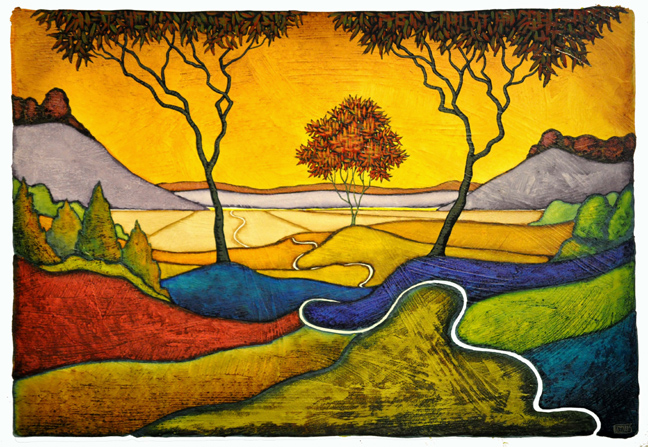
I call this new painting Gem.  It’s an 18″ by 26″ piece on paper.  The gem part came obviously from the deep and rich colors that run through and define  it.  It reminds me at first of a colorful bracelet or brooch dotted with bright gems.  Rubies and sapphires, emeralds and amethysts all set in a citrine yellow sky.  It definitely has a jewelry-like  appearance.  Bright and easy.  Almost a trifle.

But there seems to be a feeling in this piece that goes beyond the playful interplay of the surface colors, something that takes it far from being a trifle.  There is for me a feeling of self-realization in the central figure of the Red Tree, a sense of knowing and understanding one’s self.  It’s a sense that comes from knowing one’s strengths and weaknesses,  a realizing of all that one is and is not in an instant, a flash of insight.  And though it comes in as a sudden thought at a singular moment, it is formed through a lifetime of living, taking into account all successes and failures equally.  The trials that form  character, as the proverb above states.

Our lives are very much like a gem-studded bracelet, easy to see with all surfaces shining bright.  But the gems here have underwent eons of transformation through pressure and friction to reach that easy shine.  Maybe that’s what the white ribbon of the trail going through this painting signifies for me, a long and sometimes hard road to reach that final gemlike quality. 

Maybe.  All I really know is that this painting seems easy to take in at first but lingers on the way down.  And there is a great satisfaction in that discovery of something below the surface, an added depth that belies the shine of the gems.

Read Full Post »

Archaeology is the peeping Tom of the sciences. It is the sandbox of men who care not where they are going; they merely want to know where everyone else has been.

Jim Bishop
 
*************************************************************
 
   Maybe I fit into the quote above from the  late journalist Jim Bishop and maybe that’s why the idea of incorporating archaeology into my work, as I have done with my Archaeology series over the last few years, has been so appealing to me.  The idea of diverting our eyes from where we are headed to instead see where we have been, to examine those things which have shaped us as we stand now, is indeed intriguing to me.  We are the products of our past and where we are headed is often determined in the how and the why of the past.  Unfortunately, and to our detriment I fear, we often fail to look back and, as a result, are continually reliving  pasts that could and should  have been avoided.
 
This thought is definitely behind the title of this new piece, Archaeology: Formed in the Past, a 10″ by 16″ painting on paper.  I see the central Red Tree here as being formed and twisted by the artifacts below the surface, remnants of the past.  The trees in line behind stand  like stoic witnesses to this history.  The artifacts contain tools and toys, books and bottles, shoes and other items of the everyday– the things that make up a life and a world.  There is also evidence of the creative side of life here– a painting, paint brush, a drama mask, a ukulele and an artist’s mannequin. 
 
It’s always interesting to look at these pieces after finishing them and to see how they come together to offer up some sort of narrative in the collection of artifacts.  Interesting because I don’t really think about how the items will interact as I am painting.  No forethought at all really.   They’re just painted in rhythm as they come to mind, often just because a shape or form fits at the moment.  So when I see the commonality of thought and narrative  running through them, I wonder what the source might be. 
 
Is it just a reflection of my own psyche and interests? 
 
Perhaps.  Probably.  But even so, there’s something somehow compelling in sifting through the debris, even the debris of one person’s mind.

Read Full Post »

RFD

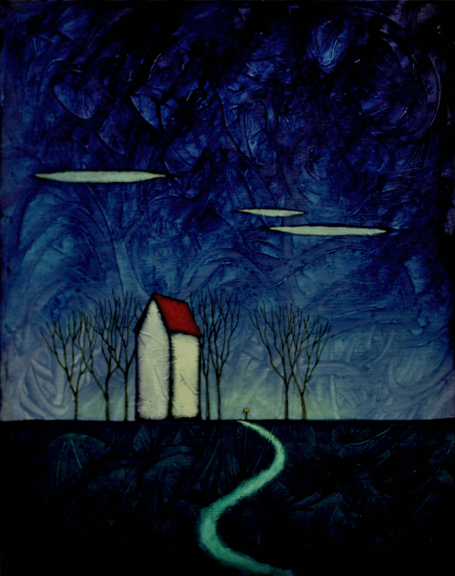
A new painting, a 16″ by 20″  canvas that I call RFD for rural free delivery.  It alludes to the small mailbox with the the door hanging open, a theme I have  used in a prior piece within the past few years.  Maybe it’s a comment on the decline of our postal system, something that saddens me because, as I have writtern here before, it meant so much to me as a child as a form of connection to the greater outer world in the days long before the internet and social media, both terms that would have drawn quizzical looks at that time.  Maybe that’s what it’s about.  Maybe not. I know I’m not sure.

There’s a moody melancholy to this piece that is both a little scary and satisfying at once, something that I am hard-pressed to explain.  But I guess that’s what I find appealing in this painting- the fact that it is harder to take in easily with no apparent answers.  It is dark and a bit foreboding, filled only with questions.  Who might live here?  Where are they now?  Is mail delivered there now or has this place been abandoned?  Is this the end of the road or does it travel on?  When is this moment?  Is it a darkening or lightening sky?  Fall or spring?

There is no Red Tree, no central personification here.  Just a tall, windowless and doorless  house with a gaping mailbox set amid bony trees and an ominous sky.  There is no heroic quality here, no absolutely positive reading or message. Just a mood of mystery. 

And sometimes that’s enough…

Read Full Post »

It took me four years to paint like Raphael, but a lifetime to paint like a child.
–Pablo Picasso
****************
This short sentence from Picasso is  one of my favorite quotes.  It both makes me smile whenever I hear it and brings to mind my own struggles with recognizing my own creative voice, something that used to be a real internal battle in the early formative years.  There was always a pull between the craft side, as might be represented by Raphael in Picasso’s quote, and the side where one paints naturally and intuitively, as the child might.
 I knew I would never paint like a Raphael.   I never cared to tie myself to any one tradition of painting and wanted the liberty of free expression, the ability to freely display emotion, even in the most mundane scene.  Wanted my own voice, preferring the colloquial over the classical. Kind of like wanting to sing like Woody Guthrie versus singing like Pavarotti.  For as beautiful as Pavarotti’s voice might be I found a quality in Guthrie’s voice and songs that spoke more directly to me.  Native simplicity I suppose it might be called.  Over the years, my voice has evolved and there are pieces where there is often a bit of this native simplicity in the work that really pleases me, makes me feel as though I am somewhat painting in the way a child might.  Or at least in a way that might speak as well to children as it did to adults.
The piece shown here is such an example.  A 10″ by 30″ canvas, it is an extension of the work I have done recently, work that I have called internal landscapes.  Called Native Rise, it is painted very intuitively and speaks plainly.  It has an attractive harmony in its elements that lets it speak easily and be asorbed quickly – if you like this sort of voice.  For me, I see this piece as being very symbolic of my true voice,  how I see and express the world as I internalize it.  It is painted easily and in my own voice.   And like my own voice, it is far from perfect but tries to speak plainly.  And truthfully as to how I see my world.
At least, that’s the way I see it   It’s funny how much more difficult it is to describe  with words my own native painting voice, something that comes so easily on the canvas.  Perhaps one shouldn’t try…

Read Full Post »

And therefore as a stranger give it welcome.
There are more things in heaven and earth, Horatio,
Than are dreamt of in your philosophy.

Hamlet, Act I, Scene V

^^^^^^^^^^^^^^^^

I call this new painting Heaven and Earth.  It’s about 7″ wide by 35″ tall on paper and is very much in the same vein as the very  large painting that I recently completed and featured here, The Internal Landscape.  This piece features a nocturnal scene however with a deep blue sky punctured by the light of stars.

The title might refer, in a way, to the lines above from Shakespeare’s Hamlet, where Horatio and Marcellus barge in on Hamlet’s conversation with the ghost of his father.  Horatio is a rationalist, philosophically, and to him  the idea of ghosts seems absurd so that when Hamlet asks him to swear to not  speak of what he has seenl he is mystified.  Hamlet then utters the lines — There are more things in heaven and earth, Horatio,/ Than are dreamt of in your philosophy.

I suppose this painting is saying much the same thing, that we live both in the world that we know and in a world of which we are unaware.  The stars above are, and have been, always with us but we know little of them, really.  The river  runs but we often know little of its journey and the roads travel to places we shall never see.  And around us at all times are radiowaves carrying voices and images from every corner of the globe, unseen and unheard.  And perhaps among all this  are the ghosts like Hamlet’s father, moving unnoticed by our eyes focused on that which we know and see.  Or, at least, are trying to know.

I guess the takeaway here is that there is often more than meets the eye, even when the scene before you might seem enough.

Read Full Post »

Triumphant One

A new painting, this a 16″ by 20″ canvas that I call, for now,  Triumphant One.  I’m still mulling some other titles, most concerning some form of the word triumph or alluding to the word labor as symbolized to me by the various patterns running through the fields.  I originally considered The Triumph of Labor but felt that it might be too easy for the casual viewer to read that as a political statement.  And, though I have long sided with the cause of organized labor and the aspects of  it that have long benefitted us as a people,  that is not what I saw for  this piece.  It was smaller in scale, more personal in how it spoke to me.

To me the triumph of labor I saw was both in the final product, as I see here in the Red Tree as it basks under a brightening  sky, and in the sheer act of the labor itself.  The fields, to me, represent not only hard work in how they are shaped and developed.  They also symbolize a sense of joy in the actual doing, a pleasure inherent in the sense of purpose that is acquired from this labor. 

And that’s what in see in this piece– both joyful triumph and a sense of purpose.  The joy of simply working at what gives one pleasure and meaning.

Read Full Post »

Well, I am finished with the large canvas I started over three weeks ago.  It is the largest piece in size I’ve ever attempted by quite a bit at 54″ by 84″ which I often found intimidating at times, as I freely admitted here.  But that intimidation and fear faded over the weeks as the painting evolved, moving from the darkness in which it began to the vibrant brightness of the finished product.  This shift in tone mirrored my own shift in my feelings for the painting.  I began with a fearful anxiety that began to ease with each new layer of color added.  I began to feel a lightness in myself as the piece began to find its unity and rhythm and a sense of confidence when it began to start taking on a life of its own as it neared completion.

It was interesting  to see how its domination of the studio space changed.  At first, its size and darkness made it seem at times like a big canvas eclipse blocking out and absorbing all incoming light.  But near the end it bagan to have its own glow, seeming to give off more light than it absorbed.  Even after the large floodlight under which I work was turned off, its glow cut through the hazy darkness.  Those moments of seeing that really struck me and gave me a real sense that it was becoming what I hoped for it. 

 As the final strokes went on to the Red Tree that stands above the lake, bringing the piece into a state of completion, it began to move completely into its own realm, its own life.   I felt like a parent watching their child move out of their home and into their own life.  The  influence of the parent is evident but there is a point where the child moves on, no longer dependent on the parent.  It is a moment filled with both the joy of  pride and the sadness of loss. 

 Like this parent, I feel both of these emotions.  I am proud of how this painting has come around and grown into something strong and viable but sad that my time with it has come to an end.   Well, close to an end.  I will spend the next few months with it, making little tweaks here and there.  Nothing large.  Just a tiny  rounding of the edges here and a smoothing of the line there. 

I’m calling this painting The Internal Landscape.  I will discuss this at a later date along with some other observations about it.  But for now, I’m going to simply stand back and take it all in again.

Read Full Post »

Not too long ago, I displayed a Chuck Close quote where he said that work is inspiration in itself, that by simply steadfastly doing  what you do will open up creative avenues to follow.  I frimly believe that and have experienced it on many occasions including just this past week. 

 As I have been documenting, I am working on a large canvas, which is nearing completion, by the way.  I showed, in a post last week, how I would cut the image into sections to weigh the strength of each area of the canvas to make sure that it had its own visual power to contribute to the painting as a whole.  I showed the two section from each edge of the canvas and concluded that both pieces stood up well as strong parts of the overall painting as well as compositions in their own rights. 

 In fact, the section from the far right kept me coming back to it.  I really liked the way it flowed upward with each piece interacting with those around it, creating a lovely harmony that really worked well, for my personal taste, at least.  It gave me a great sense of peace looking at it and I soon began exploring ways to make it work in a separate piece.

I felt a real sense of immediacy in creating something based on this and, searching the studio, realized I didn’t have any prepared surfaces ready in any dimension close to what I was seeing in my head.  There was a painting that was in a later state of completion, one that I had mentioned here recently.  It never really sang for me and had sat in a corner of the studio for quite  a long time, just waiting for me to give it the needed attention.  But every time I looked at it, I was less than inspired.  It just wasn’t working. 

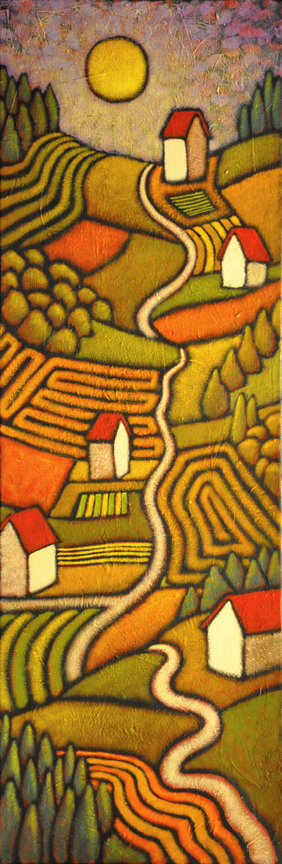
 So, looking at it as a possible new surface to paint, it wasn’t a difficult decision to paint over  the image that had never really taken off for me.  It wasn’t a perfect choice, a bit smaller and narrower than the inspiring image, shown here to the left.  The original is somewhere in the 24″ wide by 54″ range whereas this piece is only 10″ wide by 30″ high, making it a much more condensed space in which to work.

  The resulting image is therefore different, which is as it should be.  It is inspired by, not a copy of, the original image.  For me, it flows in much the same manner and has the same sort of feel and harmony.  It works for me and having said that creates its own new sense of inspiration for other work to come.  Just like Chuck Close said– one thing leads to another.


Read Full Post »

« Newer Posts - Older Posts »