Feeds:
Posts
Comments

Archive for the ‘Technique/History’ Category

GC Myers YCAC ClassOver the years I have been asked many, many times whether I offered classes or would be willing to teach and each time I have  answered with a hearty no.  There were several reasons for the answer.

First, not having taken any classes myself, I felt uninformed as to how to instruct a group.  It was out of my comfort zone and I just didn’t feel as though I had the qualifications or anything to offer.  Plus, I wasn’t sure if I could paint and talk at the same time.  I am not the most coordinated person in the world.

Second, it took time away from my own painting.  I am the artistic equivalent of a gym rat, always in place in my studio nearly everyday for about twelve or more hours.  It is who I am and what I do.  Time away from it is sometimes painful to endure.

The third, and definitely the most important, reason was that I was just hesitant in sharing any of the process behind much of my work that had taken thousands of hours alone in the studio to develop.  Trade secrets, if you will, that needed to be protected.

But over the last few years, I have come to understand that it is not purely process but the person behind it that makes the work come alive and that by hiding the process I was being small and petty.  There was nothing to fear from someone learning from my experience.  In fact, there might be insights to be gained from seeing how others react to working with my process.

So, this year I finally relented, after much urging from the director of the Arts Center of Yates County,  and will be giving a two day workshop featuring my process at  their wonderful facility in Penn Yan , NY, in the heart of the beautiful Finger Lakes.  It will take place beginning on either September 16 or 17— we are still working out final details.  The workshop will be from about 9:30 AM until 4:30 each day with a lunch break and  will be limited to 15 students.  If there is enough demand, there is always the possibility of adding a second session.

My feeling is that this is for all levels of ability, from non-painters up to those with much  more experience.  My goal is to pass on what I have gleaned from my journey over the past two decades so that it might send someone down their own personal path.  I want everyone in attendance to take away something new and of value for themselves.  And I guarantee that there will be no shortage of stories.

If you’re from out of the area and don’t know the Finger Lakes region of New York, you’ll be in for a pleasant surprise– it is an area filled with extreme natural beauty, many wonderful wineries, great watersports and a calming atmosphere.  A perfect place to getaway to.  So, if you’d like to spend a couple of late summer days painting with me in the Finger Lakes,  I urge you to contact the Arts Center of Yates County at this link and get on the list.
 

Read Full Post »

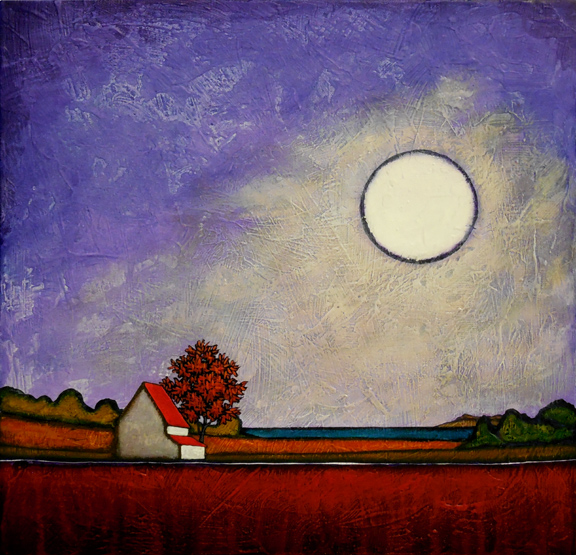
GC Myers- Listening to the MuseI spent quite a bit of time this morning looking at the image of the painting above, Listening to the Muse.  It’s part of my show at the Kada Gallery which is in it’s last weekend there.  This painting really captivates me on a personal level and reminds me of  a thought that once drove me forward as a younger painter.  It’s a thought that I often pass along as a bit of advice to aspiring artists:

Paint the paintings you want to see.

Sounds too simple to be of any help, doesn’t it?  But that simplicity is the beauty and strength of it.

For me, I wasn’t seeing the paintings out there that satisfied an inner desire I had to see certain deep colors that were being used in a manner that was both abstract and representative.  If I had seen something that fulfilled these desires, I most likely would not have went ahead as a painter.  I wouldn’t have felt the need to keep pushing.

It was this simple thought that marked the change in my evolution as a painter.  Before it, I was still trying to paint the paintings that I was seeing in the outer world, attempting to emulate those pieces and styles that already existed by other artists.  But it was unsatisfying, still the work of others, forever judged in comparison to these others.

But after the realization that I should simply paint what I wanted to see, my work changed and I went from a bondage to what existed to the freedom of what could be.  For me, that meant finding certain colors such as the deep reds and oranges tinged with dark edges that mark this piece.  It meant trying to simplify the forms of world I was portraying so that the colors and shapes collectively took on the same meditative quality that I was seeing in each of them.

In my case this seems to be the advice I needed.  But I think it’s advice that works for nearly anything you might attempt.  Paint the paintings you want to see.  Write the book you want to read.  Play the music you want to hear.  Make the film you want to see.  Cook the food you want to eat.  Sew the clothes you want to wear.

Make the world in which you want to live.

Simple.

Read Full Post »

Process/Redux

GC Myers Process jan-2011-pt-11Four years ago I posted a description of one of the process for one of my paintings, followed by a short video showing its evolution from start to finish.  I thought it might be a good time to revisit it as there are many new readers who may not be familiar with how my work comes together.   I paint in two distinctly different processes, one being a reductive process where I put paint on the surface then remove much of it and this process that is additive, with layer after layer of paint building up.  Here’s what I wrote in January of 2011:

I worked on a new piece the last couple of days, a large canvas that is  24″ by 48″.  I had already gessoed the canvas with a distinct texture and applied a layer of black paint.  I had vague ideas of where I thought the painting might go from a composition standpoint but knew that this was only a starting point in my mind.  Like most of my paintings, the finished product is often drastically different than what I imagined at the beginning.  As I paint, each bit of paint dictates the next move and if I don’t try to force in something that goes against these subtle directions given to me by the paint the piece usually has an organic feel, a natural rhythm in the way the different elements go together.  A cohesion of sorts.

Knowing I wanted to use a cityscape in this piece, I started in the bottom left, slowly building the city with geometric forms and rooflines in a red oxide paint that I use to block in my composition.  I like the red oxide because ti gives a warmth under the layers paint to come that comes through in small bits that are almost undetectable at a quick glance. 

At this point I still am unsure where the painting is going.  I have thoughts of filling the canvas completely with the cityscape with the smallest view of the sky through the buildings but am not married to this idea.  The paint isn’t telling me enough yet to know.  But it has told me that I want a path of some sort- a street or canal- through the composition.   I make room for one near the center before starting on the right side with the buildings there.  I go back and forth between the right and left sides as I build the city, constantly stepping back to give it a good look from a distance to assess its progress and direction. 

 At a point where the city is nearing the halfway point on filling the canvas, I decide I want this piece to be less about the cityscape and more about how it opens to the open sky beyond it.  I extend the road that started at the bottom and twist it upward, terminating it at a bend in what will be now a field beyond the city edge.  The sky, though still empty, is pushing me ahead, out of the city.  The piece has become about a sense of escape, taking the street from the cityscape and heading upward on it towards the open fields and sky.  Painting faster now, another field with a bit of the road appearing is finished beyond the first lower field.  I have created a cradle in the landscape for the sky to which I now turn my brush.

There’s a certain symmetry at work here and I decide I want the central focus of a sun in this composition.  I roughly block in a round form, letting it break beyond the upper edge of the canvas.  I pay little attention to the size of this sun except in its relationship to the composition below it.  My suns and moons are often out of proportion to reality but it doesn’t matter to me so long as it translates properly in the context of the painting.  If  it works well,  it isn’t even noticed.

I finish blocking in the sky with the red oxide, radiating the strokes away from the sun,  and step back.  The piece has become to come alive for me and I can start to see where it is going.  The color is starting to fill in in my mind and I can see a final version there.  This is usually a very exciting time in the process for me, especially if a piece has a certain vitality.  I sense it here and am propelled forward now, quickly attacking the sky with many, many brushstrokes of multiple colors. working from dark to light. 

There are layers of a violet color in different shades that are almost completely obscured by subsequent layers.  I could probably leave out these violet  layers but the tiny shards that do barely show add a great depth to the flavor of the painting for me and to leave them out would weaken the piece in a way. 

I have painted several hours on the sky now and still have a ways to go before it reaches where I see it in my mind.  There are no shortcuts now.  Just the process of getting to that final visualized point.  But it’s dinnertime and my day is now done.  I pick up and step back to give it one final look before I head out into the darkness.  This is where the painting is at this point, where I will start soon after I post this:

GC Myers Process jan-2011-pt-2 In the blog post with the final version I then wrote:

I will say that the final version is much different in many ways than I first envisioned with the first strokes of red oxide that went on the canvas.  Each subsequent bit of color, each line that appeared, altered the vision in my head just a bit, evolving the piece constantly until the very end of the process.  Even the last part, where I inserted the treeline that appears on the farthest ridge, was not seen in my mind until just before the decision to proceed with them was made.  I decided to go with this treeline to create a final barrier for the road to break past on its way upward toward the sky.  A final moment of escape.

991143 Escape Route 2011

And here’s the video, only about a minute long, that shows how the piece came about.

Read Full Post »

GC Myers Glory Run 2006It’s the time of the year when I take a slight pause and try to ascertain what the past year has brought and where the next year might head.  I often find myself going back through my files, looking at images of long gone but well remembered paintings from the past.  There are a lot of thoughts that come and go during this process.  I will see work that bring back strong memories of the emotions that brought it out from within and some that leaves me wondering where it came from, it seems so different than the work around it in the files.

Then there is work that seemed to be a constant in my body of work that suddenly stopped coming out at a certain point.  Boat paintings, for example.  They were a minor staple in my work through the mid-2000’s but around 2009 they suddenly stopped completely, save for a few ferry paintings.  I really have no explanation for the stoppage.  It just didn’t seem to need to come out over the last several years.

GC Myers Night Glides In 2006There is probably some psychological reasoning to be found but it doesn’t matter to me at this point.  Just seeing the work and realizing that they were a part of the body of work and may someday emerge again in some way is enough.  Seeing these pieces with some time past makes me look at them with a questioning eye.  Some are real anomalies that stand out among a crowd of colorful images.  For example, the piece shown here on the left, Night Glides In, is a definite one-of-a-kind with its serene blue tones and placid feel set against a lone craft, vaguely Viking in style, that is headed inland.  It could be the return of a warrior or fisherman or traveler or it could be something more ominous and threatening.

That possibility always comes to my mind when I see this image even though I personally tend to see it in more congenial and positive terms.  More homecoming than home invasion…

GC MyersTime and Tide 2006Another painting from about the same time that also draws my attention whenever I am skimming through is this piece, Time and Tide.  I always have to zoom in to take in the texture.  The texture in my pieces seem to shift and change over the years and the texture in this piece is different than that in subsequent years.  Maybe it was an alteration in the way I prepped my surface or a change in material but it gives this piece a distinct signature in that texture and in the perspective of the incoming ship within the picture.

Looking at these boat pieces brings back influences and thoughts that have faded a bit in time, making them seem rejuvenated with the passage of years and the gaining of new experiences in that time.  I can see a boat or two floating back into my work in the new year.

We shall see…

GC Myers Beyond Chaos 2008

Read Full Post »

Maurice de Vlaminck- Houses at Chatou 1905

Maurice de Vlaminck- Houses at Chatou 1905

When I get my hands on painting materials I don’t give a damn about other people’s painting… every generation must start again afresh.

— Maurice de Vlaminck

********************

I have to admit I don’t know much about French painter Maurice de Vlaminck  (vlah-mink)  who lived from 1876 until 1958.  His work is best known for a short period  in the early years of the 20th century when he was considered one of the leading lights, along with Andre Derain and Henri Matisse, of the Fauve movement.  Fauve translates as wild beast and the style of these painters was very much like  that to the sensibilities of that time.  It was brightly colored with brash brushwork and little attention paid to detail.  It was all about expression and emotion.

I recognize some of his early Fauvist work, mainly for the obvious influence of Vincent Van Gogh  it exhibits, and none of his later which becomes less colorful and exuberant, perhaps shaped by his experiences in WW I.  But his name is one that I have often shuffled over without paying too much time to look deeper.

Maurice de Vlaminck At the Bar 1900

Maurice de Vlaminck- At the Bar 1900

But I came across this quote and it struck me immediately.  It was a feeling that I have often felt  when I immerse myself in my work.  All thoughts of other painters– of their influence, of comparisons and artistic relationships– fade into nothing.  It is only me at that moment faced with the task of pulling something new and alive from the void.  I can’t worry myself at that moment about what other painters are doing.  Their whats and hows and whys  are all moot to me then because I am only trying to express something from within.  It might only exist and live for me in that instant, though I hope it transcends the moment, but that is the whole purpose and all of the works of all the painters throughout time can’t change this singular expression of this moment.

This single, simple quote brought me into kinship with de Vlaminck and made me promise myself to explore more deeply into his work and life so that when I come across his name in the future I don’t simply skim past without a thought.  But when I am painting, rest assured I will not be thinking of Maurice de Vlaminck.  And that is as it should be…

Read Full Post »

GC Myers WIP 2014 smOnce in a great while I show my works in progress here on the blog.  I ‘m never too excited about it because  in many of the stages that are shown the work still lacks that thing, that completeness, that gives it life.  But there is a point earlier in the process where it does attain a certain sense of completion.  It’s right after the initial blocking in of the painting with red oxide paint and after the the first layers of color have given the beginnings of light to the sky.  It has a mood of its own at this juncture, a direction and a sense of the life it will have.

Outside of the final moments near the completion of the moment, this is by far my favorite stage of the process.  After this, as more layers of color are added, it devolves for a while, becoming flat and dull on the surface.  It loses any brightness.  Without this early glimpse of what it might be, these later stages might be discouraging.

This early stage is one where I sometimes find myself wanting to stop, to go no further and just let it be as it is.  But I always seem to push past this and move on to the fuller version that has more color and a bit more polish.   I may show a few more stages along the way until the final version emerges.  By the way, this a 24″ by 48″ canvas.

Being Sunday morning, it’s time for a little music.  I have had an old Burt Bacharach song in my head for a few days, one from his heyday with Hal David where they churned out an amazing string of hits for Dionne Warwick in the early 60’s.  His music always has a distinctive sound and feel.  There is a coolness  and lightness in the sound of  much of his music that I can’t fully describe and Warwick’s strong but delicate phrasing fits it like a glove in these songs.  I guess that’s why it sticks in my mind so well.  Here’s Walk On By from Dionne Warwick.  A little coolness for what I hope will be a great Sunday for you.


Read Full Post »

Earlier in the week at the dinner at which I was speaking  I was asked why there were no windows or doors in my houses.  I answered that I wanted them to be somewhat anonymous and that leaving the windows and doors out allowed the eye to glide easily over them to the focal point of the painting.  I didn’t mention that I have painted houses and building with windows and doors, usually when the structure is a central figure in the composition.  I wrote a blog entry several years ago about one such painting.  In this essay I also mention how I came to paint clouds in the manner that I do, answering another question that I was recently asked.  Even though the painting shown is long in the hands of that collector, here’s what I had to say:

GC Myers- As Clouds Roll By 2010This  is a new painting that I’ve just finished, tentatively called As Clouds Roll By.  It’s a 14″ by 18″ image painted on ragboard.  It’s a composition that I have visited on a number of occasions, this time at the request of a collector in Pennsylvania, and one that I always get great pleasure from painting, savoring the subtle variations that make each piece unique .

Even though this is a very simple composition with few elements, the great satisfaction I feel after finishing a piece such as this is something I can’t fully explain.  Perhaps it’s the recognition of the things in this piece that fully jibe with what I hope to achieve in my paintings.  The simplicity of design. The quietude of vast open space.  The depth into the picture, even though it is a very simple composition.  The inviting warmth of the house and tree.  The languorous fashion in which the clouds roll by, in a way representing the slow and inevitable march of time.

It clicks a lot of my own buttons.

The clouds in this piece always take me back to the first time I painted clouds in that looked like these.  I was not yet a full-time painter and had obtained a large commisiion that would prove to be very important to me.  I was on a short deadline and was still painting in the dining area of our home at the time with large sheets of paper spread over folding tables.  I was working on a large triptych and was nearly finished when our late cat, Tinker, decided to explore the tables.  Bounding up, she stepped first in a damp part of my palette and ran across the three sheets, leaving perfect little paw prints in a watery blue tint in her wake.  As the echoes of my bellow faded, my mind raced as I looked at my now very unfinished work.

Start over?  No time.  Try to blend them in to the background?  Not with this particular style of painting.  I sat and looked, concentrating.  Wait a minute.  The prints only ran across the sky portion of all the sheets.  And they ran in lovely diagonal manner.

Quickly, I was at it with paint and within several minutes I had blocked in clouds where once there were paw prints.  It worked.  Tinker’s run across the sky fit the rhythm of the piece and the clouds actually gave a fullness to the composition that it had lacked.  It was actually quite an improvement.

So when I see clouds such as these, I always flash back to my initial panic and the subsequent discovery of good fortune in this happy accident.  Since that day, when what seems to be a disastrous event happens with one of my paintings I step back with a much calmer mind and eye with the knowledge that perhaps this is just a new opportunity to see things a new way.

Read Full Post »

GC Myers  Ever ReachingThree Rules of Work: Out of clutter find simplicity; From discord find harmony; In the middle of difficulty lies opportunity.

–Albert Einstein

****************

This Einstein is a pretty smart guy.

 Simplification, harmony and opportunity could be  ingredients for any recipe to success in any field but I think they apply particularly well to art.  I know that I can easily apply these three rules to my own work.

For me, its strength lies in its ability to transmit through simplification and harmony.  The forms are often simplified versions of reality, shedding details that don’t factor into what it is trying to express.

There is often an underlying texture in the work that is chaotic and discordant.  The harmonies in color and form painted over these create a tension, a feeling of wholeness in the work.  A feeling of finding a pattern in the chaos that makes it all seem sensible.

And the final rule–opportunity lying in the midst of difficulty– is perhaps the easiest to apply.  The best work always seems to rise from the greatest depths, those times when the mind has to move from its normal trench of thought.  Times when it has to find new ways to move the message ahead.   The difficulties of life are often great but there is almost always an opportunity or lesson to be found within them if only we are able to take a deep breath and see them.  These lesson always find their way into the work in some way.

Thanks for the thought, Mr. Einstein.

The painting above is called Ever Reaching, a new 16″ by 20″ canvas that is part of my upcoming show at the Kada Gallery in early December.

Read Full Post »

To exist is to change, to change is to mature, to mature is to go on creating oneself endlessly.

~Henri Bergson

***************

GC Myers  1994 Early Work Illustrative Styling

If you have read this blog for some time, you probably have noticed that I periodically like to revisit old work, especially those early pieces from when I was still in the process of finding voice.  It’s an interesting period for me to look at because the changes were coming fast, sometimes on what seemed to be a daily basis, as new things were tried, some sparking new directions and some being quickly set aside.

It was a much different set of circumstances than the way I currently work.  It was a period of fast and furious fireworks, little pops and crackles with every step forward where today it is quieter for periods of time followed by louder booms.  I don’t know if I can explain that any better and am pretty sure it means nothing to anyone but that is the nature of this whole endeavor– trying to make sense of something inexplicable.

I was looking at some early pieces and stopped on this one at the top for a bit, looking at it closely for the first time in many years.  It’s from around 1994 and was at a point where I was still trying to figure out things.  It was very illustrative– I could see it being used in a kid’s book– but there were things I took from it.  The treatment of the sky, for instance, presaged the way my process evolved. It’s a pleasant little piece but it is far from where I wanted to be and even back then I knew it when I finished it then set it aside.  It was not an emotional carrier for me at the time and that was what I was seeking.

The piece  below , Into the Valley, was from around six or seven months later, in early 1995,  and shows the changes that were taking hold in my work.  It is simpler in construction yet seems to say more for me, seems to have some more fundamental thought in it.  GC Myers Into the Valley 1995

I usually take something from these little visits back in time.  The changes become more evident as the style matures then levels off, becoming a bit more subtle, less drastic but more confident.  But always changing, always recreating itself as it matures.

Or so I hope…

Read Full Post »

GC Myers-FourShadowing ing Grouping

I recently painted the four  12″ by 12″ paintings, shown above, which is grouped as a set titled FourShadowing.  I wanted to have only the most subtle of differences between the pieces as far as subject and form so that there was a repetitive quality as your took them in, almost like the recurring chorus of a song.  The variations of colors acts as a sort of verse.

I try to not think to0 much about this, not wanting to contrive the outcome in a way that saps all of the energy from the work.  Just let the elements do their thing, let their voices be heard over the repeating imagery of the four pieces.

I saw the video below, a simple explanation of how we are affected by musical repetition based on the work and book, On Repeat: How Music Plays the Mind , of cognitive scientist Elizabeth Hellmuth Margulis, and it instantly made me wonder if repetition played the same part in visual art.  I believe that the  personal style of an artist is a form of repetition, that the more familiar a viewer is with the work of an artist, the easier they find themselves able to engage with it.  The repeating nature of their style and the body of work reinforces and reassures.

Of course, I am talking off the top of my head right now and I might read this later and ask myself what the hell I was talking about.  It’s a grain of a thought at the moment.

Anyway, take a few minutes to watch the video and think about it on your own:

Read Full Post »

« Newer Posts - Older Posts »