

Posted in Uncategorized, tagged Raymond Carver on February 14, 2011| Leave a Comment »
Posted in Uncategorized on November 18, 2010| 2 Comments »
 I am feeling a bit melancholy today and there are many things swirling in my head that I could talk about but the title of this piece fits the bill for me today. Council of Silence. There are places I don’t want to venture today, especially in a public forum such as this, so I will keep this short.
I’m thinking today, as I have for the past few days, of a friend who passed away unexpectedly this past week, a person too young and talented to go so soon. I would be stretching the truth to say we were close friends but I can honestly say that I had a genuine fondness and regard for this person. Our conversations, though less frequent than I think both of us would have hoped, were always easy and in rhythm, as though part of one long conversation that stretched over the years. A conversation that has ended this week, leaving me and many other friends alone, like the black birds in the tree above, to contemplate a number of things, such as a life ended much too soon and what lays beyond that far horizon for all of us.
I wish you a peaceful journey to that horizon , my friend. You will be remembered well.
Posted in Uncategorized, tagged Barbara Hall Blumer, Brooklyn Museum, Corning Museum of Glass, Frederick Carder, Steuben Glass, Tom Buechner on June 15, 2010| 8 Comments »

Tom Buechner In His Studio-- Photo by Barbara Hall Blumer
Tom Buechner died Sunday, June 13, at his home in Corning after a short time after being diagnosed with lymphoma. He was 83 years old. He is survived by his wife, Mary, and his three children.
I don’t know how you would characterize Tom’s career, it being so multi-faceted. He did so many things in so many areas, all at the highest levels. He was a true man of accomplishment.
He was well known in the museum world, having started the Corning Museum of Glass, which evolved into the world-class facility it is today, before leaving to head the Brooklyn Museum throughout the 1960’s. He was president of Steuben Glass, the company that produced some of the finest American crystal and art glass ever made. He also was instrumental, serving as President for a decade, in the formation of the Rockwell Museum in Corning, which has the largest collection of Western Art east of the Mississippi.
He was a leading glass scholar, being one of the biggest authorities on the work of art glass pioneer Frederick Carder. He wrote the glass section for the Encylopedia Brittanica. He also wrote a best-selling book, Norman Rockwell: Artist and Illustrator, that is one of the definitive works on the great American artist.
He is perhaps best known as a painter. Trained as a young man at the Art Students League in NY and the Ecole des Beaux Arts in Paris, Tom maintained a passion for painting throughout his life. His landscapes, still-lifes and portraits are highly sought after in the many galleries throughout this country that represent his work and hang in many fine collections and museums, including the Metroplitan Museum and the National Gallery of Art in Washington, DC. His portrait of Alice Tully hangs in the hall named for her at Lincoln Center in NY.
In this area, he was also the biggest influence in our local art community. Generations of artists benefitted from his talent and knowledge, many taking his well-known classes in painting as well as painting with him on a more casual basis, in weekly get-togethers. His influence on local painters was so strong that when I first started going to the West End Gallery, I would have to go from painting to painting to check the signatures because so many of the painters had adopted his style and palette from their time with him. He was also a huge presence behind the scenes of many local organizations and events, something that probably went unnoticed by many.
That’s just a quick thumbnail version of one hell of a life in art. There are so many other aspects to his talents that it could go on for many more paragraphs.
Now, I didn’t know Tom well at all. We talked several times briefly in the gallery, usually about his work, which had a classical appearance. Actually, I wasn’t sure he was even aware of my work until one evening when he showed up unexpectedly at one of the openings for a show of mine at the West End. As I was talking with a lady before a painting, he came up and asked if he could interrupt. He then gave me several minutes of exuberant praise, telling me that he envied me for creating a body of work that had its own distinct look and feel, that was instantly recognizable as mine. I think my mouth was hanging open in shock as he turned and was gone. The lady that had been speaking with me gasped out, “Oh my god! That was amazing! You should have recorded that.”
I was giddy, trembly inside. Even though I was well along and fairly well established in my career, I was shocked that these few words of praise meant so much to me, that they affected me so much. I felt validated. I felt changed in some way. To me, Tom Buechner represented the established art world and even though I never sought its acceptance, to be received so heartily made me feel very … well, I can’t even describe how it made me feel. It remains one of the highlights of my career.
I think that says a lot about Tom Buechner’s magnitude, that a few brief, kind words given at an opening could make me feel completely different about my own work. For that moment alone, I will always have a place in my heart for Tom Buechner.
May his spirit live on…
***********************************
The photo of Tom from the top of this post is from the book , In Their Studios: Artists & Their Environments, from photographer Barbara Hall Blumer. Here are a couple of pieces from Tom’s body of work,,,
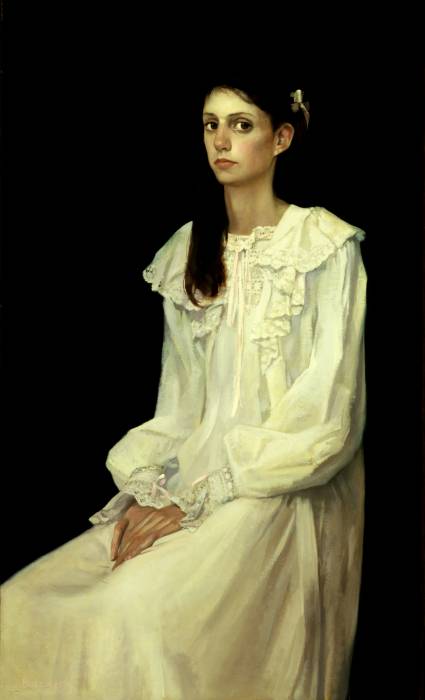
Leslie-- Thomas Buechner

Posted in Favorite Things, Influences, Recent Paintings, Uncategorized, Video, tagged Arvo Part, Gregorian Chant on May 21, 2010| 2 Comments »

Peers- GC Myers 2003
I’m in the last days of painting before I start final preparations such as framing and such for my upcoming show. I’m currently putting the final touches on a piece that is a multiple similar in form to the one shown here, Peers from back in 2003. The piece I’m working on consists of 3 rows of 3 red trees on a 30″ by 30″ canvas. I’ve used multiple images a number of times over the years, although I often go years between. There is something almost musical, almost choral, in the repetition of form.
I only mention this today because when I came into the studio I put on an album (CD actually but I still call them albums) of work from Arvo Part. One of the first pieces to play was Cantus in Memoriam of Benjamin Britten. It was a mesmerizing tonal piece and as it played, I looked at the title and realized I didn’t know what was meant by the cantus in the title.
Looking it up brought me to the term cantus firmus which is described as a sort of polyphonic composition, meaning it is comprised of multiple interwoven and, often, the same melodies. A Gregorian chant is an example of one type of polyphony. The voices, or melodies, are repeated, one over the other, some at different tones and varying lengths. I don’t know much about music but as I read I began to equate this meshing of voices and melodies in a cantus firmus with what I was trying to achieve with the multiple images in the painting I was working on. Each image is basically the same but because of the way they are positioned and come together as a whole, they become more than the product of their parts.
At least, that’s my take on it.
Anyway, I found a name for the piece I am finishing. Cantus Firmus.
Here’s the composition from Arvo Part:
+
Posted in Uncategorized, tagged Contest on May 13, 2010| 5 Comments »
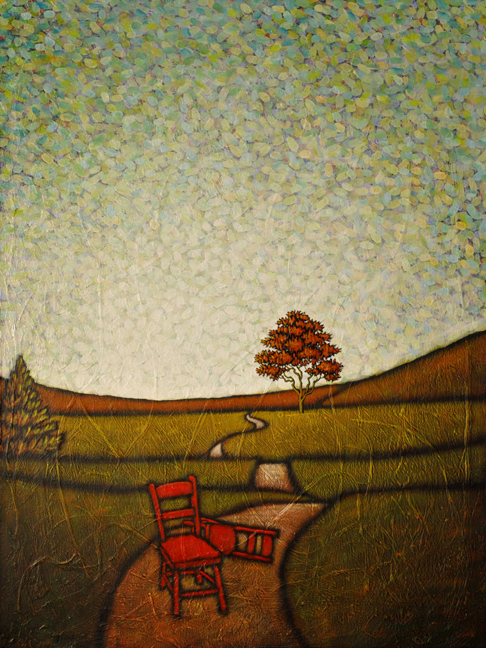
Name This Painting!
Just a reminder that there are only four more days in this year’s Name This Painting! Contest. The contest ends at midnight on Sunday, May 16. Simply submit a title that you feel fits the painting shown at the right and submit it through the comment section of this post or email me at info@gcmyers.com.
If your title is chosen, you’ll win a pair of very limited signed prints as well as a signed and dedicated copy of my book, In Quiet Places. And even if your title doesn’t make the final cut, it will be placed on the back of the painting so that it will live with the painting for all posterity.
So far it has been a pretty large group of very imaginative titles so I have my work cut out in choosing one that I feel lines up well with the painting.
So be creative and give it a whirl!
Posted in Quote, Uncategorized, tagged Goethe on May 12, 2010| Leave a Comment »

Before the Gates-- GC Myers
Whenever I speak to a group of people I inevitably find myself fretting afterwards over things I either said or, more likely, did not say. Sometimes I wake up early in the morning with the thought of things I wish I had said pushing aside my dreams. Such was the case from speaking yesterday to a group of college students. I said many things but I’m not sure how much I truly communicated to these kids. I wish I had simply stood up and uttered this short quote from Goethe:
Dream no small dreams for they have no power to move the hearts of men.
That pretty much sums up all I wanted to get across to these students, these budding artists.
Dream big. Think big. Embrace big.
Be big.
What more could I say after that? They probably would get more from a call to arms for an attitude than all the nuts and bolts advice I could ever offer. If they take on the posture of being and dreaming big and truly take it to heart, they will find a way. But they have to have that dream before my words will make any sense at all to them now.
I could go on and on and it would all amount to the same pile of meaningless words as I felt uttered yesterday, so I believe I’ll stand pat with my Goethe quote.
I am available for commencement addresses.
And children’s parties.
Posted in Early Paintings, Favorite Things, Technique/History, Uncategorized on May 3, 2010| Leave a Comment »

Kabuki TV-- circa 1994
Just looking through some old things, mostly little pieces that are from the time when I first started painting, and I came across this. At the time I was playing around with color and masking, where you put something such as tape on the painting surface and paint over it then peel it away to reveal the unpainted surface underneath. It can be a big part of traditional watercolor painting and I wanted to see if it fit with the way I thought and wanted to paint. It didn’t. But I did come up with this little abstraction that always catches my eye and makes my mind’s gears turn.
It’s always interesting to see these little pieces because it inevitably triggers memories of that time when every day was bringing new discoveries as I tried to learn more and more about color and different mediums. Sometimes things clicked and it was revelatory to discover my strengths. Other times, it was a struggle and the end product was muddled, labored. But there was still something to be learned there. Like identifying my weaknesses and learning how to strengthen these areas or, at least, downplay them.
I guess that this is the process for development in any area of your life, playing up your strong suits and trying to cover your weaknesses. Perhaps that is why I like to see these old experiments, to be reminded of my growth, artistically and personally, through the years.
At least, what I perceive as growth.
Posted in Uncategorized, tagged Traveling on April 15, 2010| Leave a Comment »
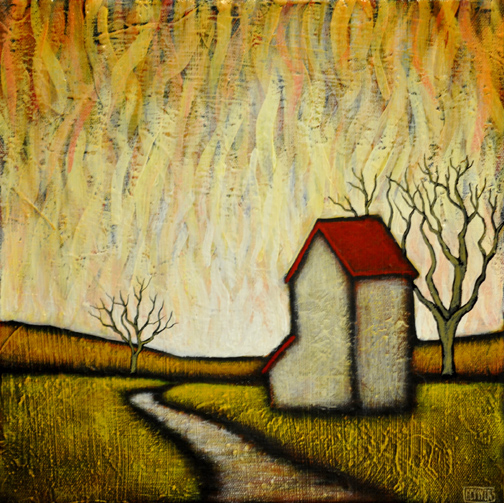 If you don’t know where you’re going, any road will get you there.
—Lewis Carroll
********************
At least, I know where I’m going today…
I’m on the road today and tomorrow, another racing road trip to drop off work at two of the galleries that represent my work. I always have ambivalent feelings about these trips. Part of me enjoys the road, taking in the scenery and simply seeing little things that I can’t see from the end of my own driveway. But part of me really doesn’t like it, doesn’t enjoy all the ways it takes me away from my treasured routine that I find myself longing for from the time I turn out of my driveway.
But I do it and enjoy seeing my friends at the galleries, catching up on small talk and the minutiae of our lives. It’s this personal connection that makes the journey worth the unease that goes along with it.
So, today, I’m flying down the road, eating greasy food and avoiding speeding tickets. And all the time wishing I was closing in on home.
By the way, the piece at the top is Any Road Unknown, a 12″ by 12″ canvas, that is traveling with me today to a new home.
Posted in Uncategorized, tagged Copying, Millet, Van Gogh on April 10, 2010| 7 Comments »
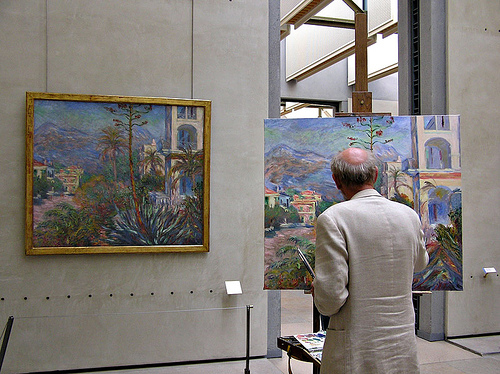
Steal from everyone but copy no one.
—-Charles Movalli
I received a call yesterday from a gallery in another state that sells my work. They mentioned during the call that a painter living in their city, who is a regular attendee of the events at their gallery, was selling work at another gallery there that was looked to be copies of my work. They were a bit upset and asked that I take a look and see what I thought.
So I went to the other gallery’s website and clicking on the artist’s name was surprised to see four pieces that, at first glance, looked very much like my work. All of the four pieces had compositions that were very much like mine. No big deal, lot’s of paintings use similar elemental compositions.
The color palette was very much like mine as well but, again, no big deal.
The texture of the panel was very evident and one had a pronounced fingerpaint-like feel, one that I use often. Again, not a big deal. I often outline my normal technique at gallery talks and have described the process I use here in this blog.
The artist used trees as the central character in his pieces but who hasn’t at some point? He used a blowing tree with reddish leaves and intertwined trees as well, both staples of my work. Is any of this a big deal?
I want to say no. I have had a number of people over the years do this with my work ( even to the point of adopting my own titles for their copies) and I have always resignedly viewed it as a form of flattery. They obviously have seen something in the work that makes them want to try to recreate it in their own form. There’s a form of validation for the original in this copying, a verification that something is working well.
It only becomes a problem for me when the copying painter stays solely in the realm of my work and doesn’t evolve their work into something that has its own voice and vocabulary of imagery. Serving as inspiration and influence in the form of being copied is fine for the short term but a real artist will soon move beyond the inspiration and create work that is their’s and their’s alone. Would we know the name Van Gogh if he had continued copying works such as Millet’s The Sower, as he did early in his painting life?
The problem of copying other people’s work is that, while one can try to emulate composition, strokes, texture and color, there is no way of copying the intent and mindset behind the original. Or the rhythm of the actual physical act of the original artist. Basing one’s work solely on the work of another reduces that person to the level of a musician playing in a cover band, playing the hits of others. That’s fine and dandy, if that is this person’s only aspiration but most people turn to art because they feel a need for self-expression, to create something that says who and what they are.
I know that’s why I came to painting.
Now, I happen to know this person whose work so resembles mine and have known him for a number of years, having done business with him at one point. He’s a really good guy and I don’t suspect for minute there is anything amiss in his study of my work. Hopefully, his work will soon start to make the evolution and I will see only his mind’s voice at work when I check on his work in the future.
Which I will…
Posted in Favorite Things, Influences, Quote, Uncategorized, tagged Watercolors, Winslow Homer on February 25, 2010| 6 Comments »

Sitting here as the first light of morning reveals snow falling, piling quickly and coating the limbs of the trees in the forest. Truly beautiful. However, we’re expecting a foot or so and, while I really love the snow, I am reminded of the tropical watercolors of Winslow Homer.
Homer, perhaps best known for works such as The Gulf Stream which is the second image from the bottom of this post, fled the cold of winter starting in the 1880’s, travelling and painting in such places as the Bahamas, Bermuda and Florida. Because of their convenience, he chose to paint in watercolors for his travels.  The results were stunning pieces with rich colors and an feeling of immediacy and spontaneity in the way they were painted. They have a really modern yet timeless feel, as though you could be looking at something painted just yesterday. They were unlike anything being done at the time and have been highly influential to generations of artists.
Despite less than flattering comments from the critics of that time, Homer knew they were special and has been quoted as saying, “You will see, in the future I will live by my watercolors.” In fact, his watercolors were extremely popular with his collectors and provided a great portion of his income. But I think with this quote he also alluded to his name living through future generations via this work, which has been the case.
On this snow-filled day, I am momentarily transformed by these pieces to warmers climes…


 Redtree Times