I think I have seen this before but it caught my eye this morning. It’s a video of Turkish artist Garip Ay who works in the art of ebru, known to us as paper marbling. In this video he takes on Van Gogh’s Starry Night but that is only the start. What turns out in the end is a bit of a surprise although you may see it coming in the process. Just a neat video and a wonderful display of total craftmanship.
I’ve also included another video of Garip Ay at work. Just seeing the process and the manipulation of the colors and the way they move on the dark water is fascinating. Mesmerizing.
Lately, when I have been very busy, I’ve been sharing some videos of artists’ work set to music. For example, I’ve shared videos of the works of Edward Hopper and Thomas Hart Benton in recent weeks. It’s always interesting to see artists work set to music, especially when they seem to complement one another.
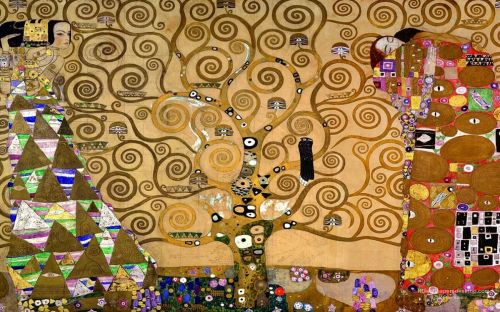
Well, I am busy again today but want to share a nice video featuring the work of Gustav Klimt put together by a Brazilian musician, Juliano Cesar Lopes, who creates musical scores for films under the name JCSL Studio Recording. He has produced a number of short films like this one as a showcase for his skills. I like his work on this short film and hope you will as well.
Last week I shared a couple of videos of the paintings of Edward Hopper set to music. I thought that I’d do the same this week for the work of another of my favorites, the great American Regionalist painter Thomas Hart Benton.
I’ve always loved the rhythm and movement of the elements in Benton’s paintings, in even his most remote landscapes. They seem to be filled with potential energy and the landscape becomes a living, breathing figurative element in his work. That is a trait that I try to emulate in my own work.
This video features his paintings set to the music of late American composer Walter Piston‘s Symphony #6, Movement #4as performed by the St. Louis Symphony Orchestra as directed by Leonard Slatkin. It has that sound of youth, motion, and energy that is often associated with America in the late 19th/early 20th century. Plus it has Benton’s work.
Another Sunday morning which means it’s time for a little music. I thought that for this week’s choice I would go with something a little further off the beaten track, going all the way up to Regina, Saskatchewan to grab this tune from the group The Dead South.
The song, In Hell I’ll Be In Good Company, is a song that I stumbled across awhile ago. I thought it was catchy and found the video engaging and fun. I’ve listened to it several times since and thought it would be a good song for today.
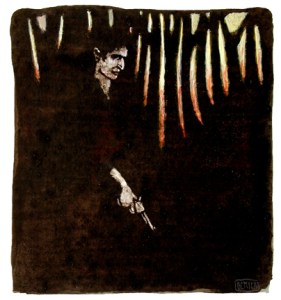
The accompanying painting is titled Confession and is from my Outlaws series. It’s hard to believe that it’s been over a decade since that group was painted. It was a relatively small and short lived series but I find myself going back to this group on a regular basis. Sometimes it’s just to look at the imagery and other times it’s to see how the narrative that I see in the image has changed over time.
There are pieces in the group where the narrative remains constant and others like this piece are a bit more ambiguous and open to new interpretations. This little painting always make me think.
Anyway, take look, give a listen and don’t worry if you think you’re going to Hell– there will be plenty of good company. Have a good day.
I am really busy today. I am working on a bigger piece that I started late yesterday. There are just a lot of things percolating and I really want to get at it this morning. I’ve been at this long enough that I know this is a time of which I need to take advantage.
The Muses come in fleeting moments and rarely, if ever, stick around for you if you don’t give them the attention and the time that they demand.
So while I go back to work I thought I would share a nice video of Edward Hopper landscapes and cityscapes set to music. The maker of the video didn’t credit the music but I was able to discover that it is a solo piano cover of Pink Floyd’s Wish You Were Here from musician Steven Garreda. It’s a really nice fit for the contemplative quiet of the Hoppers.
It’s a dark, damp day here that seems to sap the color out of the forest around the studio. All grays and browns and pale washed out greens.
It very much feels like the blues. The music, not the color.
I’ve got much to do today so I’m going to share a video that shows many of the works from one of my favorite painters, Charles Burchfield, set to the sound of one of my favorite Miles Davis songs, Blue in Green.
It’s a fitting song for a day like the one outside my studio windows.
You do not have to be good. You do not have to walk on your knees For a hundred miles through the desert, repenting. You only have to let the soft animal of your body love what it loves. Tell me about your despair, yours, and I will tell you mine. Meanwhile the world goes on. Meanwhile the sun and the clear pebbles of the rain are moving across the landscapes, over the prairies and the deep trees, the mountains and the rivers. Meanwhile the wild geese, high in the clean blue air, are heading home again. Whoever you are, no matter how lonely, the world offers itself to your imagination, calls to you like the wild geese, harsh and exciting — over and over announcing your place in the family of things.
—Mary Oliver
****************
A while back, a person interested in my work sent me the poem above, Wild Geese. It was written by the esteemed Pulitzer Prize winning poet Mary Oliver. This person wanted to know if I would be interested in translating this poem into into one of my paintings for them. I replied that when I had some time I would gladly do that as I think the poem strikes a chord that very much resonates in my work.
After a short while, this person contacted me again and said they had been looking at my work and had found a painting that they felt captured the spirit of the poem. The painting is the one shown at the top, The Singular Heart.
I was thrilled by the choice. It had the feeling and message of the poem without being absolutely literal. It’s exactly how I wanted to portray it. And the message and title of the painting fell perfectly in line with Oliver’s poem. The Red Tree stands, singular and alone, with the realization that it has a unique place, as does every being, in the family of things.
I told this person a bit about this painting and an experience I had with it that stuck with me. Once it hung in my home area gallery, the West End Gallery, and I met with a local college art class there. One of the questions was which of the pieces there was my favorite. I normally don’t answer that question because I have always felt that any painting that I decide to show has something unique to it, some quality that makes it special to me. Kind of like a parent with their kids.
But on this occasion I didn’t hesitate and pointed at this painting. I told them if I were to try to describe in one painting what I wanted to say with the body of my work and what I hoped for myself as a person, that this piece would summarize it perfectly.
I told this person that I felt it was perfect choice and was pleased when they chose this painting to represent the poem in their home. It means a lot when any painting finds a home but is even more special when I know that it resonates on many levels with its owner, that it goes deeper than the surface.
Here’s a clip of Mary Oliver reading her poem, Wild Geese:
This old photo I recently came across fascinates me. From 1937, it depicts a gas mask drill and the participants are the Pioneers of Leningrad. The Pioneers were a Soviet youth organization similar to the Boy Scout movement of the west. They learned skills related to civic and social cooperation with social gatherings and summer camps in order to create good, loyal Soviet citizens.
Beyond the obvious weirdness of the image, the photo carries the haunting thought that just four short years later many of these young people would most likely perish in the Siege of Leningrad.
For 900 days, the Nazis held Leningrad, which it had been unable to take by force, in siege attempting to starve the city into submission. Over a third of the city’s population- over 800,00 people– died during the Siege. Most died from the depths of starvation that found the citizens eating anything at their disposal– sawdust, wallpaper, and any and all pets.
It’s a horror that is hard for us, so far removed from that place and that war, to fathom yet it happened just a little over 70 years back. Some of those children in the photo, if they were fortunate to survive the war and the siege, could easily be alive today. I am sure when the photo was taken they felt strong and prepared to face whatever adversity lay ahead. They had no idea what the future truly held.
For today’s Sunday morning music I am using a song that relates in a way to the photo. It’s Red Army Blues from the Irish band The Waterboys‘ 1985 album, A Pagan Place.
The song tells the story of a Soviet soldier in WWII who somehow survives the war and comes in contact with American troops. Joseph Stalin felt that troops who were taken prisoner were weak and traitors to the Soviet state and that troops who came in contact with Allied troops were in danger of being Westernized. So after the war, many Red Army troops who had been held as POWs or had much contact with western troops were considered a threat to the state and were sent directly to the gulags where many would die while working and starving in forced labor camps. We’re talking in the millions here.
I bring up this dark page in history because of our current head of state’s recent warming up to Russia where Vladimir Putin has began reintroducing Stalin era thinking to that country. Time and fading memories have made the horrors that Stalin inflicted on his people somehow palatable. The gulags, the purges, and the artificial famines that killed millions of Soviets seem to be a distant memory now and there is actually a bit of nostalgia for Stalin. Hence, Putin’s rise.
But the memory of these things, these atrocities against his own people and humanity, should never be relinquished. If forgotten they are only a moment from becoming the present.
This is a pretty interesting video of Red Army Blues with a lot of great Soviet footage of that time which means that some of it is grisly and disturbing. Unfortunately, that is what much of our history entails. It’s worth a listen and a view.
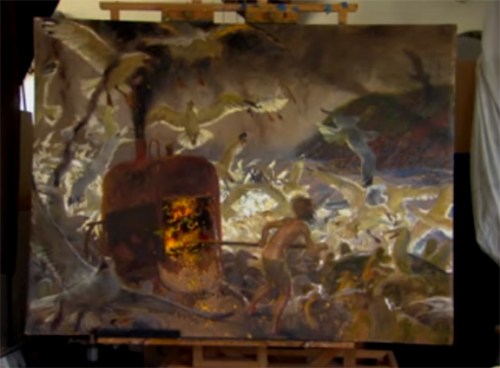
While I’m a much bigger fan of the work of his father and grandfather, Andrew and N.C. Wyeth respectively, I do like many paintings by Jamie Wyeth. I came across a video that shows him at work in his Monhegan Island studio on a painting titled Inferno which depicts gulls swarming around a boy as he stokes a trash fire that blazes in a burner made from an old fuel tank.
I was surprised, for instance, by his use of a large sheet of corrugated cardboard as his surface as well as by the way he uses watercolor paint in the same manner as an oil paint. Even if you don’t paint, the video is an interesting insight into the physicality of his process. And if you do paint, it may make you want to consider a different way of approaching your next piece. Give it a look.
I normally don’t replay past entries from the blog on Sundays but I thought this week I’d make an exception. I very much like this entry, written a few years back after the opening of one of my shows, and share it with a small alteration to the original post by changing the music from the original Hold On from the Alabama Shakes to their song You Ain’t Alone. Both songs are great and fit with the painting above, at least in my mind.
Sunday morning and I think I’m much more decompressed than yesterday morning after the show. All back to normal, whatever that is. This show has made me think on a wide variety of subjects, about purpose and meaning beyond what I see in the work as well the potential for legacy in these paintings– would they endure into the future?
A good friend stopped in the studio yesterday and we talked for a moment about the subject of legacy. I pointed out that legacy is a big if for any artist and that I can only do what I do — where it ends up in the future is something that is far beyond my own control. It could be in enduring collections or it could be in garage sales and dumpsters– you never know what the vagaries and tastes of the future hold. I witness this all of the time when I go through the records from the auction houses and see painters who were celebrated in their time who are now basically unknown. Their work sells for a pittance, far below what one might expect from reading about their fame when alive.
As an artist, you can only hope that your work has a transcendent quality that allows it to live out of the time of its creator and be of the time in which it is viewed. I don’t know how you do that outside of maintaining consistency in your own vision and hoping that it is one that somehow speaks to those in the future. But there is always the question that if your work does move ahead, does maintain life and attracts future collectors, what would your legacy work be?
I know that this a fool’s game– no one has the ability to predict that future for their own work. You can’t be objective when you are so close to it, can’t discern your own personal feelings for it from how it reads to the outer world. But there are pieces that I see that nag at me, that have a weight that tells me that they may be vital pieces in a potential legacy. Pieces that I could see easily living in the future. There are a number in the current show, including the piece above, Observers.
These pieces have an intangible quality that I wish I could more fully understand so that I could better describe it. Or capture in a way so that it would be in all of my work. There is just something that seems beyond me, something that is beyond this time.
Could I be wrong? Of course. I have been wrong many times in the past and will no doubt be wrong in the future. But for my work I can hope that in this instance I am correct and that they hold on.
Actually, this was all just an elaborate lead in for a little Sunday morning music , some soul stirring from the Alabama Shakes and lead singer Brittany Howard. It is a song titled, of course, You Ain’t Alone.
 I think I have seen this before but it caught my eye this morning. It’s a video of Turkish artist Garip Ay who works in the art of ebru, known to us as paper marbling. In this video he takes on Van Gogh’s Starry Night but that is only the start. What turns out in the end is a bit of a surprise although you may see it coming in the process. Just a neat video and a wonderful display of total craftmanship.
 Lately, when I have been very busy, I’ve been sharing some videos of artists’ work set to music. For example, I’ve shared videos of the works of Edward Hopper and Thomas Hart Benton in recent weeks. It’s always interesting to see artists work set to music, especially when they seem to complement one another.
 Last week I shared a couple of videos of the paintings of Edward Hopper set to music. I thought that I’d do the same this week for the work of another of my favorites, the great American Regionalist painter Thomas Hart Benton.
 Another Sunday morning which means it’s time for a little music. I thought that for this week’s choice I would go with something a little further off the beaten track, going all the way up to Regina, Saskatchewan to grab this tune from the group
  I am really busy today. I am working on a bigger piece that I started late yesterday. There are just a lot of things percolating and I really want to get at it this morning. I’ve been at this long enough that I know this is a time of which I need to take advantage.
 It’s a dark, damp day here that seems to sap the color out of the forest around the studio. All grays and browns and pale washed out greens.
 You do not have to be good.
 This old photo I recently came across fascinates me. From 1937, it depicts a gas mask drill and the participants are the Pioneers of Leningrad. The Pioneers were a Soviet youth organization similar to the Boy Scout movement of the west. They learned skills related to civic and social cooperation with social gatherings and summer camps in order to create good, loyal Soviet citizens.
 While I’m a much bigger fan of the work of his father and grandfather, Andrew and N.C. Wyeth respectively, I do like many paintings by Jamie Wyeth. I came across a video that shows him at work in his Monhegan Island studio on a painting titled Inferno which depicts gulls swarming around a boy as he stokes a trash fire that blazes in a burner made from an old fuel tank.
 Redtree Times