Feeds:
Posts
Comments

Conscience, Again

Been thinking about what drives people to extremism, about how seemingly normal people can take on attitudes and perform actions that seem completely out of character for them. The kind of thing we’ve seen in recent years here where people retreat into online venues that echo back their fears and prejudices in a way that magnifies them beyond all reality. That online virtual world of fear and hatred eventually finds its way out into the real world and an extremist mob is formed. Such was the case on January 6.

This all reminds me of a post from back in 2009 that I reran in 2017. It seemed like a good time to run it again. It features Henry Fonda who, for me, is the voice of the American conscience on film. His characters in Young Mr. Lincoln, The Grapes of Wrath, 12 Angry Men, My Darling Clementine, Mr. Roberts and the film featured below, The Oxbow Incident, were men of character, principle, and great conscience.

They tried to do what was right even when it went against the mob. Even when its futile.

I urge you to watch the short clip from the film. It speaks volumes. Then and now.


The Oxbow IncidentI don’t like crowds.

Maybe it’s just some sort of neurosis like agoraphobia or maybe it’s just having developed a sense of uneasiness from seeing how individual people could react differently after becoming part of a group.

It always confounded me from an early age how the dynamics of a group could change the behavior of an individual person, bringing out characteristics that might be undetected in one-to-one interactions. It’s as though the protection of the group brings out extreme attitudes that would otherwise be stifled. The whole moral compass is pushed further from the center and whatever sense of conscience that is present becomes diluted.

I was reminded of this feeling when I saw a short film about the actor Henry Fonda that talked of the parallels between his character’s experience  in the movie The Oxbow Incident , where his character was the lone voice of reason against a mob that lynches three men without evidence of their guilt and those of a being witness to a horrific episode as youth in Nebraska.

As a 14 year-old boy in Omaha, Nebraska in 1919, he witnessed a mob storm the courthouse that was located across the street from his father’s printing business. They  were inflamed by allegations made by a white woman that she had been assaulted by a black man. A suspect had been taken into custody and was in the courthouse. The mob, whose size was estimated to be between 5000 and 15000 people, exchanged gunfire with police in which two of the mob were killed.

The mayor of Omaha tried to intervene  and was beaten and himself lynched before being saved. The suspect was not so lucky.

The accounts of this mob rule are horrific. Fonda carried this memory with him for the rest of his life and it informed many of the roles he had over his career. In The Oxbow Incident his character confronts the lynch mob afterward in a bar and reads them a letter written by one of the hanged men to his wife.  I could go on and on but I think the clip says it all…


Ingersoll and Napoleon

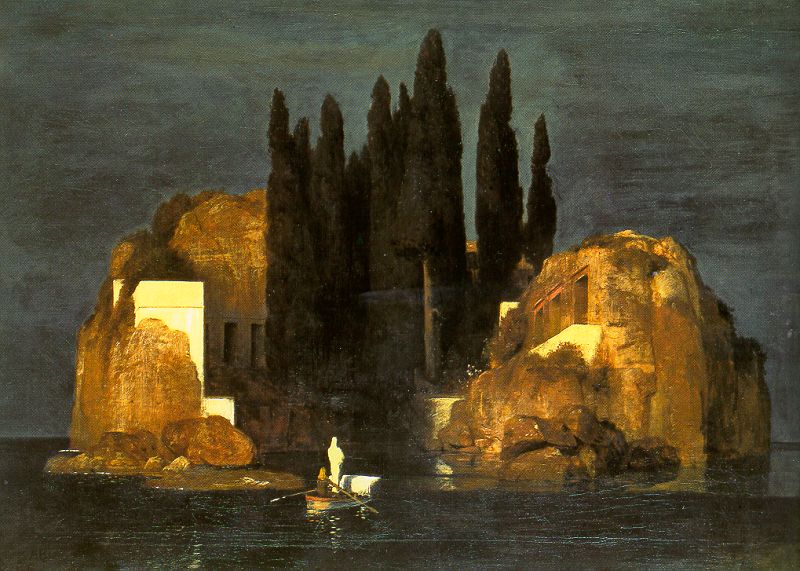
Arnold Bocklin- Isle of the Dead


I was working in the studio yesterday with the television on in the background. Born Yesterday, the 1950 film that featured the Academy Award winning, tour-de-force performance of Judy Holliday as a ditzy mobster girl friend who discovers she has a brain was playing. It’s a great film to work by, easy to follow without watching closely thanks to great writing from Garson Kanin and the very distinct voices of its main  characters– Holliday’s snorts, squeaks, and honks, Broderick Crawford‘s rough barks and William Holden‘s smooth, educated eloquence.

I have seen the film several times over the years but had missed, or at least overlooked, one part that jumped out at me yesterday. It was  scene where Holden, who is a journalist paid to educate Holliday so that she can better mingle with the DC power crowd that mobster Crawford is looking to buy into, recites a portion of a famous essay from orator Robert G. Ingersoll. This caught my ear this time because I have recently become aware of Ingersoll and have wrote about his once celebrated but now fairly forgotten life here, back in September.

Ingersoll interested me because, for one thing, his childhood home and a museum dedicated to his life is not too far from me. Once this pandemic is in the rearview I look forward to visiting it. But I am also interested in people who are widely celebrated and have great influence in their own time but seem to fall into the darkness with each new generation. Ingersoll certainly falls into that category.

This particular essay, After Visiting the Tomb of Napoleon, was wildly popular in its time. It was written in 1882 and was recorded via the new technology of voice recording– invented by Thomas Edison, a big Ingersoll fan– by Ingersoll himself and other famed public speakers. It was sold on gramophone recordings so that families could hear the words of Ingersoll in their homes, a wild concept at the time.

It goes a s follows:


After Visiting the Tomb of Napoleon
by Robert G. Ingersoll, 1882

A little while ago I stood by the grave of Napoleon, a magnificent tomb of gilt and gold, fit almost for a dead deity, and gazed upon the sarcophagus of black Egyptian marble where rests at last the ashes of the restless man. I leaned over the balustrade and thought about the career of the greatest soldier of the modern world.

I saw him walking upon the banks of the Seine contemplating suicide; I saw him at Toulon; I saw him putting down the mob in the streets of Paris; I saw him at the head of the army of Italy; I saw him crossing the bridge at Lodi with the tricolor in his hand; I saw him in Egypt in the shadows of the pyramids; I saw him conquer the Alps and mingle the eagles of France with the eagles of the crags. I saw him at Marengo, at Ulm and Austerlitz. I saw him in Russia, where the infantry of the snow and the cavalry of the wild blast scattered his legions like winter’s withered leaves. I saw him at Leipsic in defeat and disaster, driven by a million bayonets back upon Paris, clutched like a wild beast, banished to Elba. I saw him escape and retake an Empire by the force of his genius. I saw him upon the frightful field of Waterloo, when chance and fate combined to wreck the fortunes of their former king. And I saw him at St. Helena, with his hands crossed behind him, gazing out upon the sad and solemn sea.

I thought of the orphans and widows he had made; of the tears that had been shed for his glory and of the only woman who had ever loved him pushed from his heart by the cold hand of ambition.

And I said I would rather have been a French peasant and worn wooden shoes. I would rather have lived in a hut with a vine growing over the door and the grapes growing purple in the kisses of the autumn sun. I would rather have been that poor peasant with my loving wife by my side, knitting as the day died out of the sky, with my children upon my knee and their arms about me. I would rather have been that man and gone down to the tongueless silence of the dreamless dust than to have been that imperial impersonation of force and murder known as Napoleon the Great.

And so I would ten thousand times.


The essay talks of visiting Napoleon’s grave and recalling all the highpoints of his celebrated life. But after taking it in, including all the human suffering that took place due to this man, Ingersoll decides that he would rather live the life of a French peasant that lived a poor life but one that had love and family in it.

Hearing and reading this brought two things to mind. The first was a conversation I had while walking down King Street in Alexandria with another artist, many years ago now. This artist was much more celebrated than me, his work selling for much higher sums than mine which made it appealing to those in power, both in government and in the corporate world. He rubbed elbows with that crowd much more than I. As we walked, he talked about the proximity to power there in Alexandria, how you could almost feel it in the atmosphere.

He asked if being that close to it made me wish that I could access that kind of power. I didn’t even think a bit about it, answering no immediately. I knew that I was an artist for just that reason, that I didn’t want to feel the weight of responsibility that I knew I would take on in such a position. If I were to change people’s lives it would have to come on my terms, as a gentle influence and not with the power of force and will that has the potential for death and destruction in the lives of others.

To the best of my knowledge, my painting has never killed anyone nor caused anyone to lose their homes or livelihood. That sounds like a goofy thing to say but it has great comfort for me. I already worry about so much that to add the wellbeing of a whole constituency would be a burden I couldn’t bear. 

My answer surprised my companion who seemed much more open to the idea of having power. This morning, this memory along with the Ingersoll essay made me think about the 500,000 Americans who have died in the past year due to covid-19. It’s a figure that is most likely at least 10% higher when you consider excess mortality figures and take into the fact that the mitigation efforts put in place for covid-19 have more or less eradicated deaths normally seen from the seasonal flu.

But even if the figure is right, half a million folks dead and half a million families affected is a sobering thing. To be somehow responsible for even a portion of those lives would be a burden I certainly would not want to bear. I think of the former president** and his administration’s laissez-faire response and it rings a bell similar to those lines from Ingersoll. To have such a thing take place under one’s watch and to only selfishly concern yourself about one’s own desires– the cold hand of ambition as Ingersoll called it– would be Napoleonic, to say it one way.

Criminally cruel and negligent is another way.

No, I wouldn’t want the life of Napoleon or our former president. I would rather gladly live the life of a French peasant with wooden shoes. Or a simple artist painting away as the snow fell outside his studio  in the woods. 

And I would ten thousand times.

Have a good day in whatever position you are.


Texas


Austin Texas February 2021


There could be only one result . . . If men insisted on being free from the burden of a life that was self-dependent and also responsible for the common good, they would cease to be free at all. Responsibility was the price every man must pay for freedom. It was to be had on no other terms.

Edith Hamilton, The Echo of Greece [1957]


I was looking for a song to play for this week’s Sunday Morning Music and I stumbled across a Chris Rea song from the 1980’s, from an album of his that I listened to quite often back in the day. I searched the blog’s archives to make sure I hadn’t played it before or too recently.

I found that the last time I used a Chris Rea song here was last April. It was the title song, The Road to Hell, and it was used in a blog post about how people were using the word freedom in those early days of the pandemic as an excuse for refusing to accept any responsibility or accountability to their fellow citizens. For example, their right to get their hair cut–or wear a mask, god forbid!– was greater than any responsibility they held for the safety and welfare of those folks that they came in touch with.

In that post I employed some quotes from the late Classicist scholar/mythologist Edith Hamilton that described the lack of responsibility and accountability that marked the downfall of the Athenian empire. There was the quote at the top along with this:

When the freedom they wished for most was freedom from responsibility, then Athens ceased to be free and was never free again.

Her words really struck me last April in that it was the same shirking of duty and responsibility that we have been experiencing here in recent times, a trend that really stood out during our time of greatest need. People wanted to say they were free but only with the implication that it meant that they were free from all, responsibility, accountability, empathy, or conscience. 

That might be some sort of libertarian wet dream but that ain’t freedom, folks. At least, not for a country as wide and as varied as we are.

I’ve said it before: Freedom ain’t free.

Reading this blog post from last year reminded me of the situation that has been taking place in Texas. Now, I don’t claim to know all the intricacies of Texas power ( or political power) system so I can’t really make any informed commentary but it sure seems like what took place in recent times there pretty much lined up with Edith Hamilton’s words.

Put plainly, people entrusted to provide necessary services grabbed all the cash they could while doing as little as possible to maintain or improve the system or to accept any sort of personal responsibility for the citizenry they served.

The privatized power system was a cash cow that was there to be milked until it fell over and died. Then they thought they could simply walk away, buckets of cash in hand.

That’s how it looks to me but like I said, I don’t jack about what really goes on down there. But privatizing something so important as the power system without having a mechanism for accountability seems like a recipe for disaster. And this disaster, while labeled as a natural disaster, was more of a man-made disaster, one of great negligence.

I don’t think this is the same sort of freedom that Texans think they were told that this would provide.

End of commentary. Well, close to the end.

Anyway, this post reminded me of another Chris Rea from that same album, a song called Texas. It’s about a guy in, I Believe, Ireland who dreams of Texas, fantasizing about its size and wide open spaces. He sees it as a place of escape. A place where a man can be free. 

Hopefully, his idea of being free is not the same sort of freedom that we’re seeing come to fore at the present. 

Anyway, here’s the song Texas set to a wonderful slideshow of the natural beauty and wonders that make Texas an exceptional place. That exceptional is code for one of my Texas friends. He’ll get it. 

To my friends in Texas, glad to see the cold weather moving past you now. Now comes the hard work of cleaning up and restoring some sense of normalcy. Let’s work on our empathy and our responsibility to those around us so that we can all weather the next storm.

 After all, freedom ain’t free, my friends. Have a good day.


“Memoir” – At the West End Gallery


As machines become more and more efficient and perfect, so it will become clear that imperfection is the greatness of man.

—Ernst Fischer 


I’ve wondered about the concept of perfection for some time, given the way some folks are always going on about it and seeking it.

Not me, of course. Quite some time back, I came to that conclusion that perfection is not a human quality, that we are defined by our imperfections and how we cope with them. How we adapt and compensate for all the area in which we are lacking.

And that’s somewhat what the quote above says, as I read it.

When I read it, it struck me at once but I had never heard of the writer, Ernst Fischer.  Looking him up, I found him to be an Austrian Marxist writer/journalist born in 1899 who waved the banner for Stalinist policies for many years but in his later years– he died in 1972– Fischer came to regret his past. His memoir of his life began with a chapter that was titled Was That Me?, indicating his astonishment at looking back and seeing the many phases and changes he went through in his life.

I think most of us could start our own memoirs with that same first chapter title.

I know I could, even though I feel that I am very much the same at the core now as I was in my earlier days. However, my actions were not always consistent with that core and didn’t really reflect well on me. I did some things that were–how should I put this?— less than perfect. I was then, and am now, a walking exhibition of flaws, imperfections.

As are we all. At least, that applies to everyone I know.

Maybe it’s when we recognize what sort of person we want to be that we begin to alter and align our actions to what we are at our core. Then life becomes somewhat easier to swallow and our imperfections become less evident, not worn on our sleeves for all to see.

I’m not talking about trying to acquire perfection. No, I mean that we just try to recognize the flaws that make up each of us and to accept them. Life is in toleration- of others as well as of ourselves. And in adapting to and overcoming our shortcomings.

Please bear with me here. One of the negative aspects of doing a daily blog is that I often post things as though I were writing them in a journal, unedited and just as they fall out of the mind. They are not always fully realized thoughts or ideas and will soon be questioned in my own mind.

It’s like reading an old journal written when much younger and wondering, “What was I thinking there?” or, echoing Fischer, “Was that me?”

You hope that, as we age and gain experience, that this is a less frequent happening in our lives.  But writing in this public forum, forcing out words each day, it sometimes reappears. One’s imperfections become apparent.

Phew!  I don’t know what I just said here and I don’t really want to reread it so I’ll let it hang out there for now, flawed though it may be. Someday in the near or distant future I just know I’ll read it and ask myself, “Was that me?”


This post first ran back in 2010. Some things never change.

My Barbaric Yawp


I too am not a bit tamed,
I too am untranslatable,
I sound my barbaric yawp
over the roofs of the world.

Walt Whitman, Song of Myself


I finished this smaller piece the other day (it is headed to the West End Gallery today) and with the Red Tree appearing to hover above the Red Roofs both near and far, all I could think of were the lines above from Uncle Walt. That’s Walt Whitman, actually, but I always think of him in familial terms not that he was anything at all like my own uncles.

These lines from Song of Myself have rang in my ears for decades and are at the core of my desire to paint and in the formation of my voice as an artist.

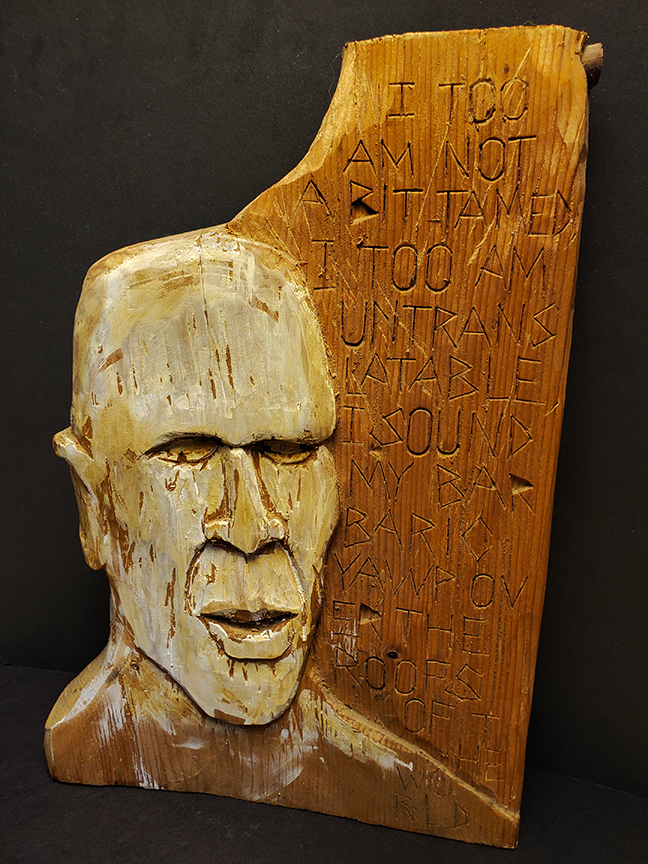
Before I even thought of beginning to paint, I tried my hand at wood carving. I did a number of bas-relief carvings that were fairly crude in a folksy kind of way. I was untrained and just went at it, much as I did later on with my painting. I believe that the painting worked out much better but the carving had a part to play for me at the time.

One of the first things I carved was a rough-hewn face with the four lines– poorly executed– from Whitman next to it. It was nothing to write home about, carved as it was from the end of an old 2×12 pine board. I am not particularly proud of it as a piece of art but it has great meaning to me and stays near me in the studio.

I have described what these words have meant to me in the past like this:

…the four lines above have been a guiding beacon for me throughout the past 25 years as I have tried to be an artist. These words instructed me to be only myself, to openly and boldly express my feelings without fear or shame. To not hide my scars, my fears or my weaknesses because they are part of my wholeness and keep me in balance. To not be underestimated or devalued by myself or anyone else. To claim a foothold in this world and bellow out the proof of my existence in my own voice:

Here I am.

There are paintings that I do that are meant to represent this thought, paintings that are meant to be plainly expressions of that Here I am. I consider them icons in my body of work, pieces that fully represent my work and what I want from it. This painting definitely falls in that category. It’s simply put but not a simple expression.

When I look at this painting I personally see myself and all my hopes and aspirations, all that I am or desire to be.

What I hope for this painting is that someone else sees that same here I am in it for themselves, that they see in it those things that make them a whole and perfectly imperfect person with a place in this world and a voice that demands to be heard.

Is that asking too much?

I immediately thought looking at this new painting that it fit into this category, that the Red Tree here represented my own need to let out my barbaric yawp, to announce my existence in this world. I am calling it I Sound My Barbaric Yawp.

It might not be quite as roughly finished as the carving but the yawp is the same.

Sound your own yawp in the world today. Have a good one.

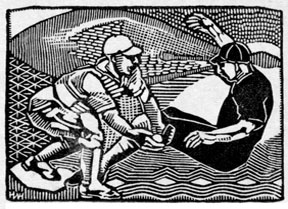
Aah, The Game Returns


I’m helplessly and permanently a Red Sox fan. It was like first love…You never forget. It’s special. It’s the first time I saw a ballpark. I’d thought nothing would ever replace cricket. Wow! Fenway Park at 7 o’clock in the evening. Oh, just, magic beyond magic: never got over that.

― Simon Schama


Maybe it takes the words of an esteemed British historian like Simon Schama to best describe the grand attraction of a ballpark when first seen in the waning light of the day, with the lights making the green grass and bright white chalk lines of the field pop into your eyes. I remember that feeling at Shea Stadium in the late 60’s, going up the darkened ramp from the concourse to the stands, emerging into a burst of deep colors and lights along with the buzz of the crowd increasing with each step forward.

It was magic beyond magic.

Baseball is back this week, with Spring Training beginning. For me, baseball is the canary in the coalmine. It felt odd and out of place last year with a raging pandemic and the country ripped apart by culture wars and the political apocalypse of an election that felt as existential as any we have had in recent times. Baseball was still there in a weird bubble that took away much of what made it important as a cultural touchstone.

It felt sporadic and detached.

Like most of us.

But it is coming back, as it always has each February, and with it comes the hope that we are nearing a point where we can sometime soon return to a form of normalcy. Where kids can experience that burst of color and light for themselves, can root loudly for slick fielding infielders and hard hitting sluggers. Where old farts like me can revel in the cyclical nature and routine of the game along with its esoteric details, its poetry, and its history. That

Author Michael Chabon, in his book Summerland, put words to my own feelings the game and how it echoes and rhymes with day to day life:

 The first and last duty of the lover of the game of baseball,” Peavine’s book began, “whether in the stands or on the field, is the same as that of the lover of life itself: to pay attention to it.

I have had trouble immersing myself in spectator sports this past year with all that is happening. But the start of Spring Training offers renewed hope. And that hope is a big part of the game. While personal glory and team victory are the goal, baseball is a game about how one copes with failure. It is a game of humility. The greatest players of all time failed more than they succeeded and most players go through their careers without winning the World Series. 

The hope is that if you give it your best effort, this pitch might be the big pitch or this catch will be the big catch. This hit might be the big hit.

This year might be the year.

It is a grand metaphor for the hardship and grace of life that repeats itself 162 times a year. Like life, it offers us everything if only we pay attention.

Pay attention and have a good day.

Here’s a favorite baseball tune from Mabel Scott to kick off the season:


Calling Me Home


“Everyone must leave something behind when he dies, my grandfather said. A child or a book or a painting or a house or a wall built or a pair of shoes made. Or a garden planted. Something your hand touched some way so your soul has somewhere to go when you die, and when people look at that tree or that flower you planted, you’re there.

It doesn’t matter what you do, he said, so long as you change something from the way it was before you touched it into something that’s like you after you take your hands away. The difference between the man who just cuts lawns and a real gardener is in the touching, he said. The lawn-cutter might just as well not have been there at all; the gardener will be there a lifetime.”

― Ray Bradbury, Fahrenheit 451


I recently finished this small piece shown above, a little guy that’s only 2″ by 4″ on paper. I wasn’t — and am not yet– exactly sure what meaning it holds for me, what message, if any, it carries. It certainly felt like it had something to offer.

It might be small but it seemed like it was speaking with a much larger voice. I was mulling this over this morning when I heard a new song, Calling Me Home, from one of my big favorites, Rhiannon Giddens. It’s from a new album coming out in April. There’s a line in the song that immediately struck me:

Remember my stories, remember my songs/ I leave them on earth, sweet traces of gold

It made me think of that existential question: What is it we leave behind?

That immediately brought to mind a favorite excerpt, shown at the top, from Ray Bradbury in his sci-fi/ dystopian classic Fahrenheit 451. It’s those things to which we devote or full effort, our mind and time, that have lasting effect. Often, things that are done with no real expectation of anyone recognizing your thought or effort in doing them.

It makes me think of my pond. I can see its top now in the winter since the leaves have fallen from the trees. I built it back in the summer of 1998 during a week spent pounding the hard pan soil beneath the clay of my property on a rented Cat D9 dozer. I am not sure my brain has come to rest yet from that beating. But the thrill of seeing it fill in the rains later that summer and fall along with the many life forms that soon made it their home were as satisfying as anything I have painted. I often look at it and think that it will be here long after I am gone, supporting lives of creatures that will have no knowledge of my efforts.  

And that pleases me greatly. Even as much as any legacy my work here in the studio, if any, will have.

I think I will call this little painting Calling Me Home. Not sure it’s absolutely the title others will see but if fits for me this morning.

Here’s the song from Ms. Giddens. have a good day, 


Big Foot Stomp, Again

To tell the truth, I had nothing in mind this morning for the blog. I was thinking that I would be too busy plowing but we didn’t get nearly as much of a snowfall as had been anticipated. We got a few inches but most of the precipitation came in an icy rain that coated everything. Not terrible, at least at my place, like some of the scenes I have seen from where the storm dropped larger amounts of icy rain that brought down wires and trees.

So, not having to get out there early to plow I found myself wondering what to talk about this morning. I went back through the archives and came across an entry from over ten years back. It’s about a piece that is in the possession of my sister. It might be my favorite among several she has , one that I always look forward to seeing when I visit her. With the pandemic, there haven’t been any visits so I haven’t had a chance to visit this piece recently. So, I thought I ‘d share it along with a little music at the end that seems to fit, at least in my head, some of the great Son House playing his wonderful Delta blues. Take a look at Big Foot Stomp, painted around 1995. And have a good day.


Singing and Mending– Robert Gwathmey


I was looking through a book containing many of the works of the painter Robert Gwathmey when I came across an image that reminded me of a small piece that I had painted several years back. Gwathmey’s painting was titled Singing and Mending and featured, like many of his paintings, a depiction of African-American life from the rural South.

This piece had a man in overalls playing a guitar while a woman mended a piece of clothing. It was the man playing the guitar that caught my eye. Perhaps it was the overalls or the position of the guitar or the bare feet but all I could think of was a similarity in its nature to a small painting that I had painted a few years ago and which now hung on my sister’s wall. It is a little oddity, a favorite that I always look at with interest whenever I go to her place. I call it Big Foot Stomp.


It was an experimental piece, a revisiting of another earlier foray in paint when I was just starting  years before. I can’t quite recall what my initial intentions were with this piece. I remember that I laid down the splattered background with spray bottles of paint, masking the lighter center with a piece of matboard as I did the darker outer edge. But I don’t think I ever had this figure in  mind when I began to paint in that center. But I’m glad that he came out in this way.

I recall painting the head first, just laying down a silhouette of paint then trying to make something from it. I remember liking the way the dark paint seemed to pop from the lighter background, making me think this was a black man and that I wouldn’t lighten it any more. It was right as it was.

The rest is hazy in my memory except for a slip in my brushstrokes that affected the size of his feet and for the decision to leave out the parts of his clothing that would normally be visible. For me, these two elements really make this little guy special. There’s something about the white space where his clothing would be that brings a spiritual element to this piece for me, as though his playing and the rhythm of his large feet on the floor are taking him to a place beyond the here and now. I think the way he rests in the splattered background enhances this.

I’ve never painted another piece like this. Maybe he was just meant to be one of a kind. He certainly feels that way. But at least in the Gwathmey piece I have found a spiritual relative to this lone guitar player.


Here’s Son House (1902-1988) and his Levee Camp Blues. House influence on the blues and, by extension, rock music, is huge. He is often cited as an influence on two other giant influencers, Muddy Waters and Robert Johnson. It don’t get much more real than that.


The Unique and Only You


“There is a vitality, a life force, an energy, a quickening that is translated through you into action, and because there is only one of you in all time, this expression is unique. And if you block it, it will never exist through any other medium and will be lost.”

― Martha Graham


I was thinking about a recent comment on social media below one of my paintings where the commenter said that the piece made this person feel as though they were wasting their time with their own painting. They added that this wouldn’t stop them from continuing to paint.

I can’t tell you how relieved I was at that. While I gladly accepted the implied compliment of the first part of the comment I was mortified by the idea that someone would not continue painting because of my work.

And this was mainly because I had been at that same point early on, when as a novice painter I would look at artists whose work was fully realized, who through hard work had found their own style and voice. At that point, in comparison to the famed artists whose careers were full and complete, I felt inferior and dejected, thinking that maybe this wasn’t the path for me after all.

Maybe I should give it up and try another path or just give up altogether.

But I had a thought in my head very similar to the words at the top from the late dancer/choreographer Martha Graham. I truly believed that I had something inside me that needed expression and since there was only one of me in this world, whatever came out, good or bad, would be uniquely mine. At that point, I wasn’t thinking about selling my work or galleries or a lifelong career. It was just about getting the inner thing that was distinctly mine out into the world, if only to say, “Like it or not, here I am.

I believed then and now that we are all distinct creatures. We are all unique endpoints of evolution, ancestry, and experience. Even those people with almost identical evolution and ancestry often have widely varying experiential differences and influences. I see this with my own brother and sister.

Nobody has your exact pedigree. Nobody has your exact life experiences. Nobody has your exact way of seeing and feeling.

You are the unique and only you.

Your expression has meaning. It may not be pleasing to everyone or may not speak to all but it is yours alone.

This thought sustained me early on and it still does. I sometimes look at what I do and am deeply unsatisfied, thinking that I will never be at the point of which I think I am capable, never reach the endpoint I have formed in my mind. I see nothing but flaws and inadequacies at that moment.

But then I think, “This is me. For better or worse, nobody else could have done this.

The endpoint doesn’t matter. It’s simply taking the journey that counts.

You don’t have to be perfect. You don’t have to be the best. You have to just try to show what you truly are– the unique and only you. Let the world know it.

And have a good day doing so.


Scarecrow


If you only had brain in your head you would be as good as man as any of them, and a better man than some of them. Brains are the only things worth having in this world, no matter whether one is a crow or a man. 

― L. Frank Baum, The Wizard of Oz


Watched the end of the impeachment trial yesterday. Sad day for this country and for every American as the former president* was acquitted.

Acquitted but not exonerated in any way.

It was actually more of an embarrassing day for republican voters who see themselves as being American first then republican. I believe there are a few still remaining out there. These folks witnessed and understood the criminality– which their party leader readily admitted was present in the words and actions of the president– that put our democracy in peril, knew that it went against everything that our country once claimed as virtues.  But they saw the majority of their craven senators say that it didn’t matter, that their partisanship and short term self-interest was more important than doing what was right for the future of our nation.

These senators seem intent on following the road to disgrace to its bitter end.

Their votes to acquit made this political in a proceeding that, at its heart, was not apolitical. It was necessary and for the majority party to have not went down this path would have been betraying their sworn oaths to the Constitution and to the future generations of this country. The House Managers laid out a compelling and convincing evidentiary argument that won the day.

57-43 is a victory in a way. It was an acquittal but, as I said, not an exoneration. No innocence was implied or proven. The majority of the country recognizes and approves of the guilt attached to this vote. I say majority because the 57 senators who voted to convict represent 76.7 MILLION MORE Americans than the 43 dissenting senators.

The people know. 

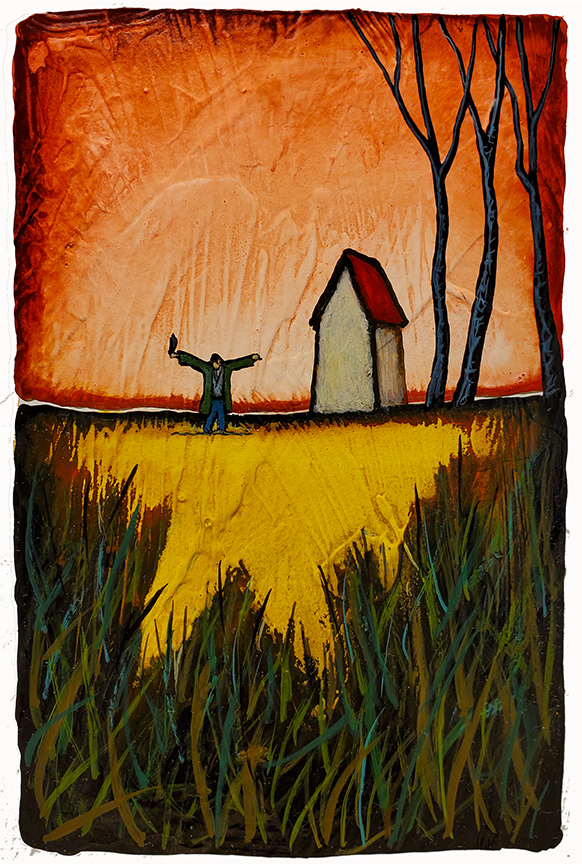
Let’s move on now to the Sunday morning music for this week. I was working on the small painting at the top the page yesterday while listening to the impeachment proceedings. I don’t know what made the idea of a person standing in the field as scarecrow come to mind but it appeared around the time the voting was taking place. I can’t quite put my finger on the feeling I get from it or its origin but it seemed to fit the moment.

Maybe it cam from the quote at the top from L. Frank Baum’s Wizard of Oz? If they only had a brain…

The piece itself reminded me of the old John Cougar Mellencamp song, Rain on the Scarecrow, from 1985. He started his career with the cheesy stage name of Johnny Cougar before attaching his actual Mellencamp last name and eventually getting rid of the Cougar altogether.

In 1985, he was still John Cougar Mellencamp. He had a great trio of albums in the late 1980’s starting with this album, Scarecrow, followed by The Lonesome Jubilee and Big Daddy. They were all strong. complete albums. This song has been a favorite from when I first heard it back then. I also want to note that John Mellencamp is a talented painter as well.

But here’s Rain on the Scarecrow to go along with the new piece at the top which is simply called Scarecrow.

Be careful out there and have a good day.