Feeds:
Posts
Comments

Another Look

“Keep Your Distance’– Now at the Principle Gallery, Alexandria, VA


If I cross your path again,
Who knows where,
Who knows when
On some morning without number,
On some highway without end
Don’t grasp my hand and say
“Fate has brought you here today”
Oh fate is only fooling with us, friend

–Richard Thompson, Keep Your Distance


Yesterday was a good day in that the first covid-19 vaccine hit the streets. A glimmer of light at the end of this tunnel, but we still got some distance to cover before we get out of it. It is important that we don’t relax and begin to think that the answer is here , that we’re all suddenly safe. It will be months, possibly 6 or 8 months, before the vaccine has hit enough people to begin to think we’re in the clear.

And in that time there is still peril. So, we must keep doing whatever we can to mitigate the risk. And that mainly comes from wearing masks and keeping your distance. It may not be convenient or to our liking but it’s not too much to ask, in the big scheme of things. Let’s do it for a little longer and not drop our guard when the end may be in sight.

In this spirit, I thought I would revisit a painting is currently at the Principle Gallery in Alexandria. I first showed it here the morning after I completed it, on the day March when the reality of the pandemic hit and everything began to shut down. Not more than an hour or two after I ran a blog entry about this painting, I visited my dad for what would end up being the final time before his nursing facility shut down. 

The painting is called Keep Your Distance and is an homage of sorts to my earlier work, especially that from around 1997 to 2001. It was in that timeframe that the Red Tree first emerged and my compositions often revolved around a solid block of color dominating the foreground separated by a thin line of unpainted surface  from a large sky. It is a simple composition that whose depth and emotion is modulated within its color, texture, and the subtle positioning and interrelationship of its forms.

Sometimes, it is the simplest compositions that I believe display the truest emotions and the greatest depths. But it takes emotional commitment to instilling those things within few forms that make up a simple composition. Even the seemingly empty parts of the composition have to carry some emotional value.

In other words, simple ain’t always so simple.

And I think that is what I like so much about this piece. It speaks reams of meaning to me without hiding it behind excess detail. It wants to be read, to be heard, to pass on whatever individual message it holds for the viewer. 

I named it Keep Your Distance. We were just learning the intimate details of the virus and the idea of social distancing was taking hold. This piece had a feeling of distance and isolation within it so it felt right. Actually, it’s a title that I may have used without the events of the time.

The title comes from a favorite Richard Thompson song of the same name. I have played that song here several times over the years but I thought today I’d play a cover I hadn’t heard until this morning. It’s from country artist Patty Loveless. Though traditional country music is in my wheelhouse, I  am not a huge modern country music fan. But I have a lot of respect for Patty Loveless.

I saw her perform back January of 2002 at Radio City Music Hall when she was part of the Down From the Mountain tour that came out of the film O Brother Where Art Thou? It was just months after the attacks of 9/11, another time of crisis in this country, and I remember how strangely quiet the city was at that time. Traffic was light and car horns were almost nonexistent. It felt like a bizarro world version of NYC. I remember having the doorman at the hotel sincerely thanking us for staying there as it was pretty lightly occupied.

But it was a great show and Patty Loveless did herself proud. Around that time, she had released an album called Mountain Soul that was a return to her traditional mountain music roots which melded well with the rest of the artists on that bill. I came away really impressed with her voice and her stage presence. So, I was pleased when I came across this version of a favorite song. It’s a little more countrified than the original but, like all great songs, it works in many genres.

Give a listen and have a great day. But remember to keep your distance, okay?


Gaudete, Revisited

Felt like some real seasonal music that went beyond the typical radio fare this morning. This took me back to a post from several years back that features one of my favorite Bruegel paintings. Win-win. Take a look and have a good day.


Bruegel, Pieter the Elder- Hunters in the Snow (Winter) 1565


I was looking for a medieval image of a scene in snow that would fit a piece of medieval seasonal music. In this instance, or most any other for that matter, you can’t go wrong with a painting from Pieter Bruegel the Elder. The Flemish painter, who lived from around 1525 until 1569, has long been a favorite of mine with the gorgeous colors of his peasant scenes as well as their elaborate and harmonious composition.

This is one of the more famous of the 45 or so known remaining paintings from Bruegel, titled The Hunters in the Snow from 1565. The contrasting darkness of the trees and the hunting party against the lightness of the snow and the atmosphere just make this piece memorable for me. It is of its time but it feels as though you could step into it, be part of it.

The piece of music I wanted this to accompany is Gaudete, a well known piece that comes from the 16th century which means that it, like the Bruegel painting, are not really medieval since that period ended with the 15th century. But both feel as though they have that medieval feel and, besides, Gaudete is based on truly medieval Latin lyrics. The song is a Christmas carol that opens with the line Gaudete, gaudete! Christus est natus which translates to Rejoice, rejoice! Christ is born. Gaudete is Latin for rejoice. While I do not practice any particular religion, this is a beautiful piece of music and a wonderful expression of the meaning of the season.  

There are all sorts of performances of this song out there. Steeleye Span, the British folk/rock group, had a minor hit in the UK with this song in the 1970’s, and it has been performed by many choral groups. I like the version below from Choir of Clare College Cambridge and London Cello Orchestra. It’s probably the drum backing that does it for me but regardless, it’s still a wonderful recording.

Anyway, give a listen and have a fine day out there.


Skating


Hey, A Charlie Brown Christmas is on PBS tonight!

I grew up with this seasonal special from Charles Schulz and his beloved band of characters who felt like childhood companions. Its soundtrack from Vince Guaraldi has become part of the genetic makeup of generations of kids and for many such as myself there’s a visceral response upon hearing any of the compositions from it.

One of my favorites is Skating with its bright, cool, and clean lines. It both evokes memory from the past and feeling in the present moment, gliding seamlessly between the two. Maybe that’s the mark of a timeless piece of art?

I don’t know.

So, for this Sunday morning music, let’s give a listen to Skating from Vince Guaraldi. Can’t think of a better way to skim into the day. Have a good one.


Scene from “A Matter of Life and Death”


Taking a small break this morning without mentioning the Supreme Court decision from yesterday, which speaks for itself. But I did want to mention that TCM is playing a favorite movie of mine, A Matter of Life and Death, tonight at 8 PM

Released in 1946 as Stairway to Heaven in the UK, it was created by the collaboration of Michael Powell and Emeric Pressburger along with legendary cinematographer Jack Cardiff. I am a huge fan of this team which made extremely interesting and thought provoking films– The Red Shoes, Parallel 49, Black Narcissus and so many others– with storylines that were well outside the norms of traditional cinema storytelling of the time, featuring spectacular visuals often filled with gorgeous saturated color and groundbreaking effects. This film very much fills all those boxes. 

It is a fantasy about a WWII British flyer who inexplicably survives the plane crash that was supposed to end his life which basically causes a rift in heaven. He falls from the sky and is found on an English beach by a US Army nurse. They form an instant bond which is the basis for the rest of this film as the flyer attempts to fend off the efforts of the heavenly agent sent to retrieve the wayward soul. It is said to be a metaphor for the revival of the British nation as well as the PTSD that was affecting so many returning troops in the post-war era.

It’s a beautiful film with scenes that alternate between great examples of Technicolor, black and white and super saturated color, each designating a different phase of the flyer’s experience. Film is, as with all arts, a subjective experience and I imagine that many folks will not find this to their liking. But for me, it’s a masterpiece. If you’re interested in great filmmaking, take a look tonight.

Here’s a link to an interesting article on this film from the Criterion Collection as well as the trailer, below, which was made for it’s recent restoration and theatrical re-release.


Auden

“In These Days”- Now at the West End Gallery


SEPTEMBER 1, 1939

I sit in one of the dives
On Fifty-second Street
Uncertain and afraid
As the clever hopes expire
Of a low dishonest decade:
Waves of anger and fear
Circulate over the bright
And darkened lands of the earth,
Obsessing our private lives;
The unmentionable odour of death
Offends the September night.

Accurate scholarship can
Unearth the whole offence
From Luther until now
That has driven a culture mad,
Find what occurred at Linz,
What huge imago made
A psychopathic god:
I and the public know
What all schoolchildren learn,
Those to whom evil is done
Do evil in return.

Exiled Thucydides knew
All that a speech can say
About Democracy,
And what dictators do,
The elderly rubbish they talk
To an apathetic grave;
Analysed all in his book,
The enlightenment driven away,
The habit-forming pain,
Mismanagement and grief:
We must suffer them all again.

Into this neutral air
Where blind skyscrapers use
Their full height to proclaim
The strength of Collective Man,
Each language pours its vain
Competitive excuse:
But who can live for long
In an euphoric dream;
Out of the mirror they stare,
Imperialism’s face
And the international wrong.

Faces along the bar
Cling to their average day:
The lights must never go out,
The music must always play,
All the conventions conspire
To make this fort assume
The furniture of home;
Lest we should see where we are,
Lost in a haunted wood,
Children afraid of the night
Who have never been happy or good.

The windiest militant trash
Important Persons shout
Is not so crude as our wish:
What mad Nijinsky wrote
About Diaghilev
Is true of the normal heart;
For the error bred in the bone
Of each woman and each man
Craves what it cannot have,
Not universal love
But to be loved alone.

From the conservative dark
Into the ethical life
The dense commuters come,
Repeating their morning vow;
‘I will be true to the wife,
I’ll concentrate more on my work,’
And helpless governors wake
To resume their compulsory game:
Who can release them now,
Who can reach the dead,
Who can speak for the dumb?

All I have is a voice
To undo the folded lie,
The romantic lie in the brain
Of the sensual man-in-the-street
And the lie of Authority
Whose buildings grope the sky:
There is no such thing as the State
And no one exists alone;
Hunger allows no choice
To the citizen or the police;
We must love one another or die.

Defenseless under the night
Our world in stupor lies;
Yet, dotted everywhere,
Ironic points of light
Flash out wherever the Just
Exchange their messages:
May I, composed like them
Of Eros and of dust,
Beleaguered by the same
Negation and despair,
Show an affirming flame.”

― W.H. Auden, Another Time


The poet W.H. Auden wrote this poem, September 1, 1939, as the Germans invaded Poland in 1939, marking the beginning of World War II.  I realize that many of you may not enjoy poetry but I think this is one that deserves a few minutes of your time, one that speaks of that time and this time. The final two verses resonate with me and mirror my own feelings as I watch the death toll from the pandemic grow with each passing day– over 6000 deaths here in the past two days alone– and the acts of sedition taking place within our government and the courts as dishonest men attempt to undo the will of our electorate.

Both are insidious, slowly creeping upon us so that many of us pay little attention and go about our days trying to act as though nothing is taking place. If the deaths were violent and amassed quickly within a day or so, we would respond with an outcry and greater action. The same with the attempted coup d’etat we have at hand. Both plod forward in a slow manner so that we somehow think it is almost normal.

It’s not. And thinking, reasonable people can see this. It brings despair but it also brings out, as Auden put it, an affirming flame in many. A stirring to action in a time when so many are complicit with their silence and the loudest voices are from the worst among us.

In the end it comes down to this, again from Auden:

There is no such thing as the State
And no one exists alone;
Hunger allows no choice
To the citizen or the police;
We must love one another or die.

Do not let your guard down. Be careful out there and have a good day.

If you don’t like to read poetry, here’s a fine reading of this piece from actor Michael Sheen.


Just Something…

“The Walking Man I” — Alberto Giacometti


Artistically I am still a child with a whole life ahead of me to discover and create. I want something, but I won’t know what it is until I succeed in doing it.

–Alberto Giacometti


The short statement above from the late artist Alberto Giacometti perfectly captures a feeling that has been with me for a long time now.

Now well into middle age, I have been a professional painter now for over twenty five years and have did okay with my career in art. I do what I want basically, earn a decent living, get some recognition here and there and have established my own little niche with my work.

It’s a decent place to be at this point in my career and a lot of young artists would love to be in my position.

But most days, even when I feel the tiredness from the wear and tear of the years weighing on me physically, I still feel new to this whole art thing, like I have just scratched the surface with my work. As Giacometti points out, I feel like there is a whole life, an endless horizon, ahead of me that is filled with all sorts of new possibilities.

New forms, new expressions, new inspirations, new voices and more– all yet unseen and unknown. Just something.

And again like Giacometti, I feel a huge gnawing desire to find that something but don’t have a clue as to what it might yet be.

That was the same feeling that I had when I was first experimenting with painting years ago. I had a hazy vision in the recesses of my mind that I wanted to pull out but didn’t truly know what it was or what it might look like until it had emerged. When it did finally come out, I instantly recognized it for what it was and what it could mean for me. I ran with the inspiration from it for many years.

But at some point during these years, I began to sense that another vision of the same sort resides somewhere down there in my mind, one that had yet to be found. One that I won’t know until it comes out.

So, though I am a sometimes tired middle-aged guy, I know that I am still a child artistically, one who still sees the whole wide world and all its potential before him.

I work and wait in anticipation that this child’s voice will someday be heard.


“And Dusk Dissolves”– At the Principle Gallery, Alexandria, VA


“I love to watch the fine mist of the night come on,
The windows and the stars illumined, one by one,
The rivers of dark smoke pour upward lazily,
And the moon rise and turn them silver. I shall see
The springs, the summers, and the autumns slowly pass;
And when old Winter puts his blank face to the glass,
I shall close all my shutters, pull the curtains tight,
And build me stately palaces by candlelight.”

Charles Baudelaire, Les Fleurs du Mal


I was looking at the image of this painting, And Dusk Dissolves, this morning while a song was playing and the two pieces meshed together so well. The song was Ashokan Farewell, a song written and performed by Jay Ungar, one that most widely known as the theme for The Civil War series from documentarian Ken Burns, for which it was written. It was written in 1981 but feels so authentic that most folks believe it is actually a Civil War era song.

It certainly has a strong atmosphere of its own. And I think that’s why it meshed so well with this painting which is my depiction of a deep moment of dusk. Dusk is an interesting and one of the more emotional points in any day. Symbolically, it marks the end of the workday and becomes a time to pause and reflect on the work done for that day. There is satisfaction in its accomplishments and a bit of sadness in its failures and missed opportunities. As I said, it is a time of pause and reflection as opposed to the dawn which is more forward looking, based on the potentials of the coming day.  

And night itself is a time for one to put the prior day behind them and to rest and perhaps plan for the next. Or to simply imagine a new future well beyond the next day or the day after that. To, as Baudelaire put it, build me stately palaces by candlelight.

But here I am in the dusk’s early light. The night has passed and my plans for stately palaces have faded in that first light as I focus on more pressing matters for this day. But for a moment, I can put off the day once more and look at this image while hearing those mournful tones of Ashokan Farewell again.

Take a look and give a listen for yourself. Have a good day.


Well We All Shine On

“Fire and Ice”- Now at the West End Gallery


Well we all shine on
Like the moon and the stars and the sun
Yeah we all shine on
On and on and on on and on

— John Lennon, Instant Karma


This morning, I wanted to hear the song Instant Karma because it was stuck in my head as I walked through the woods to the studio at 5:30 AM. I have a song, or at least the chorus of that song, running through my head most mornings as I make this short journey and this morning it was Instant Karma. I went in and turned it on and was a minute into the song before I realized that today, December 8, marked 40 years since John Lennon was murdered in NYC in 1980.

Quite a coincidence. Maybe something in my mind, hidden from its conscious part, remembered that date and wanted to remind me. I don’t know.

But it’s been forty years and it seems like yesterday. Lennon was 40 years old at the time which means he has been dead as long as he lived. I don’t know why I brought that up. After all, we all eventually are dead for much longer than we ever lived. But for some reason I can’t explain, it seems pertinent in the moment.

A couple of Lennon’s post-Beatle songs like this, Power to the People, and Give Peace a Chance (all  are below) are personal markers from my youth, remembered always in the tones of being heard through a transistor radio or on the tinny speaker in our old Chevy. They helped form much of the outlook on the world I still maintain.

Instant Karma for instance and its message that our actions have reactions and consequences taught me about being more mindful of what I did and said. I didn’t always succeed and was usually treated to some form of instant karma that reminded me to do better the next time. Eventually, the idea that good begets good and bad begets bad got through to me.

So, this morning give a listen if you’re so inclined. If you’re of a certain age this is most likely somewhat ingrained in you and you probably have some memory of that day back in 1980 or at least some memory of Lennon in his Beatle days. Feel free to sing along: 

Well we all shine on
Like the moon and the stars and the sun

Have a good day. Shine on.


Simplicity is the ultimate sophistication.

― Clare Boothe Luce


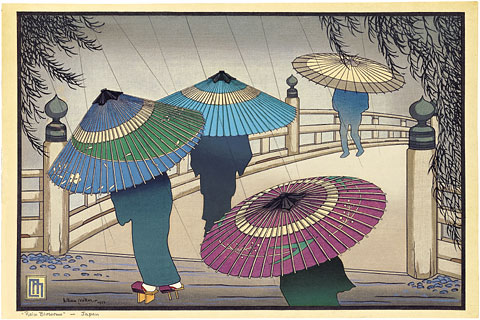
This post ran a few years back on this same date, December 7. Every time I come across this entry while scrolling through older posts it stops me cold. The purity of the color, the clarity, the compositions and the absolute simplicity, along with the sophistication mentioned by Claire Boothe Luce above, of it all just capture me wholly. It just makes me feel content and satisfied as a human.

But at the same time, as an artist, it also makes me feel discontented and a bit unsatisfied because it stirs my creative juices, reminds me that I haven’t yet reached that same feeling of contentment and happiness that I know is potentially there within my own work. 

That’s the yardstick I use when looking at the work of other artists– how much it makes me want to work even harder. And the work of Lillian May Miller does just that. Take a look.


I came across the work of Lilian May Miller only recently and was instantly infatuated with her beautiful woodblock prints. The colors and compositions just ring true for me and they seem to create a bridge between the traditional and the modern forms of the woodblock art form. I am showing quite a few of her pieces here but I could easily show many dozens more.

Miller was an interesting person as well. She was born in Tokyo in 1895 to American parents, her father a diplomat. She was enrolled in the atelier of a famed Japanese printmaker at the age of 9 and had her first exhibit at the age of 14. She shuttled back and forth between Japan and  and the United States  (where she graduated from Vassar) throughout her life, including considerable time spent in Korea when her father was stationed there for the State Department.

She saw herself as an envoy or messenger between the cultures of the East and the West. When in Japan, she dressed in a uniquely Western fashion, wearing ties and sport jackets and sporting a cropped haircut. When she made presentation back in the States, she often did so wearing traditional Japanese kimonos.

Miller achieved a degree of recognition for her work in the years leading up to World War II. However, she was devastated by the Japanese attack –which, by the way, occurred on this date in 1941– feeling that it was a personal betrayal of her love for that country. She worked for a counter propaganda unit of the Navy in 1942 until a large malignant tumor resulting from abdominal cancer was found.

She died in January of 1943 at the age of 47.

Her work and her story has slid somewhat into the ashes of art history. But much of her work remains and it doesn’t take much to see the brilliance of it at its best. It will pull its way back to light sometime soon.

This is a very quick and incomplete synopsis of her life. There was recently a more complete article on Miller on the Atlas Obscura site recently that you can read by clicking here. There is also a book, Between Two Worlds, that details her life and work.

For now, enjoy these images.


I Shall Be Released


“Walk in Peace”- Now at the West End Gallery


“This is what you shall do; Love the earth and sun and the animals, despise riches, give alms to every one that asks, stand up for the stupid and crazy, devote your income and labor to others, hate tyrants, argue not concerning God, have patience and indulgence toward the people, take off your hat to nothing known or unknown or to any man or number of men, go freely with powerful uneducated persons and with the young and with the mothers of families, read these leaves in the open air every season of every year of your life, re-examine all you have been told at school or church or in any book, dismiss whatever insults your own soul, and your very flesh shall be a great poem and have the richest fluency not only in its words but in the silent lines of its lips and face and between the lashes of your eyes and in every motion and joint of your body.”

–Walt Whitman, Preface to Leaves of Grass


Don’t want to focus on the dangers of the delusional craziness we’ve been experiencing in the past few weeks. It’s hard to believe this is where we are as a nation. But this morning, I want to, like the figure in the painting above, just walk in peace. 

So, I am going to take it easy this morning, maybe heed the words of Uncle Walt and dismiss those things that insult my own soul. 

Here’s a lovely version of Bob Dylan‘s classic I Shall Be Released from Rising Appalachia. The spare feel of the accompaniment from the bass and percussion really accentuate the beautiful vocals here. Nice.

Have a good day. Walk in peace.