View of California Wildfires From Above the Clouds
“In all your years and all your travels,” I asked, “what do you think is the most important thing you’ve learned about life?”
He paused a moment, then with the twinkle sparkling under those brambly eyebrows he replied: “In three words, I can sum up everything I’ve learned about life. It goes on. In all the confusions of today, with all our troubles . . . with politicians and people slinging the word fear around, all of us become discouraged . . . tempted to say this is the end, the finish. But life — it goes on. It always has. It always will. Don’t forget that.”
–Robert Frost , on his 80th birthday, speaking to journalist Ray Josephs, 1954
What a time it is.
Much of the imagery you see these days is downright terrifying and disheartening, from the apocalyptic fire scenes from the west coast to the images of clashes in the streets between protesters and police to the scenes of armed white supremacists being given virtual carte blanche treatment as they move about the country to the ugly, hateful stupidity displayed so publicly now by the president’s red hatted followers as they gather to piss and moan about “their country” being taken from them.
Oh, what a time it is.
I wish I could quote Dickens and say that it was the best of times, it was worst of times but quite honestly, where is the best of times to be found these days?
I saw the photo at the top of the California wildfires as seen from above the clouds and at first glimpse thought it was a closeup of the coronavirus. It wouldn’t surprise me if they had somehow sprang from the same Pandora’s Box and ultimately resembled one another. The destructive effect of the two on the lives of those involved is much the same, that’s for sure.
I guess I can only look to the words of Robert Frost and many others who have told us that life will go on. Even though they seem wise enough that I want to trust that they somehow know this to be true, these days I find myself doubting them. But for today, I am going to trust their judgement.
Life goes on.
Here’s the Beatles with their Ob-La-Di, Ob-La-Da which uses that phrase as a refrain. Keep it in mind as you hopefully have a good Sunday.
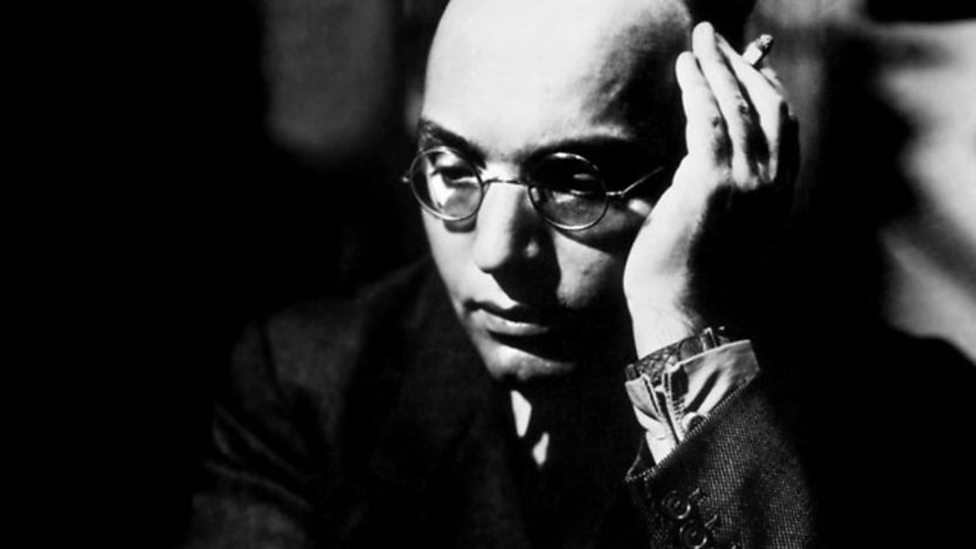
Kurt Weill. Who Wrote “September Song” with Maxwell Anderson
“The summer ended. Day by day, and taking its time, the summer ended. The noises in the street began to change, diminish, voices became fewer, the music sparse. Daily, blocks and blocks of children were spirited away. Grownups retreated from the streets, into the houses. Adolescents moved from the sidewalk to the stoop to the hallway to the stairs, and rooftops were abandoned. Such trees as there were allowed their leaves to fall – they fell unnoticed – seeming to promise, not without bitterness, to endure another year. At night, from a distance, the parks and playgrounds seemed inhabited by fireflies, and the night came sooner, inched in closer, fell with a greater weight. The sound of the alarm clock conquered the sound of the tambourine, the houses put on their winter faces. The houses stared down a bitter landscape, seeming, not without bitterness, to have resolved to endure another year.”
― James Baldwin, Just Above My Head
In this strangest of years, September has crept in without barely any notice for me. Much in the way August departed. I barely noticed the comings and goings, even though time seems to drag in these days of waiting for what might come next.
In doing so, I have neglected playing what might be my favorite song as I do every year at this time. The son is September Song, written by Kurt Weill and Maxwell Anderson for the 1938 Broadway show Knickerbocker Holiday. It was written in just a few hours after the show’s star, Walter Huston, requested that he have a solo song in the show.
Of course, in doing so, the composers had to account for Huston’s limited vocal range. The result though is a song that has become one of the great standards, covered by an incredibly wide range of artists. I have played versions from Willie Nelson, Bryan Ferry and Lou Reed along with the more well known jazz vocalists.
The song is just lovely in a most wistful way and these days we can all use something lovely and even wistful. Here’s such a version from the great Sarah Vaughan.
He has found his style, when he cannot do otherwise.
-Paul Klee
Paul Klee always seems to have something in his works and his words to which I can relate. I know these words relate to my own experience as an artist.
I do what I do. I am what I am.
I just can’t do anything else.
It can be frustrating at those times when I feel blocked and find myself wishing I was someone else with different and greater talents and skills. Or when people ask me why I don’t paint in a different way or ask me to do something outside of my artistic realm or area of interest.
So, I do what I do and I live with that.
There was a scene from a PBS series years ago that I have mentioned here before (and borrow from in what follows) that perfectly encapsulates this situation.
It was an episode of Mystery! on PBS starring Kenneth Branagh as the Swedish detective Wallander. It was an okay, nice production but nothing remarkable in the story. But there was a part at the end that struck home with me and related very much to my life as a painter. Wallander’s father, played by the great character actor David Warner (I always remember him best for his portrayal of Evil in the Terry Gilliam film Time Bandits) was, like me, a landscape painter. Now aged and in the beginning stages of Alzheimer’s, his son comes to him and intimates to his father, after having recently killed a serial killer, that he can’t go on as a detective, that he can’t take the stress.
The painter tries to comfort his son then recalls how when Wallander was a boy he would ask his father about his painting, asking, “Why are they always the same, Dad? Why don’t you do something different?”
He said he could never explain. Each morning when he began to paint, he would tell himself that maybe today he would do a seascape or a still life or maybe an abstract, just splash on the paint and see where it takes him. But then he would start and each day he would paint the same thing- a landscape. Whatever he did, that was what came out. He then said to his son, “What you have is your painting. I may not like it. You may not like it. But it’s yours.”
That may not translate as well on paper without the atmospheric camera shots and the underscored music but for me it said a lot in how I think about my body of work. Like the father, I used to worry that I would have to do other things- still lifes, portraits, etc.- or paint in a more realistic and less idiosyncratic manner in order to prove my worth as a painter. But at the end of each day I found myself looking at a landscape, painted in the only way I know, most often with a red tree.
As time has passed, I have shed away those worries. I don’t paint portraits. Don’t really paint still life. I paint what comes out and most often it is the landscape. And it usually includes that red tree that I once damned when I first began painting it had become a part of who I am.
Nearly all men can stand adversity, but if you want to test a man’s character, give him power.
–NOT Abraham Lincoln
I was thinking about character this morning and came across the quote above, which has been used on occasion by political organizations in recent times and is usually attributed to Abraham Lincoln.
Great words and most likely the truth.
But it turns out that the words were actually not from Lincoln but instead were spoken about Lincoln. The words actually come from my new hero of words, Robert Green Ingersoll, who I briefly profiled in a blog post this past week.
In 1883, at an event in Washington DC, Ingersoll was introducing a speaker who was going to lecture on the late President Lincoln. During his introduction Ingersoll said of Lincoln’s prowess as an orator, comparing Lincoln’s speech at Gettysburgwith that of the speaker, Edward Everett, who followed him and rambled on for a very long time :
“… If you want to know the difference between an orator and a speaker, read the oration of Lincoln at Gettysburg, and then read the speech of Everett at the same place. One came from the heart, the other was born only of the voice. Lincoln’s speech will be remembered forever. Everett’s no man will read. It was like plucked flowers.
After a round of applause, Ingersoll then added:
“If you want to find out what a man is to the bottom, give him power. Any man can stand adversity — only a great man can stand prosperity. It is the glory of Abraham Lincoln that he never abused power only on the side of mercy. [Applause]. He was a perfectly honest man. When he had power, he used it in mercy …”
Ingersoll modified these comments for a later lecture on Lincoln:
“Nothing discloses real character like the use of power. It is easy for the weak to be gentle. Most people can bear adversity. But if you wish to know what a man really is, give him power. This is the supreme test. It is the glory of Lincoln that, having almost absolute power, he never abused it, except on the side of mercy.”
Over the years, Ingersoll’s words were used often in many newspapers and magazines and correctly attributed to him. But as time wore on, his words were condensed down to the form you see at the top with Ingersoll’s name being forgotten, instead replaced by the very man of which he spoke.
As great and lauded as he was, Bob Ingersoll was just destined to be overlooked by history, I guess.
But his observation on character certainly holds true today.
We have a man who holds what is most likely the most powerful position in the world, the president*** of the USA, who has been given ( and has taken) almost absolute power. It has certainly revealed his true character.
And it ain’t pretty.
A multitude of revelations have come out in recent days, all painting him (almost always with his own words) as the soulless, selfish, ugly creature, something that seems so obvious to me and many others by the simple witnessing of his actions. Yet, reading through the reactions of his ardent followers on social media, it is portrayed as some sort of character assassination.
My question is: Can it be character assassination when the character of the person ( I am giving him the benefit of a doubt here, folks) in question is fully revealed as it truly is?
His actions and his words– spoken in his recorded voice— all reveal a character that is lacking any positive attributes. It is a character that shows itself as being small in scale and weak in practice.
It is a character that would let tens of thousands–maybe even hundreds of thousands– of the citizens he was entrusted to protect die, suffer and lose their livelihoods so that he might protect his political and financial aspirations.
He has told us who he is with his own words and he has demonstrated his character day after day for the past four years.
If at this point, you still believe that he has a reverence for or loyalty to this country, a respect for its citizens, or any interests beyond his own, you, my friend, are a fool.
I am going to condense that for you, probably not in a way that would please the great Robert G. Ingersoll:
If you still support this goddamn creep, you’re a fucking idiot.
Apologies to my less profane friends out there but this a time for plain speaking. Just my opinion.
The notion that a radical is one who hates his country is naïve and usually idiotic. He is, more likely, one who likes his country more than the rest of us, and is thus more disturbed than the rest of us when he sees it debauched. He is not a bad citizen turning to crime; he is a good citizen driven to despair.
― H.L. Mencken
I have been trying to stay away from current events but seeing this morning that the Department of Justice is looking to take over the defense of the president in a defamation lawsuit brought against the president*** by a private citizen over an alleged rape that took place twenty years ago just raises my blood. The fact that we, the people, are now paying for his legal defense and any subsequent settlement for is beyond the pale.
It is just another mile marker on the road to authoritarianism.
Factor in what is happening under the rulers this thing in our white house so much admires and refuses to criticize, often even as they imperil our citizen soldiers. You have the kidnappings of opposition leaders in Belarus. The poisoning of opposition leader and Putin critic Alexei Navalny in Russia, which was, by the way, not the first such occasion under the Putin regime. And then there is the crazy number of Putin critics and journalists who “accidentally” fall from high rise windows or mysteriously get shot with sight of the Kremlin.
Not to mention the brutal killing and dismemberment of a US based journalist by the Saudi regime that he often coos about, an atrocity that is now barely a blip in a radar screen filled with atrocities.
That’s the world to which our creature in charge aspires. And 40% or so of our population thinks, or in the absence of thought, believes that this is just fine and dandy.
I can’t accept that.
I will not succumb to the dark world being forced upon us. Will not keep my mouth shut. Will not close my eyes to the wrongs being perpetrated. Will not turn my head away from the rampant corruption or the many injustices of this regime.
I won’t do it.
And the 40% of us that are his true believers view this as being unpatriotic.
Well, we obviously have different views on patriotism.
I am going to defer to Aristotle on this: “It is not always the same thing to be a good man and a good citizen.
If being a good citizen requires me to be less than a good man, then I will cease being a good citizen.
Sorry for the spew this morning. Here’s a song that says this much better than my angry words. It’s from way back in 1984 from Little Steven and the Disciples of Soul and his album Voice of America. You might know him better as Miami Steve Van Zandt from Springsteen’s E Street Band or as Silvio, Tony’s lieutenant and the owner of the Bada Bing Club on The Sopranos. Or from his Sirius radio channel Little Steven’s Underground Garage or from his Netflix series, Lilyhammer. He’s a busy, multifaceted guy.
And a patriot by my and Mencken’s definitions. Here’s his I Am a Patriot.
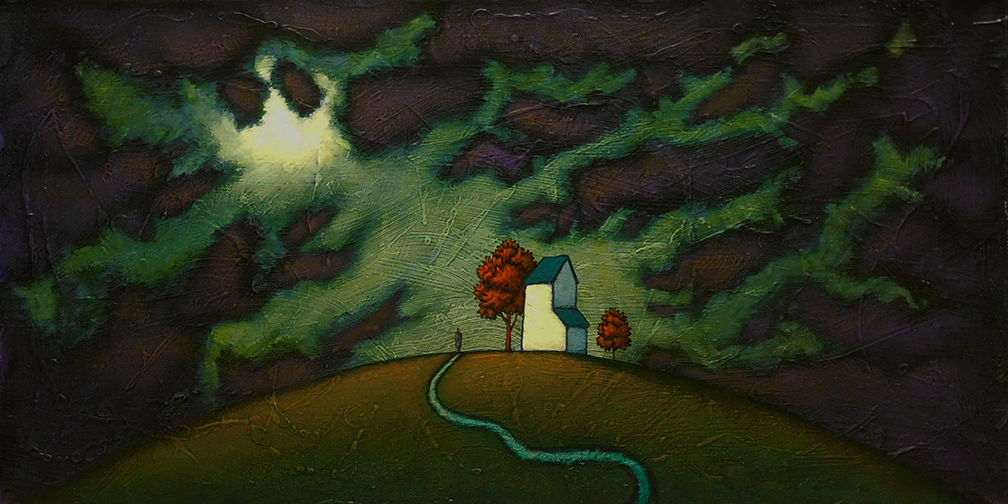
The painting at the top, The Way of the Brave, is from quite a few years back. It’s a longtime favorite of mine and one that I used when I last played this song here back in 2009. It still fits the song.
“At times the whole world seems to be in conspiracy to importune you with emphatic trifles. Friend, client, child, sickness, fear, want, charity, all knock at once at thy closet door and say,—’Come out unto us.’ But keep thy state; come not into their confusion. The power men possess to annoy me I give them by a weak curiosity. No man can come near me but through my act.”
― Ralph Waldo Emerson, Essays of Ralph Waldo Emerson
In my Gallery Talk I spoke about the struggle to go inside myself to create in these crazy days. The outer world and its many problems seems to be keeping me from the inner. It’s a frustration that more or less paralyzes me, requiring me to go put in a lot of extra effort just to get down to work.
I am trying to reconcile this, to somehow get past this feeling.
I came across this snippet above from Emerson and it reminded me that I am the one letting the outer world in. Oh, I know you can’t keep it completely out but I was the one opening the door and inviting it in. I was the one who listened to it as it went on about its problems and thought I could somehow help it out, foolish as that idea seems when I write it out. I went, as Emerson writes, into their confusion.
It also reminds me that I get to choose how I respond to the outer world. And being paralyzed is not a choice. It’s a refusal to choose.
So, I choose to shed the paralysis, to get back to work, to explore those inner paths once more. It’s my choice and what I do.
We all have that power to choose how we react to our own forms of paralysis, fear, anger, frustration and so many other negative aspects of our world. Most likely you don’t need to hear this. You probably know this as well as I. But I know I sometimes fall out of rhythm and have to be reminded once in a while.
The painting at the top is from a few years back and lives now with me in the studio. It’s one of those pieces that really hit high notes personally for me right from the moment it took form on the easel. It’s one of those pieces that surprises me in that it hasn’t yet found a home but also please me because I get to live with it for a bit longer. I thought it echoed with the words of Emerson today. It originally echoed with the words from the Rudyard Kipling poem after which it is named, If.
I was going to include the poem here in print but here’s a fine reading of it by actor John Hurt complete with the words shown. And some powerful black and white images.
I usually go on and on about the real meaning of Labor Day but I am tired today. Here’s a post from a couple of years ago about a favorite song concerning work, fittingly titled Work Song, of all things. Great tune. Have a good Labor Day and just try to at least give a little thought to what the holiday represents.
I call this painting Let Us Now Praise Famous Men, a title I used for a few paintings from my early Exiles series, in which this piece is included. I seldom show this piece and am not sure if it has ever appeared here. While I like this piece for a variety of reasons– for instance, I love the sky and hill colors– I never felt it was up to the same level as the other work in the Exiles series. I felt that it was more flawed than the others and too forced, not as organically formed as much of the other Exiles.
But every time I pull this piece out I feel a small sense of satisfaction in it and maybe that it needed to be aired out. I want to play a song today and thought this would be a good opportunity to let this little guy get out a bit. We’ll see.
The song is Work Song. It was written by the brother of jazz great Cannonball Adderley, who originally performed the song as an upbeat jazz piece. But it has been interpreted by a number of artists over the years, some to great effect. Others, not so much to my taste. But one of my favorites is from one of my guilty pleasures, Tennessee Ernie Ford.
He certainly doesn’t seem like a “cool” choice if you remember his public persona in the 50’s and 60’s as the goofily naive but affable hick from Bristol, Tennessee. I enjoyed that caricature as kid but it was his music that hooked me. He had a deep and mellow voice and a knack for choosing songs and arrangements that fit him perfectly. His series of country boogies were great and his 16 Tons is a classic. His version of this song is a great interpretation, spare and deep felt.
I couldn’t find a decent video of this song so here is the track alone:
Here’s another version that is a different interpretation from a band called The Big Beats with vocalist Arlin Harmon. I don’t have a lot of info on either though from what I can glean Harmon was a highly esteemed singer out in the Northwest. It’s a solid rocking performance with a different flavor than Tennessee Ernie’s. Give a listen.
I don’t need to be forgiven For something I haven’t done Nor for wanting my family To find their place in the sun If you keep this pressure on Just don’t be surprised If I can’t summon up my dignity While you’re roughing up my pride
There will be a reckoning For the peddlers of hate Who spread their poison all across this estate And a reckoning, too, for the politicians who Left us to this fate There will be a reckoning
—Billy Bragg, There Will Be a Reckoning
Since we’re in the midst of another Labor Day weekend, albeit one certainly not in normal times, I was listening to some Billy Bragg, the British singer who has picked up the mantle of Woody Guthrie to become the voice for workers and the downtrodden. In fact, his Guthrie connection includes the fact that he provided most of the vocals for one of my favorites albums, Mermaid Avenue. It was a collaboration between Bragg and the group Wilco to set to music and record a group of unreleased Woody Guthrie songs that were just lyrics on paper.
The result was what I consider a brilliant album. But that’s one guy’s opinion.
I came across this song from Bragg that has been bouncing around for a while but seems to have relevance for these times. It’s called There Will Be a Reckoning. In different performances Bragg has talked about how since WWII and the defeat of the fascist forces that were threatening to overtake the planet, generations of politicians have neglected to honestly address the big issues that affect the majority of the population on this planet– financial inequality, social injustice and racism, food insecurity and adequate healthcare.
They usually just kick these concerns down the road in acts of expediency.
Expediency is often just another name for cowardice.
As a result, it has created a vacuum in which those with fascist tendencies and objectives can once again begin the rise to power through the division of the population through campaigns of fear and hatred. They see the neglected problems and, though they have no plan on ever correcting the deficits, use it as a prybar to separate the masses and set one group against the other.
And quite often they succeed. And fascism gains a strong toehold and takes power. And this leaves another generation to have someday fight to stop its spread.
Yeah, if it’s not stopped, there will definitely be a reckoning.
Here’s a live version of the song from several years ago. I am playing it to let you hear Bragg’s cockney accent and a few words on the song as he introduces it. The painting at the top is my A Time For Reckoning which is still at the West End Gallery and was part of my recent show there. I think it pairs well with this song and these times.
Justice is the only worship. Love is the only priest. Ignorance is the only slavery. Happiness is the only good. The time to be happy is now, The place to be happy is here, The way to be happy is to make others so. Wisdom is the science of happiness.
–Robert Green Ingersoll
***********************
After writing yesterday about a person* with no honor whatsoever I thought I would write just a few words about a man with honor in abundance.
Most likely you don’t know his name, Robert G. Ingersoll. I know he was unknown to me. But while looking up a quote I kept coming across quotes from well known men who spoke of this man in what can only be described as glowing terms. Thomas Edison described him as being perhaps the closest thing to a perfect man on this earth. And Clarence Darrow eulogized him with these words:
“Robert G. Ingersoll was a great man. a wonderful intellect, a great soul of matchless courage, one of the great men of the earth — and yet we have no right to bow down to his memory simply because he was great. Great orators, great soldiers, great lawyers, often use their gifts for a most unholy cause. We meet to pay a tribute of love and respect to Robert G. Ingersoll because he used his matchless power for the good of man.
And Walt Whitman said this of the living Ingersoll:
“It should not be surprising that I am drawn to Ingersoll, for he is ‘Leaves of Grass’ … He lives, embodies, the individuality, I preach. I see in Bob [Ingersoll] the noblest specimen—- American-flavored—- pure out of the soil, spreading, giving, demanding light.”
I found myself asking who the heck was this guy?
Robert Green Ingersoll (1833-1899) was perhaps the most famous American of his day. He was a lawyer who was recognized as the preeminent orator of his time. As an enlightened freethinker and pioneer of humane, rational, and agnostic views, Ingersoll was a tireless advocate of rational thought, battling superstition and hypocrisy wherever he found it. Ingersoll would regularly address huge audiences, opening their minds to ideas that often provoked guarded whispers in private. He was a man far ahead of his time, advocating such progressive causes as agnosticism, birth control, voting rights for women, the advancement of science, civil rights, and freedom of speech. He had a wide influence in his day but somehow has been overlooked in the century or so that has passed since his death in 1899.
Ingersoll was born in 1833 not too far from here, up in Dresden, near the west shore of Seneca Lake. I just discovered that there is actually a small museum there dedicated to his life and work. I look forward to visiting it at some point. He only lived there as an infant because his father, an abolitionist preacher, was often on the move. However, a collection of his works published just after his death is called the Dresden Editions, published by the Dresden Publishing Company which was formed to publish this 12 volume set and was named specifically after his birthplace.
I am still discovering more on this interesting fellow so I am going to urge you to do so as well on your own. I would think that someone who garnered so much openly warm praise from the great men of his time deserves a few moments and has something to offer us now.
Note:
I thought his words at the top were an appropriate response to the ignorance and abhorrent behavior we have been exposed to on a daily basis for the past four years. Also, Ingersoll was a Colonel in the Union army during the Civil War and is buried at Arlington National Cememtery, not far from the Tomb of the Unknowns.
He was captured during the war which I guess, by current standards, makes him a sucker for enlisting and a loser for being captured.
However, even though Ingersoll might be considered a sucker and a loser, I sincerely doubt that the current occupant of our white house will have any of the greats of this age, save Kid Rock and Scott Baio, trumpeting his good works, his love for humanity or his good heart once he is stone cold and forever dead.
“On Memorial Day 2017, Trump visited Arlington National Cemetery, a short drive from the White House. He was accompanied on this visit by John Kelly, who was then the secretary of homeland security, and who would, a short time later, be named the White House chief of staff. The two men were set to visit Section 60, the 14-acre area of the cemetery that is the burial ground for those killed in America’s most recent wars. Kelly’s son Robert is buried in Section 60. A first lieutenant in the Marine Corps, Robert Kelly was killed in 2010 in Afghanistan. He was 29. Trump was meant, on this visit, to join John Kelly in paying respects at his son’s grave, and to comfort the families of other fallen service members. But according to sources with knowledge of this visit, Trump, while standing by Robert Kelly’s grave, turned directly to his father and said, “I don’t get it. What was in it for them?”
— Jeffrey Goldberg, The Atlantic, 3 September 2020
***************************************
There is a new article in The Atlantic from Jeffrey Goldberg that carries the heading Trump: Americans Who Died in War Are ‘Losers’ and ‘Suckers’ that I urge you to read. It details a host of incidents over the last several years under our current president*** where this creature displayed a total lack of respect for the service and sacrifice of those who have seen duty in our military forces. The reports in this article have been subsequently corroborated and verified by multiple news agencies and their sources.
Without going into all of the details of the article here– again, please read it for yourself– he calls those American troops who were killed overseas and are buried in the military cemeteries in those places ‘losers‘ and ‘suckers.’
It aligns pretty much with his words for the late John McCain who he claimed wasn’t a war hero because he was captured.
There was another incident during talks concerning a potential military parade, one of his fixations, where he asked that the parade not include wounded veterans, particularly amputees, saying, “ Nobody wants to see that.”
This man sees everything as being transactional. You only do something for something in return. The idea of doing anything out of a sense of duty or honor is a foreign concept to this creature. After meeting one high ranking general, he is said to have remarked to aides that this general was a very smart guy and wondered why a guy with that kind of smarts went into the military. To him, if you have the ability to enrich yourself, sacrificing that ability in order to act in service to others is a sucker move.
I was watching The Godfather 2 not too long ago, having not seen it for a number of years. There a scene near the end, a flashback to most of the members of the Corleone family along with the family attorney (Robert Duvall as Tom Hagen here but think of Michael Cohen, okay?) sitting around the dinner table before a birthday party for patriarch Don Corleone. Future boss Michael ( Al Pacino) reveals that he has enlisted in the Marines in the aftermath of Pearl Harbor.
The responses from his brother, Sonny, and Hagen were illuminating. People who do something for strangers were ‘saps.’
You only do for yourself and family.
Sound familiar? It has been said that this president*** operates in much this same way as a mob family, right down to the attitude that you only help those who can help you in some way. The others are all saps and suckers and losers.
You might ask why this matters. It is important because it shows that he sees everything around him in terms of how it serves him. The military and its veterans are seen as props and pawns to be used. I believe that if he had to sacrifice dozens or hundreds or even thousands of troops in an action that would help him stay in power.
And this extends to law enforcement, as well. He sees cops as a tool to be employed on his behalf. And even then, he only sees cops who are willing to compromise their oath or break the very laws they are charged to enforce as being capable of helping him. A good cop, someone who entered a dangerous field with relatively little financial return, would fall under the category of sap or sucker. Or even loser if they were to call out the bad cops among them.
You may not care.
You may not give a shit ( excuse me for my plain language here) about his constant lies and deceptions. Or maybe you don’t give a crow’s fart for his total refusal to accept any responsibility whatsoever for the citizens that he is supposed to represent during a worldwide pandemic. You may not give a tinker’s damn for the 190,000 dead from covid19 and find these numbers, no matter how high they climb, somehow ‘acceptable.’ You may not care about the damage being done to our future economies by his fiscal policies. You may not care about weakened position in the world, one that makes the world much more dangerous for all.
You just might not care. You got your stupid red hats and your confederate flags and Fox News. And your own beliefs, however misguided and misinformed they might be.
But make no mistake about it, this creature is the ultimate looter and he’ll burn down this whole shitshow to stay in power and to keep from ever being held accountable. If you or me or a million other saps, suckers, and losers have to die, it won’t bother him one damn bit.
And unless enough of us stand up now and vote him out in numbers too large to be disputed, I believe that is exactly what he will do.
So check your voter registration. Vote early.
And vote like your life depends on it because this might be the one time in our lives when that is actually true.
In the meantime, read the article in The Atlantic. And, here’s that scene from The Godfather 2. See if it sounds familiar to you, as well.





 Redtree Times