Feeds:
Posts
Comments

*********************

“Rats and roaches live by competition under the laws of supply and demand; it is the privilege of human beings to live under the laws of justice and mercy.”

–Wendell Berry

*****************

Man, I want to rage this morning.

It would certainly be easy to do so. We are going through multiple serious crises right now in this country and the ship of state which would normally lead and assist us through this is being steered by a creature whose attitude towards his duty is self-serving and neglectful, at its best, and traitorous, at its worst.

Maybe even treasonous, given yesterday’s revelations.

But I don’t want to go that route. Like the poet Wendell Berry’s words above, this president*** willingly lives his life in the realms of rats and roaches. Today, let’s focus on the flip side of that coin, the human side that lives under the laws of justice and mercy.

Where most of us are privileged to live.

Let’s have some hope that truth will overcome the many falsehoods and lies. That intelligence will prevail over stupidity and science over ignorance. Let’s hope that a sense of community and good will shall sweep away the hateful and selfish behaviors exhibited so often these days.

Let’s just keep a little hope alive and remember these days when they finally come to an end so that perhaps we can avoid them in the future.

That’s asking a lot, I know. For this Sunday morning music here’s a classic song from the great American songbook. It was written by Stephen Foster (who has local connections to this area) in 1854 at a time when America was going through equally hard times in those years leading up to the Civil War. This is Hard Times Come No More as performed by Mavis Staples. It’s such a great tune that there is a multitude of  wonderful versions out there but I just felt like Mavis’ version fit the moment for me.

Give a listen. Keep your head up and have a good Sunday.

********************

Hard Times Come No More

Let us pause in life’s pleasures and count its many tears
While we all sup sorrow with the poor
There’s a song that will linger forever in our ears
Oh Hard times come again no more

Tis the song, the sigh of the weary
Hard times, hard times, come again no more
Many days you have lingered around my cabin door
Oh hard times come again no more

While we seek mirth and beauty and music bright and gay
There are frail forms fainting at the door
Though their voices are silent, their pleading looks will say
Oh hard times come again no more

Tis the song, the sigh of the weary
Hard times, hard times, come again no more
Many days you have lingered around my cabin door
Oh hard times come again no more

Tis a sigh that is wafted across the troubled wave
Tis a wail that is heard upon the shore
Tis a dirge that is murmured around the lowly grave
Oh hard times come again no more

— Stephen Foster

“Climb Ever Higher”- Now at the Principle Gallery

*********************

Every day you may make progress. Every step may be fruitful. Yet there will stretch out before you an ever-lengthening, ever-ascending, ever-improving path. You know you will never get to the end of the journey. But this, so far from discouraging, only adds to the joy and glory of the climb.

–Winston Churchill

**************************

Just going to leave this thought out there this morning. Progress in any worthy endeavor is never gained easily nor is it ever fully achieved. It is the struggle that makes us fully appreciate the importance of the journey.

Have a good day.

We must be measuring time in dog years.

I say that because it struck me that that we’re not even halfway through this memorable year. So much has happened– is happening– that it sure feels like a lot more, maybe even the 3 1/2 years that it would be if we were dogs.

I checked this morning and was sadly disappointed to find that I wasn’t a dog.

Oh, to be a baying beagle or a happy, goofy Golden Retriever right now.

So many moving parts right now and there seems to be no rhythm or reason to most of them.

But maybe it’s just me. I am trying to finish the final pieces for my July West End show so I am kind of scattered anyway. Plus, I am hobbling around in a walking boot that I am wearing for a chronic ankle problem and  I scare the hell out of myself when I look in the mirror anymore. I decided to not cut my hair or shave when this whole thing took hold and now I find myself staring down the Unabomber’s weird older brother whenever I go into the bathroom here in the studio.

And while the work is a healing balm there are limits. For instance, yesterday was a good day of painting. The work was sharp and had a feeling of rightness off the brush. But at the end of the day yesterday, even after this positive day of painting, something felt wrong. My nerves were on edge and tense. Things just felt broken.

I looked around for what might be bothering me. Oh, the news feeds were not helping, of course. And while working, I had been rewatching the series Boardwalk Empire. If you don’t know the series, it takes place in Prohibition era Atlantic City and focuses on the power brokers, bootleggers and criminals of that place and era. It reminds you that the good old days weren’t all that good.

I had immensely enjoyed the series when it first aired. It has a great cast with wonderful performances, great production values and top notch writing with compelling storylines. But yesterday,I determined that this might well be a contributing factor to my tension. For as much as I liked the show and its qualities, nothing about it made me feel good about anything. It raised no feelings of hope and I needed that yesterday. In fact, it depressed me that a hundred years later, we’re still battling the same kind of insidious greed and corruption from power hungry money grubbers.

So, today it’s just music in the studio. Maybe something uplifting and positive.

Here’s a favorite of mine, from the wide and deep Bob Dylan songbook. It’s Everything is Broken.

Oops.

Actually, it’s more uplifting than you might think. Just knowing that things are broken means that there might be a way to somehow fix them.

So let’s use this as the baseline for today. Everything gets better from this point on. I am going to play two versions here. One is from the late great Bluesman R.L. Burnside and the other from Jazz/Rock keyboardist Ben Sidran, who always puts an interesting spin on the work of others.

I used the image of the burning locomotive because I saw it in a meme yesterday that said: Here Comes July!

Well, bring it on, July. I am ready for you and determined to have a good day today, damn it all. Hope you do the same.

**************


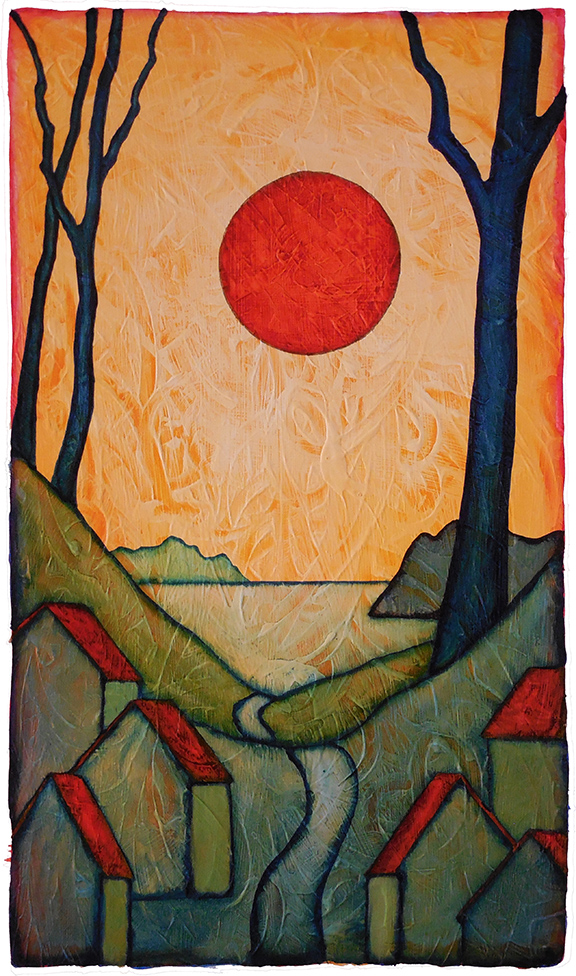
“The Solace of Light”- Now at the Principle Gallery

*************************

… I said to my soul, be still, and wait without hope

For hope would be hope for the wrong thing; wait without love

For love would be love of the wrong thing; there is yet faith

But the faith and the love and the hope are all in the waiting.

Wait without thought, for you are not ready for thought:

So the darkness shall be the light, and the stillness the dancing.

-T.S. Eliot, East Coker, The Four Quartets

********************

Whenever I read this passage from T.S. Eliot, I am inevitably moved by his words. The interesting thing is that while my response is always strong, my my personal interpretation of it, how I relate it to my own experience and knowledge, sometimes varies wildly.

And I suppose that is much like looking at a work of art. The day, the moment, the circumstance and context in which we see it– these things and more often dictate our response and our relationship to art.

I find this true for the painting shown above, The Solace of Light, which hangs at the Principle Gallery now as part of my current show there. It seems as though each time I look deeply at this piece, my relationship with it changes or, at least, moves to a different place within me.

Sometimes it feels superficial as though I am responding solely to the colors. Other times, it is deeper and I feel drawn into the forms of the scene, barely recognizing the colors. I am in and of that place in those instances.

Closer to where I want to be. Or think I want to be.

Okay, off to work. Maybe I will get there today.


Wake Up Everybody

“Inner City Blue”- Now at the Principle Gallery

*******************************

Wake up everybody no more sleepin’ in bed
No more backward thinkin’ time for thinkin’ ahead
The world has changed so very much
From what it used to be

–Wake Up Everybody, 1975, written by McFadden & Whitehead

******************************

Another quickie this morning. As much as I love to spout off, I much prefer spending my time in front of a piece of work and there’s some work that is calling out to me for attention even as I write this.

Thought I’d pair the painting above, Inner City Blue, a favorite of mine from my current Social Distancing show at the Principle Gallery, with a song from back in the day that has a message that resonates to this very moment. From 1975, it’s a prime slice of vintage Philly soul, Wake Up Everybody, from Harold Melvin and the Blue Notes with Teddy Pendergrass on vocals. Great, great song.

It feels like we have been on the cusp of meaningful and sweeping change for a long time but there has always been a violent reaction that keeps us from achieving it. And the closer we get to real change, the more violent and desperate the reaction from those who cling to a fading past. I think the last four years are evidence of that. Hatred and ignorance never rests. This song is a reminder that if we want to overcome it, we must keep up the pressure, keep thinking forward and keep our eye on the prize– a better and more just future for everybody, not just the few.

No time to rest now, no more sleepin’ in bed. Wake up everybody.

Have a good day.

How to Grow Old

********************************

Make your interests gradually wider and more impersonal, until bit by bit the walls of the ego recede, and your life becomes increasingly merged in the universal life. An individual human existence should be like a river — small at first, narrowly contained within its banks, and rushing passionately past rocks and over waterfalls. Gradually the river grows wider, the banks recede, the waters flow more quietly, and in the end, without any visible break, they become merged in the sea, and painlessly lose their individual being.

–Bertrand Russell, How to Grow Old

********************************

Bertrand Russell (1872-1970) is one of those names I come across whose words seem to always make incredible amounts of sense. That is, the words and thoughts that my pea-sized brain can comprehend. Russell was one of those multiple threats, with great proficiency and expertise in a number of fields– history, mathematics, philosophy, logic and political activism, to name just a few. I guess you might just call him a deep thinker or a great mind.

The words above are from a short selection, How to Grow Old, from a collection of his essays, Portraits From Memory and Other Essays. It’s a surprisingly down to earth collection of observations about facing the aging process.

It was the section featured at the top that caught my eye. I was entranced by this idea of going through life beginning as a narrow, rushing stream that gradually widens and slows into a river that heads to the gathering of waters that is the sea.

It made me think of my own father’s life and how he never actively tried to widen his course, never sought to expand his interests in his later years. If anything, his stream somehow became narrower, even as it slowed.

That might sound like harsh criticism to some but it’s a simple observation and I think if it were presented to him at a point when he could still understand what you were trying to say, he might even agree. He might not like it and might tell you to mind your own effin’ business but he probably wouldn’t argue the point. Not much interested him as he aged and the things that once brought him a degree of enjoyment, such as sports, no longer interested him.

Not much did. His stream narrowed and slowed.

It is one of the things about my dad’s life that sadden me. On Father’s Day, I see all of the glowing tributes to other people’s dads, about all the good traits handed down to them from their dads and I am a bit embarrassed. Because for all the worthy traits I have inherited– and there are a few– it is the object lessons learned from the deficits in his life, behaviors and traits I want to avoid, that I find most valuable.

And while there are more than a few of these from which to choose and which I will not go into here, this narrowing of one’s stream is the one I seek most to avoid. I think I have been able to do it thus far. But, even so, though there are days when some genetic predisposition start whispering to me to stop paying attention, to show no interest.

To just sit and stare into the void. To slow my stream and narrow the banks.

But I fight that feeling. Fight it hard.

Years ago, I echoed Russell’s words, writing here that I sometimes see myself and my interests and knowledge as a river– a mile wide and an inch deep. I am still as shallow but I am forever trying to carve my course wider and maybe just a bit deeper.

I am shooting for two miles wide.

And two inches deep.

*************************

Fe fe fi fi fo fo fum
I smell smoke in the auditorium

Charlie Brown, Charlie Brown
He’s a clown, that Charlie Brown
He’s gonna get caught; just you wait and see
(Why’s everybody always pickin’ on me?)

–Charlie Brown, The Coasters, composed by Leiber and Stoller

**************************

Busy today so I am going to make this short and sweet. As much as I would like to rub salt into the wounds of the president*** and his pitiful gaggle of attendees at the much ballyhooed Festival of Victimization and Racist Pride ( that would look good on a t-shirt, wouldn’t it?) that took place in Tulsa over the weekend, I am going to refrain.

Thought I would instead simply share a song. It’s an oldie from way back in 1959 from the joyful Coasters that just felt right this morning. With apologies to Charles Schulz, here’s Charlie Brown.

Have a good day!

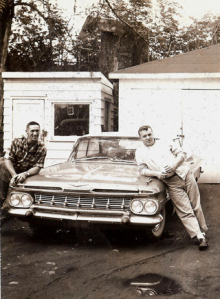
Well, it’s another Father’s Day. The picture here on the right is my dad, on the right, and his late friend, Jesse Gardner, leaning on a sharp blue Impala when they both worked at my uncle’s used car lot in the early 60’s. The three– my uncle, Jesse and dad– went on to have long careers at the sheriff’s department. Jesse, by the way, was the father of my friend and painter Tom Gardner and the grandfather and namesake of Jesse Gardner who now owns and operates the West End Gallery. Small world, eh?

Father’s Day feels somewhat bittersweet this year, given the the quarantine still in effect at the nursing facility where my dad resides and the fact that will most likely be his last Father’s Day. Between the progression of the dementia which has wreaked havoc on his awareness  and the skin cancer which has metastasized while ravaging the rest of his body, he is now nearing the end of his journey. Upon consultation with the doctors and staff, we have decided to forego further intrusions and procedures on him. They will simply try to keep him comfortable in his final time here and we will probably be able to see him one more time as he nears the end.

It was not a decision I wanted to make and it has weighed on my mind in recent days. Nobody wants to have to decide on the fate of your parents. You always hope for a painless, graceful exit for those you love. Unfortunately, the wheel of fortune doesn’t always fall in your favor so you deal with what is at hand and hope that with it some small bit of grace comes your way.

So, on what will likely be his final Father’s Day, I’ll be thinking of my dad. I will try to think about the better aspects of what I know and remember of him, trying to not focus on his flaws and imperfections, which were many. As it is with most of us.

Please don’t send any sympathies. They aren’t necessary. We all are fated to have to endure certain parts of life and that’s just how it is. All part of the bargain.

For this Sunday morning music I am choosing an old Hank Snow song, I Don’t Hurt Anymore. I don’t know if I ever did but I can hear my dad singing long to this in the car when I was a kid, tightening his voice to make it sound like the Singing Ranger. And now, hopefully the title applies.

Have a good day.

Build a House

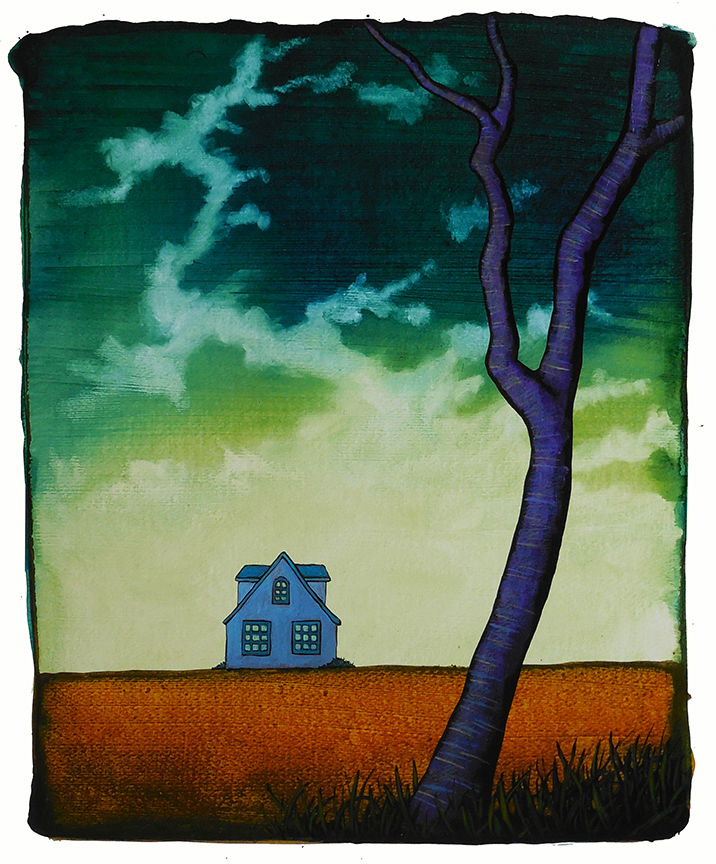
“The Quarantine House” – Now at the Principle Gallery


*********************

Thought I’d just play a song from one of my most favorite artists, the super talented Rhiannon Giddens.  It marks Juneteenth, which was yesterday, and was written in the last week or so. She collaborates on it with the great Yo-Yo Man– from a distance, of course. The song premiered on YouTube yesterday. Enjoy and have a good day.

This is what Rhiannon had to say about the song: “This song came knocking about a week ago and I had to open the door and let it in. What can I say about what’s been happening, what has happened, and what is continuing to happen, in this country, in the world? There’s too many words and none, all at once. So I let the music speak, as usual. What a thing to mark this 155th anniversary of Juneteenth with that beautiful soul Yo-Yo Ma. Honored to have it out in the world.”

*****************

*****************

Build a House

You brought me here to build your house, build your house, build your house
You brought me here to build your house and grow your garden fine

I laid the brick and built your house, built your house, built your house
I laid the brick and built your house, raised the plants so high

And when you had the house and land, the house and land, the house and land
And when you had the house and land, then you told me “go.”

I found a place to build my house, build my house, build my house
I found a place to build my house since I couldn’t go back home

You said I couldn’t build a house, build a house, build a house
You said I couldn’t build a house, so you burned it down

So then I traveled far and wide, far and wide, far and wide
And then I traveled far and wide until I found a home

I learned your words and wrote a song, wrote a song, wrote a song
I learned your words and wrote a song to put my story down

But then you came and took my song, took my song, took my song
But then you came and took my song, playing it for your own

I took my bucket, lowered it down, lowered it down, lowered it down
I took my bucket, lowered it down, the well will never run dry.

You brought me here to build a house, build a house, build a house
You brought me here to build a house. I will not be moved.

No, I will not be moved. No, I will not be, I will not be, I will not be moved.

Rhiannon Giddens

*******************

Duty and Joy

“Hunkered Down”- Now at the Principle Gallery

**********************

I slept and dreamt
that life was joy.
I awoke and saw
that life was duty.
I worked — and behold,
duty was joy.

–Rabindranath Tagore

**********************

When I first read the short poem above from the great poet and philosopher Rabindranath Tagore some time ago, it struck a chord with me. It so simply, in just a few lines, put across an observation that takes most of us a lifetime to realize. That is, if we ever do realize it.

Duty was joy.

But what is duty? Is it in being a good parent? A faithful spouse and a loyal friend? Is it in what we do to make a living? Or is it in being decent and caring human being?

Perhaps, it is how our lives touch the lives of others? Could that be a duty?

I don’t know for sure. Most likely joy is not a one size fits all proposition.

My own feeling is that duty is much like having a purpose, a reason for living. I remember reading Holocaust survivor Viktor Frankl‘s transcendent book, Man’s Search For Meaning, which described his time in the Auschwitz death camp. He observed that those who were able to survive the horror were those who somehow had a purpose for their life, who saw a future that they needed to reach ahead for. This purpose, even a modest one, often gave them the drive needed for survival, creating a path forward for them.

In the year after being liberated from Auschwitz, Frankl gave a series of lectures that were the basis for his book. In one he spoke of Tagore’s poem and that final line: Duty was joy:

So, life is somehow duty, a single, huge obligation. And there is certainly joy in life too, but it cannot be pursued, cannot be “willed into being” as joy; rather, it must arise spontaneously, and in fact, it does arise spontaneously, just as an outcome may arise: Happiness should not, must not, and can never be a goal, but only an outcome; the outcome of the fulfillment of that which in Tagore’s poem is called duty… All human striving for happiness, in this sense, is doomed to failure as luck can only fall into one’s lap but can never be hunted down.

In short, lasting joy and happiness cannot be pursued as a goal on their own, without a responsibility to some higher purpose.

I am writing this because sometimes I need to be reminded of this. I have been struggling at times recently in the studio, seemingly fighting with myself to find something that just doesn’t seem to be there. The harder I tried to find it, the further away it seemed. It was like I was looking for something to quell my anxieties and bring me some form of easy happiness. To bring me effortless joy.

I should have known better. Yesterday, I just put down my head and worked without thinking about the end result. I focused solely on my purpose in each moment, the task at hand. Concentrating on doing small and simple things with thought and care was my duty, as it were. As the day went on, my burden felt lessened and I began to feel joy in the work, joy in small aspects that I had been overlooking in prior days.

It was a satisfying day, one that left me feeling that I had moved in some way toward fulfilling a purpose. It may not be a grand, earth-shaking one but it doesn’t need to be. It is mine. My purpose. My duty.

And that is enough to bring me a bit of joy.