Feeds:
Posts
Comments

Murder Most Foul

Last week, Bob Dylan released his first original song in eight years. Titled Murder Most Foul the 17 minute song is primarily focused on the 1963 assassination of JFK but uses it more a point of departure for a guided ride on a hazy time machine that moves through the decades that followed.

Over a slow paced backing with piano, drum and strings that gives it the feel of an elegy or requiem, Dylan takes the imagery of that dark November and weaves it together with a long list of wildly disparate references to musical selections and pop culture figures.

It all becomes a mesmerizing drone.

On one hand, it seems to be just a mishmash of words and references with no real meaning.

But on the other hand, it feels like it is pointing us to this moment as an endpoint for an arc that began on that day in 1963, with every moment and event since, large or small, pushing us forward to this culmination.

Like we’ve been on a journey since that day and this moment and situation was our ultimate destination.

And for many whose lives have spanned that time period, that feeling is one that makes a certain amount of sense. For these folks, that day in 1963 has cast a shadow over everything since and there is a constant groping through the detritus of the years to find the connecting strands that will somehow make sense of it all. For them, there seems to be something going on, a set pattern of small indiscernible nudges, that is just out of reach or understanding.

And this song somehow feels like it is bringing finality to that pattern’s path.

I can’t say whether that this is true or not or if I even believe what I’ve just written. Maybe it’s an epic. Or maybe it’s just a load of crap. I guess, like all art, it’s a subjective opinion.

For me, it’s just oddly compelling. I’ve probably listened to this song forty times or more in the past week, sometimes playing it on a loop while I have been stretching canvasses or working at some other simple physical tasks. I find it oddly soothing, especially after listening to it immediately after watching the news reports on the current situation. I find myself pausing at certain recurring moments in each playing of the song and catching a few of same couplets, out of the many that make up the song, again and again.

Maybe I am trying to find the pattern in this song that might somehow bring to light the pattern that has possibly spanned the past 56+ years.

I don’t know.

I’m sharing a version with lyrics so, if you have the desire and 17 minutes to spare, give a listen. It will give you something to think about in your time of isolation. Have a good day.


A Golden Solitude

******************

Solitary trees, if they grow at all, grow strong.

Winston Churchill

******************

The solitary tree has been a vital part of my work from the beginning. Actually, the word vital understates its importance.

I couldn’t find the image of a painting from a number of years ago that I wanted to see again. This sent me on a search through a maze of files and images from over the past twenty years. I probably spent more time doing this than I should have but it became one of those obsessive things.

Shuffling through these images, one after another, that form of the lone tree just jumped out at me. I say jumped because of the way in which it surprised me. I, of all people, know that the single Red Tree has been important and prevalent in my work. There is no getting around that fact. I have literally been called the “Red Tree guy.”

I understand its symbolism and meaning very well.

But it just seemed different, more away from me personally.

There were many that had slipped my mind that made me stop to look closer. I wasn’t seeing myself anymore in those pieces but found myself admiring the character they taken on in the time they had been absent in my memory. There was a strength and dignity in them that was palpable.

They had somehow expanded in the time I had lost track of them.

They were no longer me. They were them.

It was as though my forgetfulness had made them grow in solitude and they, out of necessity, had grown stronger as a result. Much like the words above from Churchill, which were written in a letter to his mother in 1899, a few years after his father had died.

I may have been the symbolic father of those works, those many Red Trees, but their strength was their’s alone, obtained in their solitude. I felt bad that I had lost track of them but was so pleased at what they had become.

They were beyond me.

Which is all I could hope.


Oddly enough, I have some things that I must do this morning and thought I’d rerun this post from 2014 about a recently completed painting. Both the painting and the theme of this post resonate strongly with me personally. Have a good day.

****************************

We cast a shadow on something wherever we stand, and it is no good moving from place to place to save things; because the shadow always follows. Choose a place where you won’t do harm – yes, choose a place where you won’t do very much harm, and stand in it for all you are worth, facing the sunshine. 

–E.M. Forster, A Room With a View

***************************

Choose a place where you won’t do harm…

I don’t want to, nor do I think I should, say much more about this new painting, a 24″ by 36″ canvas that carries the title Cast Your Shadow.

I like the idea represented by the quote above from E.M. Forster where one seeks out a place of their own, a place where they can stand without causing harm. It’s a theme that I’ve always thought of in terms of being a smooth stone on a creek bed, pushed and polished by the current through the ages until at last coming to rest in a spot where the water flows easily over it.

The stone finds it’s place where it does no harm. It doesn’t disturb the water and the water simply passes by.

It seems like such a small desire, to find a place where the water flows easily by or where one can stand in the sun without their shadow blocking the light from others. But the simplicity of this wish is deceiving.

It is the work of a lifetime.

Wind Tossed

*******************

I dare not speak much further;
But cruel are the times when we are traitors
And do not know ourselves; when we hold rumor
From what we fear, yet know not what we fear,
But float upon a wild and violent sea
Each way and none.

William Shakespeare, Macbeth, Act 4, Scene 2

*******************

The piece at the top is a new work on paper, one that I am calling Wind Tossed. It was painted this past weekend and it very much mirrors the feelings that ran through me in the studio.

Dark and turbulent, trying to find something onto which I could grab hold and find direction. A source of light for which I could set a course.

Much like the lines from Macbeth above, I felt like a cork on a wild sea, my emotions thrown in all directions and none.

Feelings of worry and concern for those I know at risk. Fearful and anxious ones, as well, for the future. My own and that of our country.

And anger. Plenty of anger. Buckets of it, most of it directed at what as I see as a betrayal of our population by our titular leaders’ denial and refusal to accept early guidance on what the health experts and intelligence community saw coming our way. Their cavalier attitude toward this pandemic in the months leading up to this was an egregious act of irresponsibility, one that borders on malevolence and criminality.

I didn’t find a lot on which I could grab in these past few days outside of the small comfort that comes in knowing we are isolated and relatively safe, with adequate supplies and each other in which we can find some support.

But,oddly enough, there is something gained from this uncertain time. I find that that this anxiety and anger turns into something much greater than both– a defiant determination to persevere.

And that, no doubt, is what I am seeing in this painting, why it speaks so clearly to me in this moment. we may be wind tossed but the skies will one day clear. The seas will settle then and we will find our way to solid ground.

I am not one to hold much certainty in anything but of this, I am certain.


I always play a bit of music on Sunday mornings here, usually trying to link it to whatever is going on in my little world of paint or out there in the larger world. You know, a relevant song for a new painting or for a current event that might be dominating the news.

But sometimes they are songs that I simply like, songs that have meaning for me. Songs that make me cry. Or songs that make me happy and maybe even laugh.

I didn’t want to go with songs that make me cry today. There’s been enough reason to cry lately without having to be prodded.

So, I am opting for a song or two that make me happy. Make me smile and actually chuckle. Plus, you can easily link both with the situation at hand.

Facing hardship is an integral part of the nature of being alive. Illness and injury, death, loss, failure, humiliation– we all face some or all of these things in our lives.  Some face fewer and some even more of these hardships, but none are completely exempt. While facing my share–which are no more than most– I have always found music and humor to be effective coping mechanisms.

For me, it helps sometimes to laugh at my misfortune, especially if it has come about at my own doing. Laughing makes the situation seem smaller, less momentous. Laughter actually belittles the moment. I know that in the aftermath of some of my most down moments that I have some soothing salve in laughing at myself and the moment as I lick my wounds.

So, let’s lick our wounds and have a couple of songs. Both are from Eric Idle of Monty Python’s Flying Circus fame. He wrote most of the songs that the troupe employed in their shows and movies. We were lucky enough to see him many years ago, I think it was 2000, at Carnegie Hall for a very enjoyable evening of his songs and some well known Python bits.

The first is  a beautifully shot film of a sing-along performance of Always Look on the Bright Side from the film, Life of Brian. The song has become over the years the go-to song in Britain when they are facing adversity, a screw you to the problem at hand.  In recent days, a tug on the Thames River has been blaring it from loudspeakers as it chugs up and down the waterway.

Plus, this version has pipers. What more could ask?

The song here at the bottom is The Galaxy Song from the film, The Meaning of Life. It puts the problems we face into a galactic and universal perspective.

So, give a listen. Maybe sing along and smile. But do try have a good day.


***************

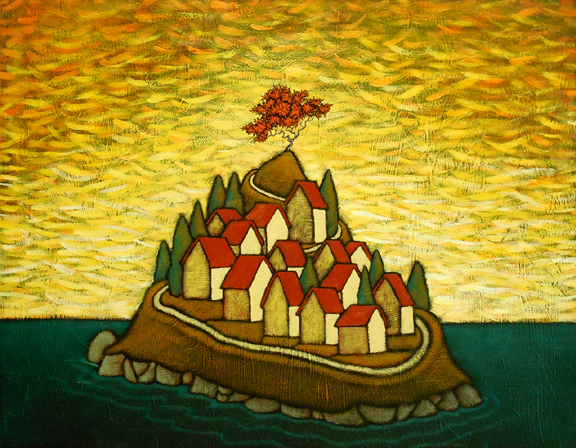
Living in isolation has never been a great challenge for me in normal times. I thought I was a distant island that only needed a visitor every once in a while for those few things I couldn’t provide for myself. But these are not normal times and the impingement from the outer world pushes hard into my space now, disrupting the solitude that I thought was impenetrable.

Listening to the words that the great leader*** spoke yesterday, where he basically admitted that he wanted the states’ governors to bend the knee before him and had instructed the VP to not call and offer assistance to those that didn’t, made me realize that we are all islanders now.

50+ sovereign states, all fending for themselves, with a hope that exceeds reality that the unified power of the central government will offer much needed aid, will somehow favor them above the others in their time of need. We are in trouble and call out for aid to those who have a sworn duty to serve us.

Much as Puerto Rico did not so long ago in the aftermath of the historic hurricanes that ravaged that island.

We are all Puerto Rico now.

We probably should have taken the treatment Puerto Rico received, a few rolls of paper towel dismissively thrown at them along with conditioned promises of aid that were never fully realized, as an omen. We all are about to receive that same treatment and the storm that approaches this time is even larger and deadlier.

Anyway, I came across a post written for a 2013 show at the West End Gallery that featured the above painting, Islander, as its title piece. I thought the words were pertinent to this time. Its a painting that really resonates deeply with me on a personal level and one that, inexplicably at least for me, has never found a home. It still resides at the Just Looking Gallery in California, waiting patiently for someone to see what I see in it.

Along with the post below, I have included a version of Simon and Garfunkel‘s classic I Am a Rock. This video features the lyrics which is a way I have been listening to a lot of music lately. Times of crisis make me look harder for connecting threads of meaning. Whether they are there is another thing.

Give a look and have a good day on your little islands.

****************

I am an islander.

But I don’t live on an island. Never have and probably never will.

No, my island is a metaphorical place, one that exists in the creative ether of my mind. An island that is completely apart from and immune to the outer world that exists across the deep surrounding waters. Self-sustaining and self-ruled, a blank slate on which I can create my own reality.

It’s a place free from the ire and pettiness of others. Free of strife and injustice. and filled with the quiet of solitude. Filled with color, warmth and emotion.

An island of creation and peace.

But there is a paradox in being an islander. While trying to remain separate, it becomes abundantly clear that we can never really exist as totally independent from the outer world. Actually, to the islander those bonds to the outside world become even more apparent and important. The isolation only serves to heighten our recognition of our inclusion and connection to the world. You begin to recognize them as lifelines, bringing those things to the island that you cannot create in yourself.

Try as one might, one can never live in isolation from their own humanity. I think the best you can do is to create an island that you can visit periodically to revitalize yourself. And that’s what I believe I see in the work for this show– paintings that take me away for a short while from the outer world and place me on that peaceful island.

For that short time, I am truly an islander.

************************

No man is an island, entire of itself; every man is a piece of the continent, a part of the main; if a clod be washed away by the sea, Europe is the less, as well as if a promontory were, as well as if a manor of thy friend’s or of thine own were; any man’s death diminishes me, because I am involved in mankind, and therefore never send to know for whom the bell tolls; it tolls for thee.

–John Donne, Meditation XVII, 1624

************************


And Dusk Dissolves

*********************

There is only one day left, always starting over: it is given to us at dawn and taken away from us at dusk.

Jean-Paul Sartre

*********************

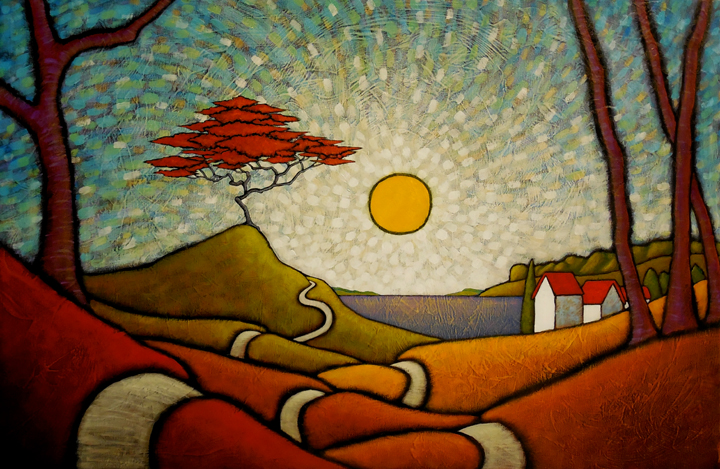
This is a new painting, a large canvas measuring 30″ high by 48″ wide, that is scheduled for my annual show at the Principle Gallery, this year called Social Distancing,which is tentatively scheduled to open on June 5.

I call it And Dusk Dissolves.

It’s a very soothing painting here in the studio, with a lot of warmth and light in its colors. I believe that is because it needed to be that in this moment.

I was trying to ease my mind in some way.

Trying to push away anger and fear, to push away anxiety and despair. To find a place in which I could rest my mind, if only for a brief moment.

And I think I find that place in this piece. In it, the Red Tree feels safe and at peace.

Yet at the same time, there is a somber wistfulness in it, as though the Red Tree is already missing the day that is still just leaving, regretting what little it has done with that precious time. As the Sartre words above attest, the day is a gift that is given to us each dawn and taken away each dusk.

This day’s gift is nearly gone.

The next dawn will bring a new gift but before that sunrise arrives there is a long dark night to be endured. Lately, it is filled with restless sleep and dreams with nightmarish imagery and intense feelings of alienation and betrayal.

Though the dawn brings a sense of joy and potential that comes with it as a gift, the ever lengthening nights begin to slowly diminish this optimistic outlook.

Maybe that’s the strength of this piece, that tension between its gratitude for the gift of the day that has passed, its peaceful acceptance of the present  moment, and its apprehension of what the new day may bring.

The current time often informs and defines my own readings of my work. Sometimes the piece translates differently over time and sometimes they emote in the same way, tell me the same story. I can’t tell on this painting right now. It’s still too close, too deeply embedded.

But I have a feeling that years from now — if that turns out to be the case– I will look on this piece and remember the comfort and reassurance it offered in a terrible time.

And that will comfort me then, as well.

Have a good day. Remember, it’s a gift.

Maybe one of the good things that might come out of this crisis is that people will look at the jobs done by themselves and others in a different way.

I read a news story where they were talking with a man who had worked for a food distributor, the kind that delivers food products to stores and restaurants, for many years. He had always thought of his job as a mere job and felt that it didn’t have much consequence in the bigger picture of the world.

But now, with the crisis putting a spotlight on the importance of the food chain, he began to see that what he did had significance, that it did, indeed, make a difference. He felt a pride in what he was doing that he had never felt before. He felt that he was working with a purpose now and not just droning mindlessly along.

This new perception changed everything for him.

I mention this because I think of those people who work the many thankless service jobs that fuel our modern world and who are still at the switch today, often putting themselves at risk in the time of this virus. Firefighters and EMTs. Law enforcement and corrections officers. Mail carriers and delivery drivers. Truck drivers, warehouse workers and stock clerks.

And especially the doctors, nurses, therapists, aides, food service and cleaning people that make up our hospitals.

And perhaps the most overlooked and least appreciated, those people who work hard at the supermarkets and other stores that are still open.

One of my first jobs was working in a Loblaws grocery store, working as both a stock clerk and cashier. It made me appreciate what a thankless job it could be and I try my best to be appreciative of any cashier or anyone who has to have people in front of them constantly through the day. It’s a hard thing to do, to maintain a consistent demeanor as a wide variety of folks parade before you for hour after hour, some not so nice at all.

And to factor in the risk from this virus as they are serving these people just a foot or two away, who are unknown to them and may well be carrying it, makes their efforts seem almost heroic.

I am sure they don’t think of themselves as being heroic. Most have no choice and have to be there just to maintain their life. They just see it as doing their job.

But often heroism comes down to that simple thing– just doing your job.

Heroism doesn’t come from those seeking accolades or praise. It doesn’t come from beating down an opponent and pounding your chest.

It comes from regular people doing best what they can when they are needed in the face of a threat because they have no other choice.

And that’s what these folks are doing right now.

No doubt that some, maybe many, will contract the virus. And that makes me feel for them even more. So, if you must go to a store (do not go if you can help it!) maintain your distance and look at your cashier for a moment. Think of the risk they are taking so you can have a bit of food. Then thank them with some sincerity.

Maybe they will feel like a hero if just for a moment. Or just for one day…

Okay, that means I get to play one of my all time favorites, which I am always looking for an excuse to play. Here’s Heroes from David Bowie.

“And we can be heroes, just for one day…”

So, be careful.

Be kind.

And have a good day.

American Tune

I am without words today. It’s not that I’m not feeling a multitude of emotions or feelings. I just want to be quiet. This morning I somehow found myself listening to American Tune from Paul Simon, a song I’ve heard and enjoyed probably a thousand or more times before. But the lyrics jumped out at me this morning in a different way, like I hadn’t fully heard them all those many times before. Maybe it was just that they seemed to fit the moment so perfectly. It said everything I might have wanted to say had I had felt like talking.

There are three versions of the song here at the bottom from Paul Simon. The first was recorded just a few days ago for ‘Til Further Notice which is presenting virtual performances by different recording artists for the duration. The sound on this is not great but it’s certainly a heartfelt performance. The second is from a television performance from 1974, not long after he first introduced the song. The bottom version is one with the lyrics, which I suggest, even though it starts abruptly and has a number of grammatical errors in its transcription. Seeing these lyrics while hearing the song emphasizes the power of the words.

Sure worked for me. Hope you take a moment and listen.

Be good. Be careful. Have a good day.

*****************
Many’s the time I’ve been mistaken
And many times confused
Yes, and often felt forsaken
And certainly misused
But I’m all right, I’m all right
I’m just weary to my bones
Still, you don’t expect to be
Bright and bon vivant
So far away from home, so far away from home

And I don’t know a soul who’s not been battered
I don’t have a friend who feels at ease
I don’t know a dream that’s not been shattered
or driven to its knees
But it’s all right, it’s all right
We’ve lived so well so long
Still, when I think of the road
we’re traveling on
I wonder what went wrong
I can’t help it, I wonder what went wrong

And I dreamed I was dying
And I dreamed that my soul rose unexpectedly
And looking back down at me
Smiled reassuringly
And I dreamed I was flying
And high up above my eyes could clearly see
The Statue of Liberty
Sailing away to sea
And I dreamed I was flying

We come on the ship they call the Mayflower
We come on the ship that sailed the moon
We come in the age’s most uncertain hour
and sing an American tune
But it’s all right, it’s all right
You can’t be forever blessed
Still, tomorrow’s going to be another working day
And I’m trying to get some rest
That’s all, I’m trying to get some rest

Paul SimonAmerican Tune


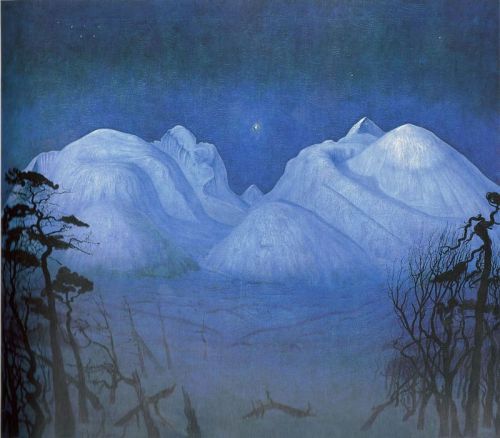
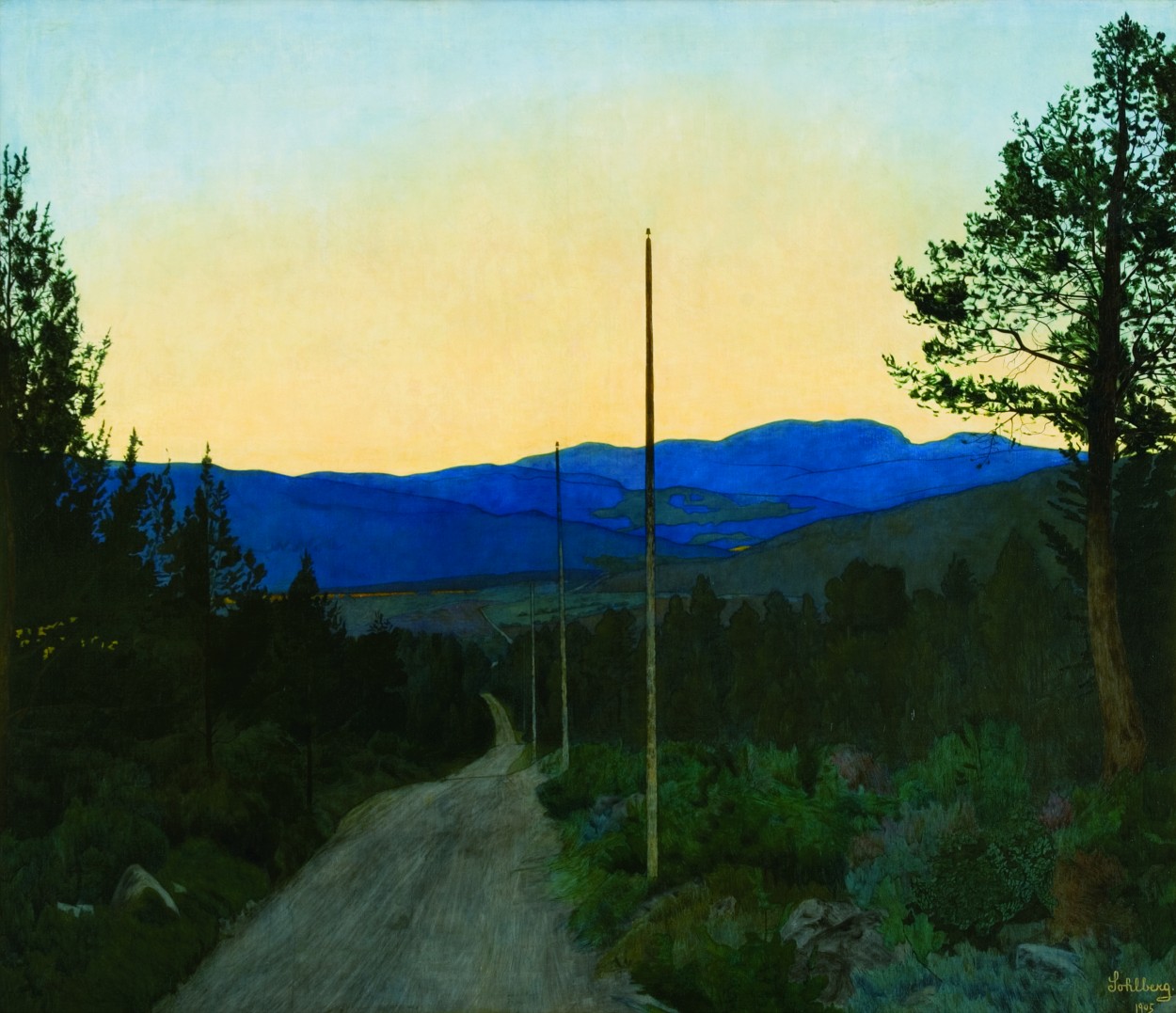
Harald Sohlberg-Night 1904


***********************

I was in the studio even earlier than normal this morning. I watched the news for a bit only to hear that some hospitals in the NYC/ Tri-state area were already near the point where doctors were going to have to decide who would be put on a ventilator and who would not. Basically, who would live and who would die. And the soulless clown in charge keeps saying that Ford and GM are manufacturing thousands of these much needed items when, in fact, they are not and that he wants to end the shutdowns in a week or so. He is willing to sacrifice lives, perhaps large numbers of them, for a stock market bump and for the fiscal wellness of multinational corporations that were as recently as a month or two ago sitting on a mountain of cash, something like $1.7 trillion.

It’s okay to let grandma die alone in a hospital so long as there’s a profit to be made.

I had to turn the news off and find something to quell my rising ire. 

Something tranquil and far removed from this horror show.

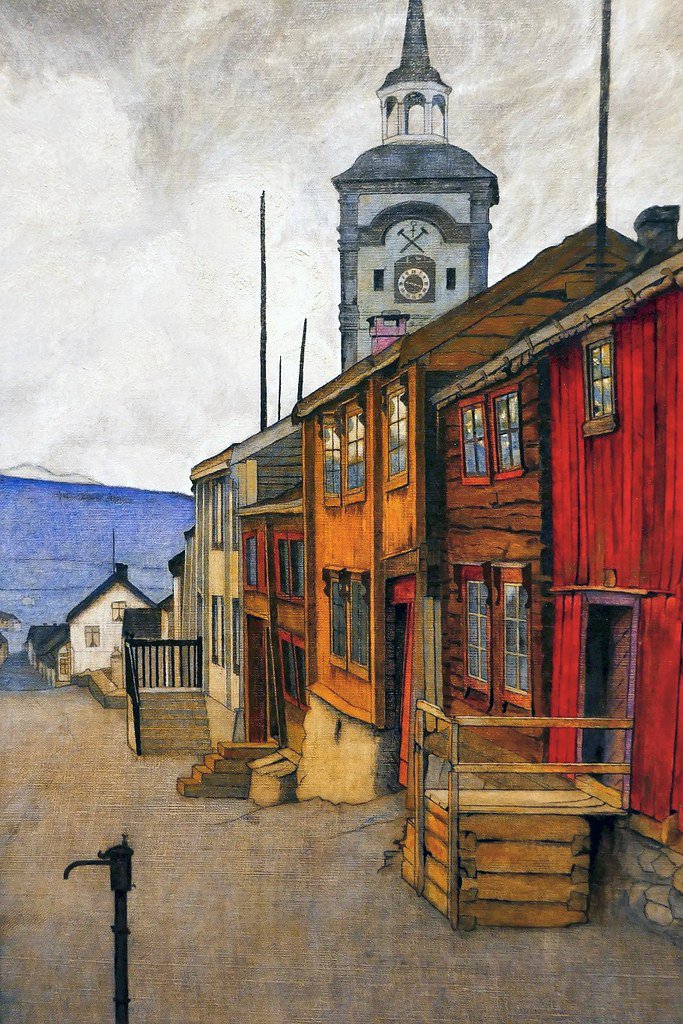
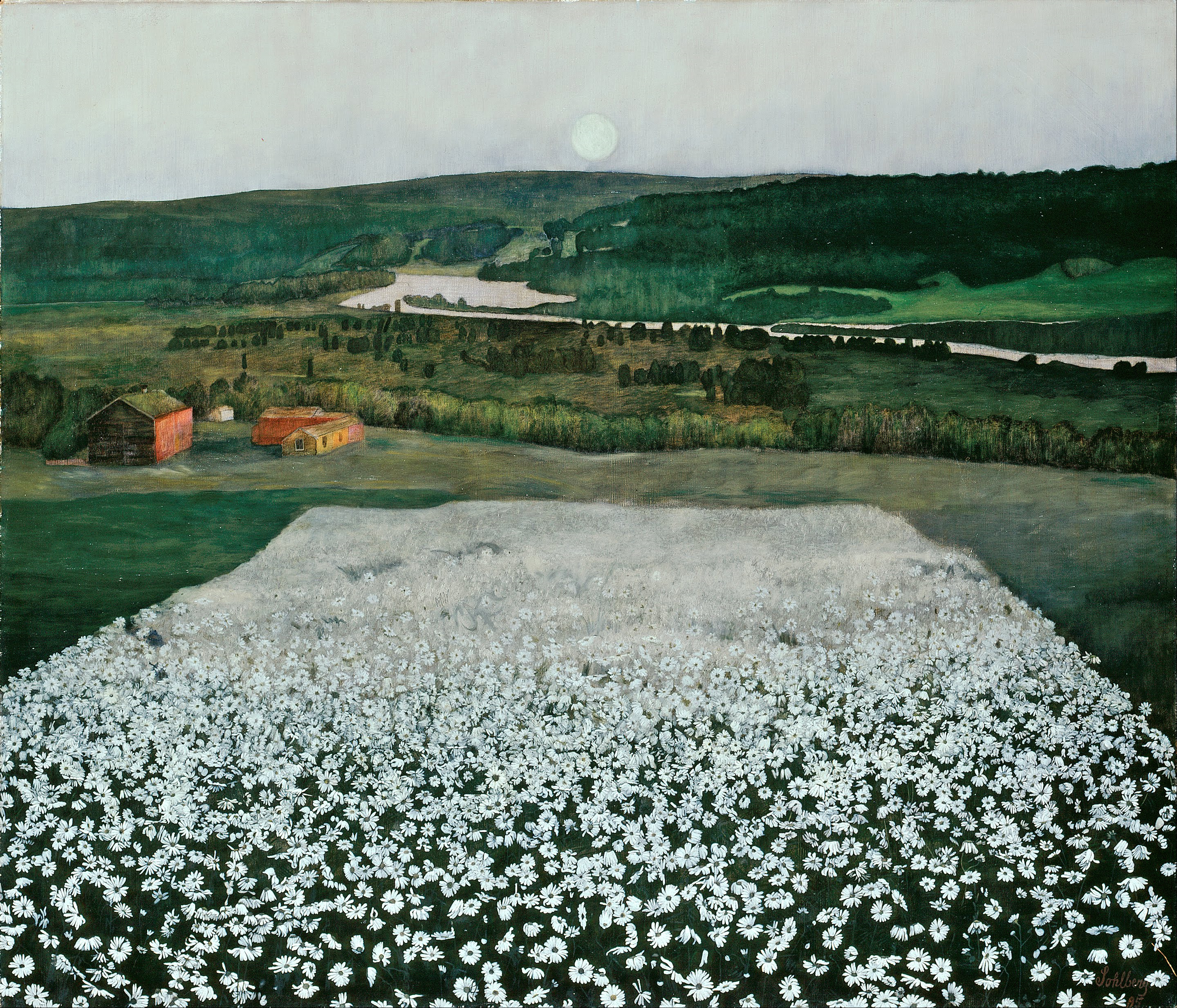
I thought I’d share a post from several years ago about a somewhat overlooked artist with whom I feel a real kinship, Harald Sohlberg, sharing many of his artistic goals and way of looking at the landscape. Like him, I seek consistency and a union of pictorial and spiritual values.

I’ve added a number of images to the original post. Take a look. Hopefully, you’ll find some tranquility in them. Have a good day.

***********************

There’s a good possibility that you haven’t heard of Harald Sohlberg, a Norwegian painter who lived from 1869 until 1935. I know he was not on my radar until I stumbled across a few of his images. In fact, there is not a lot of info about him outside of a short perfunctory bio.

This kind of stumped me but it wasn’t until I came across the short essay shown below that this made sense, giving me a lot more insight into the man behind the work. I particularly identified with his connection with the landscape and his feelings as expressed in the final paragraph where, as an old man, he desired that people see his work not for the simple scenes they seemingly portrayed but ” for the pictorial and spiritual values on which I have been working consistently throughout the years.”

As an artist, that is your greatest hope– that people will look beyond the surface and see the emotional and spiritual content that the artist uses as a catalyst. Take a moment and read this essay from a 1995 exhibit at the National Academy of Design in NYC that featured the work of Sohlberg and Edvard Munch. At least take a moment to give these few Sohlberg’s paintings a good look.

In an obituary, Pola Gauguin [son of Paul Gauguin and a painter and art critic of the time] wrote that as an artist, Harald Sohlberg was alone and forgotten: “A name which was famous in its day.” Now that Sohlberg was dead, Gauguin thought, “the coldness which he helped surround it with, will thaw.” Sohlberg’s isolation was partly the tragic result of his wholehearted endorsement of the myth of genius as formulated by Romanticism and adopted by the Symbolists. Like Munch, he was obsessively preoccupied with denying that the influence of other contemporary artists had been important to him. He dissociated himself from the discussion about where he belonged in the history of art, relegating the origins of his artistic awakening outside of art to his own psyche.

Sohlberg wrote that his form sprang forth subconsciously from his first awareness of the landscape. The difference in texture of the sky and earth gave him a sense of standing on a heavy and firm planet gazing out into boundless space. He attributed the simple forms and great lines of his pictures to this first awareness of the landscape. The point of departure was the personal experience. Thus, the artist’s experience of his subject preceded the picture. Sohlberg was preoccupied with the concrete local landscape that surrounded him and his emotional reaction to it. The place, in itself, was charged with meaning. For this reason, where he sought his subjects was important. He experienced the landscape in Norway as nature in strong and intense moods and gave form to the echoes of these moods in his mind. He agreed with many of his generation who, taking their point of departure in Andreas Aubert’s writings about Norwegian art, were of the opinion that there existed distinctive, Nordic colors, clear and strong colors created by the clear, intense light of the North. Once artists realized this, it would be possible for an independent Nordic art to develop. Sohlberg believed that, along with the unique construction of the Nordic landscape, local color ought to result in a style of its own. Experience and interpretation of nature determined the choice of colors. For Sohlberg, the main color should assemble the picture and be as strong as possible.

The function of line in painting according to him was to express feelings. It could be lonely, down to earth, or melancholy. It could be willful and persevering as required. It should be developed according to the nature of the subject and the artist’s dialogue with nature. Because the picture was bound by a perceived reality, Sohlberg paid tribute to reality by portraying it naturalistically. But his gaze carried with it the legacy of picture formulas that transformed and adapted nature. He was an artist who rarely put a stroke on the canvas before the picture was clear to him in his imagination. As an artist, he was a substitute viewer. What interested him was his own experience and interpretation, regardless of how naturalistic his pictures appeared to be. Ideally everything in the picture was controlled by his will.

As an older man, Sohlberg longed for confirmation that the public saw the values he wished to impart: “it is probably true that for simple and naive reasons my works have aroused sympathy. But I maintain that they have by no means been properly understood for the pictorial and spiritual values on which I have been working consistently throughout the years.” The quotation contains three words which are keys to an understanding of Sohlberg: “Pictorial,” “spiritual,” and “consistently.” The pictorial is means for expressing the spiritual, and one was obliged to stick to the spiritual values one held true.

– From Ivind Storm Bjerke, Edvard Munch, Harald Sohlberg: Landscapes of the Mind

Harald Sohlberg-A Street in Oslo 1911Harald Sohlberg-Night in the Mountains 1914Harald Sohlberg- After The Snowstorm Harald Sohlberg-Storgaten_Røros_1904