Feeds:
Posts
Comments

Grief and High Delight

*********************

“And I can’t be running back and fourth forever between grief and high delight.”

J.D. SalingerFranny and Zooey

**********************

When I send a painting to a gallery it is with the expectation that it might very well sell.  As a result, I don’t usually announce or comment when a piece does actually go to a new home. I am usually very pleased when a sale of my work takes place. I mean, it’s my job and my livelihood plus the sale is a validation, in a way, that the work reached out beyond my own imagination and struck a chord with someone to the point that they chose to spend their hard earned money to obtain it.

What’s not to be happy about that?

But hearing that some paintings have been sold raises conflicting emotions. On one hand, I am thrilled to see the painting find a new home and to know that I can pay my bills for another month. That is a always a good thing.

But on the other hand, there are paintings that I see as being special, as being more significant to myself. Selling one of these paintings means that it is forever out of my hands, that it is no longer mine alone. Like a part of myself has been sheared off and sent away.

As a result, much like Salinger wrote above, I find myself running back and fourth between grief and high delight.

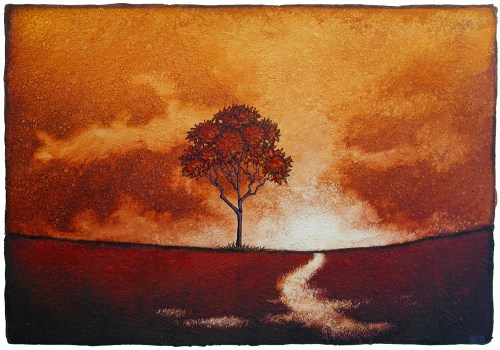
Such is the case with the painting at the top, Saints and Sinners. It’s a piece that I felt was personally among my best, one that was well beyond myself. I learned yesterday that it had sold and was very happy at first. Someone had seen that same special quality in it and was making it part of their life.

But after only a few moments, I had a sinking feeling in my stomach and a sense of loss came over me.

Even this morning, I am a little sad about it being gone forever.

Almost grief.

I say almost because, as grief goes, this is way down on the list of things that might cause one to grieve. For most people, especially non-artists, this sound ridiculous, I know.

So, let’s just call this artistic grief.

Don’t worry. I’m okay. I am not wearing black or tearing up this morning. I sold a painting, for chrissakes.

I am very happy about that but will still miss it, that’s all.

Okay, back to work. Maybe this next piece will be a worthy replacement.

Or better…


I ran the post below several years back and thought it deserved another look. As I say, it is advice from poet e e cummings to aspiring poets on becoming nobody-but-yourself, advice anyone can use for whatever creative path they might want to follow. I know it always makes me want to feel and work and fight a little bit harder. Take a look:

***************

****************

Whenever I am asked to speak with students I usually tell them to try to find their own voice, to try to find that thing that expresses who they really are. I add that this is not something that comes easily, that it takes real effort and sacrifice. The great poet e e cummings (you most likely know him for his unusual punctuation) offered up a beautiful piece of similar advice for aspiring poets that I think can be applied to most any creative discipline.

Or to anyone who simply desires to feel deeply in this world.

I particularly like the line: To be nobody-but-yourself -in a world which is doing its best, night and day, to make you everybody else-means to fight the hardest battle which any human being can fight; and never stop fighting.

That line alone speaks volumes.

Take a moment to read this short bit of advice and see what you think– or feel.

*******

A Poet’s Advice To Students

(e e cummings)

A poet is somebody who feels, and who expresses his feeling through words.

This may sound easy. It isn’t.

A lot of people think or believe or know they feel-but that’s thinking or believing or knowing; not feeling. And poetry is feeling-not knowing or believing or thinking.

Almost anybody can learn to think or believe or know, but not a single human being can be taught to feel. Why? Because whenever you think or you believe or you know, you’re a lot of other people: but the moment you feel, you’re nobody-but-yourself.

To be nobody-but-yourself -in a world which is doing its best, night and day, to make you everybody else -means to fight the hardest battle which any human being can fight; and never stop fighting.

As for expressing nobody-but-yourself in words, that means working just a little harder than anybody who isn’t a poet can possibly imagine. Why? Because nothing is quite as easy as using words like somebody else. We all of us do exactly this nearly all of the time-and whenever we do it, we’re not poets.

If, at the end of your first ten or fifteen years of fighting and working and feeling, you find you’ve written one line of one poem, you’ll be very lucky indeed.

And so my advice to all young people who wish to become poets is: do something easy, like learning how to blow up the world-unless you’re not only willing, but glad, to feel and work and fight till you die.

Does this sound dismal? It isn’t.

It’s the most wonderful life on earth.

Or so I feel.

Seeking Depths

********************

“The hidden well-spring of your soul must needs rise and run murmuring to the sea;
And the treasure of your infinite depths would be revealed to your eyes.
But let there be no scales to weigh your unknown treasure;
And seek not the depths of your knowledge with staff or sounding line.
For self is a sea boundless and measureless.
Say not, “I have found the truth,” but rather, “I have found a truth.”
Say not, “I have found the path of the soul.” Say rather, “I have met the soul walking upon my path.”
For the soul walks upon all paths.
The soul walks not upon a line, neither does it grow like a reed.
The soul unfolds itself, like a lotus of countless petals.”

― Kahlil Gibran, The Prophet

**********************

A new painting, a 24″ by 24″ piece on canvas that I call Seeking Depths.

I am starting to make progress on  work for my two main annual shows, the first at the Principle Gallery in June and the second at the West End Gallery in July. I am working on several different modes for these shows, ranging from a series of cityscapes such as the one featured in progress here last week  to revisiting the sparse ink landscapes on paper of my early work along with new paintings that are at the current end of  my painting continuum. The overlying theme for these shows is that the work will be mainly seeking to find inward depth in the picture plane and a deeper atmospheric presence.

This piece is a pretty good example of what I am looking for in the current work. There is optical depth into the canvas. The colors are darkly deep and rich. The atmosphere that moves across the depths of the painting, from the sky to the foreground, is an essential element of the painting here with  its own weight and dimension, not just a background on which everything rests.

I am looking forward to how these groups of work progress together. Having determined a direction, I now feel refreshed and eager to move ahead at a reckless pace– my favorite way to work.

We shall see what it brings…


Stuart Davis and Jazz

Stuart Davis- Swing Landscape 1938

*********************

For a number of years Jazz had a tremendous influence on my thoughts about art and life.

-Stuart Davis

**********************

I wrote yesterday about how as an artist I am influenced by many things other than the paintings of other artists. I thought I’d share some paintings from artist Stuart Davis (1892-1964) whose work itself is considered a huge influence on the Pop Art movement of the 1960’s. I’ve been a fan of his for many years, particularly after seeing how his work evolved through his career from a Robert Henri trained Modernist whose early work echoed the influence of Van Gogh through a Picasso inspired Cubist period into his own style with its own vocabulary that was largely inspired by the Jazz of the time.

I also always keep something in mind he said when I am at work: Always remember that in a painting, color has a position, and a place, and it makes space. As a result, I try to make color a vital element in my paintings, sometimes more important than the actual subject of the painting.

But, this morning let’s just look at a few of Davis’ Jazz inspired paintings and take a look and a listen to the great Duke Ellington‘s Jazz classic Take the A Train. I get the feeling Stuart Davis might have painted a bit to this track.

I am not sure but the video here looks to be a Soundie, which were short, well produced music films that were played on video jukeboxes in bars and clubs the late 1940’s. They mainly featured popular black Jazz musicians, giving these often musicians, who really didn’t have an many outlets for their music as their white counterparts, an exciting venue that really spread the popularity of their music.


Court and Spark

Joni Mitchell- The Mountain Loves the Sea- watercolor 1971

Over the years, I have often been asked about influences on my work and I often list several artists that I feel pushed me in certain directions. Then I also point out that there have been influences that fall outside of the painter mode. For example, literature, poetry and film come immediately to mind. Then there’s pop culture such as cartoons and comics, television and so much more. I’ve mentioned that there was a Coca Cola tv ad back in the 80’s that featured saturated colors– reds and golds– that stuck in my mind for years before I began painting.

There are so many contributing sources of inspiration.

I mention this today because as I was looking for a piece of music to play this  morning, I came across the old Joni Mitchell album from 1974, Court and Spark. It was a great album, one that I loved even as a teenage boy. I had not listened to it in years but each of the songs was imprinted in me by this time.

I also hadn’t looked closely at its album cover for many, many years though it was a beautiful cover, cream colored with a small watercolor painting, The Mountain Loves the Sea, that Joni Mitchell had painted a few years before, tastefully in its center. It had a simple elegance that I recognized, again even as a teenage boy. But it was just one of those things that, because I had seen it so many times before, I didn’t look with any attention at all.

But I looked closer today at the painting in the cover’s center and was surprised at how much my own work sometimes held echoes of this little painting. I would never thought of Joni Mitchell as an influence beyond her music but looking at this little image made me rethink that.

Maybe it was just one of those little things that push you without your knowledge in one direction or another. Influences that you internalize and can’t recognize or name until you come face to face with them. We all have them, those small things we take in and blend together to make us who we are.

I am glad this was one of those things for me. So, let’s give a listen to the title track from Court and Spark.

Have a great Sunday.

One of the benefits that come from writing this blog for nearly 12 years now is that on those days when I am super busy and have to get to work early, I can go into the archives and pull out a favorite. Below is a such a favorite from back in 2013, made doubly so in that it is in itself a reposting of an even earlier entry from 2009. Give a look ( and a listen) if you have a few minutes.

*********************

farmer[2013]– Yesterday, I checked my blog with a search to see if I had ever written here before about that day’s subject, Long John Baldry. I found that I had only mentioned him once in a post from back in 2009. I read the older blog and it made me chuckle. It was titled You Can’t Judge a Book… from a song that Baldry had once covered and had to do with how our preconceptions are often wrong about people. It immediately brought to mind something that had happened over the weekend here at the studio.

My niece, Sarah, brought a friend and her husband to visit the studio from their NYC home. Sarah didn’t share much about her friend outside of saying that they danced together and that she was a filmmaker for one of the large big-name auction houses in NYC.  I had no idea about what her husband did for a living. That was the extent of my knowledge outside of knowing they had been married the year before in New Orleans.

But they arrived and we had a wonderful visit. Both were charming and inquisitive, asking real questions and relating their own experiences in response to my answers. They were easy to speak with and made me feel comfortable in describing my work and process, not something that a lot of people can do easily. We visited for a couple of hours and they headed back to the city.

During our visit we learned a bit about the friend’s husband, whose name I won’t use out of respect for their privacy.  He was in the music business in some fashion, performing as a DJ, and had spent a lot of time touring here and abroad. He also was working on soundtracks for films. When I asked what sort of music he worked in, he said, in an almost apologetic way, that it was mainly rap and hip-hop. The manner of his response struck me in a curious way. He went on to explain that it was the music of when and where he grew up, in the neighborhoods of NYC. Again, this was said in an apologetic manner.

I didn’t think much about it until after they left and I decided to see if I could find out more about his music.  Googling him, I discovered that he had a prodigious reputation in the rap genre, with over twenty years in the business as a DJ and producer for a pretty big name rapper. He had recently started his own record company and had released an album  of his work only weeks before our meeting. I watched a couple of videos of his work and listened to several songs.

I am not an authority on rap/ hip hop in any form but this was powerful stuff. I was really impressed and thought back to his apologetic description of his work.

I understood it then.

He didn’t want to be judged and was trying to make it easy for me to not judge him. I mean, here I was, a middle-aged white guy with gray hair out in the country— not exactly a prime candidate for a hip-hop connoisseur. He had surely heard the venom directed toward his musical genre before from people who looked like me.

So, he judged me before I could judge him. I understood that.  It’s most likely what I would have done had I been in his place. My only regret is that it robbed me of an opportunity to ask the many questions that I formed in looking up his work after they had left the studio. It would have been fascinating to compare our creative processes, to see how he synthesized his influences. I got the impression from our talk that, though we worked in vastly different environments with disparate influences, we both working on a similar creative rhythm, expressing emotion within the framework of our own personal environments.

Well, the next time we will both know and won’t worry about judging one another. Here’s the original post from back in 2009:

I’ve just put the final details on a couple of paintings that will be part of my solo show at the Principle Gallery in Alexandria, VA. The show opens June 12th and I’m scheduled to deliver the work to the gallery a week before so I’m in the final stages of preparation. This is my tenth one-man show at the gallery and before that I did two shows as part of a group of painters from the Corning , NY area that was dubbed the Finger Lakes School.  

I particularly remember one moment from the first show with that group. There was a pretty good crowd and several of us from the group mingled, answering questions and such. I had a small break in the conversation and I heard a female voice from behind ask her companion where we were from. Her friend answered that we were from the Finger Lakes region in New York, pointing out that it was a pretty rural area with a lot of wineries and farms.

“Well, you know, they do look like farmers,” she replied.

I think I did a spit take. Over the years I often think back to that lady’s comment and sometimes laugh. Maybe we shouldn’t have all worn our overalls and straw hats that night. It just reminds me how people judge others by that initial glimpse and how often they end up being wrong. Actually, I’ve come to the conclusion that, in the end, I would prefer being mistaken for a farmer than an artist anyhow. Offhand, I can think of more positive attributes for the farmer. So, if you can make it to the opening look for the guy who looks like a farmer…

That brings me to a song, You Can’t Judge a Book, that was originally written by blues great Willie Dixon and made popular by Bo Diddley. This is a personally favorite version from Long John Baldry, one of the pioneers of the British blues/rock movement in the early 60’s and a guy who had real panache. Give a listen and be careful before judging someone, okay?

*************
https://www.youtube.com/watch?v=exANll1Mk7o

*************************

For this day’s work, lords, you have encouraged treason and opened the prison doors to free the traitors. A nation can survive its fools, and even the ambitious. But it cannot survive treason from within. An enemy at the gates is less formidable, for he is known and he carries his banners openly against the city. But the traitor moves among those within the gates freely, his sly whispers rustling through all the alleys, heard in the very halls of government itself. For the traitor appears no traitor; he speaks in the accents familiar to his victims, and he wears their face and their garments, and he appeals to the baseness that lies deep in the hearts of all men. He rots the soul of a nation; he works secretly and unknown in the night to undermine the pillars of a city; he infects the body politic so that it can no longer resist. A murderer is less to be feared. The traitor is the carrier of the plague. You have unbarred the gates of Rome to him.

************************

I have seen the words above online used as a meme, attributed to the orator Marcus Tullius Cicero from the year 42 BCE. I immediately thought they described to a tee the current situation at hand here in this country, especially with the revelations of continued Russian meddling for and collusion with our president*** from the last couple of days.

These words  certainly could be applied to this president*** and his enablers and to think they came from over two thousand years ago was enlightening. The ways of treason and the traitor have not changed much over the ages.

Taylor Caldwell

Taylor Caldwell

Unfortunately, though I feel resonance between those words and these times, those are not the actual words of Cicero. They are from a 1965 novel, A Pillar of Iron, from bestselling author Taylor Caldwell. The book is a fictionalized account of the life of Cicero and his fight to save the Republic from approaching tyranny. He was assassinated for his efforts at the urging of Marc Anthony in 43 BCE.

While the words as we see them are not the actual words of Cicero at the time, much of their intent is derived from his orations of that time. Caldwell did her research and scoured the words of Cicero to create her own fictional interpretation of what Cicero may have said when he addressed the Senate then.

So, while the traitorous treachery Caldwell’s version of Cicero called out in the words at the top of the page may have come from 1965, their meaning most likely was born in some part in the words of Cicero from over 2000 years back. And whether they are from 2000 years ago or just 55 years, fact or fiction, they are words to which we should pay attention.

Skeleton In Progress

***********************

Watching the painter painting
And all the time, the light is changing
And he keeps painting
That bit there, it was an accident
But he’s so pleased
It’s the best mistake, he could make
And it’s my favourite piece
It’s just great…

Kate Bush, from the song “An Architect’s Dream” 

*********************

I’ve been working on a group of cityscapes recently but I am not prepared to show them yet, wanting to see what direction they are sending me first. But I thought I would share a quick photo of the one I am currently at work on.

A work in progress.

It’s at the stage that is probably my favorite of all the stages that a painting inevitably passes through on its way to becoming a finished work. It is basically done from the standpoint of its composition. All the elements are blocked in and it is already beginning to impart whatever it has to share to me, its only viewer to this point. The bits of color set against the monochromatic red oxide skeleton of the piece provide bursts of contrast and add depth into the picture plane.

This stage is, except for that final moment when the piece comes to life near the end of the process, always exciting for me. It is like a human skeleton come to life as I build it, telling me aloud where I should be working on it next. It points out how much potential the painting contains, where I should focus my attention and where it can expand its feeling with multiple layers of color.

Most of the time I quietly listen to this talking skeleton and heed its directions to me.

But sometimes I want to tell the skeleton to just shut up stand still for a minute because maybe you’re done as is, Mr. Bones.

Yeah, sometimes I like the work so much at this point I want to stop and just let it be. I worry that by adding more layers of paint that I will cover its essence as I see it at this point. Make it something less than its potential.

But I never just let it be. I don’t know that I have the guts to work that way, to show it as it stands. Or have the ability to stop seeing more in it and needing to continue working at it.

This piece may be as close to just stopping as I get. I could see it being finished with just a few touches to the sky and the moon. Maybe a little more work in leveling out some of the rough spots.

Or not.

I don’t know.

I guess we’ll have to wait and see if this skeleton gets fleshed out.

Here’s the song, An Architect’s Dream, from Kate Bush that provided the lines at the beginning of this post.

Vuillard

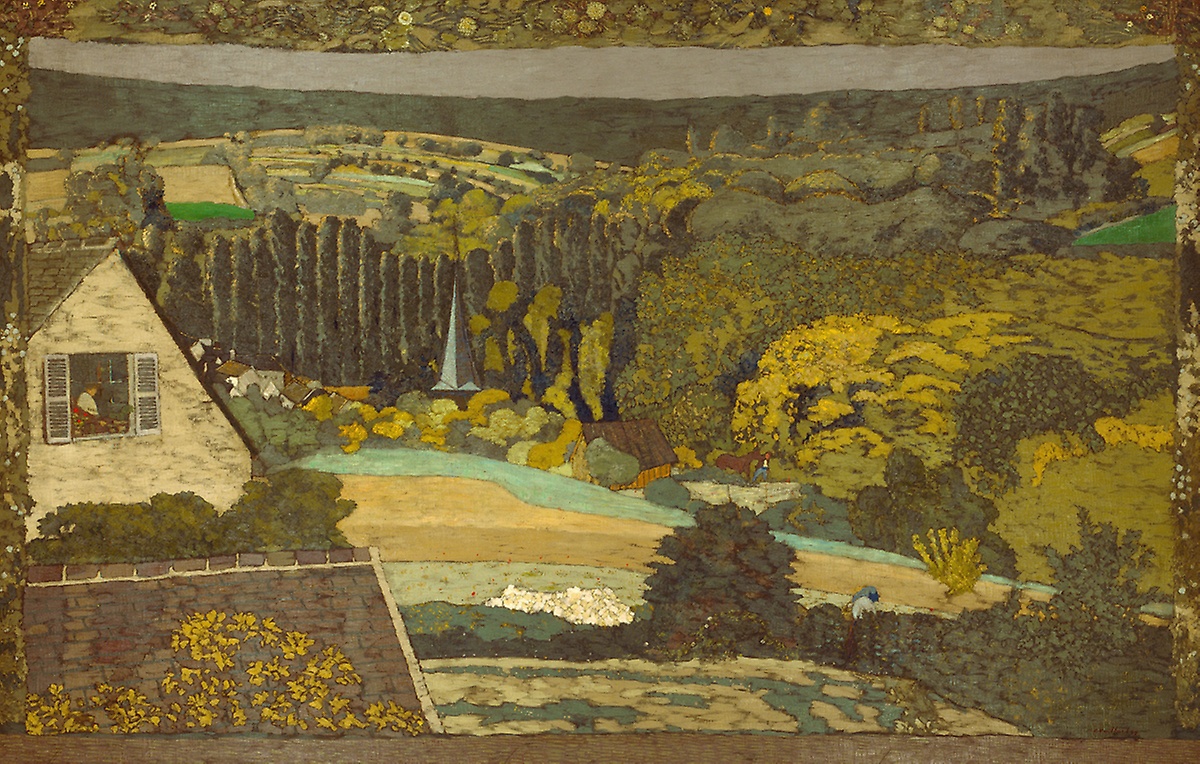
Édouard Vuillard – Landscape at Saint-Jacut

*******************
To say that a thing is beautiful is simply an act of faith, not a measurement on some kind of scale.

–Édouard Vuillard

*******************

If you asked me about my favorite painters, Édouard Vuillard (1868-1940) is not a name that would come to mind. In fact, I never even gave much thought to his work and didn’t have much of an opinion on it. I knew a little bit about the interior scenes for which he is well known but if you asked me to name or even describe his best known work, I would be at a loss.

But the more I look and the more I see of his work, the more of a fan I become of Édouard Vuillard. There is such a wide array of style in the body of his work that shows his exploration and growth.

The interior scenes I once shrugged over now seem to be wonderfully dense explorations into abstraction, pattern and color. There is so much to latch onto in each piece that a cursory glimpse doesn’t often suffice. I now see his work with a bit of a sense of awe and can honestly take that leap of faith and say that I see them as beautiful.

I even like a few of the things from him I have read, like the words at the top. Beauty is indeed subjective, not measurable with any set scale. My sense of beauty may well differ from yours. You may be moved by things that do nothing for me and vice versa. I don’t know that there is any one things, any one piece of art, that is absolutely beautiful to everyone.

Maybe there is. Who knows? Certainly not me.

He also wrote: I do not belong to any school, I simply want to do something that is personal to my self

These words depict that need to create something that is only mine, not something instantly attributable to a school or movement or any other artist, that has always been the driving force behind my own work. I don’t know that I have always been successful but I can say that Vuillard definitively did create a distinct body of art, beautiful work that is all his own.

Just good stuff. Here are a few examples from a sea of choices.


Backtracking, Again

Since I have much to do this morning, I am running this post from back in 2013 that concerns a few early pieces. I came across one of these pieces, Doug’s First Day on the Job, early this morning and, while it made me chuckle, it reminded me of current events. Thought this post was worth looking at again.

*******************

GC Myers Early Interior sm“Can you remember who you were, before the world told you who you should be?”

Charles Bukowski, Post Office

***************

I have often shown early work here, stuff from when I was still trying to find a path forward. Most of it is from before I ever thought  that showing my work in public was a possibility. As I have pointed out, I still revisit this early work on a regular basis in an effort to stay connected with that time in which the need to create was the only motivation needed. There’s also an element of backtracking in this as well, trying to put together how this work somehow led to what I do now.

Sometimes it is hard to see the connections as the work is so singular and never followed up on, then or now. I think those are the pieces from that time that intrigue me the most, making me wonder how my journey forward from that time would have been different had I chosen and stayed on that path.

For example, here are three pieces from around the same time, all painted within a month or so of each other back in 1994. None really lead directly forward to the current time but I really always enjoy seeing these three pieces, wondering what my motivation was at the time. The first , shown above, is an interior scene that just formed on the paper. I had no idea what was going to be there, outside of the checkered tablecloth. I remember that the cross on the wall was a last minute addition, one that changed the whole feel of the piece. I can understand why I didn’t follow this path but it still makes me wonder.

GC Myers Still Life smThe next was this still life, here on the left. I remember this piece well, having ambivalent feelings about it as a whole. I liked the clear graphic look of it but it was almost too clean, too sharp. It had really good eye appeal but it seemed all surface to me. I see things from this piece that I did bring forward, such as some of the clearness of the colors which I like in some instances. The thing that always strikes me is that I see a face in profile, looking to the right. Faces subconsciously built into the composition are something I often look for in my work, feeling a curious satisfaction when I find them. I wish I knew why. Maybe that’s what draws me back to these early pieces.

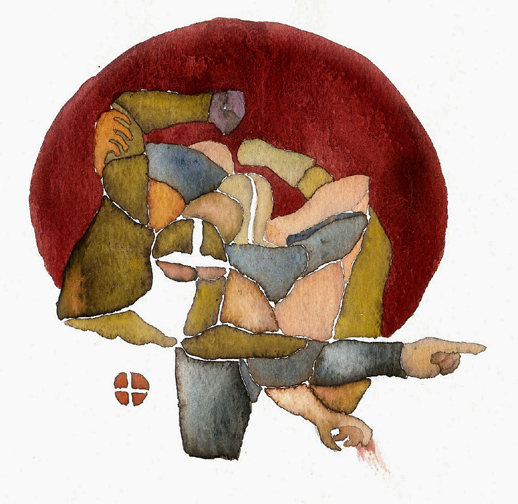
GC Myers- Doug's First day on the Job smThe last was one that had a title, Doug’s First Day on the Job.  I remember this as a piece that I viewed as an exercise even as I started, experimenting with forms and color. The resulting scrum of arms and fists with the strange authoritarian figure in the foreground, hooded and  pointing ominously out of frame reminded me of the chaos and confusion of  a kid’s first day on a new job. A strange environment with new procedures to learn and strange new people who struggle with each other and boss the new guy around. I knew even as I painted this that this was not my path but I enjoyed this piece anyway. It had a cleansing effect and was a wonderful lesson in color and form .

Plus it made me chuckle.

I don’t know that there is any great connection between these pieces or to my future and current work. I always wonder though at how these disparate  pieces formed in such a short time, wondering if I have that same burst of energy within me still. Maybe that is the reason for this backtracking, looking for that energy source, that fount of inspiration.

I don’t know…