Feeds:
Posts
Comments

Seventh Heaven

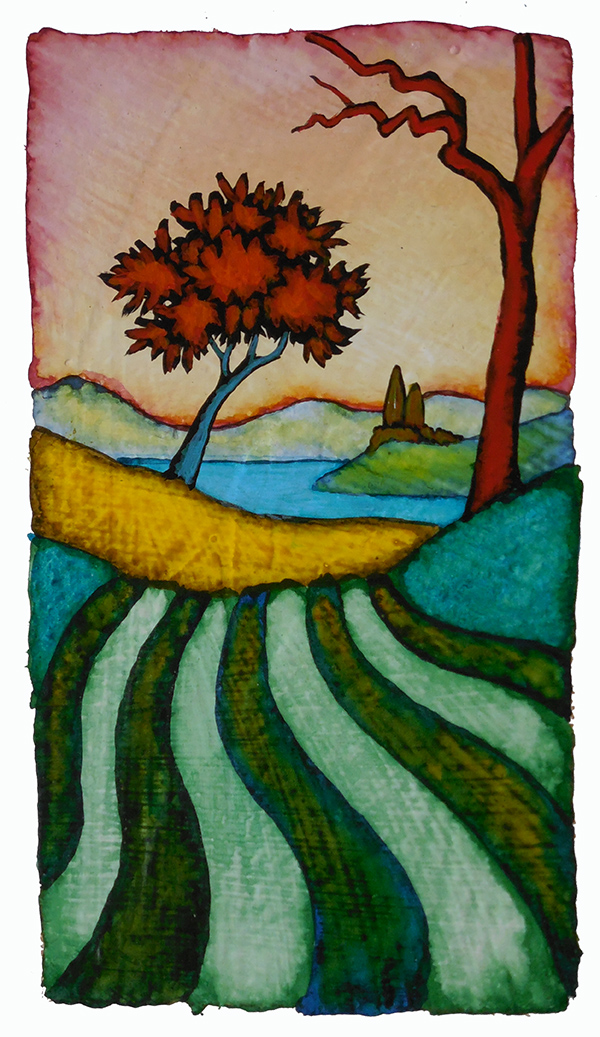
When I finished this small painting, the term Seventh Heaven quickly came to mind and bound itself to it as its title. There was a quality attached to it that evoked that phrase that I’ve heard thousands of times, mostly describing a time and place of immense satisfaction.

Bliss.

But in all those times I never thought about what Seventh Heaven really meant or where it came from. It was just a phrase that was thrown around easily without thought.

Turns out it has beginnings and attachments to the ancient Greeks, the Kabbalah of Jewish mysticism and in Hindic and Islamic belief.

The Greeks’ believed there to be seven classical planets beyond our earth —Mercury, Venus, the Moon, the Sun, Mars, Jupiter, and Saturn— each having its own heaven.

In the Jewish Kabbalah, there are seven levels of heaven, each ruled by an angel. For example, Shamayim is the first heaven, governed by Archangel Gabriel. It is the closest of heavenly realms to the Earth; it is also considered the abode of Adam and Eve. The seventh heaven here is called Araboth. Under the leadership of the angel of Saturn, Cassiel, it is the holiest of the seven heavens, housing the Throne of Glory attended by the Seven Archangels and serves as the realm in which God dwells. Beneath the throne itself lies the abode of all unborn human souls. It is also considered the home of the Seraphim, the Cherubim, and the Hayyoth.

The Islamic seventh heaven is similar in many ways to that of the Kabbalah, comprised of a divine light that is incomprehensible to mortal man.

Hinduism divides the material universe into fourteen worlds, seven of them being upper and seven being lower. Brahmaloka is the highest of the seven upper worlds, the highest of the joyful worlds a person might attain. It is the home of Lord Brahma.

There’s more but we’re going to keep this shallow today. It comes down to all of the different forms of  Seventh Heaven denoting a place of ultimate joy.

That description fits this little piece, with its seven rows in the field of the foreground, for me.

It is a seventh heaven by itself.  Even if it brings me only a moment of bliss, that’s I all I can ask for here on this earth, I suppose.

******************

This piece, Seventh Heaven, is part of the Little Gems exhibit at the West End Gallery which opens Friday, February 7 with an opening reception that runs 5-7:30 PM.


.
 

Coming to the studio this morning and the song, It Ain’t Necessarily So, runs incessantly in my head for some unknown reason, reminding me of a post from a few years back that speaks directly to this. Here it is:

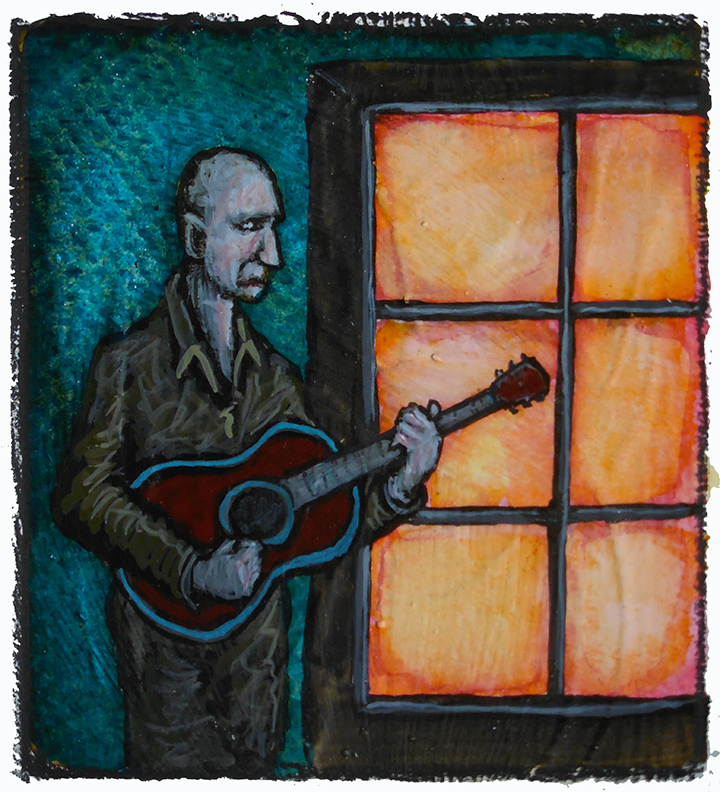
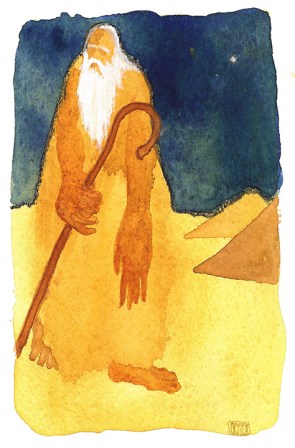
GC Myers- Moses (I Supposes)Sometimes when I am walking over to the studio in the morning I will have a song stuck in my head. Sometimes it is one that I recently heard, something from the radio. But sometimes it’s one that just springs deeply from the past, something I haven’t thought of in some time. That’s how it was this morning. And thinking of that song linked me to a small painting that I did many years ago.

They just fit together in my mind for some reason.

The song was It Ain’t Necessarily So, the song sung by the slick drug dealing Sporting Life in the great George and Ira Gershwin opera, Porgy and Bess, set among the Gullah population living on the sea islands off of Charleston, South Carolina.

Just a fantastic mix of sound and wordplay.

For some unknown reason, when I hear this song this small painting from over 20 years ago always comes to mind. It’s a piece that I did very quickly, not really knowing what I was trying to paint.  It just sort of popped out and I immediately began calling it Moses (I Supposes). There was something about this piece that I have always liked. Maybe it’s the I-don’t-give-a-damn way way everything in it is painted, from the giant hands down to the giant feet.

It’s just a personal favorite that somehow always springs to mind when I think of this song. Maybe because Moses is mentioned in a verse in the song–

Lil’ Moses was found in a stream
He floated on water
‘Til Ole’ Pharaoh’s daughter
She fished him, she says from dat stream.
***************
I don’t know for sure why the song and painting are connected in my mind but I enjoy the combination. Here is one of my favorite versions of the song, the one from the Simon Rattle directed version with the London Philharmonic from the Glyndbourne Festival with Damon Evans as Sporting Life.
Have a great day and remember– not everything is necessarily as it seems to be. It ain’t necessarily so…
**************


Riding High

The annual Little Gems exhibit opens this coming Friday, February 7, at the West End Gallery in Corning. This is the 26th year that the West End has hosted this show and I am fortunate to have been along for the ride, going back to that first one in 1995 at their second story old gallery space.

That was my first experience showing my work publicly. I had no idea what to expect when I stood there, anxiously trying to blend into the background as people milled around the gallery, on that night of the first opening. But based on the past 25 years, things seem to have worked out okay.

For me and for the Little Gems show which has turned out to be a perennial favorite for fans of the West End Gallery. It is the most popular show there, year in and year out. It’s fun for most of the artists to make small work and perhaps try out new things. There are plenty of small but mighty paintings created for this show which allows attendees, be they avid or first-time collectors, to attain original and high quality pieces of art at obtainable prices.

This painting above is called Riding High. I haven’t looked back but I think a boat painting is part of my contribution for this show most years. It’s a theme and an image that translates well to a smaller scale, maintaining its full impact. By that, I mean that it seems bigger on the wall than it actually is.

A lot of the work throughout this show have that quality.

So, hope you can make it to the show this Friday, February 7. The opening reception begins at 5 PM and goes to 7:30. The show is hanging if you want to stop in for a preview and to claim a little gem for yourself.

Here’s a song from the late June Carter Cash‘s final album that I think lines up well with this painting. It’s a lovely old Carter Family song called Sinking in the Lonesome Sea.

Have a good day.


Memoir

**********************

“I’m not sure this will make sense to you but I felt as though I’d turned around to look in a different direction so that I no longer faced backward toward the past but forward toward the future. And now the question confronting me was this: What would the future be”

― Arthur Golden, Memoirs of a Geisha

**********************

This small painting that is hanging as part of the Little Gems exhibit at the West End Gallery (opening Friday, February 7) is titled Memoir.

The thought behind that title was that that while the future seems uncertain as we look forward, our pasts as we recall them are often just as uncertain.

Our personal histories are a patchwork, like the sky in this painting, of half memories and dimly lit stories. Faces and names fade. Words once spoken are lost in the void. We have grainy snips and snaps of what we recall as significant moments and some surprisingly sharp images of insignificant moments that puzzle us, leaving us to wonder why they remain so clear.

Do they mean something more and we just don’t see their true meaning?

I looked at this small piece and wondered what I would include in my memoir. What would I pull from that haphazard patchwork that I would want to share now and into the future?

After sifting through the shards of broken memories, I come to the conclusion that I don’t want to write a memoir. Let my memoir show itself in my work, let my story be told in paint and line and shapes, a crude group of hieroglyphs that will no doubt go untranslated in generations to come.

Let the future, if it is so inclined, write my past. That shall be memoir enough for me.

For this Sunday morning music, here’s a song to go along with this painting. It’s the Nick Lowe pop classic, When I Write the Book.

Have a good Sunday.

Moral Bankruptcy

**************************

The worst of it is that we live in a spoiled moral environment. We have become morally ill because we are used to saying one thing and thinking another. We have learned not to believe in anything, not to care about each other, to worry only about ourselves. The concepts of love, friendship, mercy, humility or forgiveness have lost their depths and dimension, and for many of us they represent only some sort of psychological curiosity or they appear as long-lost wanderers from faraway times, somewhat ludicrous in the era of computers and space ships. . . .

If I speak about a spoiled moral atmosphere I don’t refer only to our masters. . . I’m speaking about all of us. For all of us have grown used to the totalitarian system and accepted it as an immutable fact, and thereby actually helped keep it going. None of us are only its victims; we are all also responsible for it.

Vaclav Havel, New Year’s Day Address, 1990

**************************

I came across the line, We have become morally ill because we are used to saying one thing and thinking another, in a tweet last night from former CIA Director John McLaughlin who said it ran through his mind several times yesterday as he watched the display of moral bankruptcy from the GOP senators taking place before our very eyes.

The onetime Czech playwright and dissident Vaclav Havel spoke those words in his New Year’s Day address to the Czech people after becoming the first democratically elected President of that nation in the post-communist era just weeks before. To that point, Havel had lived his entire life under an authoritarian regime. His plays were banned in his own land and he was imprisoned as a political prisoner multiple times, over four years during the longest incarceration, for attempting to bring light into a society where truth was what the regime claimed it to be. Many citizens were under almost constant surveillance and show trials were the norm.

Shows trials are those, particularly in Soviet nations of the Cold War Era, that have a predetermined outcome and don’t rely on witnesses or real evidence. As with truth, the evidence was what the regime claimed it to be. It was an expedient manner to remove political opponent with the appearance of justice taking place.

Sound familiar?

After reading Havel’s address and watching the events of the last few days, knowing already what the outcome will be as in any show trial, I could see real parallels in the moral illness that Havel described in his address and the behavior of our Republican senators. How can these people who speak one thing while thinking another believe that this will not corrupt our whole society, that which they have been entrusted to protect?

Their corruption will beget more corruption and that corruption more yet. Our Great Leader’s thousands upon thousands of lies will become accepted truths and his skewed amorality becomes the moral compass of our nation. Unless we reject these new norms, we will remain in this spiral that will soon bring us to a form of totalitarianism complete with more show trials and deeper surveillance for those who dare to stand against those in power.

We still have a chance to avoid this end. As Havel said: None of us are only its victims; we are all also responsible for it.

You can’t stand on the sidelines now. You can’t let others do the heavy lifting alone. Too many of us have done that for too long.

We are all responsible for it.


Wicked Game

************************

The world was on fire and no one could save me but you
It’s strange what desire will make foolish people do

Chris Isaak, Wicked Game

************************

Another piece headed to the West End Gallery for their annual Little Gems exhibit, opening next Friday, February 7. It’s called Wicked Game after the title of the Chris Isaak song from 1989. Wow, hard to believe it’s been that long. But that opening line– The world was on fire…— was the first thing that came to mind when I finished this little piece.

It fit the painting.

As does the second line– It’s strange what desire will make foolish people do…– which fits the time, this particular moment in history as we watch a Republican party so fixated on their desire to maintain power that they will turn a blind eye to the corruption of our system that has taken place in the open for us all to see. The question of whether they will ever stand up for truth and justice, against those wrongs we know have been done and those we expect will be done in the future, seems to leaning toward a big and emphatic NO.

Doing that which is right even when it doesn’t personally benefit you or goes against your personal interests is a noble and honorable thing.

Don’t expect to see such a thing anytime soon.

Like the song says: It’s strange what desire will make foolish people do. Put on your seatbelts, folks. It’s going to be a bumpy ride.

Here’s the original from Chris Isaak.


Yesterday, Alan Dershowitz ,the attorney for the president***, stated:

“If a president does something which he believes will help him get elected in the public interest, that cannot be the kind of quid pro quo that results in impeachment.

Reading this with the most benign interpretation, you might have a scintilla of reasonable argument. The president very well may do things that are in the public interest that also make him look better just because he’s did his job. Signing trade deals, for example.

But that’s not what we’re looking looking at here. And if you look at what Dershowitz claims in practical terms shows it for the insanity it is.

In short, anything the president*** does to be reelected is not illegal or impeachable so long as he believes his reelection is the best thing for the nation.

It’s a throwback to Richard Nixon‘s response in his David Frost interview when asked about the illegality of his actions: “Well, when the president does it, that means that it is not illegal.

This argument places the power of the president above all law.

It also opens a Pandora’s Box for behaviors that could well push a nation into authoritarianism.

By Dershowitz’s logic, if the president*** believed (just believed with no evidence) that the election of the Democratic candidate for president would not be the best thing in the public interest, he could unleash all sorts of attacks with the full power of all the governmental agencies at his disposal.

Anything he did toward this end would be permissible. Anything.

And because of this current sham trial and the expected acquittal being gifted to the president*** by this craven and cowering group of GOP senators, there will be no oversight, no method of stopping him from crushing anyone who stood up to him. Even his cover ups and his refusal to provide documents or allow testimony become legal because, in his mind, it is in the public interest.

His interest becomes the public interest.

His grievances become the public’s grievances.

And he is a man with more grievances than any other man alive.

That’s scary territory, folks. Especially when you’re dealing with the kind of personality we know is possessed by this person.

We will have no guarantees of fair elections or of fair justice. There are so many scenarios– and all of them are awful– that wait for us if we throw open the lid of this Pandora’s Box.

And many of them will affect average citizens in a very real and negative fashion. It won’t just be high profile politicos.

There will be an acquittal. We all know that. Short of new new impeachment proceedings (he can be impeached again and again) brought about by even more overwhelming evidence, we will only have one chance to slam this lid shut.

And that is to Vote Blue in overwhelming numbers up and down the ballot in this year’s elections.

Don’t wait. Make sure you’re registered to vote now. Make sure your friends and families register and vote.

To do anything less is insanity.


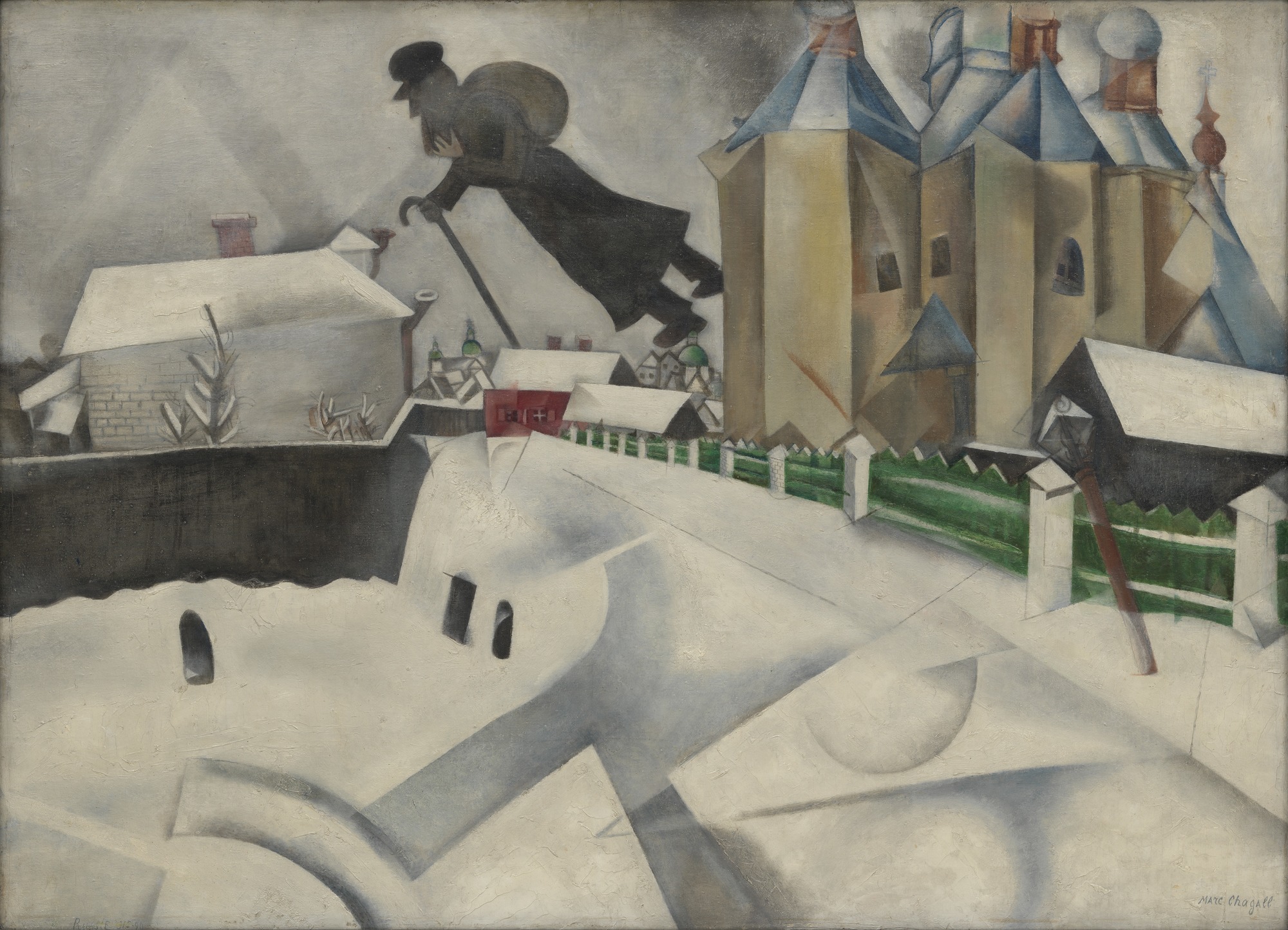
Marc Chagall- Paris Through My Window 1913

*****************

If a symbol should be discovered in a painting of mine, it was not my intention. It is a result I did not seek. It is something that may be found afterwards, and which can be interpreted according to taste.

–Marc Chagall

*****************

I love that a painter like Marc Chagall whose work is seemingly teeming with symbols never painted them with the intention of becoming such. It seems hard to believe but I believe him and understand what he’s saying. So often something in a painting gets picked up on by a viewer who infuses personal meaning onto it.

It becomes something more.

And even after it has attained symbolic status, it is stilled created in later iterations without that in mind. At the moment of creation, it’s just about giving the vision a sense of completeness. It is simply what it is at that moment and becomes something else afterward.

Another favorite of mine, Richard Diebenkorn, said pretty much the same thing: I trust the symbol that is arrived at in the making of the painting. Meaningful symbols aren’t invented as such, they are made or discovered as symbol later. 

Basically, the artist paints first then translates after the fact.

Hey, symbols happen.

That works for me and I think this is the case for most artists. I don’t really know for sure. I am sure there artists who wouldn’t agree with this, especially those who deal in allegorical work which is symbolic by design, and that’s fine. Everyone has their own mode of operation that hopefully works for them.

That being said, this is just an excuse to look at some Chagall paintings and the symbols in them.

Marc Chagall- La Vie 1964

Marc Chagall- The Night the Sun Rose

Marc Chagall Over Vitebsk 1915-20


Yesterday, we observed the 75th anniversary of the liberation of the Auschwitz concentration camp near the end of World War II. an event which made clear the horrors that the Nazis had perpetrated on the Jews and other groups. One of the survivors of Auschwitz was Viktor Frankl, who went on to become an eminent psychiatrist and author.

His book, Man’s Search For Meaning, is one of my favorite books, one that brought more insight to the world of those who lived through the Holocaust. The lessons from it also helped me through the tough times in my life. The post below from several years back discusses the lesson of that book.

I urge you to read the book. You can even listen to the entire audiobook freely on YouTube. I have included it at the bottom along with a video presentation that gives a brief synopsis of some of the takeaways from the book. It’s short and well done. There is an ad for the Great Courses which takes up the last minute but it’s worth watching.

++++++++++++++

GC Myers- The Moment's Mission 2011Everyone has his own specific vocation or mission in life; everyone must carry out a concrete assignment that demands fulfillment. Therein he cannot be replaced, nor can his life be repeated, thus, everyone’s task is unique as his specific opportunity.
——Viktor Frankl

**********************

The words of Viktor Frankl, the WW II concentration camp survivor who went on to greater fame as a psychotherapist and author, seemed to ring true for this square painting after I finished it. I saw the Red Tree here as one that finally saw its uniqueness in the world, sensing in the moment that with this individuality there came a mission that must be carried out.

A reason for being. A purpose.

I think that’s something we have all desired in our lives. I know it was something I have longed for throughout my life and often found lacking at earlier stages. I remember reading Frankl’s book, Man’s Search For Meaning, at a point when I felt adrift in the world. I read how the inmates of the concentration camp who survived often had  a reason that they consciously grasped in order to continue their struggle to live. It could be something as simple as seeing the ones they loved again or finishing a task they had set for themselves. Anything to give them a sense of future. Those who lost their faith in a future lost their will to live and usually perished.

At the time when I read this, I understood the words but didn’t fully comprehend the concept. I felt little meaning in my life and didn’t see one near at hand. It wasn’t until years later when I finally found what I do now that I began to understand Frankl’s words and saw that I had purpose in this world as a husband, an artist and a person of feeling.

We are all unique beings. We all have unique missions. The trick is in recognizing our individuality and trusting that it will carry us forward into a future

+++++++++++++


**********************

I myself incline to drift, to accept a lesser situation rather than strive for a greater, and yet, I know that character in life and art is only made by an effort that is quite beyond one’s ordinary everyday acceptance of things as they are. 

–Lawren Harris, Letter to Catherine Whyte

**********************

Came across this quote from one of my favorites, the painter Lawren Harris, and it really stood out for me on a couple of fronts.

Personally, it was a reminder that an artist’s character is developed by continuing to push beyond what they know they can do. To become more and not settle for the situation as it is. It’s easy to do what you know is possible but trying to do what you are not sure is within your grasp builds confidence, builds character. That is what moves the needle.

That’s an important thing for any artist to have in mind. I know I have to kick myself on a regular basis to not lull myself to sleep by doing what I know I can do and not attempting to do that new thing that seems too much for me to handle.

But on a larger scale, Harris’ words speak to where we are as a nation at this very moment, We are in a crucial moment and what happens in the coming days and weeks will determine both where we are headed as a nation and what makes up our collective character. Do we take the easy way that just accepts things as they are? Or do we pull from deep within our character and do that which is right even though it might require true effort and perhaps even sacrifice?

I wish I could say which way it will go but I don’t know. I believe that there is so much more that will be soon uncovered that to maintain the status quo will be untenable and there will be big change.

That the character we aspire to as a nation will finally come forward.

But that’s just my belief. Like all beliefs, without effort, it’s not worth much.

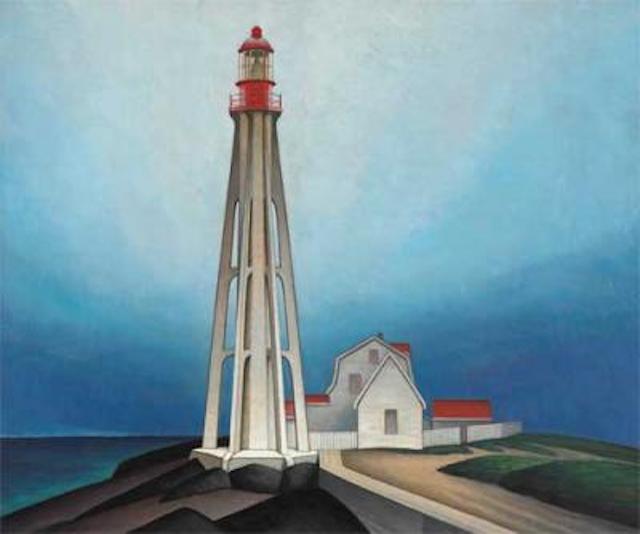
I thought the painting at the top, Light House at Father Point, was a great symbol for this post. The light house is a warning device, one that alerts sailors that they are approaching an area where they must proceed with caution.

We are at such a point as well. If we don’t pay attention we could end up on the rocks.

Let’s heed the warning from our own light house and not just take what is at hand as being the way things should be.

Let’s make an effort.

Let’s be more.

Let that define our character.