… With your majestic and superior cackling hen Your people I do not understand, So to you I shall put an end And you’ll never hear surf music again…
–Jimi Hendrix, Third Rock From the Sun
*****************
It’s said that that the final line from the spoken word section of Jimi Hendrix’s Third Rock From the Sun in 1967 was a response to hearing that Dick Dale, the King of Surf Guitar, was gravely ill with colon cancer. Well, Dick Dale got past that dangerous episode and continued his reign for another 50+ years, passing away yesterday at the age of 81.
His background hardly pointed to his rise as the King of Surf Guitar. Born in Boston, Dale (the name he adopted for the stage– his real name was Monsour) was of Lebanese descent and was raised playing Middle Eastern instruments which provided the basis for his style of playing. You can really hear it in his most popular song, Misirlou. It was revived with its prominence in the film Pulp Fiction.
Dale had a great run promoting himself as the King of Surf Guitar through the years, even as surf music faded into a its niche as a nostalgic reminder of its popularity in the early 1960’s. But Misirlou had staying power beyond nostalgia. It’s just good stuff that can still get people on their feet.
So, here’s to you Dick Dale. Your music will live on. Here’s a performance of Misirlou from Dick Dale in 1995.
For this Sunday morning music, it would be hard to not feature a bit of the Irish. It is St. Patrick’s Day, after all. So I thought I’d share a beautiful version of old Irish chestnut, Raglan Road, performed by actress Cristin Milioti. Hardly an Irish name but this is a lovely version of a beautiful tune. (You can click here to see the poetry of these lyrics.) You might recognize her from her work on the second season of Fargo where she played Betsy Solverson, the cancer stricken police chief’s wife.
I thought I’d also replay a post from a few years back about one of my Irish ancestors. As I say in the post, it’s story of many immigrant families. Have a great day. You, too, St. Patrick.
One of the things I am trying to emphasize with this current Iconseries is the fact that we are all flawed in some way, that we all have deficiencies and stumbles along the way. Yet, uncovering these faults in my research, I find myself holding affection for many of these ancestors that dot my family tree. Perhaps it is the simple fact that without them I would not be here or perhaps I see some of my own flaws in them.
I’m still working on that bit of psychology.
The 12″ by 12″ canvas shown here is titled Icon: Mary T. She is my great-great grandmother. Born Mary Anne Ryan of, I believe, Irish immigrant parents in the Utica area (though some records list her as being born in Ireland) she married Michael Tobin, an Irishman ( it is thought that he was from County Kerry but the research is still up in the air on this) who came to the States around 1850, right in the midst of the Great Irish Immigration.
Michael worked on the railroads being built throughout central New York in the late 1800’s. Following the progress of the railroads, the couple and their growing family worked their way down through the state towards Binghamton, NY where they eventually settled. Mary Anne eventually ended up as a housekeeper in a prominent home in the area. Michael died around 1890 although records are sketchy on this and Mary died at my great-grandmother’s home in Elmira in 1914.
All told, they had seven daughters and three sons. Most worked in the then booming tobacco industry of that time and place. Most of her daughters worked as tobacco strippers and some worked as cigar rollers, as did her sons.
That’s the simple telling of the story. Looking into the back stories provide a little more depth which can sometimes change all perceptions.
None of her sons ever married and all had desperate problems with alcohol. One son was listed in a newspaper report from some years later as having been arrested for public drunkenness around 40 times over the years, seven times in one year. He was also arrested for running a still more than once during the prohibition years. Two of her sons died in institutions where they had been placed for their alcoholism.
A Silk Spencer
I came across a story in the local Binghamton newspapers about Mary and two of her daughters, who were also working as domestics with here in the prominent Binghamton home owned by a local attorney and nephew of the founder of Binghamton. In 1874, the story reports that a number of items came up missing, including a “forty dollar silk spencer,” which is a sort of short garment like the one shown here at the right. Neighbors informed the owner of the spencer that Mary had a number of the stolen items in her possession and a search warrant was sworn out.
Detectives came to the Tobin home and made a thorough search but turned up nothing. They then, acting on a hunch, tore up the carpets which revealed a trap door that led to a small hidden basement. There they found many of the stolen items but no spencer. But they did find a silk collar that had been attached to it. Mary and her two daughters were arrested.
Mary did finally claim to be the sole thief and her daughters were released. I have yet to find how this particular story ends and how Mary was punished but based on the futures of some of her children I can’t see it being a happy ending.
Doing this painting, I was tempted to make my Mary a bit harsher, a lit more worn. But as I said, there’s some sort of strange ancestral affection at play even though I know she was obviously a flawed human. She’s smaller and more delicate looking in the painting than I imagine she was in reality. But maybe that’s little payback for the information her story reveals about the future of my family.
This is a simple painting because, as I pointed out, this is a simple story at its surface. It’s the story of many, many immigrant families.
“Our civilization is flinging itself to pieces. Stand back from the centrifuge.”
― Ray Bradbury, Fahrenheit 451
*************************
I have completed a number of paintings in my Multitudes (or Masks or Faces or whatever the hell I am going to call them) series in the past couple of months and I still can’t quite put my finger on what they truly are or what purpose they serve for myself. As I’ve said, many of these faces have lived with me for most of my life.
They are absolutely familiar. Maybe even going to the base of the word, they seem like family.
The overall effect from these pieces for myself is not a stirring of one single emotion. They are a compendium of feelings. Some are benign and some are very kind faces. Some are worried and fearful. Some seem lost in thought and some just seem lost. Some are angry and some even contain a bit of menace and hatred.
The massing of them tends to balance the emotions for me.
This seems less so in the piece shown above, an 18″ by 18″ canvas that I originally called The March. It’s a piece that I find very appealing in so many ways, especially in the glow its colors produce in any kind of light. The colors, especially the orange/red of the flags, seem to pop off the surface and at a glimpse it seems almost festive. Maybe a celebratory parade?
But the more I look, the more it frightens me, seemingly capturing some innate dread of mine. I see in it a reflection of some of the craziness that is in great abundance around the world at this juncture in time. Waking this morning to hear of the 49 people slain by a white supremacist as they worshipped in their mosques in New Zealand only reinforces this sense of dread and looking at this piece, I see in it the willingness of people to join in, to sacrifice self and sense to become part of a mass movement to march under a banner that divides more than it unites.
The joy and snap of the banners that I first saw in this painting have become something else. They now represent a emboldened expression of feelings and beliefs that is sanctioned by the crowd. Most had been rightfully restrained in shame for decades and centuries but have now been unleashed. They now seem to me like banners of ignorance and stupidity, of racial hatred and blind allegiance to dead ideals.
It was never intended to be so. I just painted it as it came to me, delighting in the colors and forms as they came together. It came easily and freely, giving me great pleasure and joy as I painted it.
But now when I look at the faces and bodies with their uniform shade of color, I see a parade of old white men marching to protect that which they see as their god given sense of entitlement. Even the poorest among this crowd believes that the earth is their’s alone, that they reign supreme over all races and species. In it I see this crowd as believing this is their last ditch effort to maintain this imagined supremacy. That now is the time to take this world back.
And in the world outside this painting, I sense the same. It is a worrisome and dangerous time. We must be vigilant against this parade of fools. And after writing this this morning, maybe that is what the title should be.
Parade of Fools– that will be its title, after all.
Funny how the perception of a piece can change with time and circumstance.
“You study, you learn, but you guard the original naïveté. It has to be within you, as desire for drink is within the drunkard or love is within the lover.”
― Henri Matisse
*******************************
I can always turn to Henri Matisse for something interesting, either in his work or in his words. While he was prolific in his painting there is also a wealth of quotes, interviews and essays from him that give insight into a warmly wise and giving spirit. I will admit that there are painters whose body of work more readily excite me but the words of Matisse never fail to provide inspiration and reassurance when I am seeking some form of validation of what I am doing.
For instance, he speaks of maintaining one’s own original naïveté as one learns and grows as an artist. That rawness and the natural sense of excitement that comes with it, is something I have also felt was important to maintain even as my craft has grown. I see the raw energy of naïveté as the blood that gives a painting its life force, that allows the viewer to see past the improbabilities and imperfections and see the beauty and truth being presented.
Maintaining that naïveté is much more difficult than you might think. You sometimes have to fight against the proficiency gained through years of practice and trade the reality of the world shared with everyone else for the reality contained within yourself, trusting that this inner world, imperfect as it is, will have a commonality that might speak to similar inner worlds among some of those who view it.
And that brings us to another favorite Matisse quote, below. The link to the universe he mentions is very much the same thing that links one’s inner world to that of another. At least that’s how I see it. This seems like a good spot to end this. Have a great day
***************************
“We ought to view ourselves with the same curiosity and openness with which we study a tree, the sky or a thought, because we too are linked to the entire universe.”
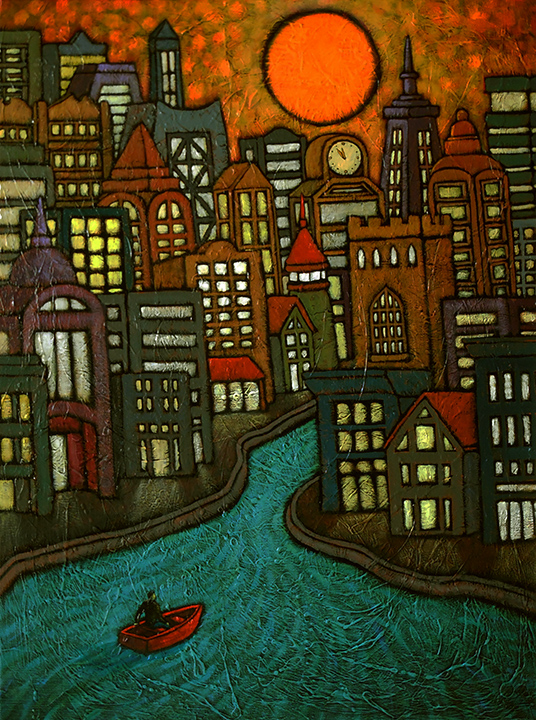
Daylight Savings Time! Woke up late this morning so I am hustling around trying to get to a piece on the easel that has been gnawing at me overnight. I just realized yesterday that in all the time I’ve been doing his blog and sharing some of my favorite music I hadn’t played any Jimmy Reed, the late great bluesman. Going to rectify that today. I came across his albums when I was teen and some of his songs from the 50’s and early 60’s remain among my faves including Big Boss Man (You ain’t so big/ You just tall That’s all), Baby What You Want Me to Do ( You got me runnin’/ You got me hidin’), Ain’t That Lovin’ You Baby, and the song I’m sharing below, Bright Lights Big City.
Thought the painting above might fit. It’s fairly new and is one that I am still taking in mentally. There’s a lot going on and I thought the idea of being taken in by the movement and bright lights of the big city as one approaches it was a nice complement to the song.
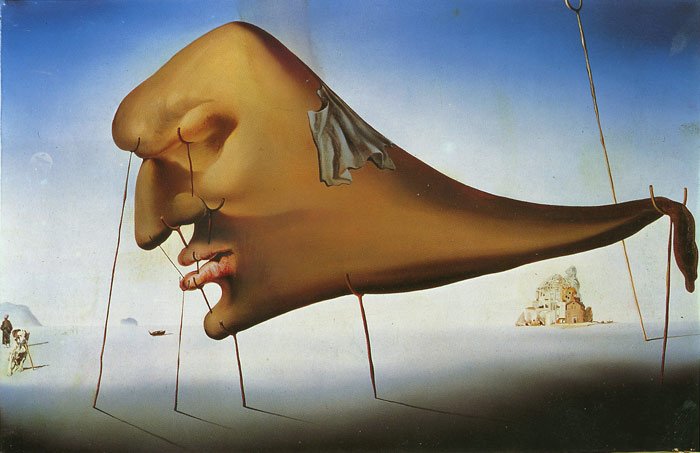
The fact I myself do not understand what my paintings mean while I am painting them does not imply that they are meaningless.
–Salvador Dali
****************
Been writing this blog for over ten years now and this is the first post about him so you might understand when I say that I am not the biggest fan of the work of Salvador Dali, the famed Spanish Surrealist painter who died in 1989 at the age of 85. His work was always visually interesting, sometimes in a disturbing fashion, and was painted in a high traditional manner. Some of it is beautiful work. But it just never fully clicked with me. Some pieces I liked very much and others left me completely cold.
I will say that for me and many people of my age, he was the face of art, being one of the few artists who sought (and found) attention on television. If you had asked me at the age of 12 how an artist might act, I would most likely have described the wild antics of Dali that I had observed on a variety of shows of that time. He was always eccentric bordering on a lunacy that, even as a kid, I could never decide was real or contrived.
And maybe it is this public persona, the one that had him seemingly mugging and posing for attention at every opportunity, that tainted how I looked at his work. Sometimes it seemed like his paintings were doing the same– just trying too hard. A little too engineered and manipulative. Nowadays, I try now to set aside that image of his persona and focus now on each painting individually. It allows me to fully enjoy the work that speaks to me and to simply take in the others.
I also enjoy some of his writings, which are often more lucid and focused than his public appearances. For example, I like his feelings as expressed above about the meanings of his work as well as this other short observation:
If you understand a painting beforehand, you might as well not paint it.
Both quotes could apply to my feelings about my own work. I have often felt that the best and most alive work is produced when there is no contrivance, no clever idea at the beginning of how I can manipulate a response from the viewer. Almost as though there is an absence of forethought, a void that allows the subconscious mood at the moment to dictate in color and form without the dull, wooden clutter of thought out cleverness.
Sometimes, I find that the paintings that I expect the least from when beginning often produce the most when done.
You might disagree with this. Your argument might be valid. I will not argue the point and can only speak for myself and my experience.
I apologize for not going into more detail on Dali’s career here but there is a ton of material out there that anyone can easily find. I thought I’d just share a few words and images for you to consider. You make your own judgments.
“It has always seemed to me that so long as you produce your dramatic effect, accuracy of detail matters little. I have never striven for it and I have made some bad mistakes in consequence. What matter if I hold my readers?”
― Arthur Conan Doyle
**************************
Who would have thought that the creator of Sherlock Holmes would have some good advice to offer to artists?
The words above from Sir Arthur Conan Doyle about how he he would sacrifice accuracy of detail in order to gain greater dramatic effect in his work are very enlightening.
And reassuring.
I have been going through a lot of older work from over twenty plus years back when I was still in a formative stage with my painting. I hadn’t read these words from Doyle but one of the first conscious decisions I made about my work was that I would not be a slave to detail, that I would slash away as much detail as possible while still conveying a sense of what was being represented. Oh, I would use smaller details when they served the greater effect of the painting but the fewer the better.
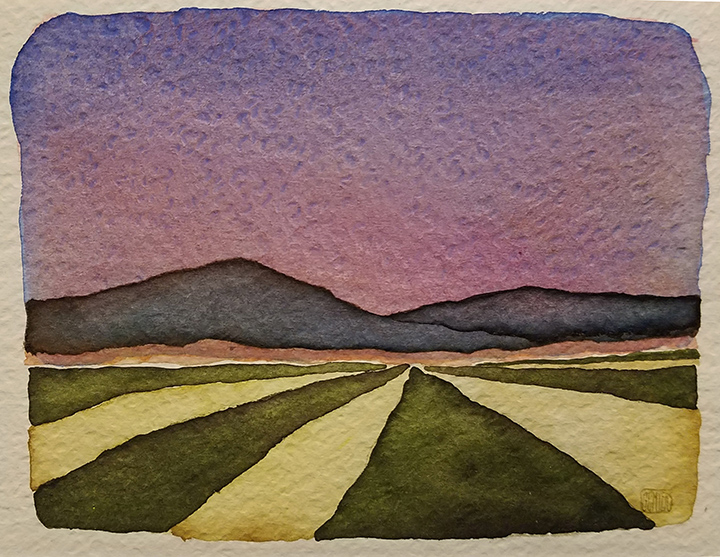
One example from this early work is the piece at the top that is from around 1997. I was surprised when I came across this small painting in a file folder that I hadn’t examined in many years. It was a solid example of the work I was doing at the time, mainly in watercolor with the beginnings of my relationship with the acrylic artist inks that have long been a staple of my work.
It is sparsely detailed with little consideration to trying to replicate natural color. It just allows the colors and the shapes do what they will in communicating a sense of place and feeling. It works pretty well for what I want from it.
Over the years, I sometimes have strayed from this credo of spareness but I always find my way back to it. There just seems to be more space for the expansion of feeling when details are cut away. It’s a good thing to keep in mind.
So, thanks for the reminder, Mr. Doyle. I can use all the help I can get.
The switch to Daylight Saving Time really cuts into my prep time this morning. So I am going to share my musical selection for this Sunday along with a rerun of a post that originally ran ten years back. I reran it once four years back but I think it’s worth sharing again. Plus the painting fits the song. So here it is along with The Beat Is Rhythmfrom Club Des Belugas. As is the case with much of their music, it’s heavy on the beat which is as good a way as anything to give a kick to a dragging Sunday morning.
This is another piece from my early Exiles series, titled Bang Your Drum. This is a later piece, finished in late 1996.
Initially, I was a bit more ambivalent about this painting compared to the feeling I had for the other pieces of the Exiles series. It exuded a different vibe. For me, the fact that the drummer is marching signifies a move away from the pain and loss of the other Exiles pieces. There is still solemnity but he is moving ahead to the future, away from the past.
Over the years, this piece has grown on me and I relate very strongly to the symbolism of the act of beating one’s own drum, something that is a very large part of promoting your work as an artist.
For me and most artists, it is a very difficult aspect of the job, one that is the polar opposite to the traits that led many of us to art. Many are introverted observers of the world, passively taking in the world as it races by as they quietly watch from a distance. To have to suddenly be the the motor to propel your work outward is an awkward step for many, myself included. Even this blog, which is a vehicle for informing the public about my ongoing work and remains very useful to me as a therapeutic tool for organizing my thoughts, is often a tortuous chore, one that I sometimes agonize and fret over. Even though my work is a public display of my personal feelings, this is different. More obvious and out in the open.
There’s always the fear that I will expose myself to be less than my work. The fear that people will suddenly discover the myriad weaknesses in my character that may not show in my paintings, forever altering their view of it. The fear that I will be revealed to be, as they say, a mile wide and an inch deep.
But here I stand with my drumstick in hand, hoping to overcome these fears and trusting that people will look beyond my obvious flaws when they view my work. Maybe they too have the same fears and that is the commonality they see and connect with in the work. Whatever the case, there is something in the work that makes me believe that I must fight past these fears and move it forward, out into the world.
What that is, as I’ve said before, I just don’t know. Can’t think about it now– I’ve got a drum to pound…
I wrote the post below about Earl Kerkam about five years ago. He is an enigmatic character, a painter praised by many of the giants of modern art yet vastly underappreciated by collectors and the general public. I thought I would revisit it today (along with adding a few more images) after going through some auction records of his work from recent years and finding that he is still tremendously undervalued. As I sometimes point out, the artist can only control his creation of the work, not how it is perceived by the outside world. Earl Kerkam is a fine example of that.
I am very interested in the painter’s painter, those artists who garner the respect and admiration of other artists while often not attaining the same sort of attention from the general public. I try to figure out where the disconnect comes in how these artists are perceived so differently by these two groups. I recently came across a prime example by the name of Earl Kerkam, a NY painter who lived from 1891 until 1965.
Kerkam trained in some of the finest art academies here and abroad, studying for a while with Robert Henri. He showed his work in important shows alongside some of the greats of the early 20th century. His work is included in some of the great museum collections of this country. In the aftermath of his death, modern artists of huge stature such as Mark Rothko and Willem de Kooning proclaimed Kerkam to be one of the finest painters to ever emerge from America.
Yet his work is basically unknown outside a handful of art insiders. His work sells at very modest, even low, prices at auction and I doubt if anyone who reads this will have ever heard the name.
There could be many reasons for this relative anonymity. Perhaps his work is too esoteric, too caught up in the dogma of style or too personally narrow in its range of emotional impact. Perhaps his work was caught between eras, never really falling into a classification where he would be swept to the forefront of a wave. This might have something to do with it because, while his work is modern, it never really moved into the realm of the abstract expressionism that was the rage of the day.
I don’t really know and looking at his work I found myself torn between liking it in some instances and being indifferent to others. I can see how both sides, artists and the general public, might take opposing views on his work. His work remains an enigma to me and I don’t know if I will ever see enough of it, or at least a single piece that could be called a masterwork, to make me say that he deserves to be among the beacons of mid-20th century painting or if he was simply a fine painter who garnered just the attention his work deserved. But for now, the name Earl Kerkam is at least on my radar and I will be open to finding other works from him that will move my perceptions.
It’s just another reminder of who’s in charge from Mother Nature this morning as the temps here again sit at zero. There’s bright sunshine out there with the angle of the light making your mind believe that Spring is at hand and that, like the words of A.A. Milne in the bit of verse above, Winter is dead.
Stepping out into it, you realize that it was just another cruel trick. The air is sharp like a fresh razor blade. More so because your mind was telling you it would be warmly caressing your skin instead of biting at it.
Well played, Mother Nature. You got me again.
But Spring is coming and the seemingly endless wait will make the arrival of green grass and the first peeks of bulbs breaking the ground all the more special. The beauty of contrast.
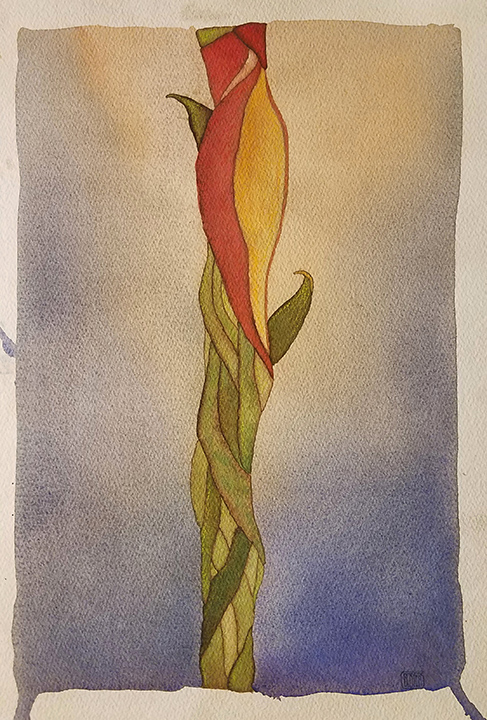
The painting above is an old piece from about 1994 or 1995. It was among a small group painted at that time that was meant to have an object serve as a pole bisecting the picture plane with the light seeming emanating from it. Kind of in a Georgia O’Keeffe manner. I did a few of these pieces with imagined flowers or tree trunks.
Don’t know why I didn’t continue following this path because I am generally very pleased with them when I come across them. They have the sense of completeness and color interest that I still seek in my work. But at that point, every day of painting brought so many new discoveries and ideas that it was sometimes hard to decide which way to turn next. I had so many sparks being generated in my head that it would not have been possible to follow them all.
That changes over time, of course. New discoveries are fewer and farther apart. Sparks still come, many with the same intensity, but they create a low banked fire now instead of the roaring blaze that it seemed like when everything was new.
When everything was new…
And that brings us back to Spring. Maybe that’s the attraction, trying to tie one’s own personal renewal to that of the Earth. If so, I will be green again soon.
 ******************
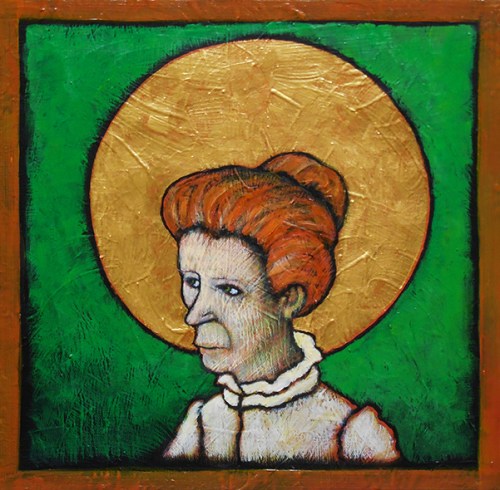 One of the things I am trying to emphasize with this current Icon series is the fact that we are all flawed in some way, that we all have deficiencies and stumbles along the way. Yet, uncovering these faults in my research, I find myself holding affection for many of these ancestors that dot my family tree. Perhaps it is the simple fact that without them I would not be here or perhaps I see some of my own flaws in them.







 Redtree Times