Feeds:
Posts
Comments

****************************

The artist performs only one part of the creative process. The onlooker completes it, and it is the onlooker who has the last word.

Marcel Duchamp

*******************************

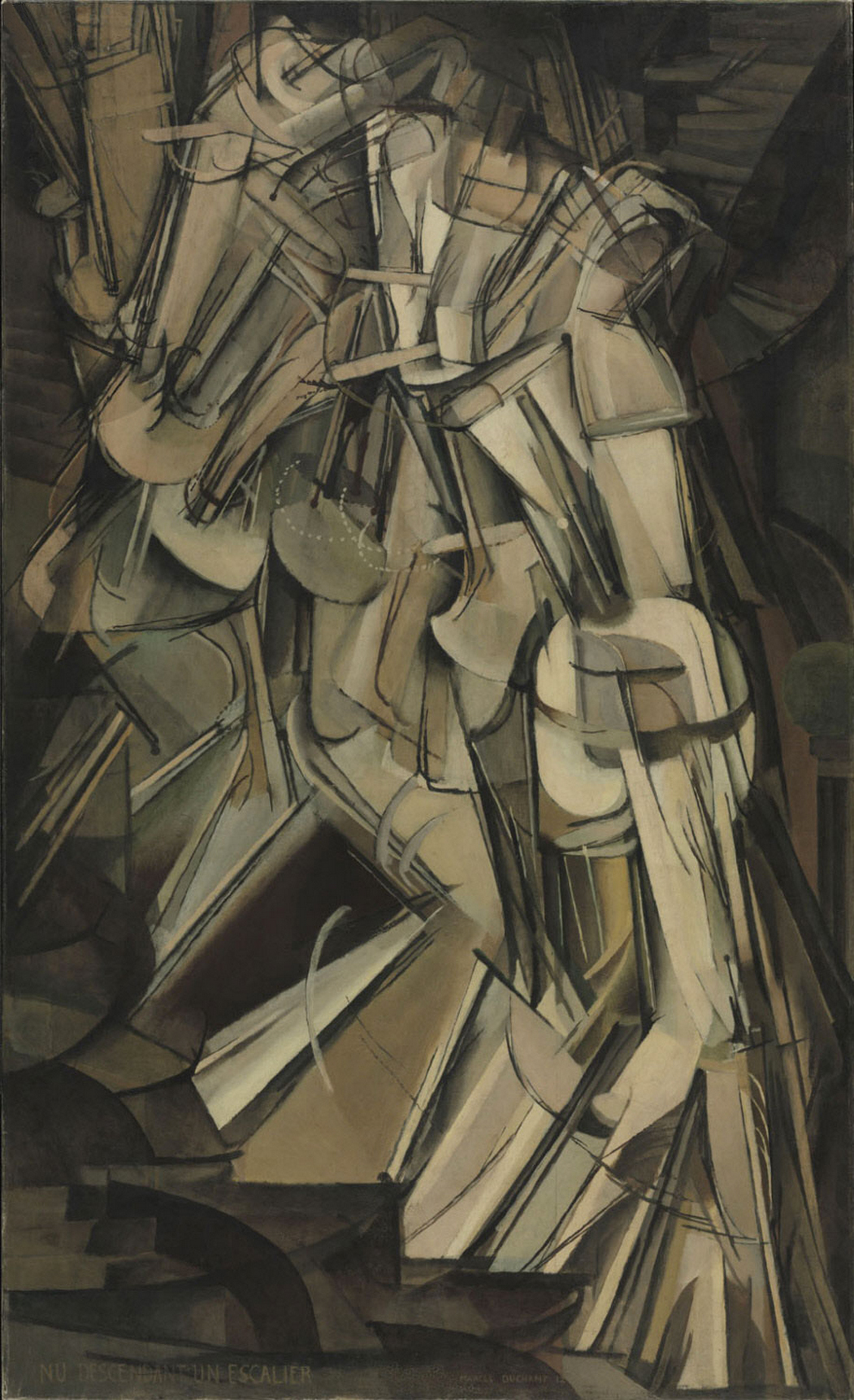
I can’t say I have always fully appreciated or understood all of the work of Marcel Duchamp (1887-1968). The French born artist is best known for his Nude Descending a Staircase #2 (above) which was the center of the fabled and highly influential Armory Show of 1913. The Cubist painting was considered a shocking departure from the norm, breaking the human form and its motion into abstracted blocks and lines. For an art world that was still basically reeling from the push of Impressionism against traditional academic style painting, it seemed like a gateway to total chaos.

Perhaps it was the notoriety from  this show and the effects of World War I that pushed Duchamp even more away from the art establishment of that era. His work became more and more provocative, as he became associated with the Dada movement which rejected all the norms of traditional art. You may know his 1917 sculpture, Fountain, which was a urinal signed with the pseudonym R. Mutt. Shocking the world at the time, it is considered a Dada masterpiece and one of the most influential works of the 20th century.

The thing I find interesting is that after the late 1920’s, Duchamp, still a relatively young man, more or less gave up the making of art and focused on playing chess. He viewed the game as more pure than art in that it was beyond commercialization. He did little art making in the time until his death in 1968.

But while Duchamp, with his contrarian nature, remains an enigmatic character for me, I do heartily agree with his words above. Art is not completely in the making of it. It is the viewer and the impression of the work that they carry with them that completes the artwork. Regardless of how or why the artist created the work, it is the impression that the work makes on the viewer that matters. A deeply personal piece that is that is beautifully crafted may not have the same impact as one that is rough and crudely executed.

That remains the last word of the viewer and what the see and feel in the work.

And that will always be a mysterious and sometimes confounding thing that is beyond the control of the artist.


Ghost Ship

*******************************

“The muses are ghosts, and sometimes they come uninvited.”

Stephen KingBag of Bones

*******************************

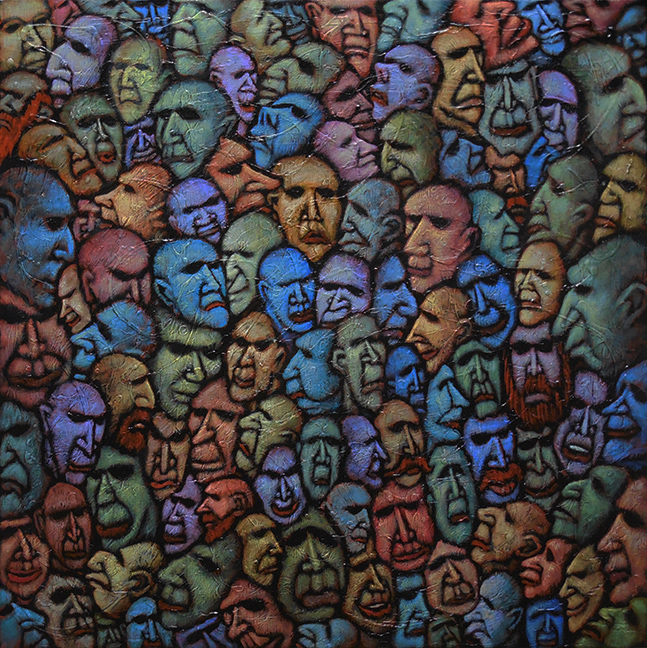
Finished this piece up a week or so back. The final product was never imagined beforehand. It was intended to be a canvas filled with faces but somewhere along the line something changed. Maybe, like the Stephen King words above, it was the uninvited act of a ghostly muse that caused this painting to form.

Who knows?

I do know that when I stepped back feeling that I was done, the whole of it surprised me very much. Mainly because it very much attracted me and raised so many questions, both about what the painting was and where it fit in my body of work.

I could even say it perplexed me. Part of me felt that it wasn’t even my painting, that it belonged to someone else’s mind. It was so unlike my other work that I wondered if this simply a one off event, something that pops up, maybe with the help of some vaporous muse, and never comes around again, or if it was a new direction that had pushed its way into my consciousness.

I can’t say but it sure keeps me looking its way.

It has some size at 24″ high by 30″ wide which gives it even more oomph in the room. I know that in a studio that is filled with new work, it dominates my eye every time I turn its way. There is a confectionary quality to it that passes on a delight of sorts to myself as I look at it. But it also has an ominous feel that makes me wonder where this ship is going and from where it came.

It feels as though there is a lot of mystery here, questions that will never be answered.

It’s been a struggle trying to pin down a title for this piece. I am leaning towards Ghost Ship. Thinking of a boat floating aimlessly on the sea that is empty but for the host of spirits of past travelers that hang on, their stories waiting to be told. Sounds right to me at the moment.

All in all, it pleases and perplexes. I am glad to have it with me for the next few months so that I can better consider its meaning for myself. It might be one of those pieces that is meant only for me.

Who knows?

Nevelson/ Human Mirrors

*************************

No matter how individual we humans are, we are a composite of everything we are aware of. We are a mirror of our times.

Louise Berliawsky Nevelson

************************

I am always intrigued by the images I see of the work of Louise Berliawsky Nevelson (1899-1988) who emigrated to the US from Ukraine in the early part of the 20th century. She is best known for her sculpture that is comprised of found objects assembled in large, monumental wall pieces that are often painted in monochromatic tones. There is visual excitement provided by the various shapes of the many bits and pieces contained within the sculptures. They are familiar forms, often dissembled furniture elements, that take on a new meaning in the work.

It makes me want to try to do that sort of thing but the pull is not strong enough to ever get me to actually try. It’s interesting work that makes me try to see a meaning within it that fits my own vision and needs. But I can never quite see a way where it can do what I need it to do for myself. I take that as a sign that it is not my form of expression.

Plus, from a pragmatic standpoint, it looks like it would be a nightmare to dust.

Nevelson’s words above resonate with me. As humans, we are composites of everything we take in. Likewise, artists express this humanness in their work, mirroring their feelings taken from these influences.

I know this is definitely true for myself. I generally can’t help but reflecting my feelings on the world around me. I would think to try to not do so would make one’s work cold and distant. Inhuman.

And that takes us away from the purpose of art as expressions of our humanity.

So, to my artist friends out there, take in all you can and let the world know how you feel it. It’s the human thing to do.

Forgotten Beginnings

Funny how the mind works sometimes.

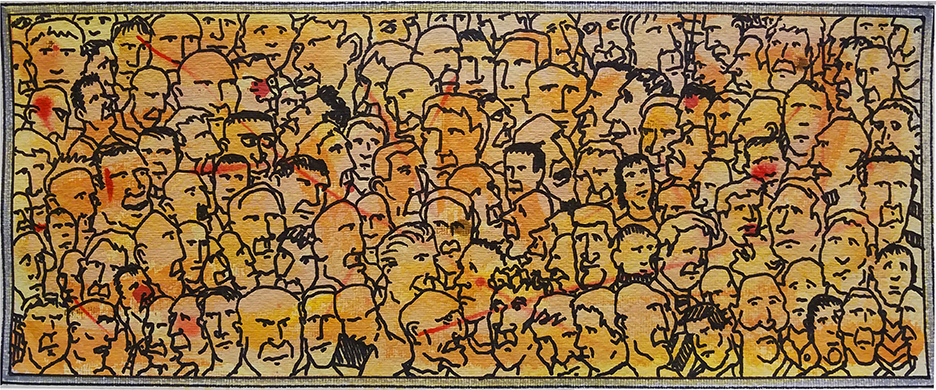
Lately I’ve been showing some paintings from a new series that features masses of faces. Last week I wrote that these groups of faces reminded me of the artifact from the subterranean layers from my Archaeology series. I thought that was a new observation as was the whole idea of this series.

But yesterday I was going through a bin of old work that I haven’t looked through in years and came across the piece shown above. It was done in the early days of 2008 when I was trying to break from a painting funk as I prepared for my annual show at the Principle Gallery that June. The Red Tree had been firmly entrenched as my trademark in the eight prior shows and I felt that it was boxing me in and that I was running out of gas.

It was becoming harder and harder to create the excitement in myself from the work that was needed to make it come alive.

So I turned to a task that a 5th grade art teacher had given me years before. He gave us large sheets of paper and told us to simply fill them, in pen and ink, with anything that came to mind. It could be simple shapes but he suggested making it a junkyard of objects. So I would start at the bottom of the page, drawing things piled on top of other things until the page was full.

It was an exercise that became a regular thing with me in adulthood as I would doodle this way in the margins of newspapers and in journals. Being blocked as I was back in early 2008, I pulled out a Sharpie and many sheets of watercolor paper. I spent a week or so just filling these sheets and at the end of that time the idea of the Archaeology series evolved from this work.

But since then I had completely forgot that I has did one of these sheets with simply drawn faces. It’s not particularly great in any way. It is rough and sloppy but I can see in it the beginnings of the Multitudes series. Around that time, I was drawing faces with a blunt Sharpie, trying to create an expressive face with as few lines and detail as possible. Here’s are two examples from that time taken from an old art business calendar that used as a sketchbook.

So, the idea that I am currently chasing is not new at all. It was forgotten, sitting in some far corner of my mind, biding its time until I was ready for it. Apparently that time has come.

Funny how the mind works sometimes.

The Crowd

************************

Men, it has been well said, think in herds; it will be seen that they go mad in herds, while they only recover their senses slowly, one by one.

Charles MacKay,

Extraordinary Popular Delusions and the Madness of Crowds

**************************

I am still in the midst of a frenzy of faces.

I call this group of work, like the newer painting above, a 20″ by 20″ canvas, Masks or Multitudes. This particular piece is still untitled although I am seeing it as The Crowd for the moment.

Still not sure what the meaning is behind these pieces.

Maybe there is no meaning. Maybe they are just familiar shapes and it is a matter of color and form that is attracting me.

Maybe attracting is the wrong word because it is not really attraction that has me painting them. A better word might be compelling. I feel compelled to paint these at this time.

Why is another thing altogether.

On one hand, I see it in the terms of Walt Whitman‘s voice in Song of Myself, as I wrote here recently– I am large, I contain multitudes. In this rationale, the faces are part of me, individual pieces of a whole. It makes sense as I have been seeing these faces all my life. They seem part of me.

Maybe that is what these paintings are.

But then sometimes I see something different in them and think that they are quite something else. Something less benign. Something more strange.

Strange because I have become more and more averse to crowds, especially the collective behavior of crowds. While I try to subscribe to Will Rogers‘ mantra of I never met a man I didn’t like, I find myself leery of crowds. I would change Roger’s line a bit, to something more like I never met a crowd I liked with one caveat–I only feel somewhat comfortable with crowds at my gallery talks or openings. I don’t fear and sort of understand the common denominator of those groups.

But mob thought in general worries and alarms me. It seems too easy for one to be swept up in the frenzy of a mob, to sacrifice aspects of yourself for a collective aspect that might not normally be seen in you when you as an individual.

That might even apply to the overall intelligence of a crowd. You would think the level of intelligence would rise with the inclusion of more minds but actually it seems to lower to compensate for the common denominator. As the late writer Terry Pratchett put it:  The intelligence of that creature known as a crowd is the square root of the number of people in it.

As a result the crowd is subject to manipulation, to being led astray from what the individual knows is right when they really consider it in solitude. It becomes easy to believe things that might otherwise seem ridiculous or outrageous.

We have plenty of examples of that in our current state of affairs here in the USA.

Sometimes I see this work in that way, as representing the mob. But then again when  look deeper and see the faces individually, they seem less threatening and more along the lines of Whitman’s thought.

I just don’t know. That they compel me might be all I can say with any certainty. I find myself being both uneasy and comforted by this work. And there’s something to be said for that paradox and contrast. They are important aspects of art, the part that imparts meaning.

Hope that is what I am looking at.

Stanley Donen

It’s fitting that on the day of the annual Academy Awards that this week’s Sunday morning musical selection be taken from a movie, a scene from a film directed by the great Stanley Donen, who died yesterday at the age of 94.

Unless you’re a big fan of films you might not know the name but you most likely know his work. It started back in 1949 with his direction of the musical On the Town with Gene Kelly and Frank Sinatra. He went on to direct some of the greatest musicals of the 1950’s– Seven Brides for Seven Brothers, Funny Face, The Pajama Game, Damn Yankees and Royal Wedding, the film that had Fred Astaire dancing on the walls and ceiling of a room. I note this because Donen  directed Lionel Richie’s Dancing on the Ceiling video 35 years later with many of the same effects.

In a long and interesting career, he also directed non-musical films that I have really enjoyed over the years, films like Indiscreet, The Grass is Greener, Charade, Arabesque and Two For the Road. He even directed one of my favorites, the 1967 cult classic Bedazzled with Dudley Moore as the hapless fool who strikes a deal ( and is constantly baffled by his end of the deal) with the devil played brilliantly by Peter Cook.

But more than any other film, Donen is known for his direction of Singin’ in the Rain from 1952, often called the greatest movie musical of all time. It’s a film I could watch time and time again, always finding something new to focus on- the fantastic dancing, memorable songs, fast paced comedy, and beautiful production with those saturated MGM colors that always excite my artistic senses. I am showing two clips from the film both from a fantasy segment, Broadway Melody, featuring Gene Kelly and Cyd Charisse.

The first, Gotta Dance, has the up and coming Kelly running into and immediately falling for gangster’s moll Cyd Charisse. I love this scene for the rough set design and color employed with the dark reds of the backdrop making Charisse’s brilliant green dress shoot off the screen. That and the sensual dancing between her and Kelly. Just a great scene.

The second is the Broadway Melody Ballet. Kelly after earlier encountering Charisse has gone on to stardom and comes across her and her gangster boyfriend again. It transitions into a dreamlike ballet sequence with a surreal set design that has always fascinated me. It has steps that are camouflaged with colors that appears as soft strips that converge in a vast soft pastel desert. I actually used the concept and color in a few early pieces. Also notable is Charisse’s transition from the hardened moll into a softer dream figure in the sequence.

Take a look if you like. Sadly, you won’t see this kind of thing again but thanks to Mr. Donen and others this great work is still there to be enjoyed.

Have a good Sunday.


Rothko/Experience

Mark Rothko- Red and Black 1968

*****************

A painting is not a picture of an experience, but is the experience.

Mark Rothko
.
*****************
This quote from Mark Rothko made me stop this morning. I hear a lot of artists talk about capturing a moment with their work. I am pretty sure those words have come out of my mouth when I am just blathering on. But a piece of art works best when it causes the viewer (for visual artists) to feel as though they are experiencing something new in that moment when they stand in front of it.
.
Not a representation of a moment but a moment in itself.
.
But how do you do that?
.
I can’t really say for sure. Maybe it comes in being fully engaged emotionally during the creation of the work. Perhaps that moment of emotion becomes part of the piece and it is that which the viewer senses and experiences in the work.
.
I don’t really know but it is something I will consider when I am in front of the easel in a few minutes.

Aaah, Baseball Returns

Casey at the Bat- Sean Kane

The feeling is in the air again and brings back sensory memories. Green grass smell. Bright sun light and brown earth. The vocal patter of the players. The plunk of a ball entering a mitt. The sound of bat on ball, sometimes a dull thunk and sometimes a resounding crack that makes you turn your head to see the flight of the ball.

And the path of that hard hit ball in the air is sometimes a majestic arc that immediately ignites a sense of wonder and a brief glimpse of some innate understanding that evades us at all other times.

Aaah, baseball has returned.

First spring training games start today and to be honest, I am a little more giddy than normal this year. It just feels like we need the game to be bigger and even more transcendent in these times. It needs to be a balm, a healing agent for what ails us. As a longtime symbolic shadow of this country, the game has served that purpose in the past and I have hopes it can do so again.

So, play ball. Please.

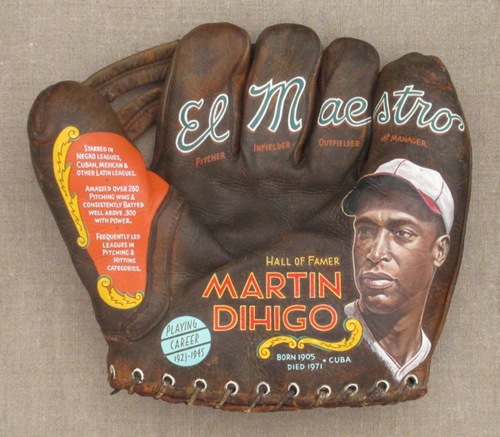
I am showing some of the work of Sean Kane, an artist who works painting baseball gloves, especially those beautiful vintage gloves that seem like little more than fat work gloves. If you’ve ever tried to play with one of those, you have greater appreciation for the players of earlier days and what they could do with those gloves.

Anyway, I saw his work and was immediately smitten. Just gorgeous stuff,especially for those of us with a soft spot for the history of the game. One of my favorites is the one from the Cuban player Martin Dihigo who played his career in the Negro Leagues and other leagues in Latin America.

And that Jackie Robinson glove, inside and out, and the Casey at the Bat triptych at the top are both masterpieces! Grand slams!

You can see much more of his work at his site,  Sean Kane Baseball Art, by clicking here.

Play ball!

Sean Kane- Martin Dihigo Glove

Sean Kane- Jackie Robinson Glove Outside View

Sean Kane- Jackie Robinson Glove Inside View

Sean Kane- “Say Hey” Willie Mays Glove

Sean Kane- Babe Ruth Glove

Sean Kane- Shoeless Joe Jackson Glove

Call of the Siren

********************************

The masses do not see the Sirens. They do not hear songs in the air. Blind, deaf, stooping, they pull at their oars in the hold of the earth. But the more select, the captains, harken to a Siren within them… and royally squander their lives with her.

–Nikos Kazantzakis

********************************

I am still working on the Multitudes paintings with their masses of eyeless faces. It’s work that is consuming, acting as a siren of sorts, drawing me to it and keeping me from moving on to other things. It is much like author Nikos Kazantzakis describes above.

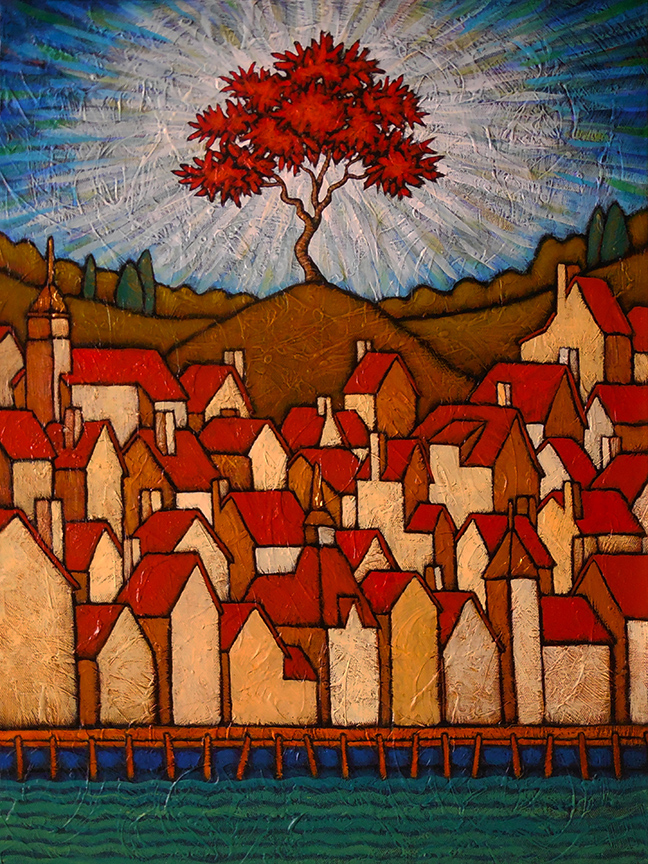
It reminds me also of a newer painting shown at the top that was finished just before jumping into the Multitudes pieces. It is a 24″ by 18″ canvas that I am titling Call of the Siren. It incorporates the Red Tree and the Red Roofs along with a band of color at the bottom that represents the sea.

This bottom section has a pattern that seen with the vertical piers of the dock creates a pattern that feels Greek to me. It wasn’t intended and I can’t say if this pattern, as I see it, is really Greek in origin. But it feels that way to me and perhaps brings the thought of the Sirens of Greek mythology to mind when I look at this piece.

Another thing I note in this painting is the the massed buildings of the town seem to form a fence It is another barrier, beyond the sea journey that brought them here, that must be overcome for those who are called by the Sirens. And once one has made it over wide waters and through treacherous cities, there is still a hill to be climbed.

The Sirens never makes things easy.

I know this to be true– I’ve royally squandered much of my life chasing their song.


A Little Frida

*******************

Nothing is absolute. Everything changes, everything moves, everything revolves, everything flies and goes away.

–Frida Kahlo
*******************
.
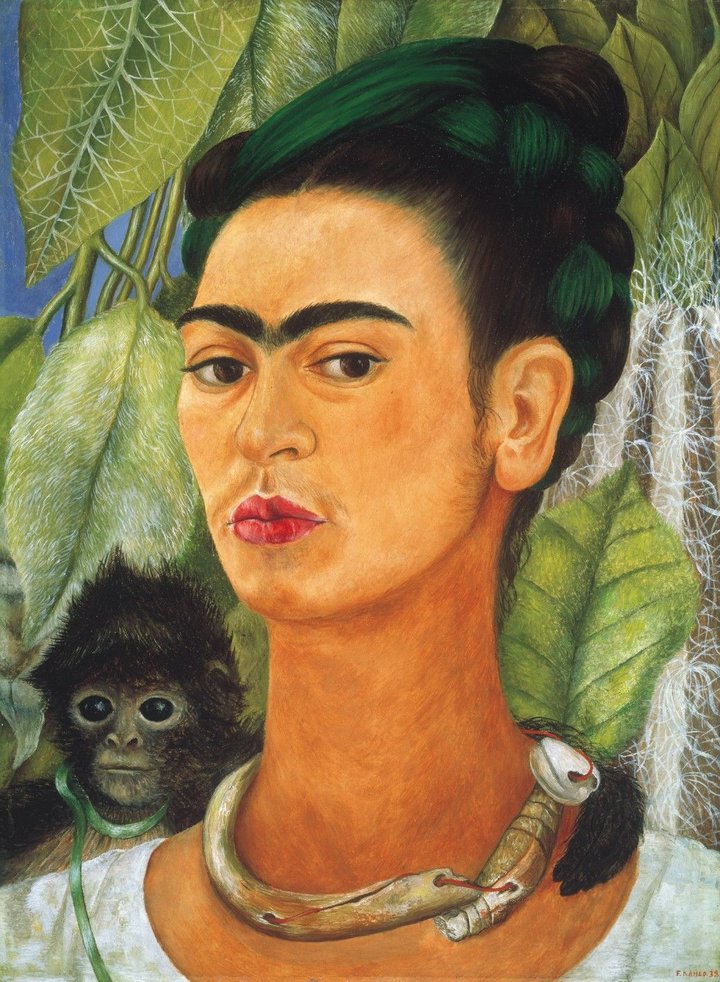
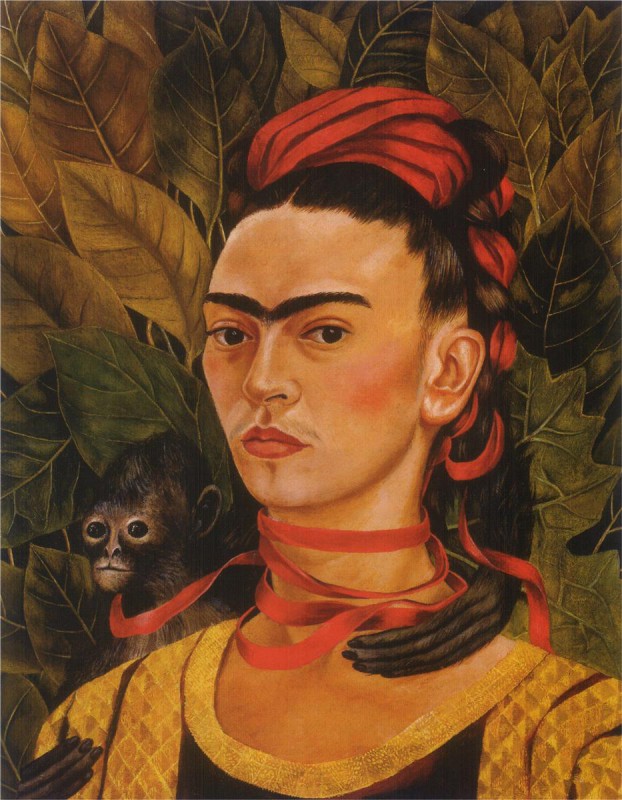
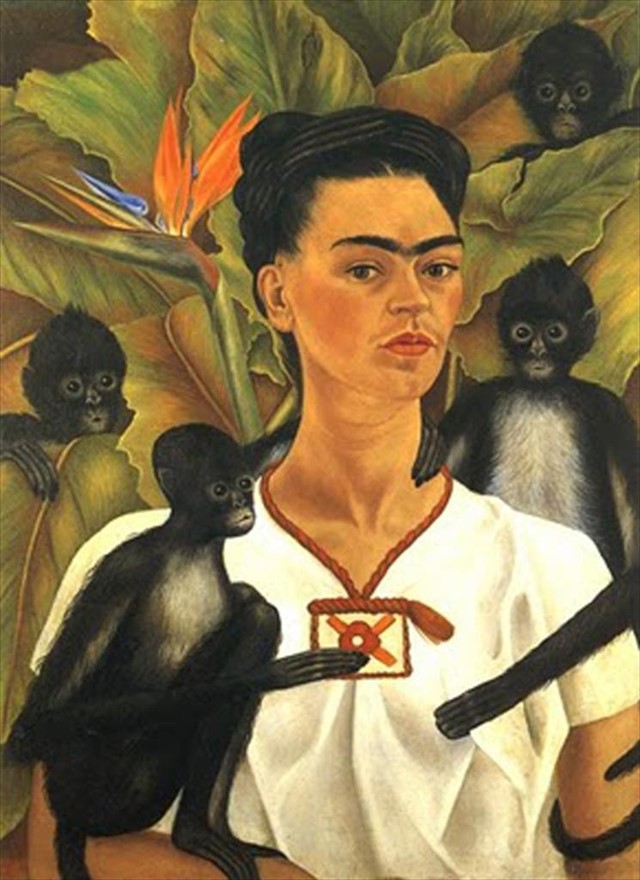
I have been wanting to feature Frida Kahlo (1907-1954) for some time now. Her work is a unique and deeply personal voice in the world of art, one that touches on her identity as a Mexican, as a woman and as a political being. Her body of work might well be the the most overtly biographical collection done by an artist. Her famed self portraits make up about a third of her output.
.
I have no doubt that most of you have seen her work and are somewhat aware of her story. She has become an icon in modern art, the story of her all too brief life– the debilitating pain she suffered from childhood polio and a later accident, the turbulent and loving marriage to the painter Diego Rivera, her political beliefs, her affairs and much of her personal life– captured in books and film.
.
So, I am not going to spend a lot of time on that. Instead, let’s just take a look at a few of her paintings. As I said, they are unique and deeply personal but there is something in them that appeals to aspects in many of us. There is also a short film with more of her paintings set to a song about her.
.

*************


*************