Feeds:
Posts
Comments

Hello Dali


****************

The fact I myself do not understand what my paintings mean while I am painting them does not imply that they are meaningless.

–Salvador Dali

****************

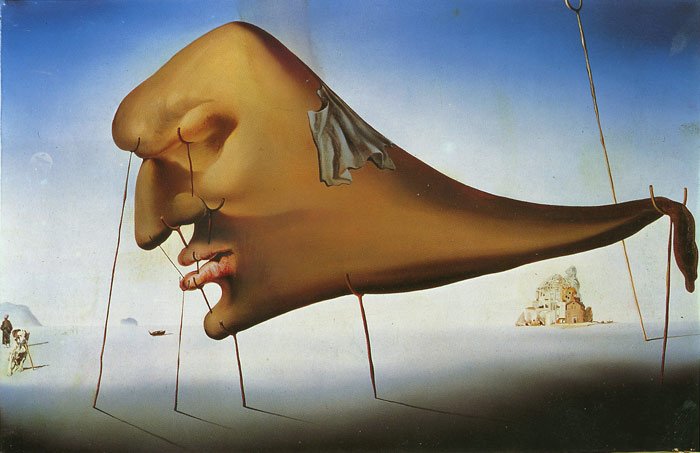
Been writing this blog for over ten years now and this is the first post about him so you might understand when I say that I am not the biggest fan of the work of Salvador Dali, the famed Spanish Surrealist painter who died in 1989 at the age of 85. His work was always visually interesting, sometimes in a disturbing fashion, and was painted in a high traditional manner. Some of it is beautiful work. But it just never fully clicked with me. Some pieces I liked very much and others left me completely cold.

I will say that for me and many people of my age, he was the face of art, being one of the few artists who sought (and found) attention on television. If you had asked me at the age of 12 how an artist might act, I would most likely have described the wild antics of Dali that I had observed on a variety of shows of that time. He was always eccentric bordering on a lunacy that, even as a kid, I could never decide was real or contrived.

And maybe it is this public persona, the one that had him seemingly mugging and posing for attention at every opportunity, that tainted how I looked at his work. Sometimes it seemed like his paintings were doing the same– just trying too hard. A little too engineered and manipulative. Nowadays, I try now to set aside that image of his persona and focus now on each painting individually. It allows me to fully enjoy the work that speaks to me and to simply take in the others.

I also enjoy some of his writings, which are often more lucid and focused than his public appearances. For example, I like his feelings as expressed above about the meanings of his work as well as this other short observation:

If you understand a painting beforehand, you might as well not paint it.

Both quotes could apply to my feelings about my own work.  I have often felt that the best and most alive work is produced when there is no contrivance, no clever idea at the beginning of how I can manipulate a response from the viewer. Almost as though there is an absence of forethought, a void that allows the subconscious mood at the moment to dictate in color and form without the dull, wooden clutter of thought out cleverness.

Sometimes, I find that the paintings that I expect the least from when beginning often produce the most when done.

You might disagree with this. Your argument might be valid. I will not argue the point and can only speak for myself and my experience.

I apologize for not going into more detail on Dali’s career here but there is a ton of material out there that anyone can easily find. I thought I’d just share a few words and images for you to consider. You make your own judgments.


**************************

“It has always seemed to me that so long as you produce your dramatic effect, accuracy of detail matters little. I have never striven for it and I have made some bad mistakes in consequence. What matter if I hold my readers?”

― Arthur Conan Doyle

**************************

Who would have thought that the creator of Sherlock Holmes would have some good advice to offer to artists?

The words above from Sir Arthur Conan Doyle about how he he would sacrifice accuracy of detail in order to gain greater dramatic effect in his work are very enlightening.

And reassuring.

I have been going through a lot of older work from over twenty plus years back when I was still in a formative stage with my painting. I hadn’t read these words from Doyle but one of the first conscious decisions I made about my work was that I would not be a slave to detail, that I would slash away as much detail as possible while still conveying a sense of what was being represented. Oh, I would use smaller details when they served the greater effect of the painting but the fewer the better.

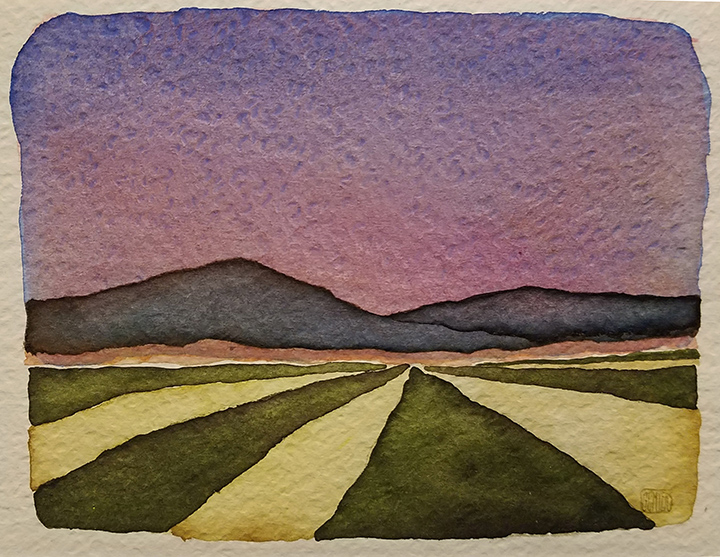
One example from this early work is the piece at the top that is from around 1997. I was surprised when I came across this small painting in a file folder that I hadn’t examined in many years. It was a solid example of the work I was doing at the time, mainly in watercolor with the beginnings of my relationship with the acrylic artist inks that have long been a staple of my work.

It is sparsely detailed with little consideration to trying to replicate natural color. It just allows the colors and the shapes do what they will in communicating a sense of place and feeling. It works pretty well for what I want from it.

Over the years, I sometimes have strayed from this credo of spareness but I always find my way back to it. There just seems to be more space for the expansion of feeling when details are cut away. It’s a good thing to keep in mind.

So, thanks for the reminder, Mr. Doyle. I can use all the help I can get.

The Beat Is Rhythm

GC Myers Exiles-Bang Your DrumThe switch to Daylight Saving Time really cuts into my prep time this morning. So I am going to share my musical selection for this Sunday along with a rerun of a post that originally ran ten years back. I reran it once four years back but I think it’s worth sharing again. Plus the painting fits the song. So here it is along with The Beat Is Rhythm from Club Des Belugas. As is the case with much of their music, it’s heavy on the beat which is as good a way as anything to give a kick to a dragging Sunday morning.

This is another piece from my early Exiles series, titled Bang Your Drum. This is a later piece, finished in late 1996.  

Initially, I was a bit more ambivalent about this painting compared to the feeling I had for the other pieces of the Exiles series. It exuded a different vibe. For me, the fact that the drummer is marching signifies a move away from the pain and loss of the other Exiles pieces. There is still solemnity but he is moving ahead to the future, away from the past.

Over the years, this piece has grown on me and I relate very strongly to the symbolism of the act of beating one’s own drum, something that is a very large part of promoting your work as an artist.  

For me and most artists, it is a very difficult aspect of the job, one that is the polar opposite to the traits that led many of us to art. Many are introverted observers of the world, passively taking in the world as it races by as they quietly watch from a distance. To have to suddenly be the the motor to propel your work outward is an awkward step for many, myself included. Even this blog, which is a vehicle for informing the public about my ongoing work and remains very useful to me as a therapeutic tool for organizing my thoughts, is often a tortuous chore, one that I sometimes agonize and fret over. Even though my work is a public display of my personal feelings, this is different. More obvious and out in the open.

There’s always the fear that I will expose myself to be less than my work. The fear that people will suddenly discover the myriad weaknesses in my character that may not show in my paintings, forever altering their view of it. The fear that I will be  revealed to be, as they say, a mile wide and an inch deep.  

But here I stand with my drumstick in hand, hoping to overcome these fears and trusting that people will look beyond my obvious flaws when they view my work. Maybe they too have the same fears and that is the commonality they see and connect with in the work. Whatever the case, there is something in the work that makes me believe that I must fight past these fears and move it forward, out into the world.

What that is, as I’ve said before, I just don’t know.  Can’t think about it now– I’ve got a drum to pound…

I wrote the post below about Earl Kerkam about five years ago. He is an enigmatic character, a painter praised by many of the giants of modern art yet vastly underappreciated by collectors and the general public. I thought I would revisit it today (along with adding a few more images) after going through some auction records of his work from recent years and finding that he is still tremendously undervalued. As I sometimes point out, the artist can only control his creation of the work, not how it is perceived by the outside world. Earl Kerkam is a fine example of that.

earl-kerkam1891-1965-1361546399_orgI am very interested in the painter’s painter, those artists who garner the respect and  admiration of other artists while often not attaining the same sort of attention from the general public. I try to figure out where the disconnect comes in how these artists are perceived so differently by these two groups. I recently came across a prime example by the name of Earl Kerkam, a NY painter who lived from 1891 until 1965.

Kerkam trained in some of the finest art academies here and abroad, studying for a while with Robert Henri. He showed his work in important shows alongside some of the greats of the early 20th century. His work is included in some of the great museum collections of this country. In the aftermath of his death, modern artists of huge stature such as Mark Rothko and Willem  de Kooning proclaimed Kerkam to be one of the finest painters to ever emerge from America.

earl-kerkam1891-1965self-portrait-1361546314_bYet his work is basically unknown outside a handful of art insiders. His work sells at very modest, even low, prices at auction and I doubt if anyone who reads this will have ever heard the name.

There could be many reasons for this relative anonymity. Perhaps his work is too esoteric, too caught up in the dogma of style or too personally narrow in its range of emotional impact. Perhaps his work was caught between eras, never really falling into a classification where he would be swept to the forefront of a wave. This might have something to do with it because, while his work is modern, it never really moved into the realm of the abstract expressionism that was the rage of the day.

I don’t really know and looking at his work I found myself torn between liking it in some instances and being indifferent to others. I can see how both sides, artists and the  general public, might take opposing views on his work. His work remains an enigma to me and I don’t know if I will ever see enough of it, or at least a single piece that could be called a masterwork, to make me say that he deserves to be among the beacons of mid-20th century painting or if he was simply a fine painter who garnered just the attention his work deserved. But for now, the name Earl Kerkam is at least on my radar and I will be open to finding other works from him that will move my perceptions.

Not Quite

She turned to the sunlight

    And shook her yellow head,

And whispered to her neighbor:

    “Winter is dead.”


― A.A. Milne,

    When We Were Very Young

*************************

It’s just another reminder of who’s in charge from Mother Nature this morning as the temps here again sit at zero. There’s bright sunshine out there with the angle of the light making your mind believe that Spring is at hand and that, like the words of A.A. Milne in the bit of verse above, Winter is dead.

Stepping out into it, you realize that it was just another cruel trick. The air is sharp like a fresh razor blade. More so because your mind was telling you it would be warmly caressing your skin instead of biting at it.

Well played, Mother Nature. You got me again.

But Spring is coming and the seemingly endless wait will make the arrival of green grass and the first peeks of bulbs breaking the ground all the more special. The beauty of contrast.

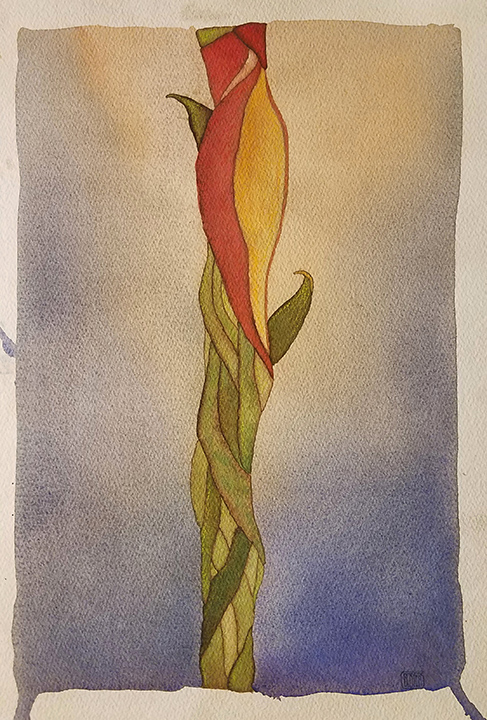
The painting above is an old piece from about 1994 or 1995. It was among a small group painted at that time that was meant to have an object serve as a pole bisecting the picture plane with the light seeming emanating from it. Kind of in a Georgia O’Keeffe manner. I did a few of these pieces with imagined flowers or tree trunks.

Don’t know why I didn’t continue following this path because I am generally very pleased with them when I come across them. They have the sense of completeness and color interest that I still seek in my work. But at that point, every day of painting brought so many new discoveries and ideas that it was sometimes hard to decide which way to turn next. I had so many sparks being generated in my head that it would not have been possible to follow them all.

That changes over time, of course. New discoveries are fewer and farther apart. Sparks still come, many with the same intensity, but they create a low banked fire now instead of the roaring blaze that it seemed like when everything was new.

When everything was new…

And that brings us back to Spring. Maybe that’s the attraction, trying to tie one’s own personal renewal to that of the Earth. If so, I will be green again soon.

And that is a good thing.

***********************************

A little busy this morning but never too busy to stop for a brief moment to consider an image or a few words from Andrew Wyeth. The words and image above are a good example. I just love this quote. It’s an idea–that a piece of art should not be judged on its craftsmanship but on how well it conveys emotion and beauty– that has always rang true for me.

Craftsmanship should not be seen as the goal but rather as a means, the handmaiden as Wyeth terms it, to get there.

Got to get to work now. Have a great day!

The Calling Out

**************************

There are in every man, always, two simultaneous allegiances, one to God, the other to Satan. Invocation of God, or Spirituality, is a desire to climb higher; that of Satan, or animality, is delight in descent.

–Charles Baudelaire

**************************

The words above from the poet Baudelaire sum up the paradox of our existence, at least in the way it seems to me. We are creatures forever torn between opposing forces.

Good and evil. Love and hate. Desire and indifference. The physical and the spiritual.

It’s something that I try to represent in much of my work in terms of contrasts of dark and light. The warmth and coolness of colors. High and low tones.

Showing the contrast of the light of hope alongside the darkness of despair.

This newer piece, an 18″ by 24″ canvas, seems to follow Baudelaire’s words quite literally. Titled The Calling Out, the Red Tree here seems to have climbed to the loftiest point to appeal to a higher source as represented by the light emanating from the sun. There is a great, enveloping warmth in this painting but  for me, it is the underlying darkness that makes this piece effectively come alive.

Even the sun has a darker tone than the light it emits. This unnatural sun gives the piece an almost ominous feel but it is that same contrasting light coming from it that brings a redeeming sense of hope to the painting. It lives firmly between the darkness and light much like man according to Baudleaire’s words.

And that is where I want my work to live: Seeking the light but ever aware of its own darkness.

That, of course, is just how I see it. You might well see it in different terms and that is, as always, as it should be.


James Ensor- “Intrigue”

*******************

The mask means to me: freshness of color, sumptuous decoration, wild unexpected gestures, very shrill expressions, exquisite turbulence.

–James Ensor

*******************

As has been pointed out here, I have been working recently on some new work with large groups of faces, heads, masks, multitudes or whatever one sees in them. It has been exhilarating, with the work pulling me back into a rhythm where I am eager to see what the next work brings. While that is a great feeling in itself, I am still deliberating over where the work might take me, still trying to decide if it is work that is just meant to cleanse the system or if it is a new path to follow in some way.

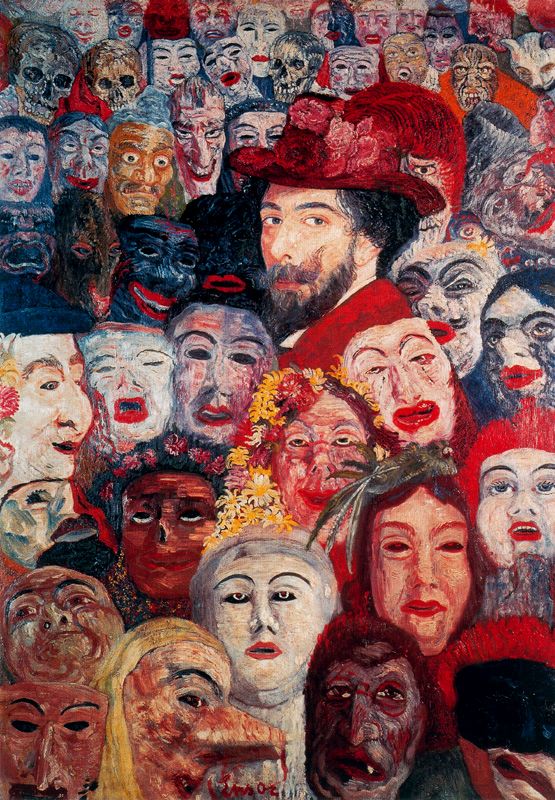
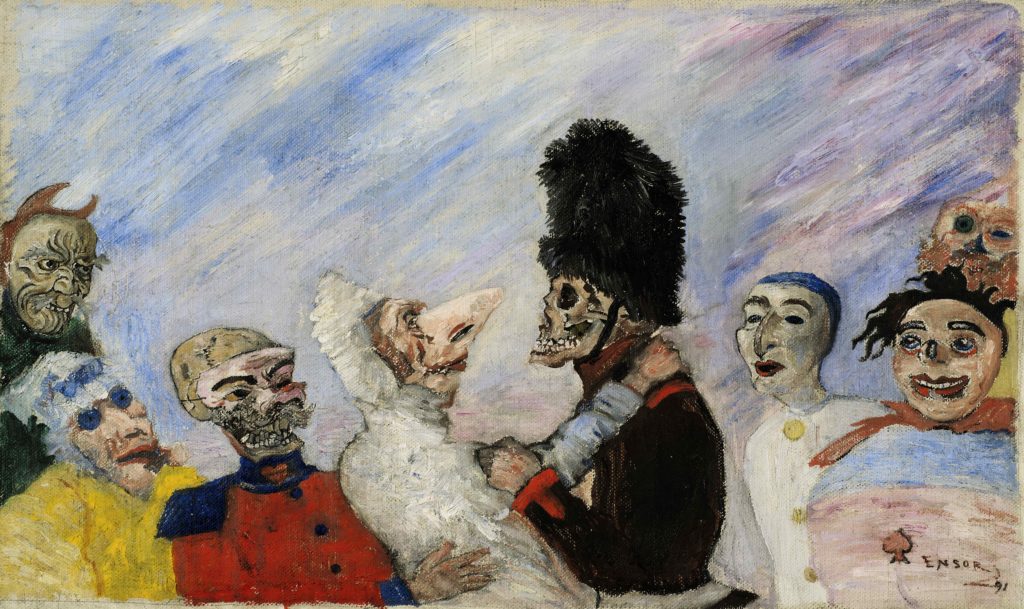
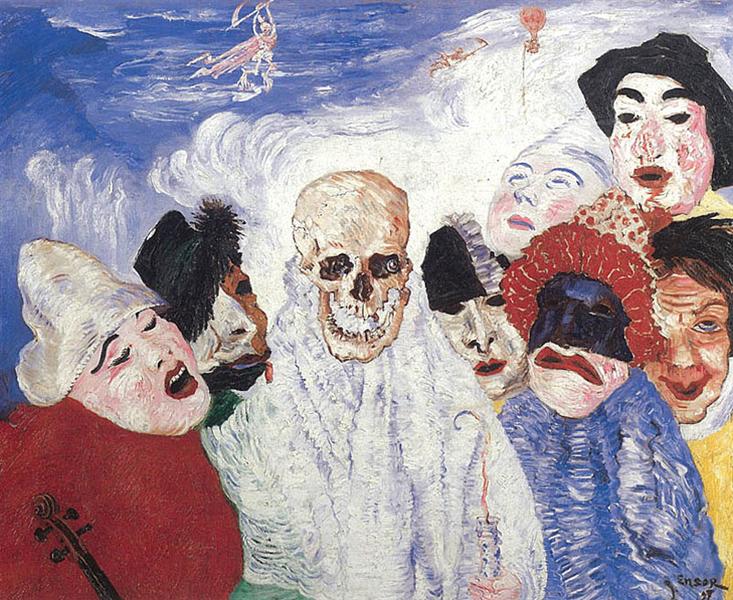
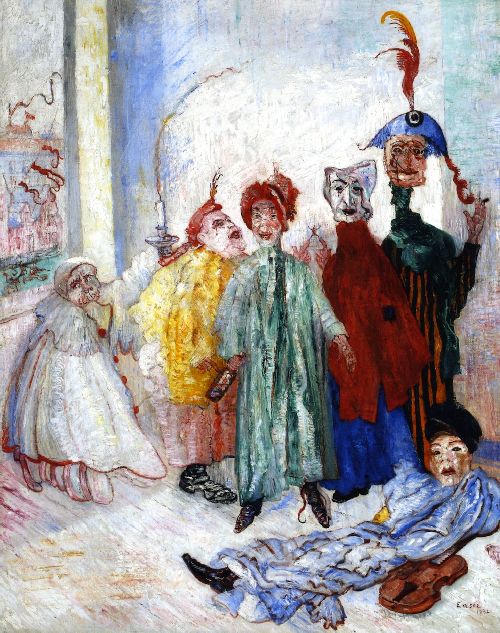
I turn for a bit of advice from art history going back to James Ensor (1860-1949), who I featured here a few years back with a post about his famed  painting Christ’s Entry into Brussels in 1889.  Ensor was well known for his paintings featuring groups people wearing contorted and strange, even grotesque, masks. Many were based on the masks seen at the carnivals and festivals of the time in his native Belgium.  But seen out of context, they were pretty controversial, as you might imagine, in the late 1800’s, given the subject matter and the rough method of much of his painting. This was around the time that the work of the Impressionists was still considered scandalous so you can imagine how the image of a soldier with a skull for a face embracing a maiden with a gigantic nose mask might play.

It’s fascinating work. Wish I could tell you more but the images themselves tell me a lot and inform my own work by providing fresh inspiration for new work. Just looking at this work this morning has me itching to get to the easel.

Take a look at some of the work of James Ensor and see if it does anything for you.

Ensor- “Christ’s Entry into Brussels in 1889”

Ensor- “Portrait of the Artist Surrounded by Masks”

James Ensor- Squelette Arretant Masques

James Ensor- Old Lady with Masks

James Ensor – ” Death and the Masks”

James Ensor- “Strange Masks”

James Ensor- “Masks Confronting Death”

James Ensor- “The Despair of Pierrot”

Great Red Spot

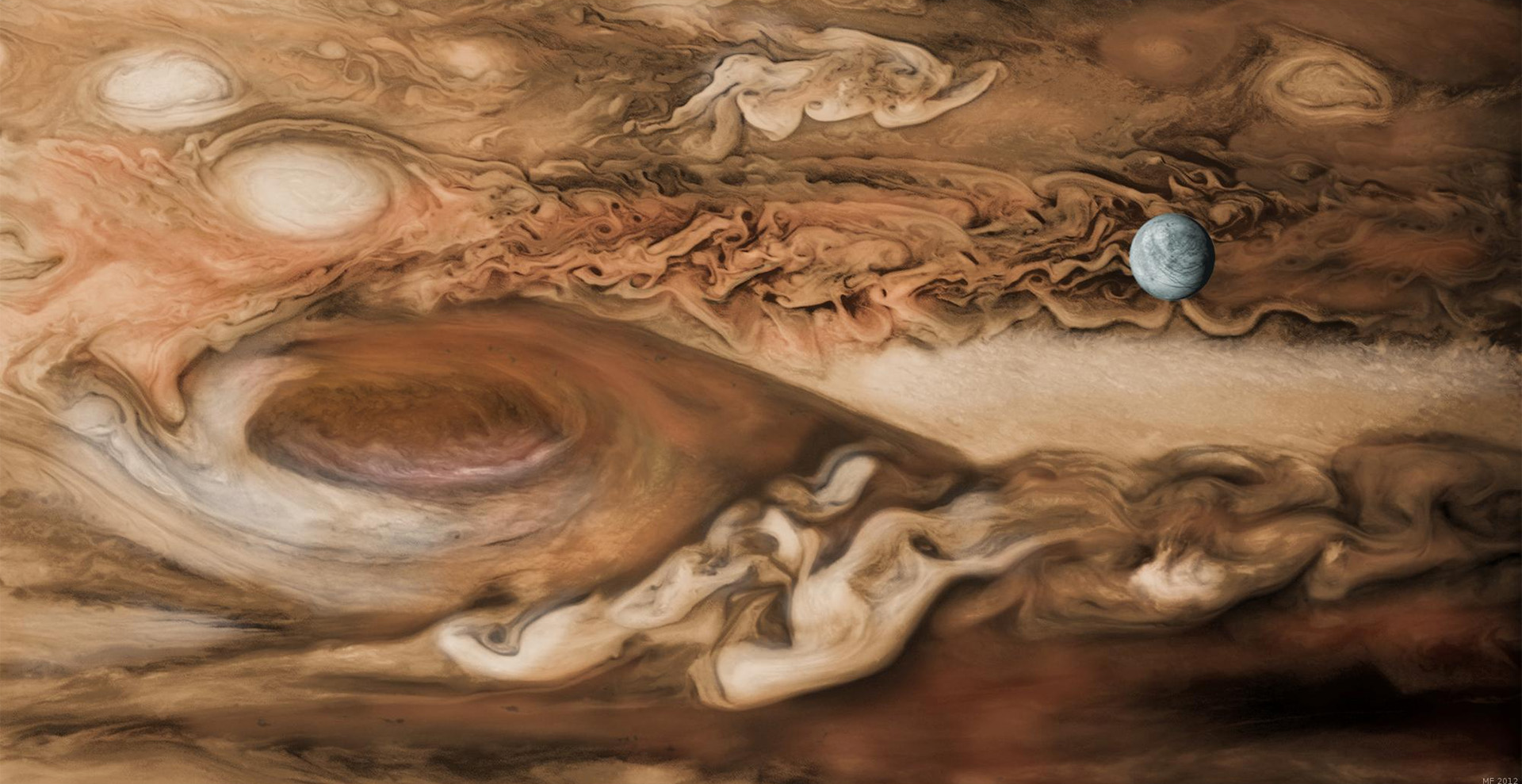
I don’t have much time but I wanted to share these images taken by the probe Voyager I way back in 1979. Hard to believe these are forty years old but I guess that’s a mere eyeblink in astronomical time. These are of the Great Red Spot on the planet Jupiter  with the one at the top having Europa, a moon of Jupiter, in front of it.

The bottom is a little more detailed view of the Great Red Spot. I wish I had the ability to paint in the way this image comes off. Whenever I stumble across these images, I am astounded at their abstract beauty.

Finisterre

Finisterre is a peninsula at the westernmost point of Spain. In Roman times, it was thought to be the end of the known world.

Thus the name: finis/end + terre/land.

Finisterre.

It is also the title of a lovely song from English folk singer June Tabor that I am featuring for this week’s Sunday music. Very atmospheric.

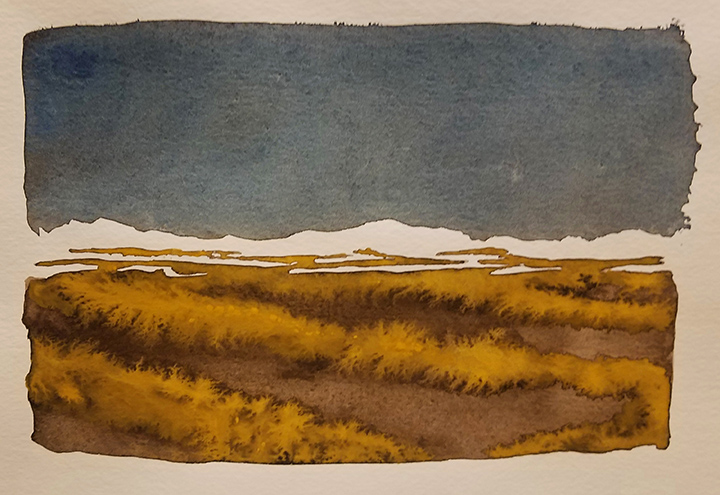
The accompanying painting at the top is a piece I came across this past week in an old sketchbook from back in 1994, when I was just starting to paint. I hadn’t seen it in some time and was pleased that it had aged well, that it had a completeness that was not the norm for the work I was doing at that time. The rest of the sketchbook, for example, is filled with landscapes that are cringeworthy enough that this piece seems out of place.

I chose it to accompany this song because it also has an atmospheric quality, one that speaks of open space and emptiness. Pauses and the quiet rush of the wind through the grass. It might not be Finisterre but it feels like it might be the end of the world for someone.

Have a good Sunday.