Feeds:
Posts
Comments

Multitudes

*********************

Walt Whitman: Song of Myself, Part 51


The past and present wilt—I have fill’d them, emptied them.

And proceed to fill my next fold of the future.

Listener up there! what have you to confide to me?

Look in my face while I snuff the sidle of evening,

(Talk honestly, no one else hears you, and I stay only a minute longer.)

Do I contradict myself?

Very well then I contradict myself,

(I am large, I contain multitudes.)

I concentrate toward them that are nigh, I wait on the door-slab.

Who has done his day’s work? who will soonest be through with his supper?

Who wishes to walk with me?

Will you speak before I am gone? will you prove already too late?


*******************************
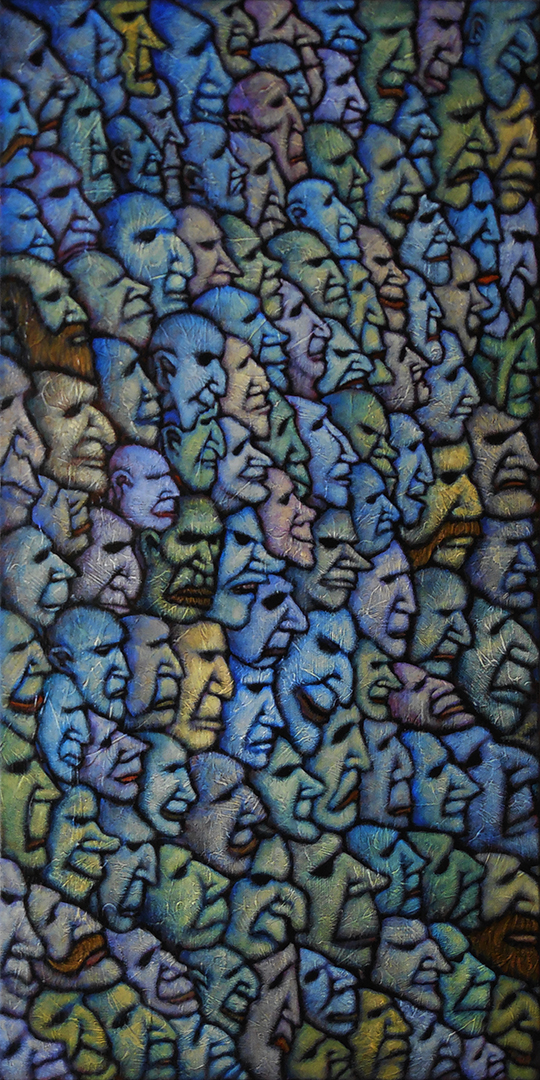
The image shown on the right is another new painting, a 36″ by 18″ canvas that is part of a new group that has drawn a great deal of my attention lately in the studio. They are large groups of faces that are painted in an almost subconscious manner, with little if any forethought given as to how they relate to the surrounding faces. They emerge from dashes of paint and quickly rendered shapes that cause me to simply find human form in them.

It is very intuitive work. It reminds me very much of the process involved in painting the subterranean artifact layers in my Archaeology series. Just make a mark then transform it into something tangible, something possible.

I have known most of these faces for forty or fifty years. They have lived in me, have emerged periodically on bits of paper, on journal pages and in the margins of the newspaper. Some have shown themselves individually in some of my work through the years– the Exiles, Outlaws and Icons series for example.

But they all seem familiar to me. Some possess a pleasant and friendly aura and others much less so. Some are ugly and bitter in appearance. Some even seem evil and worry me a bit, causing me to ask if they are all just variations of my own self.

I don’t really know.

Part of me says yes. I was instantly reminded of the line from Walt Whitman’s Song of Myself  (shown above):  Do I contradict myself?/Very well then I contradict myself,/(I am large, I contain multitudes.)

Whitman’s grand poem had him speaking as the voice of the collective consciousness of mid-18th century America, a voice that encompassed all sorts of people and attitudes that make up the stewpot that is this country, then and now. As an artist, the hope is that your own work taps into that same vein, that it speaks to connects with the wider spectrum of people. So, in doing this, in attempting to access this collective multitude, to pull them all from your own inner self.  To do so, you have to find that part of yourself that is part of all of them.

Can it be hope and love? Fear and anger? Or just the emotion of being?

I don’t really know.

What I do know is that there is something in this work that seems right for the moment.  Seeing these groups of faces had me wondering how this had slipped by me for so long. It feels natural, like it should have been part of my work for some time now.

So how had I not did this before? I think the answer is that I needed to develop the skills and visual vocabulary to do these pieces in a way that used the faces in the most impactful way. If I had did this years ago, I think it would have been lacking the color, rhythm and forms needed to make them effective. Those are all things that have come from years and many tens pf thousands of hours in the studio. For me, these paintings are a great coupling of subject-these crude faces– and those elements– color, rhythm and form. I find myself attracted as much by the colors and shapes as I am by the individual faces.

I am considering calling this group Multitudes from the line from Uncle Walt. Or it might still be Masks from the for the appearance the faces have with their dark eyelessness.

I am still trying to figure this out so excuse this off the cuff writing. There are a lot of thoughts emerging and growing even as I write this so I reserve the right to change to contradict myself at some later point. Like Walt, if I contradict myself, so be it — I am large, I contain multitudes.


President’s Day

A few presidential quotes to celebrate Presidents Day:

However [political parties] may now and then answer popular ends, they are likely in the course of time and things, to become potent engines, by which cunning, ambitious, and unprincipled men will be enabled to subvert the power of the people and to usurp for themselves the reins of government, destroying afterwards the very engines which have lifted them to unjust dominion. 

– George Washington

****************

If national pride is ever justifiable or excusable it is when it springs, not from power or riches, grandeur or glory, but from conviction of national innocence, information, and benevolence. 

John Adams

****************

To waste, to destroy, our natural resources, to skin and exhaust the land instead of using it so as to increase its usefulness, will result in undermining in the days of our children the very prosperity which we ought by right to hand down to them amplified and developed. 

– Theodore Roosevelt

*****************

The only limit to our realization of tomorrow will be our doubts of today.

-Franklin Delano Roosevelt

******************

Let every nation know, whether it wishes us well or ill, that we shall pay any price, bear any burden, meet any hardship, support any friend, oppose any foe to assure the survival and the success of liberty.

-John F. Kennedy

*******************

I don’t care. I believe Putin.

-The 45th President* of the United States

*********************

The last one here is significant because it is one of the very few times on record that the current placeholder has actually spoken the truth.

Happy Presidents Day?


Stolen Car

Want to keep it short this morning as I want to get right to work on a piece that is on the easel. And that desire to go right to the brushes is a good thing, an indicator that a groove is coming.

So, for this Sunday morning here are a couple of noir-ish photos to accompany one of  my favorite songs, Stolen Car, from the 1980 album ,The River, from Bruce Springsteen. The mood of this song, especially within its organ and piano lines, always moves me.

Good painting music.

Have a good Sunday…

The Sail

*************************

“He in his madness prays for storms, and dreams that storms will bring him peace”

― Mikhail Lermontov  (1814-1841)

*************************

Maybe you didn’t see it yesterday and if not, good for you. It was an awful and uncomfortable thing to behold.

Witnessing madness always is. And that is what we were watching and experiencing.

It brought to mind the line above from the 19th century Russian (fitting, I guess) poet, Mikhail Lemontov, speaking of the sailor who believes that since the calm always follows the storm that the calm only comes because of the storm.

That’s the sort of logic with which we are dealing. One that believes that chaos brings order.

Hopefully, we can ride this storm out safely until there is calm.

Or until someone capable can wrest the wheel from the hands of a mad captain who seems bent on continuing to ride into storms.

The line above is actually a translation from the Russian that is often attributed to Leo Tolstoy since he included it in his The Death of Ivan Ilych. I believe a character was quoting the Lermontov line and people over time have come to believe that Tolstoy originated the line.

The line comes from a Lermontov poem, The Sail. There are many translations and not all use the exact wording though the meaning is much the same in all. Here’s one tranlation:


The Sail

Gleams white a solitary sail

In the haze of the light blue sea.—

What seeks it in countries far away?

What in its native land did leave?


The mast creaks and presses,

The wind whistles, the waves are playing;

Alas! It does not seek happiness,

Nor from happiness is fleeing!


Beneath, the azure current flows,

Above, the golden sunlight streaks:—

But restless, into the storm it goes,

As if in storms there is peace!


Karsh/ Blue Guitar

There is an exhibit currently hanging at the Rockwell Museum in Corning of photos from photographer Yousuf Karsh, who had an incredible ability to capture the essence of his subjects. Many of his shots of the celebrated figures of the 20th century are the best known images of those folks. I saw an exhibit of his work years ago and was really inspired by it. It played directly into a piece from my Exiles series at the time that I wrote about here back in 2008 that I am sharing again below.

The Karsh exhibit at the Rockwell Museum in Corning hangs until May 5.

*****************

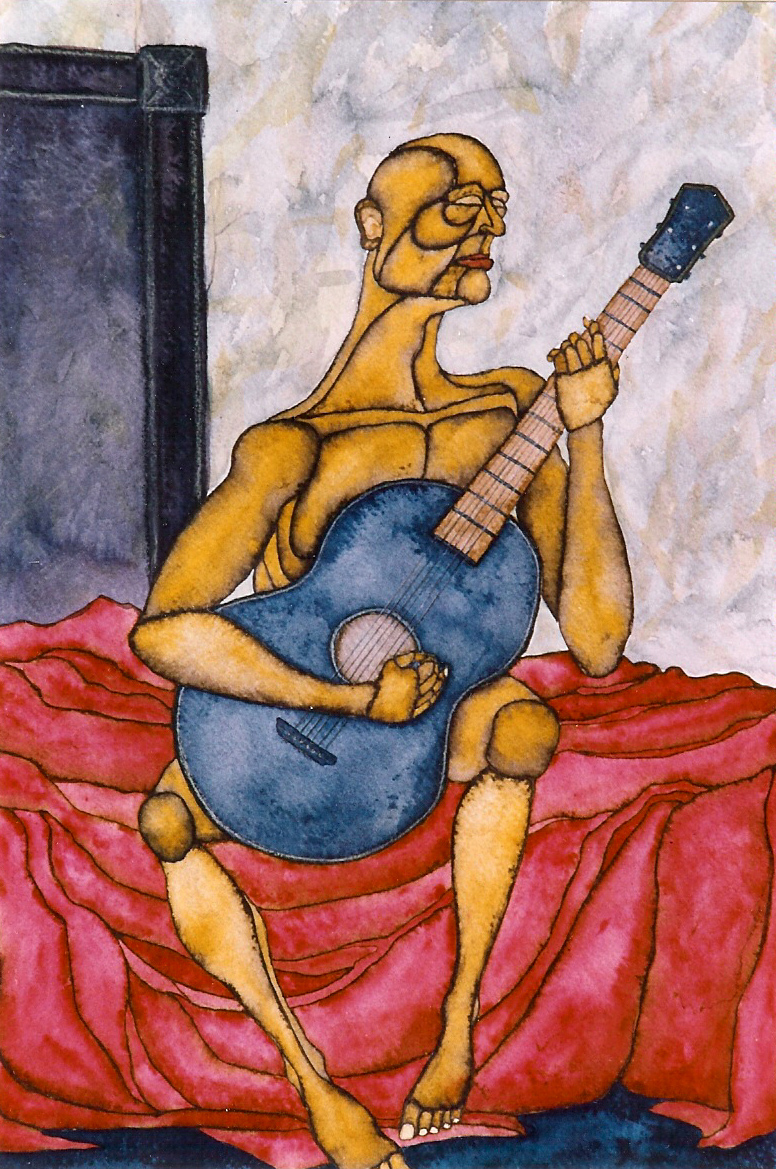
Blue GuitarThis is another of the paintings from the Exiles series, a piece titled Exiles: Blue Guitar. This was larger than the other paintings in the series and was the most intricate in design. It was the only piece to show a full body, more or less. The crimson sheets beneath the figure are certainly not typical of my work. Even the blue guitar was an anomaly. I think these things, in themselves, make this a distinctive painting and one that is perhaps the one piece I most regret letting go.

I remember painting this piece back in ’96 with great clarity. The face was based on a portrait of the Finnish composer Sibelius taken by Karshthe famed photographer. I had seen the photo at a wonderful and powerful exhibit of Karsh portraits at the MFA in Boston that knocked me out. Karsh had a knack for revealing the essence of his subjects in a single image.

I was immediately taken with the image of Sibelius’ face. It expressed bliss, but not joy. A painful bliss, perhaps an ecstasy tempered by the knowledge that the world is an imperfect one and that this moment of grace is a fleeting one, soon to be gone. It was exactly the expression I saw for my guitarist and one that I wanted the whole piece to convey.

This painting was the centerpiece of my first exhibit many years ago and remains vividly in my memory. Eventually, I went back in and darkened the background which made the guitarist pop even more. But the images of that change have been lost over the years which I greatly regret. This piece sold years ago and I now have no idea of where this painting ended up. I hope that whoever possesses this piece appreciates all that it represents and gives this sad, blissful guitarist a bit of attention now and then.

*****************

Note: The opening for the for the 25th Anniversary exhibit at the Principle Gallery is next Friday, February 22. I mistakenly wrote here the other day that it was tonight because, well, I get confused and make mistakes sometimes. My apologies for any confusion. Hope you can make it to the show next week!

Vulnerable Love


*************************

“To love at all is to be vulnerable. Love anything and your heart will be wrung and possibly broken. If you want to make sure of keeping it intact you must give it to no one, not even an animal. Wrap it carefully round with hobbies and little luxuries; avoid all entanglements. Lock it up safe in the casket or coffin of your selfishness. But in that casket, safe, dark, motionless, airless, it will change. It will not be broken; it will become unbreakable, impenetrable, irredeemable. To love is to be vulnerable.”

C.S. Lewis, The Four Loves

**************************

For Valentine’s Day, some sage advice from C.S. Lewis on love and one of my favorite love songs, Two Angels from Peter Case.

Hoping you have a good day.

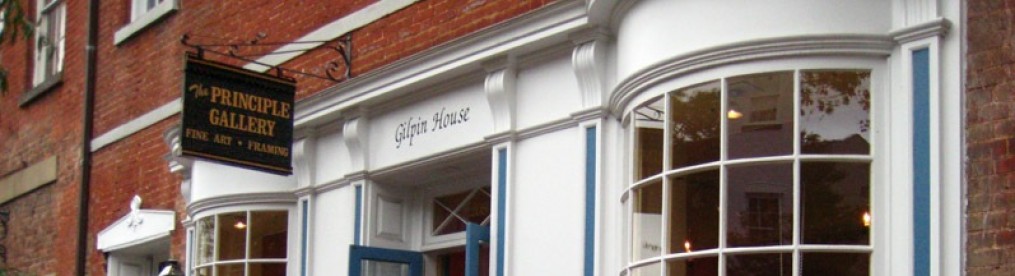
There is an opening next Friday, February 22, [I originally said the opening was on the 15th because, well, sometimes I get confused]of a special exhibition at the Principle Gallery that marks 25 years of providing high quality artwork in historic Alexandria, Virginia. It has been my great pleasure and honor to be part of this great gallery for 23 of those years and I am pleased to have several pieces in this special show.

Like many of the artists it represents, the Principle Gallery has grown and evolved over those 25 years, becoming one of the most prominent galleries in the country with artists and collectors from near and far as well as another gallery branch in Charleston, SC.

But even with its growing influence in the gallery world, its strength remains the personal and warm welcome it offers to anybody who wanders through the doors of its location in the historic Gilpin House at 208 King Street. There is never a sense of pretense or condescension and the entire staff does all it can to make all feel comfortable. It is all about allowing the gallery visitor to experience the artwork in a way that allows them to relax and fully absorb the art in a personal fashion.

And they have done that successfully every day for the past twenty five years. And I sincerely thank and applaud hem for that. I hope that if you’re in the area you can stop in to celebrate the occasion with them on Friday evening, February 22. The opening reception begins at 6:30.

Unfortunately, I can’t make this opening. But I will be there in June for the opening of my 20th annual solo show. Hope to see you then!


Loving Truth

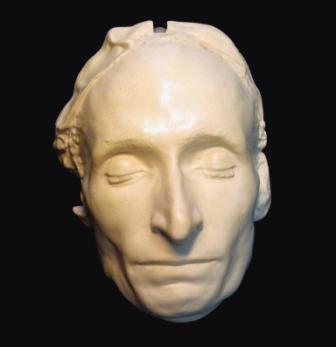
Blaise Pascal Death Mask

***************************

Truth is so obscure in these times, and falsehood so established, that, unless we love the truth, we cannot know it.

–Blaise Pascal

***************************

We live in a time of falsehoods. It is a time where some choose to deny the obvious truth and instead believe the desired lie.

Their opinion, their own sense of belief, has more value to them than all the mountains of truth and evidence that could be stacked against them.

How do you change such people? How do you make them see truth where they see only falsehoods?

You don’t change them.

You can’t change them.

You can only maintain a love for truth and continue to shine a light on it.

Then you must use that truth to defeat those who believe in the current false reality.

No persuasion will ever convert these people.

It must be defeat. Complete and devastating defeat.

A defeat so absolute that some will, in time, begin to understand how far they had veered off the path of truth and reality.

Some will never see the truth and will forever see themselves forever as victims.

Victims of a conspiracy. Victims of circumstance.

Always victims.

How this defeat comes about, well, that is yet to be determined.

But defeat must come.

Sounds harsh, I know.

And in the end, it may turn out to be harsh.

But to let truth be obscured by falsehood, to accept and live in a world completely based on lies, would prove to be far more severe and brutal.

The truth must continue to be loved and spoken.

Truth must prevail.

Amen.

Thus ends today’s sermonette.

Thanks for letting me vent and special thanks to French mathematician, theologian and general brainiac Blaise Pascal (1623-1662) for today’s quote and all of his various and many contributions to truth and the betterment of mankind.


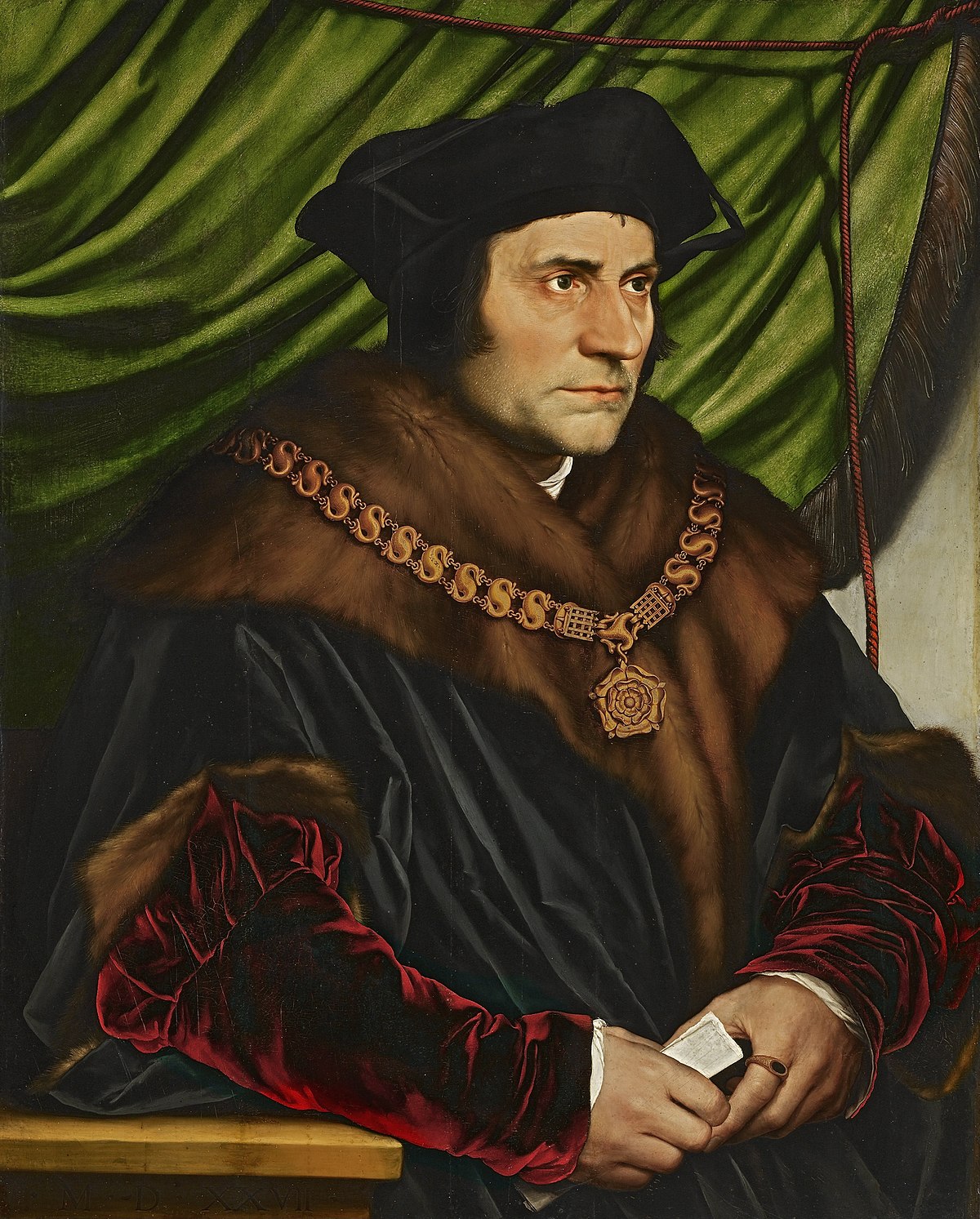
I came across an interesting short video from the Frick Museum with details about one of my favorite paintings, a portrait of Sir Thomas More done by Han Holbein. I thought I would show it along with a repost of a blog entry from back in 2009. Take a look.

You run across a lot of people who are completely dismissive of anything from the past. They feel that we at the moment are the leading edge of humanity’s progress, that we are the culmination of all that has come before us and thus, anything created long before our time can not have equal value  now. There’s this sense that only the modern can fully express the complexity of our world.

When I see this painting of Sir Thomas More painted by Hans Holbein the Younger in around 1527 I realize what flawed logic that is.

Here is a painting that was painted nearly 500 years ago that, when seen in person at the Frick in NYC, has surfaces that are absolutely beautiful. It still glows with its sumptuous colors. All the years of technical progress have not produced materials that could accomplish any more than Holbein did with the materials of his time.

holbein_henryviiiI could stand and look at this piece for hours, marveling not only at the beauty of the paint but at the way Holbein captured More’s humanity and the sense of the time in which it was painted. For me, this painting really illustrates, gives life to, an important figure in history. More was the ultimate man of conscience, refusing to give in to Henry VIII‘s will that he endorse Henry’s divorce from Catherine of Aragon so that he might marry Anne Boleyn. It ultimately cost him his head and cost the world a wonderful mind, one that gave us the concept of Utopia.

It is obvious to me that Holbein felt warmly towards More in the way the piece is painted and the way he captures his persona. In the painting Holbein  did of Henry VIII (on the left) I get a different sense. It’s meant to be large and strong, to be a display of regal power and that it is. But there’s a coldness in the piggish eyes and an arrogance in the stance. Oh, it’s a beautiful painting, on many levels, but when you compare the two it’s obvious where Holbein’s sympathies lay.

This is art and history coming together at single points. It captures the humanity that is contained in all of us and remains unchanged even to the edge of our time. Good stuff. No, great stuff…

Born to Be Blue

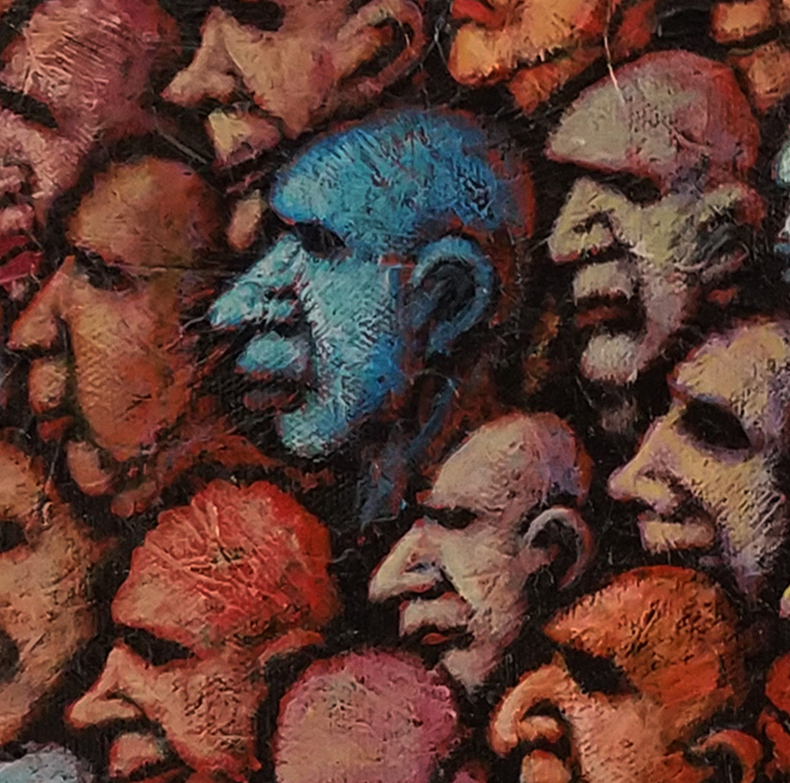
This Sunday morning’s musical selection is tied somewhat to a group of new work that has been rekindling my fire here in the studio. I’ve shown a couple of images of new paintings here and on social media of what I might call my Mask pieces.

Each has been a group of faces that is done in quick strokes from a single brush, starting from one point and filling the canvas. It is unplanned in almost every way. No color plan. No theme. Just intuitively and roughly formed faces that stem from a lifelong collection of faces that have been stacked in my head, culled from looking intently at clouds, woodgrains and patterns of all sorts through the many decades. Seeing them spill out in this way has been energizing in a way that I know from experience will spill over into the rest of my work even if this particular work remains for me privately.

I haven’t been thrilled with how the camera is catching the images thus far. They have been quick photos that don’t fully capture much of the subtlety in the closer parts of the painting. So when the musical selection came up this morning, this section of one of the paintings jumped out at me. I thought showing it in detail would better show how I am seeing the work.

The song selection is the jazz standard Born to Be Blue, written by Mel Torme in 1946. It’s been performed by scores of singers over the years but it became a signature piece for the late Chet Baker.which is the version I am sharing below. In fact, a 2015 film biography of his life starring Ethan Hawke as Baker uses the song title as the film’s title. This version highlights his vocals rather than his horn work and features great piano playing from Bobby Scott.

Hearing it made me think of a blue face that I consider a central character in one of these pieces. At least my eye always lands on him first before roaming across the rest of the picture. The image at the top is a detail featuring him and shows better some of the surface and textures that compose the painting.

That being said, I am eager to get back to work on a new piece in this same style. Enjoy the song and have a great Sunday.