Feeds:
Posts
Comments

The Abernathy Boys

Growing up, my siblings and I were what might be considered free-range. We had a lot of freedom to do what we wanted on our own. On any given summer day, I was off on my stingray bike for a full day of totally unsupervised adventure. Most of it was pretty benign but some of it involved some risky behavior. Fortunately, I emerged relatively unscathed and that freedom built nice layer of amount of self-reliance, something I value highly.

But if we thought we were free-range, we were real pikers when you think about the Abernathy Boys from around the turn of the 20th century. They were two brothers born four years apart who lived in Frederick in southwest Oklahoma, a still relatively wild space at that time. Their range was much larger and freer than anything I imagined as a kid.

Their father was a well known cowboy who had achieves notoriety as catch-em’alive” Jack Abernathy for his ability to capture live wolves with only his hands. This feat drew the attention of Teddy Roosevelt, who came to Frederick in 1905 to see Abernathy perform the his unique skill. When Oklahoma achieved statehood in 1907 Roosevelt appointed Abernathy to be a U.S. Marshall.

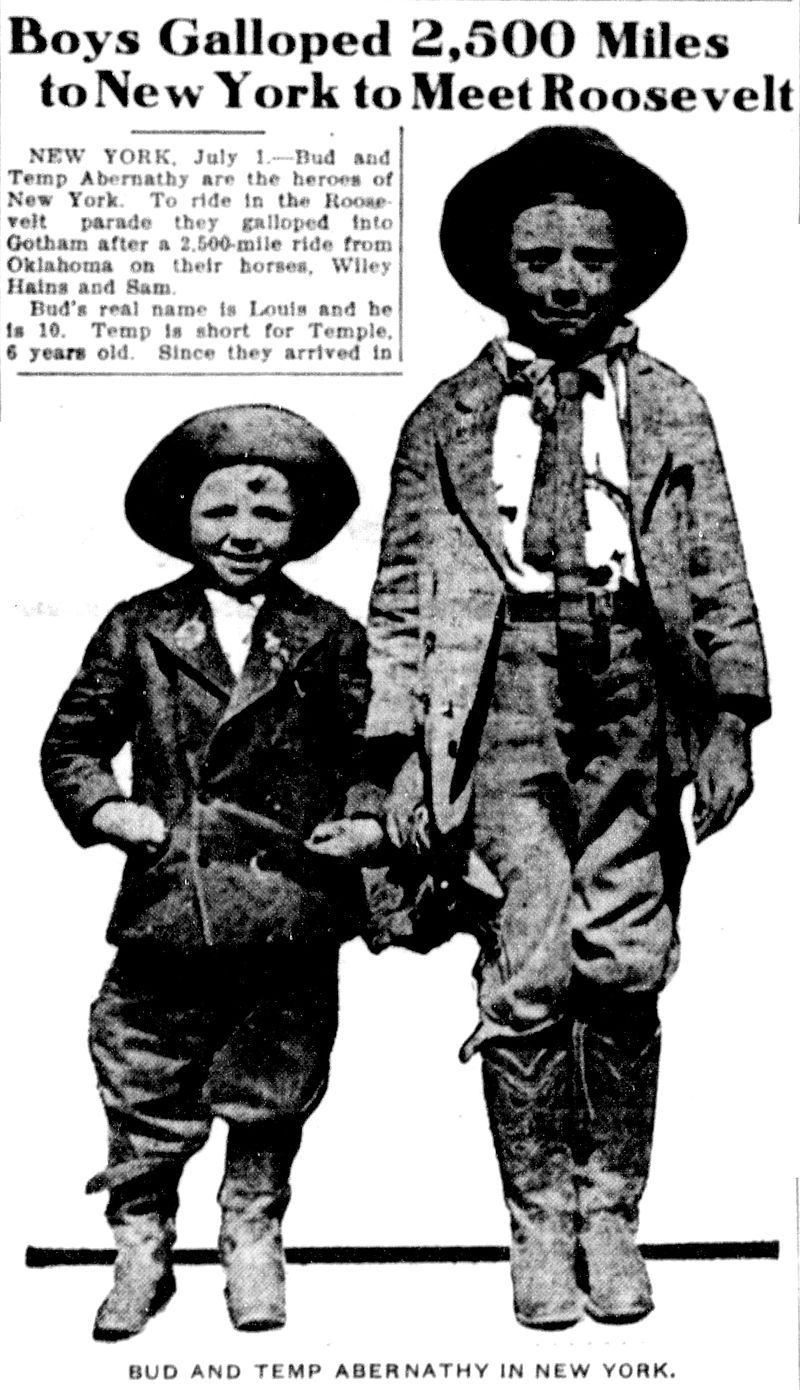
Jack’s sons, Louis “Bud” and Temple, had much of his panache. Their first adventure came in 1909 when Bud was 9 and Temple a mere 5 years old. The two mounted their horses and rode from Frederick to Santa Fe, New Mexico then back home again. Alone. It was a journey that covered more than 1400 miles and had them fording wild rivers and fending off wolves.

The following year had them setting heir sights a little higher. Emboldened by reaching the much more mature ages of 10 and 6, they set off for New York City.

Alone.

Their journey captured the imagination of the country and was soon a national news story. Along the way, they met the Wright Brothers with Orville offering to give them a ride in his plane. Arriving in Washington, DC, President Taft welcomed them at the White House. From their they headed north to NYC where they met up with Teddy Roosevelt again. He was just returned from an overseas expedition and was given a ticker tape parade, which the boys took part in the parade, riding on their horses just behind Teddy’s car in the procession.

When it was time to head home, the boys opted to ship their horses via the railroad and “bought” a Brush automobile to drive home. It’s believed that the Brush company gave the boys the car as part of a PR campaign based on the great attention they were receiving at the time. So they set off across country in their new Brush Automobile. Ages 10 and 6. The idea of the 6 year old cranking that buggy alive seems like a steep task, but, hey, they were the Abernathy Boys.

Two years later, in 1911, the Abernathy Boys were offered a challenge: If they could ride their horses from NYC to San Francisco in 60 days or less, they would receive $10,000. So at ages 11 and 7, they were off. It was a rough crossing but they made it. In 62 days. They didn’t get the cash but did set an equestrian record that still reportedly stands.
Their final adventure, at least the last recorded, took place in 1913 when they were ages 13 and 9. They rode an Indian motorcycle (in the photo at the top of the page) from OK to NYC and back again. I can only think that it would be a long, tough ride for Temple on that little seat in the back. But, hey, when you’re 9 years old and accomplished all he had, it was probably a joyride.

The Abernathy Boys went on to have successful lives, no doubt bolstered by their self-reliance and initiative. Bud went on to become a lawyer and  Temple was an oil and gas man. Bud died in 1979 and Temple in 1986.

Though their journey was relived in a few books and a film of the time and it is still celebrated in their hometown, it’s one of those stories that have faded over time. But it’s a great tale, one that probably could have only occurred at that place and at that time in history. Very evocative of the spirit of that age.

I know we live in a different age, but the next time the kids go out to check the mail box alone, don’t feel the need to watch them from the window. Take it from the Abernathy Boys, most likely they will be okay.

Just a little heads up that tonight is the opening reception for the annual Little Gems show at the West End GalleryThis year’s show is the 25th such show at the longstanding Corning gallery and in that time it has transformed into one of their most popular shows each year, for both collectors and the gallery artists. The art is smaller and affordably priced plus, for the artists, it’s a chance to work in a smaller scale than what might be their normal work  and they can play a little.

Just a fun show.

It has been mentioned here many times in the past that I have a soft spot for this show as it was the first time I ever showed my work, back in 1995. I can sincerely say I don’t know where I might be right now without that opportunity those many years back. So, even when I have a lot going on while getting ready for my upcoming shows, I always make time for this show.

The reception is open to the public, of course, and runs from 5-7:30 at the gallery on Corning’s historic Market Street. Hope you can make it out tonight. You can preview the show by clicking here.

The Masks

*****************************

“Masks beneath masks until suddenly the bare bloodless skull.” 
 Salman RushdieThe Satanic Verses

*****************************

This was a small piece that was began yesterday. I had finished a new painting that very much pleased me but left me feeling that it was not a jumping off point to immediately begin another piece in that same vein. In short, it left me feeling a bit blocked.

So, this piece, a 12″ square canvas, was started as a palate cleanser, something where I could just makes marks and shapes and color to fill some space, hoping that it somehow sparked something. This was basically how the Archaeology series began back in 2008. At the time, I was stumped and felt that I was at the end of my creative surge. I began working from a method taught by my 5th grade art teacher where we would simply take large blank sheets of paper and, using pen and ink, fill them in anyway we could. It’s something that I often turn to when I am feeling uninspired and it often bears interesting results.

Here, it started with a face, quickly slashed in with loose strokes, just trying to make a form with as little fuss or detail as possible. Then came another and another and so on. Each inspired the next. They went down in my normal red oxide at first then I went back at each face with quick, rough strokes of other colors, letting the tones and shapes play off one another. It was meant to be coarse in its execution, done fast and without much conscious thought, giving it a bit more expressionistic feel.

What they are, I don’t know. I wasn’t trying to represent anyone I knew or had seen. Just the general faces that have often popped out in my drawing over the years. But many of them have been with me for many years now. Some of them appeared when I was a small child and would try to find them in wallpaper patterns or in the edges of curtains. Everything could be made into a face, so it seemed.

And some I see as being from images culled from medieval texts, even down to the way the lips are modeled. Not done purposely, but they appear that way to me.

But most I recognize here  have been with me since my childhood, some that are friendly and some that deeply bother me, leaving me with an uneasy feeling as though I recognize them from past unpleasant personal experience.

Maybe from this life or some other earlier incarnation, if there are such things. Maybe it’s just a matter of facial and image recognition present in us all that pulls from sort of collective consciousness, that makes us respond to certain shapes and forms. Like I said, I don’t know.

Or maybe it’s just a psychological biopsy of the facets of a personality. Again, I don’t know.

But as a palate cleanser, it has served its purpose. It has amped me up a bit and I could see this small piece growing into larger painting, say 4 or 5 foot square. I could see that having a great impact on the wall, even if it’s only the wall here in the studio. But I don’t know if it will go anywhere beyond this.

Don’t even know if I will completely finish this particular or if I should even try to put eyes in the dark holes where they should be in these faces. I like the feeling that the dark pits give the piece. It gives the faces the appearance of being masks.

And maybe that is what our faces really are- masks.

As always, I don’t know if that’s true. But I do now that if this piece transforms into a larger series I will call it the Masks.

We shall see.


‘Nuff Said

******************

“he had nothing to say and he said it”

― Ambrose Bierce

*****************************

Take that any way you wish. But for those of you who endured that tortuous hour or so last night, you know what I am talking about.

‘Nuff said.

And just to make this post worthwhile, Ambrose Bierce may be one of the greatest American writers that that is unfamiliar to most of us. He was a renowned journalist, prolific short story writer– his An Occurrence at Owl Creek Bridge is considered one of the best ever American short stories–and a pioneer in the genre of horror writing. His The Devil’s Dictionary is one of the classics of humor. He disappeared in Mexico around 1913-14 while traveling as an observing journalist with Pancho Villa’s rebel forces. Pretty fascinating character that is worth the time to look into a bit further.

Beckmann’s Bridge

Max Beckmann- The Actors 1941

*****************************

What I want to show in my work is the idea which hides itself behind so-called reality. I am seeking for the bridge which leans from the visible to the invisible through reality. It may sound paradoxical, but it is in fact reality which forms the mystery of our existence.

–Max Beckmann

*****************************

For some reason, the work of Max Beckmann has never found its way to this blog. I have had an affinity with his work for many years. Part of that no doubt comes from the black linework that is present in much of his work as a result of his beginning his paintings on a black painted surface, which is something very familiar to my own process. This allowed his colors to expand off the surface, again something with which I can associate. This made his colors feel brighter and bolder, giving his work a look that separated itself from the bulk of other artists in the German Expressionist movement with which he is most often associated.

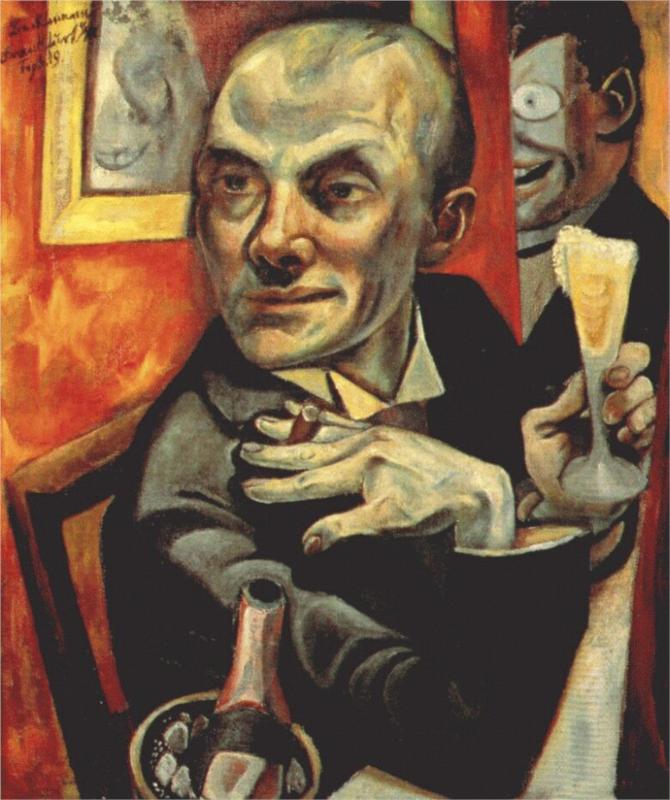
Max Beckmann- Self Portrait with Champagne Glass 1919

Beckmann was born in Leipzig, Germany in 1884 and from an early age showed a talent for painting. His first self portrait was painted at the age of 14. His self portraiture was an important aspect of his work as he painted at least 85 versions over the course of his life. Perhaps only Picasso and Rembrandt have documented themselves more.

Beckmann served as a medic during the First World War and the chaos and violence he experienced served to inspire his work for coming decade of the 1920’s. Working in Berlin in post-war Weimar Germany, Beckmann became a star, his work darkly documenting the existential doom that seems to mark Berlin of that time. But with the rise of Hitler, Beckmann’s light faded in Germany. He was a major target for Hitler’s wrath toward what he termed Degenerate Art and fled to Amsterdam in 1937. There, he desperately (and unsuccessfully) tried a number of times to get a visa to the USA.

But he survived the war and in 1948 emigrated to the USA. Over the course of the next three years, he taught painting at Washington University in St. Louis and the Brooklyn Museum. He died from a heart attack days after Christmas in 1950 on a Manhattan street corner as he was on his way to see one of his paintings at the Metropolitan Museum.

As I said, I have always felt drawn to his work. His words speak equally as powerfully to me. He often writes of his attempts to decipher the mystery of existence that is present in the mundane. I think I can understand that.

Hope you can take some time to look over his work a bit more.

Max Beckmann- Family Picture 1920

Max Beckmann- Still Life with Three Skulls 1945

Max Beckmann- Self Portrait with Trumpet 1938

Max Beckmann- The Night 1918-1919

Max Beckmann- The King 1938

Max Beckmann- Paris Society 1931

Max Beckmann- Before the Masked Ball 1922

A Shel Break

Just one of those days that calls for a Shel break. By that, I mean a few short poems from the late Shel Silverstein. They are often labeled as being for kids, most likely for their simplicity in their messaging and the cartoon-like quality of his line drawings. But there is wonderful wordplay and a layer of maturity in them that usually makes me smile as well as think just a bit. I think the best children’s works have that quality that gives them an appeal beyond the kids.

Take the two pieces at the bottom, Losing Pieces and Zebra Question. They both play with how we speak and how we see things. Simple, sure. But interesting and a just a bit thought provoking.

And I can sure use a little bit of Shel this morning. My head feels like it has hinges and someone has opened it, scooped out everything and left me little to work with.

Got to go find some good stuff to put in it.

Not much to say today, feeling a little rundown. Looking for a spark in some way, something to get the engines running at higher rpm’s, but can’t find anything in the music I’ve been listening to this morning that does the job. So I’ll resign myself to just holding on until that livelier spirit comes again.

The song that seems to jibe best with that feeling is the old Creedence song, Long As I Can See the Light. Here’s a nice version from the late Ted Hawkins, a name most likely unknown to most of us. He was one of those incredibly gifted artists who was always just short of meeting Lady Luck. Oh, he saw her a few times but it was just in passing as she gave him a flirting glance.

Here in the States, he was primarily a street performer who was “found” a number of times by record producers who could never quite put it all together for him. He gained much more recognition headlining shows in Europe, moving at one point to the UK. He was deported back to USA and reverted to being simply a street busker. He finally achieved a bit of a breakthrough when Geffen Records signed him and produced what might have been his breakthrough record, The Next Hundred Years. I say might have been because Hawkins died from a stroke at the age of 58 in 1995, only months after the release of the album.

Lady Luck is a fickle flirt, indeed.

But here’s his powerful version of the CCR classic. Enjoy.

The painting above is a new piece, Prodigal, that is included in the Little Gems show at the West End Gallery that opens this coming Friday, February 8.

*****************

Just a bit chilly this morning. Another -9 or -10° beginning to the day. The only consolation comes in knowing that it could be worse, like it is for some folks out in the Midwest. Everything seems to take longer in the cold so it has me running a little late. Thought it might be a good morning to run a post from a few years  back concerning the photography(painting?) of Teun Hocks. Take a look and if you’re in the colder regions, stay warm

*************************************


I came across these photos by Dutch artist Teun Hocks  (b. 1947) which reminded me very much of the work of Robert and Shana ParkeHarrison, which I have featured here twice before.  Actually, it was on this same day last year that I last featured them– perhaps I am looking for an alternate reality on this date as opposed to trying to relive in some way that morning twelve years ago [this post originally ran on September 11, 2013].  The ParkeHarrisons create elaborate but real backdrops against which they photograph their Everyman in allegorical scenes– there is no digital manipulation.  It is more like the worlds created in the earliest days of cinema when what was seen had to made real in some way, even the most fantastic scenes.

Teun Hooks Untitled- Man on IceTeun Hocks works in very much the same vein except that he creates a painted backdrop against which he photographs himself as the sometimes comical but deadpan Everyman.   Think Buster Keaton here.  He then creates oversize  gelatin silver prints on which he paints in oils, treating his original photo as an underpainting.  The result is a beautiful image with a painterly feel that is  imbued with both humor and pathos.  You can’t but help feel some sort of connection with Hooks’ character as he faces a sometimes puzzling reality.  Don’t we all?

I’m showing just a handful of the work of this prolific artist here as well as a YouTube video showing a larger group.  Hope you’ll enjoy this on this day.

Teun Hocks

Teun Hocks Baggage

Teun Hocks Untitled-Man Sleeping with Weight

Teun Hocks CrossroadsTeun Hocks Prairie

Teun Hocks Music

Keith Haring/ Reason

***************************

The best reason to paint is that there is no reason to paint… I’d like to pretend that I’ve never seen anything, never read anything, never heard anything… and then make something… Every time I make something, I think about the people who are going to see it and every time I see something, I think about the person who made it… Nothing is important… so everything is important.

Keith Haring

***************************

I can’t say that I was ever a huge Keith Haring fan. Maybe it was because his Graffiti-based Pop Art imagery seemed to be everywhere all of the time  through most of the 80’s and 90’s. It seemed like you couldn’t turn around without seeing his images. But I have to admit that I have come to have an appreciation of his work, especially the prodigious output he produced in his short life. He died at the age of 31 and created a pretty amazing body of work in the limited time he spent on this planet. Even if you don’t recognize the name, you most likely have seen and recognized his imagery at some point.

Part of my newfound appreciation comes from the fact that I am able to look at his work now and find things in it that I may be able to transfer in some way to my own work. Take for instance, the rhythms of some of his black and white pieces shown below. I see something in them that speaks to me and might work in my voice, as well.

I also like the attitude he took with the quote at the top. The idea that the importance of art comes from the fact that we see something in it that makes it important to us is a striking and sometimes abstract concept. It’s one that has struck me at times in the studio when I am suddenly hit by the absurdity of the idea that I am standing there smearing paint of a piece of board. In that moment I can’t think of a reason why I should be doing this thing.

And maybe it is that absurdity that makes it worthwhile. Perhaps to continue to do something that seems so unimportant in the grand scheme of things creates its own importance.

A sort of testimony to both the futility and significance of our existence.

And maybe that is art’s true purpose, to let us feel both humble and expansive.

Something to think about while I am wondering what the hell I am doing here in the studio today.

*******************


********************************

“The sun –the bright sun, that brings back, not light alone, but new life, and hope, and freshness to man–burst upon the crowded city in clear and radiant glory. Through costly-coloured glass and paper-mended window, through cathedral dome and rotten crevice, it shed its equal ray.”

― Charles Dickens, Oliver Twist

********************************

I guess it’s wishful thinking to be discussing a painting based on light and warmth on a day when we are just beginning to feel the brunt of the bitter cold that has swept down from the polar regions. It’s below 0° right now and it won’t get much above that for the next few days around here. Brrr! So the hope contained in a rising sun and the light and heat from it becomes something to really think about.

The painting above is a new one, a 24″ by 24″ canvas, that I am calling Reaching For The Light. The jumble of upward rising buildings has a new addition to go with the regular roofs and spires–chimneys. This new element gives the effect of an appendage reaching upward from each building to get to the sunlight.

I like that feeling that it gives.

I thought the descriptive snip above from Dickens’ Oliver Twist fit this painting. I often have images based on Dickens’ vivid descriptions of cityscapes from Victorian England in mind when I am working on these type of paintings that are cramped and crowded with buildings. His words created an imagery that stuck firmly in my mind from when I first read them so many years ago.

It was a place of darkness, soot, and shadows. The idea of the sun cutting through the grayness with its cleansing light and warmth is one of hope, one of moving to a better situation beyond the squalor and despair of the moment.

That’s how I am seeing this painting with the Red Tree serving as the symbolic central figure acting out this idea of grasping for the light.

So, on this coldly bitter day, I have to find hope in the same sun that we have come to fear as the ever increasing effects of global climate change become apparent.

Stay warm, folks.