Feeds:
Posts
Comments

Keeping Hope, Again

I have been filled with a dark and foreboding anxiety lately.  It’s even deeper and darker than the uneasiness and apprehension that has been with me for the past year as I watch the fabric of this country seem to unravel before my eyes. In recent weeks I get the sense that we are nearing a tipping point, that without some sort of dramatic change in our course forward we may find ourselves at a time and place from which there may be no recovery. 

At least in a peaceful and orderly manner.

I know this sounds hyperbolic but I feel that even darker days may be ahead. 

It’s easy to lose grip on our hope in these times, to feel our own humanity slip away only to be replaced by fear, anger and paranoia. That is something that seems evident by observing the growing division and incivility taking place in day to day life. 

As bad as it seems, I am reminded of an entry posted here several years back soon after the death of historian and social activist Howard Zinn. It was about the need to behave as a real human in the darkest of times, if only to remind us of those better qualities that we are struggling to maintain. The world may be dark and darkening with each passing moment, but kindness and compassion have the power to create moments of light that defy the shadows that creep over us and to give us a renewed energy to go on.

It’s short–less than the blather I’ve written here to introduce it– but it is worth a moment to absorb it. The last paragraph is a gem.
***********

To be hopeful in bad times is not just foolishly romantic. It is based on the fact that human history is a history not only of cruelty, but also of compassion, sacrifice, courage, kindness.

What we choose to emphasize in this complex history will determine our lives. If we see only the worst, it destroys our capacity to do something. If we remember those times and places — and there are so many — where people have behaved magnificently, this gives us the energy to act, and at least the possibility of sending this spinning top of a world in a different direction.

And if we do act, in however small a way, we don’t have to wait for some grand utopian future. The future is an infinite succession of presents, and to live now as we think human beings should live, in defiance of all that is bad around us, is itself a marvelous victory.

——Howard Zinn

************

Burchfield’s Advice

Get yourself to a vantage point of seclusion and view the world with your eyes alone. Think of the infinite spaces of the skies and the world beneath.

Charles Burchfield

********************

Good words for a painter. Or any other human, for that matter.

The poet Robert Frost wrote a wonderful preface to the 1939 edition of his collected poems. It was titled The Figure a Poem Makes and it described how he viewed his process of unveiling the true nature of his work. Reading it, I was struck by the similarities between his work as a poet and how I view my work as painter.

For example, the following paragraph-I have highlighted individual lines that jumped out at me. I probably could have highlighted them all:

It should be of the pleasure of a poem itself to tell how it can. The figure a poem makes. It begins in delight and ends in wisdom. The figure is the same as for love. No one can really hold that the ecstasy should be static and stand still in one place. It begins in delight, it inclines to the impulse, it assumes direction with the first line laid down, it runs a course of lucky events, and ends in a clarification of life–not necessarily a great clarification, such as sects and cults are founded on, but in a momentary stay against confusion. It has denouement. It has an outcome that though unforeseen was predestined from the first image of the original mood-and indeed from the very mood. It is but a trick poem and no poem at all if the best of it was thought of first and saved for the last. It finds its own name as it goes and discovers the best waiting for it in some final phrase at once wise and sad-the happy-sad blend of the drinking song.

A painting often begin in delight. A certain tone of color, the way a line bends, the manner in which a brushstroke reveals the paint or in how the contrast of light and dark excites the eye.  The delights pull you in and keep you engaged and it is not until you have finished that you are able to understand the sum of these elements, to detect the wisdom, the meaning, behind it all. It is only then that you know what you have uncovered and how it should be named.

The work itself, if left to its own means, knows what it is and will tell you.

Then there is this gem of a paragraph:

No tears in the writer, no tears in the reader. No surprise for the writer, no surprise for the reader. For me the initial delight is in the surprise of remembering something I didn’t know I knew. I am in a place, in a situation, as if I had materialized from cloud or risen out of the ground. There is a glad recognition of the long lost and the rest follows. Step by step the wonder of unexpected supply keeps growing. The impressions most useful to my purpose seem always those I was unaware of and so made no note of at the time when taken, and the conclusion is come to that like giants we are always hurling experience ahead of us to pave the future with against the day when we may want to strike a line of purpose across it for somewhere. The line will have the more charm for not being mechanically straight. We enjoy the straight crookedness of a good walking stick.

I have often spoke of the need to be have my emotions near the surface when I work, to always need to feel excited and surprised by what I am working on. To recognize things I never knew as being part of me. If I am not moved by the thing I am working on at any given time, how can I expect others to be moved by it? This paragraph speaks clearly to my experience as an artist.

Then there is the final sentences of the essay:

Like a piece of ice on a hot stove the poem must ride on its own melting. A poem may be worked over once it is in being, but may not be worried into being. Its most precious quality will remain its having run itself and carried away the poet with it. Read it a hundred times: it will forever keep its freshness as a petal keeps its fragrance. It can never lose its sense of a meaning that once unfolded by surprise as it went.

My translation of this, as a painter, is that the work must be free to move and grow of its own volition. It tells you where it wants to go and, if you don’t constrain it and try to push it to a place where it was not intended to go, will reveal its truth to you. If you can do that, it remain always fresh, always in the present and always filled the excitement and surprise that it contained in that burst when it was created.

I don’t want to bore you too much. It’s a great essay and is a valuable read for anyone who makes art in any form. You can see ( and download) the whole book, The Collected Poems of Robert Frost, with this essay in full by clicking here.

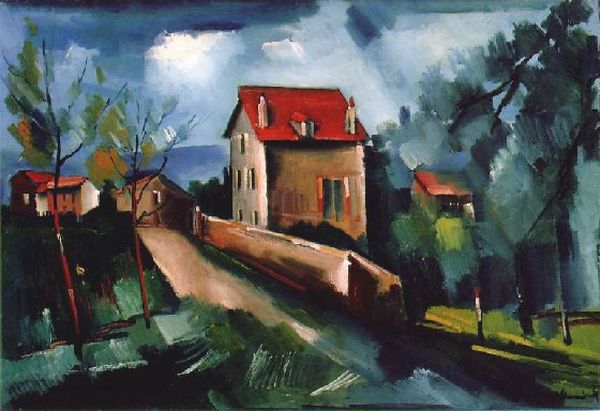
I ran the post below a few years back, mainly about the quote in it from Fauve painter Maurice de Vlaminck. His attitude as expressed in those words really resonates with me. I, too, find myself not giving a second thought to anyone else’s work when I am in my own. The only concern then is filling my space, creating my own new world. His words are in my mind this morning so I thought today would be a good day to replay this short article with the addition of a video of de Vlaminck’s work and a few more images.

Maurice de Vlaminck- Houses at Chatou 1905


When I get my hands on painting materials I don’t give a damn about other people’s painting… every generation must start again afresh.

— Maurice de Vlaminck

********************

I have to admit I don’t know much about French painter Maurice de Vlaminck (vlah-mink)  who lived from 1876 until 1958.  His work is best known for a short period  in the early years of the 20th century when he was considered one of the leading lights, along with Andre Derain and Henri Matisse, of the Fauve movement. Fauve translates as wild beast and the style of these painters was very much like  that to the sensibilities of that time. It was brightly colored with brash brushwork and little attention paid to detail. It was all about expression and emotion.

I recognize some of his early Fauvist work, mainly for the obvious influence of Vincent Van Gogh it exhibits, and none of his later which becomes less colorful and exuberant, perhaps shaped by his experiences in WW I. But his name is one that I have often shuffled over without paying too much time to look deeper.

Maurice de Vlaminck- At the Bar

But I came across this quote and it struck me immediately. It was a feeling that I have often felt  when I immerse myself in my work. All thoughts of other painters– of their influence, of comparisons and artistic relationships– fade into nothing. It is only me at that moment faced with the task of pulling something new and alive from the void. I can’t worry myself at that moment about what other painters are doing. Their what’s and how’s and why’s are all moot to me then because I am only trying to express something from within. It might only exist and live for me in that instant, though I hope it transcends the moment, but that is the whole purpose and all of the works of all the painters throughout time can’t change this singular expression of this moment.

This single, simple quote brought me into kinship with de Vlaminck and made me promise myself to explore more deeply into his work and life so that when I come across his name in the future I don’t simply skim past without a thought. But when I am painting, rest assured I will not be thinking of Maurice de Vlaminck.  And that is as it should be…

Maurice de Vlaminck-The Blue House

Maurice de Vlaminck- landscape with Red Roofs

Maurice de Vlaminck- Landscape of Valmondois

Maurice de Vlaminck- The Gardener

Mauirice de Vlaminck – La Partie de Campagne

White Bird

I was thinking of something in a Halloween theme for today’s Sunday Morning Music.  But I changed my mind when I realized that after the last year in this country it had become an ironic holiday. Or at least overkill because every day feels like Halloween and at some point on most days I find myself screaming at the sky in horror.

All tricks and no treats.

Why the hell do I want to celebrate that?

So, I’m gonna go in a different direction (note the Chagall print at the top– not scary, right?) and play a song, White Bird, from 1968 from the San Francisco based group, It’s  a Beautiful Day. They never achieved the same kind of fame as the other bands– Jefferson Airplane, Santana and the Grateful Dead–who came out of SF’s 1967 Summer of Love. but this song is pretty captivating in tone with it’s soaring violin from David LaFlamme, who re-released a version of the song a decade later under his name. That’s where I first heard the song.

Give a listen and have a good day. And if you hear a blood-curdling scream in the woods around my studio, don’t worry– it’s just another day in Halloween Land.

Horace Pippin

Horace Pippin- Amish Letter Writer


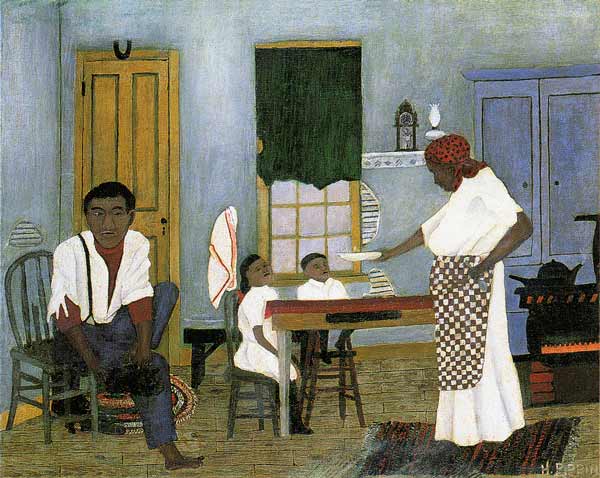
Not surprisingly, I have a real affinity for self-taught and naive painters. Among my favorites is American Horace Pippin who lived from 1888 until 1946.  He only produced about 140 paintings in his relatively short life but they are real gems, displaying a wonderfully sophisticated and more mature form of naivete. He achieved a pretty high level of recognition in his short career, being championed by a number of critics as well as artist N.C. Wyeth. The bulk of his work is now held in museums.

Though born in West Chester, PA, Pippin grew up in Goshen, NY, which interests me because I have three grand-nephews living there.  Goshen was where he began his artistic journey after winning art supplies in a newspaper contest, using them to make drawings of the jockeys and horses at the famed Goshen racetrack. He was wounded in World War I, serving in the famed Harlem Hell Fighters, and turned to art in a more serious manner to strengthen his damaged right arm.

He married and moved back to West Chester and his work began to draw notice, appearing in numerous exhibits in museums and galleries alongside some of the giants of the art world. In 1946, he suffered a stroke and passed away.

As I said, he produced a fairly small number of paintings, many depicting the African American experience of the time along with a number of biblical and historical paintings, John Brown and Abe Lincoln being favorite subjects. They are a rich American treasure.

Here’s a nice video of much of his work with Ella Fitzgerald’s great Cry Me a River backing it.

Horace Pippin- Milk Man of Goshen

Horace Pippin- Domino Players

Horace Pippin- Abe Lincoln Good Samaritan

Horace Pippin- The Trial of John Brown

Horace Pippin- Sunday Morning Breakfast

Horace Pippin- John Brown Going to His Hanging


Mystery of the Unseen

“How fathomless the mystery of the Unseen is! We cannot plumb its depths with our feeble senses – with eyes which cannot see the infinitely small or the infinitely great, nor anything too close or too distant, such as the beings who live on a star or the creatures which live in a drop of water… with ears that deceive us by converting vibrations of the air into tones that we can hear, for they are sprites which miraculously change movement into sound, a metamorphosis which gives birth to harmonies which turn the silent agitation of nature into song… with our sense of smell, which is poorer than any dog’s… with our sense of taste, which is barely capable of detecting the age of a wine!

Ah! If we had other senses which would work other miracles for us, how many more things would we not discover around us!”

Guy de Maupassant, The Horla

**********************

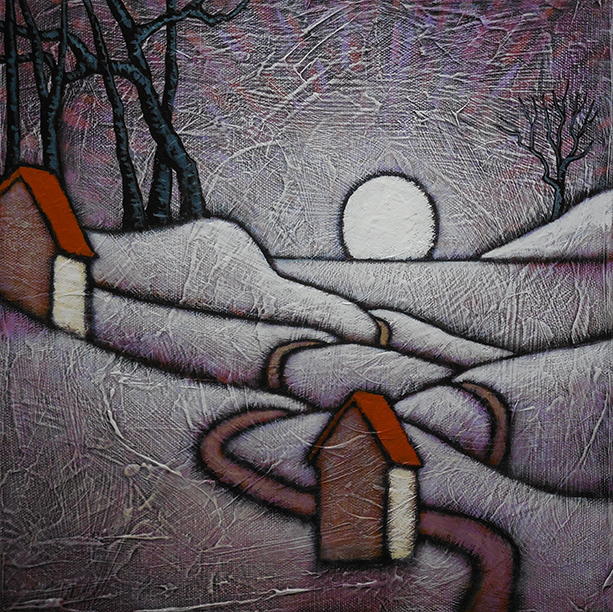
Yesterday I finished the painting above, a 12″ square canvas that is scheduled to head to the Kada Gallery in Erie for my show, Sensing the Unseen, that opens there on December 1. It’s a piece that feels faithful to the theme of the Kada show– that there are energies and forces swirling around us that are imperceptible to our senses. I’ve often felt that one of the purposes of art is to give these forces shape and form.

To make the unseen visible.

And I think this painting is a good example of that thought. Its simple forms, lack of detail and sparse narrative elements might seem an unlikely setting for the unveiling of  hidden forces.

Or maybe these things make it the perfect setting for doing such a thing. Distraction is stripped away. The whiteness of the moon at the horizon becomes a central point of focus. The lightness of the landscape (is that snow?) and the path push the eye further inward, past the windowless houses that seem to act as boundary markers between the known and the unknown. There is a created sense of depth and space that belies the tight dimensions of the picture plane. It all makes you feel as though there is something ponderous, something that begs to be known in that space.

Even the color creates a mysterious paradox. It feels cold with the whiteness of the snow and the moon (or is it a sun?) yet the underlying magenta makes it feel warm. It seems perilous and cold yet still feels warm and inviting. It pushes away and pulls in.

Or it’s just a simple little snowy landscape.

I chose its title, Mystery of the Unseen, from the paragraph at the top taken from a short story, The Horla, from the French master of the short story, Guy de Maupassant. It’s a horror story describing how an unseen alien force– an extraterrestrial– inhabits a man, controlling his mind with the intent of conquering humanity. It was the last story he wrote before being committed to a sanitarium, where he died.

I guess that’s the dark side of the unseen.

Hardly the feeling I experience in this painting.


Big Country Blues

Have a lot on my plate this morning, a lot of things needing to be done. But I came across this video by one of my favorite singer/songwriters, the late Townes Van Zandt, and thought I would share it. It’s called Big Country Blues and the video features the photos of primarily working class Americans from the great Richard Avedon.

It’s a compelling video, given this time in this country. I watched it twice this morning just to fully take in the imagery and Townes’ music never lets me down. I wish he were around just to hear his take on these times. He could write some sad songs, after all.

Give it a look and a listen.


Mesmerized

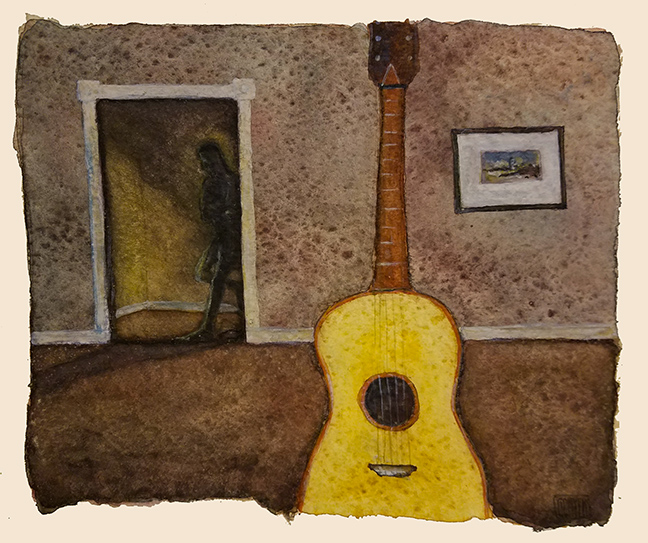
I was looking for an image to pair with the music I want to share today  and thought this old piece might work since I’ve been showing a lot of older unseen work lately. It’s a watercolor piece from 1995 or 1996 that I never felt secure enough about to show, one with a guitar dominating the front of the picture plane and a dark character propped in the doorway.

There are a few things wrong with this piece, most notably the way the fretboard  just ends at the body of the guitar. And the dark character is just, well… a little strange. He’s either smoking a cigarette or has been recently on fire–which might explain his charred appearance– and is still smoldering.

But even with these obvious flaws, for some reason I still find myself looking fondly at this piece and liking it. Still not sure about showing it to anybody but liking it, nonetheless.

The music I wanted this to accompany is from Australian fingerstyle guitarist Alan Gogoll who is being hailed for his technique that creates bell-like harmonic tones. I came across a couple of his videos and was drawn in by the way the filming focused on his hands. I am fascinated by watching the hands of musicians when they play and his technique has a grace and poetry in the movement of his hands.

He also has a series of short Instagram videos and one very long Youtube video in which the camera is inside the guitar facing out through the sound hole. You see his fingers picking and the vibration patterns of the strings as each string is plucked. Called Stringscapes, they are pretty mesmerizing.

I am showing a short song called Mulberry Mouse first, followed by the Stringscapes video. As I said, this video is long, coming in at 28 minutes. But it is worth at least taking a look for a minute or two. Or longer. Actually, while I was writing this I took a look and about four minutes passed. I said they were mesmerizing.

You can see more on Alan Gogoll’s website by clicking here.


The Book of Hours

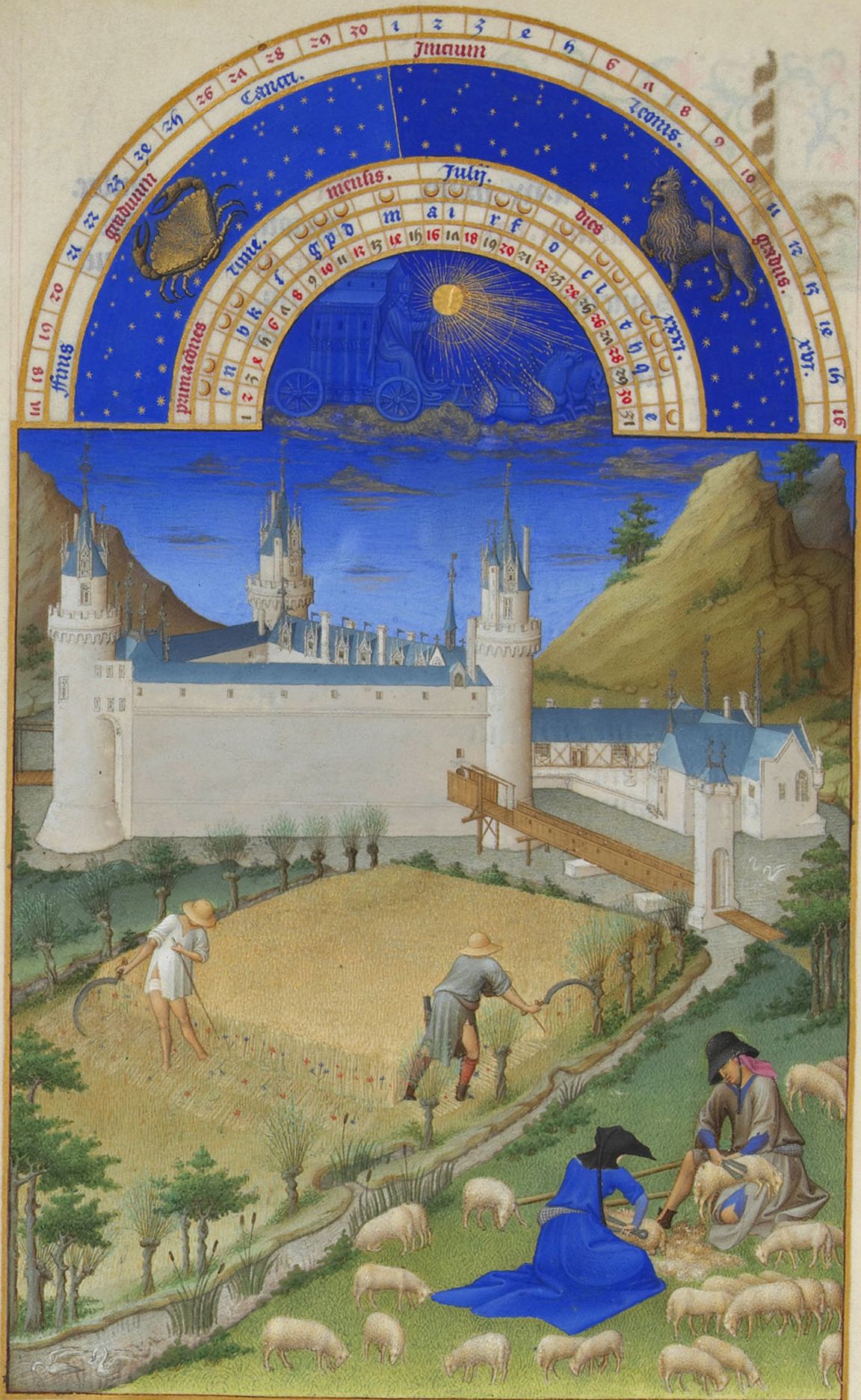
Several years ago I wrote about a spectacular illuminated book called Tres Riches Heures du Duc de Berry. It was a Book of Hours created for a French Duke in the 15th century filled with prayers, calendars, timetables and the like. It also included some of the most extraordinary paintings that illustrated the text, including twelve pages that showed each month in proper seasonal context. I came across the film below that focuses on these beautiful pages, showing them in some detail.

After hitting the start arrow on the video below, you have to click on the link to go to YouTube to watch the video at the request of its creator.  But it’s well worth a look to start out your week on such a calm and lovely note.

**********

Limbourg Brothers- Tres Riches Heures du Duc de Berry FebruaryOne of the great pleasures in being fairly ignorant is the thrill that comes from stumbling across something that is absolutely spectacular without any knowledge of its existence beforehand.  Of course, the flip side of this experience is the depressing realization that sets in when you realize how little you really know.  I know this from experience.

The other day,  while searching for images of medieval snow scenes for the previous post, I also came across a beautiful image taken from a 15th century illuminated manuscript called the Tres Riches Heures.  It was a gorgeous winter scene, very Dutch looking, with a astronomical chart with beautiful blue lapis bands arching across the top of the page.   I was immediately taken in by the image.

Limbourg Brothers- Anatomical Man- Tres Riches Heures du Duc de Berry FebruaryDoing some quick research I discovered that this image was but one of over 130 painted images in the Tres Riches Heures, many of which were done by a trio of Dutch siblings, the Limbourg Brothers, between 1412 and 1416 for the French Duke du Berry.  The Tres Riches Heures is a book of hours which consists of prayers and devotional exercises along with  timetables for specific prayers and calendars for feast days and other days of note in the liturgical year, along with some customized additions.  This particular book of hours was the most spectacular ever produced.

Of course, something this incredible never comes easily.  The Limbourg Brothers, unfortunately, all died within the year of 1416, most likely from the plague, leaving the Tres Riches Heures incomplete.  It was worked on for many years by an unknown intermediate painter, most likely a court painter for French king Charles VII, who had attained the unfinished group work in the years after the Limbourgs died.  Finally, between 1485 and 1490, the work was completed by artist Jean Colombe.

Limbourg Brothers- Hell- Tres Riches Heures du Duc de Berry FebruaryToday, this considered arguably the most valuable book in the world– a book filled with 130 beautiful Dutch paintings, a book that took nearly eighty years to complete.

As I say, I was thrilled to come across it, having no prior knowledge of it or the magnificent work of the Limbourg Brothers or Jean Colombe.  But then I was a bit taken aback by the realization that I had such a gap in my knowledge, especially of a work of such grandeur.  But, that’s the way it goes.  You trudge forward, a blind squirrel periodically stumbling across a nut.

Now I know…