Feeds:
Posts
Comments

Retreat

Nowhere can man find a quieter or more untroubled retreat than in his own soul.

Marcus Aurelius

*************

I am not sure that I am 100% sold on these words from Marcus Aurelius.

I think it’s a wonderful idea to think that you have the ability to retreat to an inner sanctum of peace, a safe haven that isolates you from the troubles and turmoil of the outer world. But is it so? Can you retreat inward and leave the outer world behind?

Can you climb onto that island and pull up the ladder behind you?

I think there must be folks who can do this, can block out the world and find the tranquility of the soul described by Marcus Aurelius. I think they must be either much more evolved than me or foolhardy because I’m just not sure that it’s in me at this point.

I would love to set my worries, fears, and furies adrift and climb that ladder, never to see them again.

But that’s not the way I am nor is it the way of the world.

Chaos finds a way of always drifting back to our shores.

But maybe this island of retreat is not about completely isolating oneself, not pulling up that ladder forever.  Maybe it’s in climbing up for a brief period of time to discover those moments of silence and absolute stillness that allow those wounds inflicted by the world to heal.

The world is still out there and will soon return but perhaps there is balm in the quiet of the present moment.

*********

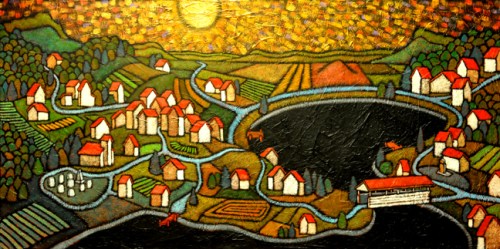
The painting here is a new 6″ by 12″ canvas that I am calling Retreat.

Another busy day. First thing this morning I am speaking to about 65 third-graders who have been exposed to my work through their art teacher who contacted me with a wonderful list of questions the kids had asked.  I wrote about them a week or two back and showed some of their paintings. I am looking forward to talking with them and answering their questions as well as doing a brief demonstration.

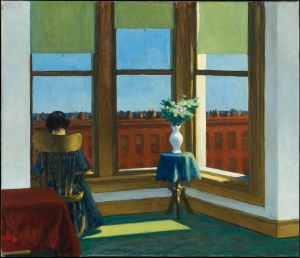
But even though I am real busy I wanted to share another video of Edward Hopper paintings, this time focusing on the isolation of his interiors.  The soundtrack for this video uses the lovely Moonlight in Vermont from the Nat King Cole Trio.

So take a look and try to have a great day.

I am really busy today. I am working on a bigger piece that I started late yesterday. There are just a lot of things percolating and I really want to get at it this morning.  I’ve been at this long enough that I know this is a time of which I need to take advantage.

The Muses come in fleeting moments and rarely, if ever, stick around for you if you don’t give them the attention and the time that they demand.

So while I go back to work I thought I would share a nice video of  Edward Hopper landscapes and cityscapes set to music. The maker of the video didn’t credit the music but I was able to discover that it is a solo piano cover of Pink Floyd’s Wish You Were Here from musician Steven Garreda.  It’s a really nice fit for the contemplative quiet of the Hoppers.

I’m back to work but please enjoy.

It’s a dark, damp day here that seems to sap the color out of the forest around the studio. All grays and browns and pale washed out greens.

It very much feels like the blues. The music, not the color.

I’ve got much to do today so I’m going to share a video that shows many of the works from one of my favorite painters, Charles Burchfield, set to the sound of one of my favorite Miles Davis songs, Blue in Green.

It’s a fitting song for a day like the one outside my studio windows.

GC Myers- Balance (Known/Unknown)We have to balance the lineality of the known universe with the nonlineality of the unknown universe.

Carlos Castaneda
******************

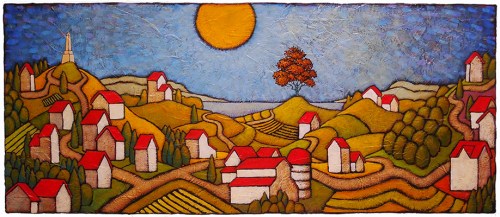
I am calling this new painting Balance (Known/Unknown).  It is a 14″ by 32″ canvas and will have a slightly different edge detail that I will shown at a later date.

The Carlos Castaneda quote above just reached out to me when I was looking at this piece. The Red Tree here seems to be standing at the edge of the known, the terrestrial world that is defined here with earthy color, solid forms, and dark lines– the lineal universe.  Beyond it the non-lineal universe beckons, represented by a nebulous sky and a sun that acts as an unblinking eye.

It all is very much a metaphor for the purpose of art and that is to act as an intermediary between the known and the unknown, the go-between for that which is of our five senses and those things that go  far beyond those senses.

Things that we feel in an emotional sense.

And that is what art often does, putting the deep feeling of that which we cannot see onto those things that we do see.  It makes the intangible tangible.

That said, I like this new piece and have been enjoying my time with it. Every day I find a new angle within it that gives me pause, that excites me, and sets me thinking. And that is all I hope for in my work.

Deacon Blues

GC Myers- The Deacon's New Tie 1995I was thinking about what song to use for this week’s Sunday morning musical interlude and the song I chose brought to mind an old painting of mine, one that lives with me still. It from the early Exiles series from around 1995 and is called The Deacon’s New Tie.

Finished near the end of the series, it is a bit lighter and more whimsical than the other pieces in the earlier post. Outside of going out for an exhibit many years ago, the Deacon has been a constant companion here in the studio.

There’s really no back story to the Deacon. He sort of just emerged from the surface. I had no preconception of what he would be when I started. I remember clearly starting this piece on a blank sheet and making a nose. Slowly, the face formed and when his eyes with their hangdog look came around I knew he was different than my other Exiles characters.

The funny thing about the Deacon is that several months after the piece was done and include in the Exiles show, I came across an article in the newspaper about a 95 year-old man in central Florida who had won a case where he was trying to be forced from the land on which he had lived for nearly 70 years. There was a picture of a bald old man sitting on his veranda, a slight smile on his lips. There was something slightly familiar in that face, something that caused me take a second look. There it was: he was the spitting image of my deacon.

Then, reading the article, it stated that he was a longtime member of a local church and was known to friends and neighbors as the Deacon. Coincidence or maybe just a certain look reserved for those Deacon-like characters.

As you may have already surmised from the title, this week’s song is Deacon Blues from Steely Dan, a group that I often think people have let slip away in the collective memory.  I was a fan and know that I often forget them until I stumble across their music by chance.  Luckily, there’s a local restaurant where we’ve dined for many years and we can’t remember a single visit where a Steely Dan song hasn’t played on their sound system at some point during the meal. The owner must be a Steely Dan fan but I think many people would be surprised at the huge success, both critical and commercial, that this band achieved in the 1970’s.  Solid then and now.

Anyway, this is one of their hits from back in 1977, Deacon Blues. Give a listen and have great Sunday.

Wild Geese

GC Myers- The Singular HeartYou do not have to be good.
You do not have to walk on your knees
For a hundred miles through the desert, repenting.
You only have to let the soft animal of your body
love what it loves.
Tell me about your despair, yours, and I will tell you mine.
Meanwhile the world goes on.
Meanwhile the sun and the clear pebbles of the rain
are moving across the landscapes,
over the prairies and the deep trees,
the mountains and the rivers.
Meanwhile the wild geese, high in the clean blue air,
are heading home again.
Whoever you are, no matter how lonely,
the world offers itself to your imagination,
calls to you like the wild geese, harsh and exciting —
over and over announcing your place
in the family of things.

Mary Oliver

****************

A while back, a person interested in my work sent me the poem above, Wild Geese.  It was written by the esteemed Pulitzer Prize winning poet Mary Oliver. This person wanted to know if I would be interested in translating this poem into into one of my paintings for them. I replied that when I had some time I would gladly do that as I think the poem strikes a chord that very much resonates in my work.

After a short while, this person contacted me again and said they had been looking at my work and had found a painting that they felt captured the spirit of the poem. The painting is the one shown at the top, The Singular Heart.

I was thrilled by the choice. It had the feeling and message of the poem without being absolutely literal.  It’s exactly how I wanted to portray it. And the message and title of the painting fell perfectly in line with Oliver’s poem.  The Red Tree stands, singular and alone, with the realization that it has a unique place, as does every being, in the family of things.

I told this person a bit about this painting and an experience I had with it that stuck with me.  Once it hung in my home area gallery, the West End Gallery, and I met with a local college art class there. One of the questions was which of the pieces there was my favorite. I normally don’t answer that question because I have always felt that any painting that I decide to show has something unique to it, some quality that makes it special to me. Kind of like a parent with their kids.

But on this occasion I didn’t hesitate and pointed at this painting.  I told them if I were to try to describe in one painting what I wanted to say with the body of my work and what I hoped for myself as a person, that this piece would summarize it perfectly.

I told this person that I felt it was perfect choice and was pleased when they chose this painting to represent the poem in their home. It means a lot when any painting finds a home but is even more special when I know that it resonates on many levels with its owner, that it goes deeper than the surface.

Here’s a clip of Mary Oliver reading her poem, Wild Geese:

Synthesis

dscn0027sm

Ideas excite me, and as soon as I get excited, the adrenaline gets going and the next thing I know I’m borrowing energy from the ideas themselves.

Ray Bradbury

*********

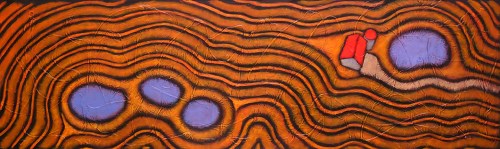
Yesterday I wrote briefly about the Aboriginal art of Australia, work that really stirs me up in a lot of ways. As I was looking at the Aboriginal paintings while writing the blog, different ideas for my own work were running through my mind. There was a rhythm and a pattern that kept biting at me and by the time I got to my own painting I had a sense of what I was hoping to see, as far as forms. The color would evolve as the painting moved along through the process.

Using a 12″ by 36″ piece of masonite prepped with gesso and a layer of black paint, I began and moved quickly.  Like late author Ray Bradbury said in the quote above, the idea was creating its own energy and I was feeding off it. At these times, the painting is absolutely effortless.  As the painting is finally all blocked in,  begin to see the final finished version come to form in my mind.

Layer after layer of color are applied quickly, each layer slightly altering the overall feeling of the piece and moving it by steps closer to what I am now seeing concretely in my mind. After a final pass through, I stop and feel satisfied.  That’s what you are seeing at the top of the page.  I am satisfied in the moment but am still spending time taking it.

Sometimes when I paint like this, the energy from the actual act of painting hangs with me for a while.  I have learned that I need to give these pieces a little more time so that I can see them without the influence of the energy created in the process.  Sometimes after a bit I might see that some colors need to be deepened or brightened in order to move the energy in the painting.

Looking at the piece now I can see the synthesis from the work I was looking at yesterday morning into the finished piece above. I took in the shapes, colors, rhythms, and patterns of that work and tried to translate it into my own visual voice without imitating or copying it in any way.  It is more about appropriating the energy and rhythm of that work.

Now without the context of yesterday’s blog, you might look at this piece and simply see my work.  But artists are, at their core, synthesizers that constantly take in information and imagery and sounds and movements then shape them into a unique form that fits the vision they have for the world. This is one very basic and direct example of that synthesization of influence.

So, gotta run– there’s some synthesizing to be done!

kate-owwen-gallery-tony-sorby-journey-tracks-to-sacred-sites

Tony Sorby- Journey Tracks to Sacred Sites

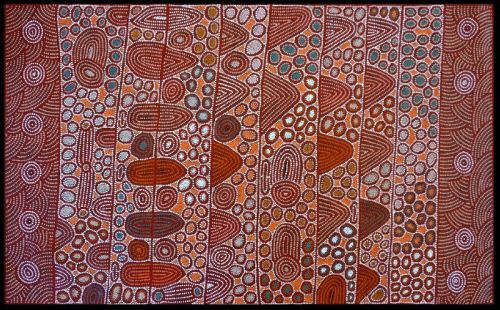
Whenever I come across a piece of Australian Aboriginal art online it just stops me cold. I am immediately pulled in amid the dots and forms and earthy colors.  There seems to be something beyond what I am looking at, something deeply rhythmic and pulsing, something that connects me to a bigger pattern.

And that makes sense as even the most contemporary of this art is directly connected to the very beginnings of these people, documenting their paths, ceremonies and customs through the ages. It tells who they are as a people and perhaps, in its own way, does the same for even us non-aboriginals, connecting us in our humanity.

It has an organic authenticity that artists in other genres strive to capture in the voice of their own work. It is new and ancient at the same time. It has a modern abstract feel yet has representational symbology that comes through. As has been said, most of this work could hang in a modern art museum or in a museum devoted to anthropology– it is art and history.

I just find it fascinating and have nothing but great respect for these artists. I spent about an hour looking at the site of  a wonderful gallery devoted to Aboriginal art, the Kate Owen Gallery, based in the Sydney area of Australia. I could have spent many more hours on the site.  I urge you to take a look.

I’m showing a few pieces that jumped out at me and I barely scratched the surface of all the great work there

kate-owen-gallery-helen-mccarthy-tyalmuty-awurrapun

Helen McCarthy Tyalmuty-Awurrapun

kate-owen-gallery-eileen-napaltjarri-tjiturrupa

Eileen Napaltjarri-Tjiturrupa

kate-owen-gallery-alma-nungurrayi-granites-yanjirlpirri

Alma Nungurrayi Granites-Yanjirlpirri

kate-owen-gallery-helen-mccarthy-tyalmuty-family-tree

Helen McCarthy Tyalmuty-Family Tree

kate-owen-gallerychristine-nakamarra-curtis-mina-mina-jukurrpa

Christine Nakamarra Curtis-Mina Mina Jukurrpa

kate-owen-gallery-joylene-napangardi-reid-womens-ceremony

Joylene Napangardi Reid-Women’s Ceremony

I thought I’d share a post from several years back where I showed a painting at several stages in its progress.  It was finally titled Game of Life and remains a favorite of mine.  Below is the blog entry that was based on the beginning of he process.  At the bottom are several photos that show it in progress.

gc-myers-feb-2013-1

This is a new piece that I started over the weekend.  It’s a fairly large canvas, 24″ by 48″, gessoed and blackened before I began to lay out the composition in the red oxide that I favor for the underpainting. I went into this painting  with only one idea, that it have a mass of houses on  a small hilltop. That is where I began making marks, building a small group of blocky structures in a soft pyramid. A little hilltop village. From there, it went off on its own, moving down the hill until a river emerged from the black. An hour or two later and the river is the end of a chain of lakes with a bridge crossing it. We’ll see where and what it is when  it finally settles.

I like this part of the process, this laying out of the composition. It’s all about potential and problem-solving, keeping everything, all the elements that are introduced, in rhythm and in balance. One mark on the canvas changes the possibility for the next. Sometimes that possibility is limited by that mark, that brush of paint. There is only one thing that can be done next. But sometimes it opens up windows of potential that seemed hidden before that brushstroke hit the surface. It’s like that infinitesimal moment before the bat hits the pinata and all that is inside it is only potential. That brushstroke is the bat sometimes and when it strikes the canvas, you never know what will burst from the rich interior of the pinata, which which is the surface of the canvas here. You hope the treats fall your way.

One of the things I thought about as I painted was the idea of keeping everything in balance. Balancing color and rhythm and compositional weight, among many other things, so that in the end something coherent and cohesive emerges. It’s how I view the process of my painting. Over the years, keeping this balance becomes easier, like any action that is practiced with such great regularity. So much so that we totally avoid problems and when we begin to encounter one, we always tend to go with the tried and true, those ways of doing things that are safest and most predictable in their results.

It’s actually a great and safe way to live. But as a painter who came to it as a form of seeking, it’s the beginning of the end. And as I painted, I realized that many of my biggest jumps as an artist came because I had allowed myself at times to be knocked off balance. It’s when you’re off balance that the creativity of your problem-solving skills are pushed and innovation occurs.

It brings to mind a quote from Helen Frankenthaler that I used in a blogpost called Change and Breakthrough from a few years back:  “There are no rules. That is how art is born, how breakthroughs happen. Go against the rules or ignore the rules. That is what invention is about. ”  

 You must be willing to go outside your comfort zone, be willing to crash and burn. Without this willingness to fail, the work becomes stagnant and lifeless, all the excitement taken from the process. And it’s that excitement  in the studio that I often speak of  that keeps me going, that keeps the work alive and vitalized.

It’s a simple thing but sometimes, after years of doing this, it slips your mind and the simple act of reminding yourself of the importance of willingly going off balance is all you need to rekindle the fire.

This is a lot to ponder at 5:30 in the morning. We’ll see what this brings in the near future.  Stay tuned…

gc-myers-feb-2013gc-myers-feb-2013-wip gc-myers-feb-2013-2wip gc-myers-game-of-life-small