Feeds:
Posts
Comments

The Aerialist

Grand Prismatic Spring Yellowstone Wyoming Photo by Jassen T.I am in the last full day of preparing my work for my show, Home+Land, for the West End Gallery before delivering it tomorrow. This last day is always one filled with a great sense of relief and just a bit of anticipation as I begin to envision the whole of it in the gallery.  Over the last several days, I’ve began to feel very good about this group and am eager to see it hanging together.

But this morning I didn’t want to think about it at all and scanned some of my favorite sites to see what’s new.  Well, new to me.  I went back to the National Geographic site and came across some photos by a San Francisco based photographer named Jassen T.  I wish I had more info to share on him but his work on the Nat Geo site is great, mainly aerial imagery including the one above, a shot looking down on Grand Prismatic Spring in Yellowstone National Park in Wyoming.  Love the jewel-like colors and the organic flow of the forms.  Just a great image.

Another of his aerial shots is the one at the bottom of a salt marsh in the San Francisco Bay.  It has a very painterly look, reminding me in some ways of another Bay area artist, Wayne Thiebaud.  I find myself constantly moving my eyes back to this image, taking in the forms.  I know what it is in reality but my mind wants to continuously interpret in many other ways.  It just sparks all sorts of thoughts which must be the sign of a good image.

Thanks, Jassen T., for the great images.  They were very refreshing this morning.  Hope to see more of your work in the future.

Salt Marsh San Francisco Bay Photo by Jassen T.

GC Myers-Foundling smArt is interested in life at the moment when the ray of power is passing through it.

Boris Pasternak

******************

I think Pasternak (author of Doctor Zhivago) is really spot on with with this terse definition of art.  Art at its core is, for me, an attempt to affirm our existence and the existence of that life force within us.

I really like that term that Pasternak uses here– ray of power.  That description of the force that drives all living things jibes well with that animating force that I try to find in my own work, that indeterminate quality that makes a static thing seem to take on a life of its own.

How and if it comes through in the work is the interesting thing for me.  Sometimes, despite my extreme efforts, I cannot find that life force.  Maybe I should say because of my extreme efforts instead of despite.  Sometimes it seems as though trying to consciously find that thing prevents it from being found. It often finally appears when I don’t focus on that aspect and lose myself in the process of actually painting– the colors, lines and forms before me.

It’s as though you don’t find it.  It finds you.

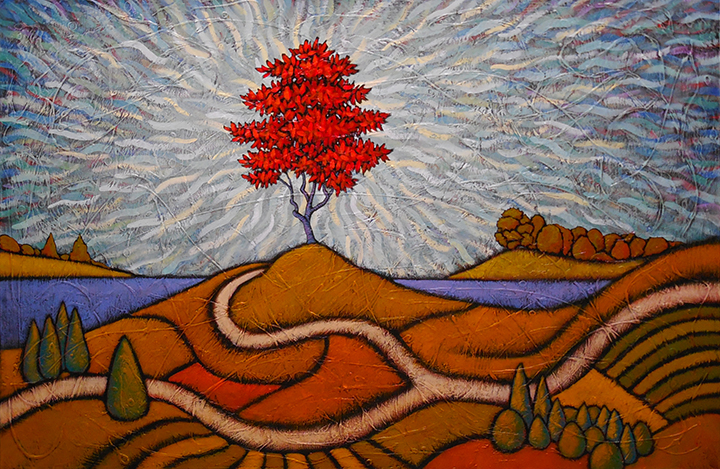
I chose the painting at the top, Foundling, to illustrate this post before I wrote that last line but it fits so well with the idea of that ray of power as well as the idea of it finding you.  This painting, a 24″ by 36″ canvas, is, of course, from my upcoming show, Home+Land, opening July 17 at the West End Gallery.

GC Myers- Dissolve small

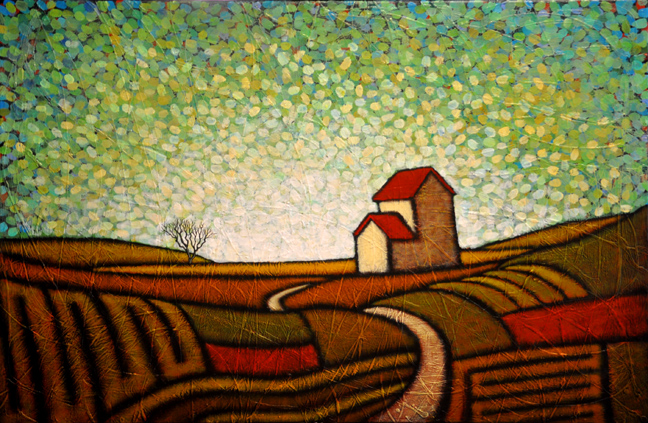
Another painting from my upcoming West End Gallery show, Home+Land, is the not so new painting above called Dissolve.  After it was completed and sent to a gallery, I lost track of it and thought that it had been sold.  But in fact it was on loan to adorn a design center in the DC area and was recently returned.

I was excited when I learned that it was still around because there were so many things in this piece that appealed to me.  I knew immediately that I wanted to show it in this show as it fits in so many ways.

Here’s what I wrote about this piece a few years back when the piece was completed:

This painting called Dissolve is another in the series I’ve been working in for the past few months.  This 24″ by 36″ piece is based very much on the same format as Like Sugar In Water, [a large 36″ by 60″ painting from that same time, shown below].  Both paintings grow from the bottom where they begin in structured blocks of color.  The path cuts through, rising from the geometry of the fields up to a plain that flattens out.  The path continues by the red-roofed house and is not seen again as it enters the broad yellow field that runs to the horizon.  The path’s upward movement is continued in  the spreading bare limbs of the distant tree which merges into the broken mosaic of the sky.

GC Myers- Like Sugar In Water

GC Myers- Like Sugar In Water

It’s a simple concept and a simple composition, dependent on the complexity of the color and the placement of the elements in order to transmit feeling and emotion.  These simpler compositions, when done so that they work well, are often very potent purveyors of feeling and are among my persoanl favorites.  The stripped down nature of the scene takes away all distractions and centers the essence of the work in the willing viewer’s eyes, making it very accessible to those who connect with it.  And that is much of what I hope for my work- to create work that stirs strong emotion within a seeming;ly simple context.

Maybe there’s more to it than this.  I can’t be sure if my thoughts and interpretations are any more valid than those of a first-time viewer.  That’s the great thing about art– there are no absolutes.  It’s also the thing about art that scares a lot of people.  Many people fear the gray areas of this world, of which there are many,  and desire absolute belief and knowledge in all aspects of their lives.   But art most often  lives in the ambiguity, the uncertainty,  of those gray areas and that can be unsettling to some. 

 Dissolve seems absolute and certain at first glance but is all about the gray areas of our world and our belief.  At least as I see it…

Beginning to See the Light smHere’s another new painting that is part of my upcoming show, Home+Land,at the West End Gallery, opening July 17.  This 12″ by 12″ canvas is titled Beginning to See the Light, which sort of continues a theme from yesterday’s post as the title is also the title of a Velvet Underground song.

While I was working on yesterday’s post and listening to some music from the Velvets, I kept looking at this piece and when this song came on it just seemed right as a title for it in the moment.  It’s not that the lyrics necessarily jibed well but just the idea of that moment of realization that the title possesses seemed right because this is what I see in this piece– arriving at a moment of understanding.  The world seems calm and right but vivid in that moment.

Here’s the song that gave me the title.  It’s coupled with some absurdist/avant garde imagery from a 1968 Soviet film, The Color of Pomegranates.  I don’t know how relevant this is to the song but it’s kind of interesting?

Some Kinda Love

GC Myers-Heartshare smSunday morning on a holiday weekend but no holiday here in the studio yet.  No, not for another week or so as I get ready for my Home+Land show that opens in just under two weeks, on July 17 at the West End Gallery.  It’s been crazy busy the last couple of weeks but I am seeing the results coming clearer now and I think it has a real pop to it, one that has me getting excited to see the work hanging in the gallery.

There’s just something about seeing the work spaced on the gallery wall and not propped up in various positions around the studio that makes me see it as something apart from myself, something in and of itself.  It’s a bittersweet but exciting moment for me when I see a painting that has taken on personal meaning for me in the studio, like the one shown above, Heartshare, on the wall of the gallery.

It really lays claim to its own identity at that point and my time with it is close to an end.  It has become what it is and takes on the characteristics of the viewer, perhaps symbolizing things that I never saw or imagined in it myself.  That’s the mystery and beauty of this thing called art– sometimes one thing takes on many different meanings for different people.  There are no absolutes.

Well, it is Sunday morning and time for a little music so I thought I’d carry through on the theme of the painting at the top.  Here’s a song  called Some Kinda Love from the Velvet Underground.  Formed by Lou Reed and John Cale, the Velvets were one of the most influential bands of the mid-60’s.  A good rhythm to start your Sunday.  Have a great day.

FYI: The painting at the top, Heartshare, is 16″ by 20″ on canvas and is part of a series of paintings I’ve done over the last several years based on the myth of Baucis and Philemon.

Saturday-Evening-Post-J.C.-Leyendecker-Statue-of-Liberty-1934-Yesterday, on her wonderful blog, The Task at Hand, my friend Linda (aka Shoreacres) had the image above from a Saturday Evening Post cover in 1934.  It was from artist JC Leyendecker who did many, many covers for the popular magazine and was one of the finest artist/illustrators of the era.  This cover really stuck out for me because it didn’t really look much like his other more iconic covers that often depicted comical scenes.

This was more design-based, almost with a Pop Art feel.  Just a great image, plain and simple.  I thought I would share it and some of Leyendecker’s other 4th of July covers with you today and wish you all a very Happy 4th of July– a slice of Americana on this most American holiday.

Saturday-Evening-Post-J.C.-Leyendecker-1928 Saturday-Evening-Post-J.C.-Leyendecker-Town-Crier-1925- Leyendecker 4th of July SEP cover 1930 joseph-christian-leyendecker-fourth-of-july-1776-saturday-evening-post-cover-june-30-1923 saturday-evening-post-j-c-leyendecker-sleeping-uncle-sam-1924


Madam Marie Asbury ParkI am coming into the last week of preparing my solo show, Heart+Land, which opens July 17 at the West End Gallery.  It’s at this point every year, after the second show in a matter of a couple of months, that I begin to feel a bit worn down.  I really see it in trying to write the blog.  A lot of mornings I find myself sitting here just staring at the screen and feel that my mind is blank as well, as though the wheels in my mind feel like they will never turn again.  I am preoccupied with with those pieces that still need work and other tasks that are waiting for me just out of my sight.  Out of sight but not out of mind.

So, I thought I would start the holiday a day early with a little music and one of my favorite Springsteen songs.  Some know it as Sandy from the name of the girl to which Bruce’s character is singing but it’s actually titled 4th of July, Asbury Park from his 1973 (yes, it was that long ago) album The Wild, The Innocent and the E Street Shuffle.  It’s a song that immortalized the Jersey boardwalk culture of that time, like the fortune teller Madam Marie whose real life shop is shown above, with its bittersweet lamentation about lost love and outgrowing the lures of youth’s easy pleasures.

So, I am giving it a listen then heading back to those tasks that are beginning to tap their toes with impatience.  Have a great 4th of July.

Deadvlei

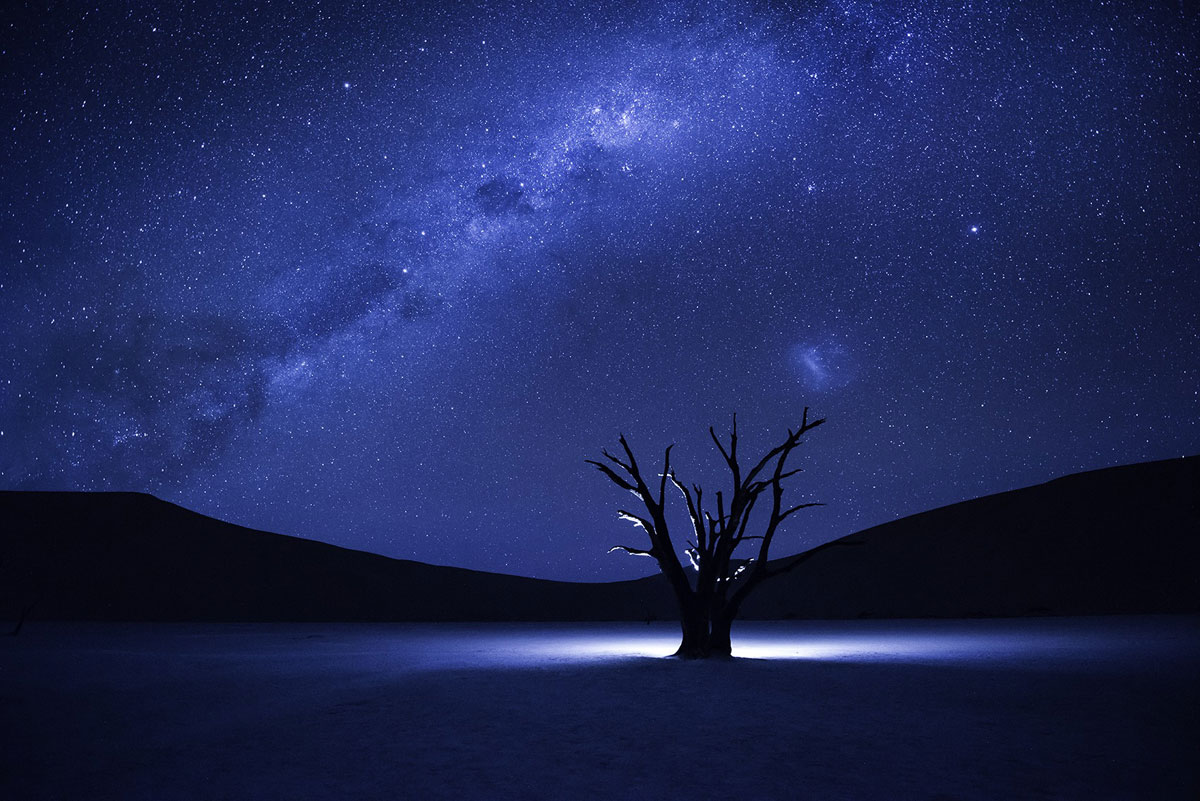
Deadvlei Namibia Photo By Christopher R. Gray- Natl Geo Traveler Photo Contest 2015I came across this wonderfully stark image this morning, an entry in the National Geographic Traveler Photo Contest from photographer Christopher R. Gray.  It is a night scene from an area of the Namib Desert in the African nation of Namibia called Deadvlei.

Located in a region of salt marshes periodically fed by the Tsauchab River, Deadvlei ( which translates as “dead marsh“) was cut off from the river’s feed nearly 1000 years ago from flooding then climate change.  This left  it a huge  dry and hard salt plain nestled among some of the highest sand dunes on the planet, some towering over 1300 feet in height.  The trees, mainly camel thorns,  that were there all those centuries ago remain, darkly scorched tree bones that do not decompose in the arid conditions.

This area’s remoteness also gives it some of the darkest skies on the planet, making visible all the many stars and galaxies that have become invisible to us in the more populated parts of the world.  That night sky makes for a pretty striking image with the single tree set against the silhouette of the sand dunes.

It’s kind of a natural Ozymandias, a reminder of our own mortality set against the eternal nature of the Earth.  Great photo.

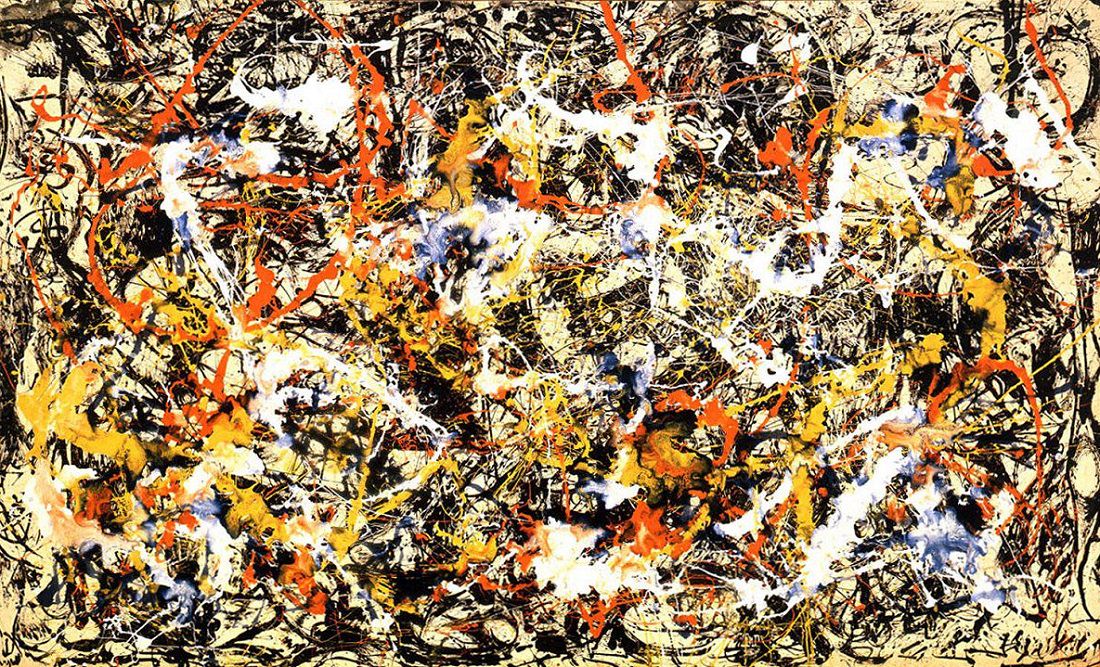
Jackson Pollock -Convergence 1952Painting is a state of being…Painting is self discovery.  Every good painter paints what he is.

–Jackson Pollock

*********************

In yesterday’s The Guardian, here was a review of a current exhibit at the Tate Liverpool of Jackson Pollock paintings.  Writer Jonathan Jones describes Pollock’s work around 1950, in the period when he was briefly liberated from his chronic alcoholism,  as being the pinnacle of his career. As he put it : Pollock was painting at this moment like his contemporary Charlie Parker played sax, in curling arabesques of liberating improvisation that magically end up making beautiful sense.

GC Myers-Under TextureThat sentence really lit me up, as did the words of Pollock at the top of the page.   In Pollock’s work I see that beautiful sense of which Jones writes. I see order and rhythm, a logic forming from the seemingly incomprehensible. The textures that make up the surfaces of my own paintings are often formed with Pollock’s paintings in mind, curling arabesques in many layers.  In fact, one of the themes of my work is that same sense of finding order from chaos.

 To some observers, however, Pollock’s work represented the very chaos that plagued the world then and now.  But true to his words, Pollock’s work was indeed a reflection of what he was– a man seeking grace and sense in a chaotic world.

Painting is, as Pollock says, self discovery and indeed every painter ultimately paints what they are.  I know that in the work of painters I personally know I clearly see characteristics of their personality, sometimes of their totality.

I believe that my work also reveals me in this way.  It shows everything– strengths and weaknesses, hopes and fears.  You might think that a painter would be clever enough to show only those positive attributes of his character, like the answers people give when asked to describe their own personality.  There are some that try but it comes off as contrivance. Real painting, real art, is in total revelation, showing the chaos and complexity of our true self and attempting to find order and beauty within it.

GC Myers- In the Moment of GraceThis is a new piece, an 18″ by 24″ painting on panel, that  is part of my upcoming show at the West End Gallery.  It is titled In the Moment of Grace.  Fittingly, it was finished in the time that I listened to President Obama‘s stirring eulogy for the victims of the Charleston tragedy on Friday in which he pulled its theme from the classic hymn Amazing Grace.  Although I was already fully invested in  this painting, that fact added so much more meaning to it for me.

That eulogy was the culmination of a remarkable and historic week, one that found the Supreme Court issuing decisions that upheld the Affordable Care Act (ACA) and made Gay Marriage a right throughout the nation.  And if that wasn’t enough, the Confederate flag finally came down in South Carolina, though it took the act one young black woman willing to be imprisoned for her civil disobedience rather than the act of an intransigent State House and Senate.  The President’s words over the fallen in South Carolina framed the end of this week perfectly.

Amazing Grace.

Despite the wonder of it all, I know there is much more to be done and more conflicts to be faced in the struggle for equality and fairness for all.  That is the nature of change and change is the nature of America.  And I think that is the point that is missed by so many of those who hold so tightly onto the past,  those people who say that they want “their country” back: America is not a monolith, not owned by one group or region and cannot be defined by one thing, person, place or time.

That is its strength.  Like a great work of art, it lives always in the present.  And the present is an inclusive and shifting prism, a kaleidoscope or, yes, a rainbow of diverse people who make up this nation.  It has eventually always made room for all who sought to live in that light and it is that spirit of inclusion that separates us from the rest of the world.  Tolerance unifies a disparate people and brings us closer to grace.

As I said, there are many more hurdles to be overcome, more work to be done.  I could continue preaching here for a while but I wish to just sit back for a moment and relish the present.  So, for this Sunday morning music I thought a little Amazing Grace would be appropriate.  Her is a truly beautiful version from Judy Collins and the Boys Choir of Harlem, sung on the National Mall in Washington, DC.

Have a good Sunday and reflect for a moment on this remarkable week.