Feeds:
Posts
Comments

Holton Rower Pour PaintingI came across the video below recently of artist Holton Rower creating one of his paintings by pouring gallon after gallon of paint on to a central point, often over structures he has constructed  that create different effects in the movement of the paint. These gallons of paint flair out, creating  works with brilliant bands of contrasting color.  The larger pieces are quite striking.  There is also the performance aspect of his process that makes for entertaining viewing as you watch and wonder how each color that is introduced will affect the entirety of the piece.

Here’s a very short bio from Artsy:

Claiming, “I probably use more paint than anybody in the history of art,” Holton Rower, grandson ofAlexander Calder, is best known for his “pour paintings,” created by pouring up to 50 gallons of rainbow-colored paints over variously configured blocks and panels of plywood, and allowing it to spread and pool into textured, psychedelic compositions. He grew up surrounded by art and working in his father’s construction business, where he learned about the qualities of a range of materials. In his own studio, he experiments with many techniques and media, including sculpture, installation, and assemblage. In the early 2000’s, Rower began developing his “pour paintings,” which he equates to sculptures. Ranging from small- to large-scale, and appearing as vortexes or the ringed segments of tree trunks, they are records of control and chance, human ingenuity and natural forces.

Take a look at the video below.  You may find it interesting even if it’s not your cup of tea.

Holton Rower-The-Hole Holton Rower

Jazz

Blues Twilight Cover Richard BoulgerMost  mornings in the studio I will click on to the Pandora site for a little music while I write the blog.  Normally I will choose the  Chet Baker channel which is a blend of his music along with many others in a wide variety of jazz styles.  I find that it’s a great sound to drive my thoughts without overpowering them, energetic and moody at once.  Being able to step in and out of the music while I am thinking make it a great soundtrack to work by in the morning.

Listening to this has exposed me to a lot of artists and their music that were unknown to me beforehand.  Can’t say I know much about jazz or its history, primarily a few of the better known tracks from the legends.  But I try to keep an open mind and don’t turn myself off to it because of my own lack of knowledge, an attitude I hope a lot of folks who say they know nothing about art will maintain as well.  Try it on– maybe it will fit you better than you might think.

So, for this week’s Sunday music I chose a piece from a musician that was totally unknown to me not too long ago, Richard Boulger.  His horn work is beautiful and his compositions flow really well.  I heard this piece one morning and was totally taken by it and now find myself listening to it once or twice a day now while I paint.  It just fits me well.

Here’s Miss Sarah from Boulger’s 2008 album Blues Twilight.  Hope you’ll enjoy it and have a great Sunday.


A Seat at the Table

GC Myers- A Seat at the Table  smMan is a part of the world, and his spirit is part of the spirit of the world.  We are merely a peculiar mode of Being, a living atom within it, or, rather, a cell that, if sufficiently open to itself and its own mystery, can also experience the mystery, the will, the pain, and the hope of the world.

Vàclav Havel

*****************

The Red Chair normally represents memory for me.  Often it is the form of familial memory with the chair lifted by the branches of what seems to be its family tree.  But in this newer painting, an 18″ by 36″ canvas that I call A Seat at the Table I see it as being part of a larger family unit, as a piece of the entirety of the world and the universe.

Oh, it may only play a small part but it is a part nonetheless, a link in the chained mesh of all things.  It belongs.

It has a seat at the table.

And that’s an important thing to remember for each of us– that we do belong, that we play a part in serving to hold together this universe.  We are not universes unto ourselves however much it sometimes seem.  We best function in our parts when we seek to serve others and in some way strengthen our part of  this universal mesh.

So play your part and involve yourself in the world, in the universe.  You do have a seat at the table, after all.

Traditions are lovely things- to create traditions, that is, not to live off of them… the great shapers do not search for their form in the fogs of the past.

–Franz Marc

******************

Franz Marc- The Yellow Cow 1911

Franz Marc- The Yellow Cow 1911

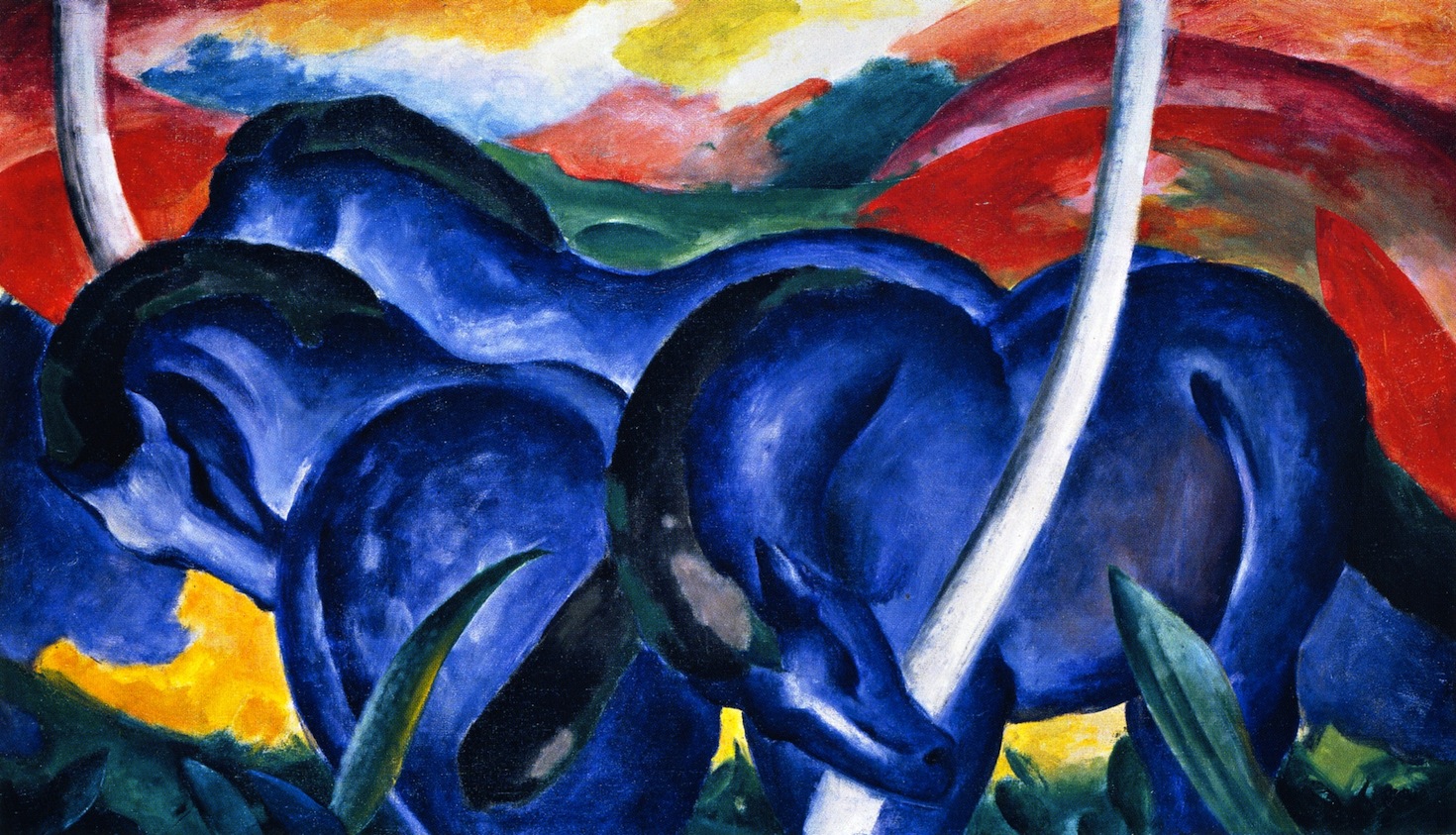
I chose today’s quote from German painter Franz Marc because he was an influence for me early on.  Not so much in the style or subject matter that he employed but simply in the fact that he created work that stood out and was identifiable as his from across a gallery space.  This is basically what he is pointing towards in this aphorism–to not toil in the fields planted by earlier artists but to carve out your own space and work it in the way that suits and  best expresses you.

Franz Marc- Large Blue Horses

Franz Marc- Large Blue Horses

He is not downplaying the influences of the past.  Early in his career  Marc copied the works of other artists from before and contemporary to him, using it as a way in which to find an avenue of expression that meshed with his vision.  He did not want to remain a replicator but wanted instead to be a creator.  And that was the attraction for me.

There was safety and security in remaining in this symbolic field with others but it would often be as an anonymous member of a larger group, your furrow always directly compared to the furrow of those alongside you, your harvest compared to their’s.

Breaking away and heading out was risky.   You had to believe that in taking this leap of faith that you would be able to work your little spot in your own way away from others and produce a harvest that is uniquely appetizing to others in some manner.   But you might end up toiling in barren soil, creating crops that appealed to no one but yourself.  It was scary to think that your field might never expand but you were at least nourishing yourself.

This was the type of thinking that drove my work early on, fueled by looking at the work of Marc and others who veered from the traditions of the past in their times.

Unfortunately, Franz Marc only worked his fields for a relatively short time, dying in WW I at the Battle of Verdun.  He was 36 years old.  But his crop still lives on, surviving being labeled as degenerate art in the 1930’s by Hitler and the Nazi regime.

It is unique and his own tradition.

Franz Marc- The Waterfall 1912

Franz Marc- The Waterfall 1912

Beyond Color

Foreign Affairs mar Apr Cover 2015I have mentioned my niece, Sarah Foster, here in the past for her exploits as a talented dancer and choreographer in NYC. But she has another form of her talent that showed itself recently in her day job with Foreign Affairs magazine. That is that of a video editor.  The coming March/April issue of the prestigious magazine deals with the issue of race and has images of  the faces from a group of people from all races all set against backdrops that match their skin tones.

Sarah produced  a very fine video for the magazine explaining the backstory behind these images, which is the work of  Brazilian photographer Angélica Dass.  She  an ongoing and open-ended project called Humanae which has her photographing people of all races from around the globe.   So far over 2500 subjects on five continents have participated.

All are photographed in exactly the same circumstances– the same distance, the same light and exposure.  She then matches the color from their nose to the Pantone color system, an international standard for color matching, and makes the backdrop that color.   She then labels each with the Pantone code and number.   The result is a wonderful and powerful examination of how we define race by colors that really don’t exist.

Humanae Image of Angelica DassThe video feature a telephone interview with Dass ( shown here on the left–she’s Pantone 7522 C) who explains her project.  The video is a great accompaniment to it, giving you a taste of many images.

Great work.  Well done, Sarah!!

For more info on Angélica Dass and the Humanae Project click here.

James Ensor Christs Entry Into Brussels in 1889I’ve been spending some time recently looking at the work of painter the Belgian painter James Ensor who lived from 1860 until 1949 in the seaside town of Ostend.  It’s not a name that you probably recognize and even seeing the work may not ring a bell for you.  I know that it didn’t for me.  But the work did excite me, especially given the context of the time in which much of it was created.   He began creating his visionary and sometimes macabre world in the 1880’s when the Impressionists were still taking shape.  Given the look and subject matter, it came as no surprise that he is considered a major influence on the Surrealists and Expressionists of later generations.

James Ensor Christs Entry Into Brussels in 1889 DetailBut it was new to me and captivated me at once, especially the piece at the top of this page , Christ’s Entry into Brussels in 1889.  It is a massive piece, over 8 foot tall and 14 foot  in length.  It is a Mardi Gras parade ( Happy Fat Tuesday, by the way– bon temps rouler!) of caricatured figures escorting Christ into modern day Brussels in 1889.  It is loud and aggressive and roughly painted, so unlike the prevailing style of the time.  Filled with energy, it is a treasure trove for the eye.

Here is the description from the Getty Center in LA where it now resides and is shown:

James Ensor took on religion, politics, and art in this scene of Christ entering contemporary Brussels in a Mardi Gras parade. In response to the French pointillist style, Ensor used palette knives, spatulas, and both ends of his brush to put down patches of colors with expressive freedom. He made several preparatory drawings for the painting, including one in the J. Paul Getty Museum’s collection.

Ensor’s society is a mob, threatening to trample the viewer–a crude, ugly, chaotic, dehumanized sea of masks, frauds, clowns, andcaricatures. Public, historical, and allegorical figures along with the artist’s family and friends made up the crowd. The haloed Christ at the center of the turbulence is in part a self-portrait: mostly ignored, a precarious, isolated visionmary amidst the herdlike masses of modern society. Ensor’s Christ functioned as a political spokesman for the poor and oppressed–a humble leader of the true religion, in opposition to the atheist social reformer Emile Littré, shown in bishop’s garb holding a drum major’s baton leading on the eager, mindless crowd.

After rejection by Les XX, the artists’ association that Ensor had helped to found, the painting was not exhibited publicly until 1929. Ensor displayed Christ’s Entry prominently in his home and studio throughout his life. With its aggressive, painterly style and merging of the public with the deeply personal, Christ’s Entry was a forerunner of twentieth-century Expressionism.

Looking at this piece sends my mind whirling and makes me want to break free of my comfort zone, to think outside of the box in which I have been comfortably residing for a while now.  It rekindles old ideas that have laid dormant, untouched, for many years and makes me wonder if I have the nerve to execute them now.  For me, this excitement to expand is true validation of the power and energy of this work.

Now to decide how to use that inspiration…


Bring the Light

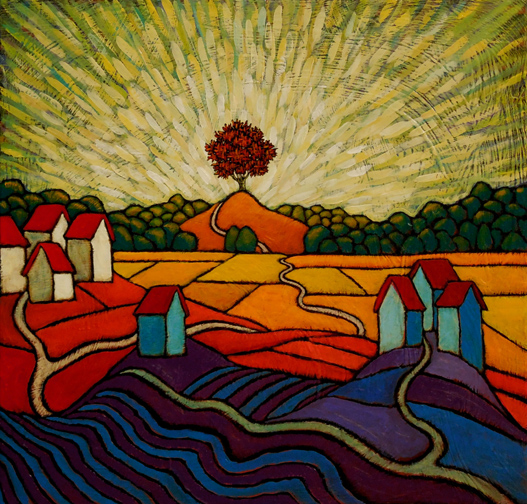
GC Myers  Bring the Light smallThis is a new painting, 18″ by 18″ on canvas, that was finished a couple of weeks back  titled Bring the Light.  It features the Red Tree high atop a promontory  amid a sunburst of light, across open fields from two groups of Red Roofed houses, one still yet to receive the light.

It’s an interesting piece, one that has me studying it quite a few times a day here in the studio.  On one viewing, there seems to be a lot going on here but then  it begins to read simply  as three wavy bands of color– the sky down to the tops of the green-leafed trees then down to the purples and blues of the foreground.  The road acts as a connecting ribbon and the houses and Red Tree as staple-like connectors, all holding the piece together.

On another viewing, it appears more narrative, like a storyline crafted from the description in the first paragraph, and on the next viewing seems to be a study in depth into the picture, with multiple planes and receding lines.

It could be confusing but the central focus of the Red Tree framed in light pulls it together for me, creating a harmonious feel and unifying the many disparate elements of the picture.  That’s a role and a purpose that fits the Red Tree well in much of the work, this piece included.

Two Angels

GC Myers Two Angels 2001It’s Valentine’s Day. I went back through the blog archives and discovered that I sometimes don’t post anything on this day or sometimes post something  off the subject of this day.  One year, it was baseball.  Well, I do love the game so maybe it was a Valentine of sorts.

I thought I would post something this year, a poem that I posted several years ago.  It’s an anonymous verse from India that strikes just the right chord of love and devotion for me without turning to pablum.

Although I Conquer All the Earth 

Although I conquer all the earth,

Yet for me there is only one city.

In that city there is for me only one house;

And in that house, one room only;

And in that room, a bed.

And one woman sleeps there,

The shining joy and jewel of all my kingdom.

    —Anonymous, Ancient India

Also, below is a song from Peter Case, Two Angels,  an elegantly simple song that is a favorite of mine and also on subject for the day.  Surprisingly, it is a fairly little known song though I understand it was used on an episode of True Blood.  If that doesn’t scream romance, I don’t know what does.

The painting above is an oil on panel, 10″ by 58″,  that I did back in 2001.  I cannot find or recall its title at the moment but am calling it Two Angels for today.

GC Myers 992-141-small1It’s another cold day here in the northeast,  -5° this morning when I walked out the door.  By the time I got over here to the studio after my short commute ( a stroll through the woods) I was ready for a little heat.  Turned on the computer to look up an old piece and immediately came across this small triptych from 2002 which was always a favorite of mine. It’s a little anomaly comprised of three small squares, each about 4″ by 4″.  I always liked the surface of these pieces — they had a smooth, almost burnished look that I haven’t used in many years.

Seeing this piece made me want to revisit that surface treatment once more, thirteen years later.  It also made me want to feel that heat in the form of a very distinct song.  Fire from Jimi Hendrix.  Talk about going back in time.  Are You Experienced? in 1967.  This song will be fifty years old in a couple more years which seems crazy– it’s timeless heat.

So, Jimi, on this frigid morning, let me stand next to your fire.


Rothko Number 14Art to me is an anecdote of the spirit, and the only means of making concrete the purpose of its varied quickness and stillness.

–Mark Rothko

*****************

I don’t think there is anything that I can add to this except to nod silently in agreement.

Have a great day.