Feeds:
Posts
Comments

Posts Tagged ‘Albert Camus’

The Steadying Light– At the West End Gallery


But hell can endure for only a limited period and life will begin again one day. History may perhaps have an end; but our task is not to terminate it but to create it, in the image of what we henceforth know to be true. Art, at least, teaches us that man cannot be explained by history alone and that he also finds a reason for his existence in the order of nature.

–Albert Camus, The Rebel (1951)


With the hope that this doesn’t turn into an extended rant, let me point out that the hell that Camus refers to in the passage above from his book, The Rebel, is one created by authoritarian governments. As he puts it:

Modern conquerors can kill, but do not seem to be able to create. Artists know how to create but cannot really kill. Murderers are only very exceptionally found among artists. In the long run, therefore, art in our revolutionary societies must die. But then the revolution will have lived its allotted span. Each time that the revolution kills in a man the artist that he might have been, it attenuates itself a little more. If, finally, the conquerors succeed in moulding the world according to their laws, it will not prove that quality is king but that this world is hell.

Authoritarians come to power through destructive means and not having the ability to create or govern, stifle free thought, art, and the artistic impulse– anything that might in any way question their right to power. As a result, art dies which creates, in effect, a hell on earth. But he adds that each time they kill the artistic impulse, they weaken their authority, bringing their hellish reign closer to its inevitable end. As Camus writes: But hell can endure for only a limited period and life will begin again one day.

I guess my point here is a simple one– Art Endures. It is the realm of thought, feeling, and creation that cannot be suppressed for long because it is an innate and indomitable part of humanity, more so than the rule of any king or tyrant. 

Like a buried seed, it persistently seeks light and air.

So, though the days may seem dark and hellish, that seed is planted, always there, growing unseen beneath the surface. Waiting to emerge once more.

Art endures. And with it, our humanity and hope.

Here’s a favorite song from Richard Thompson. This is a duet with the great Bonnie Raitt of his The Dimming of the Day, that I haven’t shared here before.


Read Full Post »


Land of Seven Moons— At West End Gallery


The first progressive step for a mind overwhelmed by the strangeness of things is to realize that this feeling of strangeness is shared with all men and that human reality, in its entirety, suffers from the distance which separates it from the rest of the universe.

–Albert Camus, The Rebel: An Essay on Man in Revolt (1951)


I live a pretty isolated existence so I can’t speak for everyone, but it seems like a lot of people are feeling alienated by the jumbled strangeness that is taking place. It’s an overwhelming sense that the landscape around you as well as the people within it and their customs are foreign to you, that you somehow don’t fit in. 

It’s a sense of feeling like a stranger in a strange land, to use that term that descended to us from Moses in the book of Exodus and its later use as the title for the sci-fi classic from Robert Heinlein. It’s a term I’ve employed a number of times through the years to describe the sense of alienation with which I have sometimes struggled.

I have to admit that this feeling is in air around me in recent times. However, this sense that many others may well be experiencing that same sense of estrangement from an existence that once felt naturally homelike makes me believe, like the words at the top from Camus, that there is a progressive step, a way forward from this, at least for us as a group.

Though it overwhelms our minds now, we have to understand that the reality that we observe in this moment does not have to last forever. And because there are so many of us feeling this new sense of strangeness, it will not. 

That’s just my feeling this morning. There may not be anything instructive in it. But it perhaps it can provide some comfort, as strangers in this strange land, knowing that beyond the now alien emptiness around us there are others who are looking up at those same seven moons, wondering as I do how they came to be and if they will always be there. 

Here’s song that sprang to mind just now. Actually, the lines from the chorus:

Nobody told me there’d be days like these
Strange days indeed
Most peculiar, mama

It’s Nobody Told Me from John Lennon, recorded near the end of his life and released several years after his murder. 

Strange days indeed…


Read Full Post »

Invincible Summer

“Calidum Frigus”- At the West End Gallery


O light! This is the cry of all the characters of ancient drama brought face to face with their fate. This last resort was ours, too, and I knew it now. In the middle of winter I at last discovered that there was in me an invincible summer.

–Albert Camus, Return to Tipasa


Camus wrote the much quoted line above after revisiting the Roman ruins at Tipasa in Algeria in the aftermath of World War II. He had visited that site a number of times and finally recognized that unlike the modern Europe still reeling from the effects of war and fascism, there was a freshness there in those seaside ruins, an elemental dimension in them that couldn’t be smothered by time or modern events.

A sense of newness and the joy that comes with it was part of that place, was something that couldn’t be eroded by time and the elements. 

He was able to equate that with the part of our nature that we all carry, that being our will to go on, our will to find joy and meaning.

An invincible summer contained within us all.

Here’s an expanded version of the excerpt from Camus’ essay:

I discovered once more at Tipasa that one must keep intact in oneself a freshness, a cool wellspring of joy, love the day that escapes injustice, and return to combat having won that light. Here I recaptured the former beauty, a young sky, and I measured my luck, realizing at last that in the worst years of our madness the memory of that sky had never left me. This was what in the end had kept me from despairing. I had always known that the ruins of Tipasa were younger than our new constructions or our bomb damage. There the world began over again every day in an ever new light. O light! This is the cry of all the characters of ancient drama brought face to face with their fate. This last resort was ours, too, and I knew it now. In the middle of winter I at last discovered that there was in me an invincible summer.

In these crazy times, it’s especially easy to fall prey to the somber melancholy of winter, to forget that you carry your own invincible summer within you when the sky is slate gray and the cold winds blow.

But it remains there in this winter and in other dark times of our lives. Our invincible summer.

So, hold on to that and have a good day.


Read Full Post »

“The Exile’s Wilderness”- Now at the Principle Gallery

****************************

“From the moment that man believes neither in God nor in immortal life, he becomes ‘responsible for everything alive, for everything that, born of suffering, is condemned to suffer from life.’ It is he, and he alone, who must discover law and order. Then the time of exile begins, the endless search for justification, the aimless nostalgia, ‘the most painful, the most heartbreaking question, that of the heart which asks itself: where can I feel at home?”

Albert Camus, The Rebel

****************************

I came across the excerpt above from The Rebel from Albert Camus while searching for something to accompany the painting at the top, The Exile’s Wilderness, which is part of my current exhibit hanging at the Principle Gallery.

This short paragraph stopped me in my tracks and I found myself reading the words and phrasing of it over and over again this morning. It summed up so well the feeling that I take from this painting and that sense of exile, of separateness, that I have often experienced.

The search for justification, the sometimes pointless nostalgia of memory, the feeling of being responsible for everything alive and for setting things in some sort of order– they all feel too familiar.

But it’s that final question that stirred me most: Where can I feel at home?

It is a heartbreaking question. I believe most of us take for granted that feeling of comfort and of being at home. But for the Exile it is an elusive thing, perhaps even an impossibility. In the absence of the real comfort of home they settle for the security found in hiding or in blending in, hiding in plain sight with large and faceless crowds.

That’s the wilderness to which I refer in this painting– a place for the Exile to hide and find security in a world where they may never feel truly at home.

And odd as this may sound, there is great comfort in this. Just having a place where one feels safe and secure is a desirable state of being for most of us because in such an environment we can create and define our own sense of home.

If you think about many of the problems facing us today, most come down to conflicts between people rightly seeking that sense of home, of safety and security, for themselves and those who would deny them that right.

There’s a lot to read into this painting, more than it lets on at first glance. Much like the Exile walking unseen and unnoticed among the crowd.

Read Full Post »

***************************

“Find meaning. Distinguish melancholy from sadness. Go out for a walk. It doesn’t have to be a romantic walk in the park, spring at its most spectacular moment, flowers and smells and outstanding poetical imagery smoothly transferring you into another world. It doesn’t have to be a walk during which you’ll have multiple life epiphanies and discover meanings no other brain ever managed to encounter. Do not be afraid of spending quality time by yourself. Find meaning or don’t find meaning but ‘steal’ some time and give it freely and exclusively to your own self. Opt for privacy and solitude. That doesn’t make you antisocial or cause you to reject the rest of the world. But you need to breathe. And you need to be.”

Albert Camus, Notebooks 1951-1959

***************************

It’s probably been forty years since I last read Albert Camus‘ books, The Stranger and The Plague. I remember the affect each had on me at that time and can easily see how these books might have relevance in these times as well. As can the the words of advice above taken from Camus’ notebooks.

“Find meaning. Distinguish melancholy from sadness. Go out for a walk.”

It seems as though an existentialist or absurdist, however one categorizes Camus, would be an appropriate voice for these times.

The painting at the top, Private Space, is going with me down to the Principle Gallery tomorrow when I deliver the work for my annual solo show there. This year’s edition is titled Social Distancing and opens next Friday, June 5.

I chose the words from Camus at the top to accompany this 15″ by 30″ painting because that list bit of it– “Opt for privacy and solitude. That doesn’t make you antisocial or cause you to reject the rest of the world. But you need to breathe. And you need to be” — seemed to express exactly what I was seeing in this painting.

Plus I most often opt for privacy and solitude in my own life and I am pretty sure I am not antisocial.

Well, not completely.

I might be considered cordially antisocial. Perhaps an affable misanthrope? Is that a thing?

I kind of see both of those things in this painting. There’s an approachable element in the Red Tree but also a sense that it wants to be at a distance from others. It doesn’t reject the world but wants to face it on its own terms, in its own way.

I can live with that definition– for this painting and myself.

Have a good day.


Read Full Post »

Between, Again

GC Myers- Between

*************************

A man’s work is nothing but this slow trek to rediscover through the detours of art those two or three great and simple images in whose presence his heart first opened.

-Albert Camus

*******************

These lines above are from an essay, Between Yes and No,  written by the late French Nobel Prize-winning writer Albert Camus. It basically states, in sometimes grim detail, his belief that art “exalts and denies simultaneously.” In short, truth, and life in general, operates somewhere in the middle, never a binary choice, never absolutely in yes or no.

To put it in visual terms– that’s my job, after all– life is never fully black or white. We live in shades of gray.

Yes or no is generally an oversimplified view for existentialists like Camus. The enigma of this world, this life, comes from forever living with both the yes and the no.

Shades of gray.

While I may not fully understand all the subtleties of Camus’ essay, I do fully agree with the premise as I see it in my own simplified way. I think that art communicates best when it contains both the yes and the no— those polar oppositions that create a tension to which we react on an emotional level. For example, I think my best work has come when it contains opposing elements such as optimism tinged with with the darkness of fear or remorse.

Yes and no.

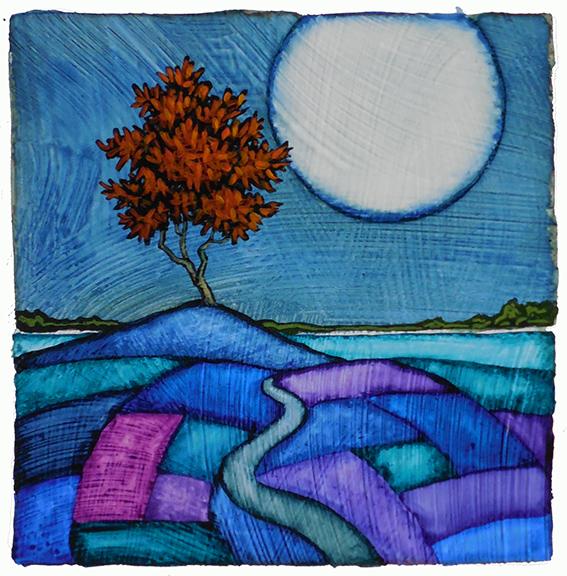
I guess it’s this thought that brought the title for the piece ( 4″ by 4″ on paper) at the top which I call Between. Simply put, I see it as the Red Tree being torn between the nebulous  desire of the Moon’s promise set against the security of its earthly home, represented by the patchwork quilt-like look of the surrounding landscape. Between the unknown and known.

Somewhere in between the yes and the no…

***********************

The post above ran back in 2015. I’ve edited it a bit for a little more clarity, to make it a little less gray.

Read Full Post »

We are at a crucial time in this country and, maybe as well, the world as a whole. I think even those who refuse to pay attention are beginning to see that something very wrong has taken place and there is an effort to find the truth behind it. If this situation were a painting, it began with an underpainting of a scene based on lies. But each new day brings more and more strokes and color in the form of facts and truths that expose the underlying falsehood, the illegitimacy of the scene painted for us two plus years ago.

With each day, the final painting is becoming clearer and clearer.

I could go on but that would most likely be overkill. Too pedantic and preachy.

Instead, I thought I would share some of my favorite quotes– I do love a good quote— dealing with lies and liars. A page of lies. Actually, not lies but about lies. As a liar myself, I can attest to the veracity of most of these but you would have to take my word for that. And, believe me (the liar’s favorite phrase, by the way), you don’t want to do that.

Though I think these are all pertinent, the most applicable to the current situation might be the last from Ray Bradbury‘s dystopian classic Fahrenheit 451. Most people will not be told, will not dare to extrapolate into the future. They only see the present moment and even then, it is seen with a subjective sort of vision, the kind that only sees and knows what is in its immediate reach. But once the fallout from this hits them, they will ask how this could have possibly happened, even though they themselves enabled it with their lack of attention.

The Albert Camus quote is also a favorite. The projection of self by the liar is most illuminating.

But don’t trust me, take a look for yourself.

Read Full Post »

“ATTENTION, WALMART SHOPPERS…”

+++++++++++++++

Blessed are the hearts that can bend; they shall never be broken.

― Albert Camus

+++++++++++++++

We’re wrapping up Gratitude Week on Black Friday. So instead of fist-fighting over a cheap TV in front of Walmart with some creepy toothless guy who looks like he just came from cooking his last batch of meth, why not avoid it altogether and focus on those things you already have.

There’s a pretty good chance you already have everything you really need in your life. And if not, you’re not going to find it in a Black Friday swarm.

So take this time to step back and be grateful for the blessings you possess.

Like the song says: Be thankful for what you’ve got…

Here’s that song, one of my all-time faves from Billy DeVaughn. Be of good heart and have a good and peaceful Friday.

https://www.youtube.com/watch?v=PkXZA9SIBkU

Read Full Post »

I have been living with this painting, Introspection, for several months now in the studio. It’s been in a spot where my eye regularly falls on it and it never fails to make me pause for a second or two to give it some consideration. It fulfills its title very well for me, reminding me to look inward on a regular basis while trying to shut out the noise of the world of man.

It’s leaving the studio today, heading out to California to hang at the Just Looking Gallery in San Luis Obispo. I think I am going to truly miss its gentle reminder.

Read Full Post »

********************

Exiles--QuartetWe all carry within us our places of exile, our crimes, and our ravages. But our task is not to unleash them on the world; it is to fight them in ourselves and in others.

Albert Camus

***************

I have written about and showed a number of the pieces from my early Exiles series here on this blog. It was a very important group of work for me in that it was the first real break towards forming my own voice, creating and displaying work that was emotional for myself. It was also the work that spawned my first solo show in early 1997.

The inspiration for this work was mainly drawn from the experience of watching my mother suffer and die from lung cancer over a short five or six month period in 1995. Her short and awful struggle was hard to witness, leaving me with a deep sense of helplessness as I could only wish that there was a way in which I could somehow alleviate her pain. Most of the work deals with figures who are in some form of retrospection or prayer, wishing for an end to their own suffering.

But another part of this work was drawn from my own feelings of emotional exile, a feeling of estrangement in almost every situation. I had spent the better part of my life to that point  as though I didn’t belong anywhere, always on the outside viewing the world around me as stranger in a strange land, to borrow the words of that most famous biblical exile, Moses. These figures were manifestations of that sense of inner exile that I carried with me.

Little did I know that these very figures would help me find a way out of this exile. With their creation came a sense of confidence and trust in the power of my self-revelation. I could now see that the path from the hinterlands of my exile was not in drawing my emotions more and more inward, allowing no one to see. No, the path to a reunion with the world was through pouring this emotion onto the surface of paper or canvas for all to see.

This is hard to write and I am struggling with it as I sit here this morning. I started writing this because I had been reconsidering revisiting this series, creating a new generation of Exiles. But in pondering this idea I realized that the biggest obstacle was in the fact that I no longer felt so much a stranger in a strange land. I no longer felt like the Exile, no longer lived every moment with these figures. It turned out that they were guides for me, leading me back to the world to which I now feel somewhat connected, thanks to my work.

If there is to be a new series, they will most likely not be Exiles.

The piece shown here, Quartet,  is one of my favorites, a grouping of four figures.  You may not see it in these figures but the visual influence for this work were the carvings found on Mayan ruins of Mexico and Central America.  I myself see this mainly in the figure at the bottom right.

Read Full Post »

Older Posts »