Feeds:
Posts
Comments

Posts Tagged ‘Film’

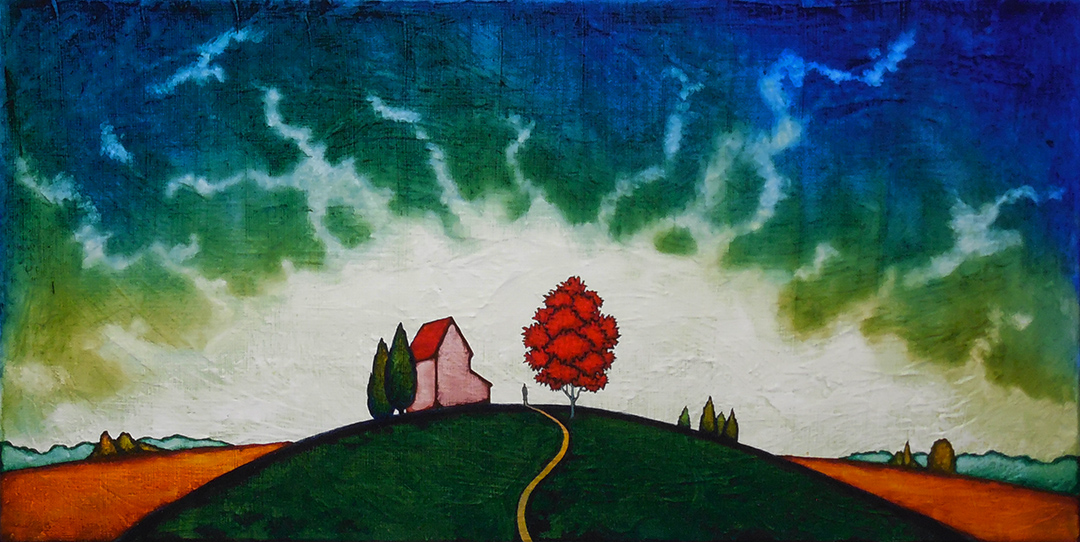
GC Myers-  The Welcome Tree

The Welcome Tree–At the West End Gallery


“I always had the feeling that we were amateurs in a world of professionals. Amateurs stand so much closer to what they are doing, and they are driven by enthusiasm, which is so much more forceful that what professionals are driven by.”

–Emeric Pressburger, on his film partnership with Michael Powell


I recently watched the documentary Made In England: The Films of Powell & Pressburger on TCM. It was made by Martin Scorsese who is a huge fan of the movies of this pair, citing them as a major influence on his films. I am also a fan of their very unique films– The Red Shoes, The Life and Death of Colonel Blimp, A Matter of Life and Death, Black Narcissus, and many others. They often look different, with their lush colors and daring perspectives, than other films from their time and have stories with ideas that also seem far from the mainstream. There is a richness that runs through their work.

The quote at the top of the page from Emeric Pressburger was part of the film and it jumped out at me. This idea of being an amateur in a world of professionals is one that I have often, if not always, felt about my own place in the art world. This kind of links in with what I wrote yesterday, when I was describing my anxiety over the Phronesis interview with Scott Allen. I wrote a bit about sometimes feeling like an impostor when speaking, or even writing, about what I do, that there are far more qualified and talented artists out there who should be speaking about art.

But it was second sentence in that passage from Pressburger that clarified everything for me. It was the enthusiasm of an amateur– that stupid courage, as I put it yesterday– that brought me there. It was the excitement of just doing work that I wanted to see and wasn’t finding elsewhere. There was freedom in not knowing or caring what others were doing or how my work might compare to their work.

And that has worked for many years. Of course, there are blips, times when I begin to think I am a professional, begin to care how my work compares to others or that it has to be more polished or conventional. Much as Pressburger points out, the professional me then is further from that initial force that drove me when I only saw myself as an amateur.

It is something I am struggling with right now. It sounds funny but I want to feel like an amateur again. I want to have that stupid courage at play again, that feeling where I don’t give a damn what anyone thinks about what I am doing or how it compares to anyone else’s work. In fact, I don’t want it to compare to anyone else’s work.

To just do it and let the chips fall where they may.

Is that an easy thing to do? It sounds like it should be, doesn’t it?

It isn’t. As with anything, there are complications, other things to be considered– the need to make a living, the need to maintain your relationship and goodwill in the galleries that show your work, the constraints of time and energy, etc. The good thing here is that stupid courage sometimes convinces you to set aside those concerns and, as they used to say, let your freak flag fly.

Hope any of this makes sense to you. It’s kind of the thing that an amateur might write. Maybe I am back on track?

We’ll see.

Here’s a song from Moondog who I spoke of in the Phronesis interview. I am not going to go into any detail at the moment, but he was a most interesting character. Another amateur in a world of professionals. I find myself often listening to his unique music. I will write more about him soon. This is a song called Rollo which Scott Allen said was his son Will’s favorite.


Read Full Post »

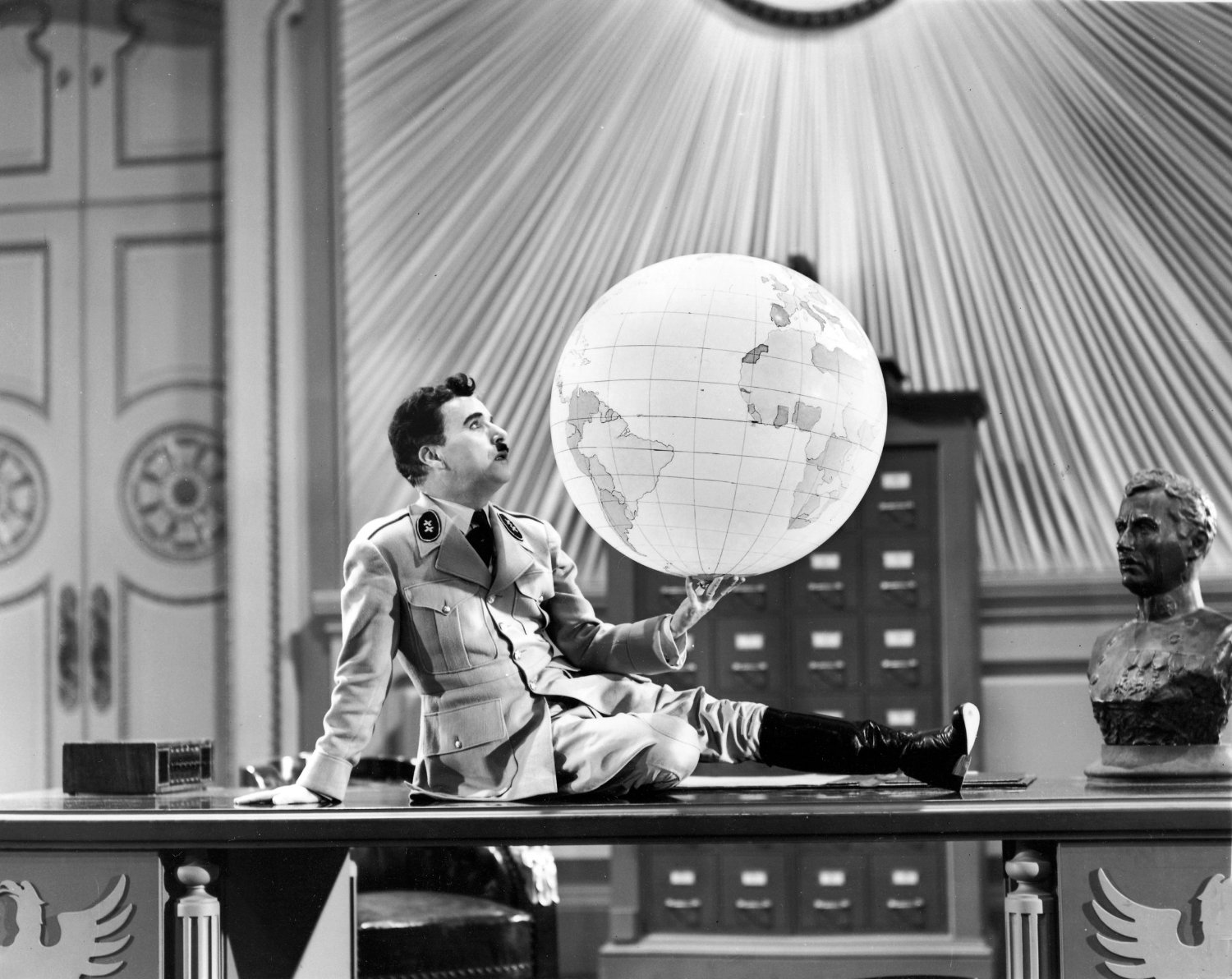
Charlie Chaplin The Great Dictator 1940

Charlie Chaplin- The Great Dictator, 1940


Our knowledge has made us cynical
Our cleverness, hard and unkind
We think too much, and feel too little
More than machinery, we need humanity
More that cleverness, we need kindness and gentleness
Without these qualities life will be violent, and all will be lost

— Charlie Chaplin, The Great Dictator Final Speech


The final speech in The Great Dictator the 1940 Charlie Chaplin film that brutally satirized the Naziism/Fascism that was then a dire threat to the entire world, feels very relevant to this moment in history.

The Great Dictator is about a Jewish barber in the fictional nation of Tomainia that is ruled by a ruthless dictator, Adenoid Hynkel. Without getting into the plot, Chaplin portrays both the Jewish barber and the Hitleresque Hynkel. At the film’s end, the barber is mistaken for Hynkel and is forced to make a speech, one in which delivers a message of hope to the world rather than the hateful rhetoric that was expected.  

It is a direct appeal to the people of the world to reject the brutalism of such dictatorships and fight for the humanity of mankind. It was controversial at the time and Chaplin’s friends and advisors tried to dissuade him from including it in the final cut, telling him that it would cause him to lose a million dollars, a vast sum in 1940. Chaplin responded that he didn’t care if it cost him 5 million.

It feels though we are at a similar point in time with a presidential candidate who threatens to unleash the military on US citizens who oppose him, to imprison his political rivals, to revoke the licenses of TV networks who displease him, to monitor and control pregnancies, and to first round up then mass deport millions of illegal immigrants along with many who are now legal. And so much more.

These are not inferred threats or hyperbole. These are his words. 

It is never wise to dismiss such threats. I hope enough people understand the peril we face.

Please take a few minutes to watch this final speech. It is inspiring in the context of history, then and now. If you get a chance, I urge you to see the whole film. It is both funny and heartbreaking on many levels and Chaplin exhibits his brilliance throughout. Jack Oakie is hysterical as the clownish Mussolini-like dictator, Benzino Napaloni, of the neighboring nation of Bacteria. He would have been a great choice to portray the current GOP candidate.

Anyway, here is the final speech from The Great Dictator:


Read Full Post »


Even if it weren’t Halloween today, there’s plenty enough scary stuff taking place. And, unfortunately, it won’t end with the passing of this day of normal tricks and treats. I am just hoping that there are more treats than tricks in our near future.

But today I am just sticking with Halloween and playing a song that kind of aligns with the day. It’s Season of the Witch from Donovan from way back in 1966. Great sound. One of my favorites, Richard Thompson, does a good cover but I am sharing the Donovan original.

The video that accompanies the song below is from a landmark 1922 Swedish silent film made by Danish filmmaker Benjamin Christensen  titled Häxan which was called Witchcraft Through the Ages in its English release. It has truly remarkable and sometimes disturbing imagery, sometimes seeming as though it were pulled directly from a Hieronymus Bosch painting. I have written here about my admiration of the silent films around this time who were realizing the visual potential of the medium and this is certainly one of those films that come to mind. I have included a trailer for the film below the song’s video.

There was also a rerelease of the film in 1968 which was shortened and featured a narration from author William S. Burroughs and a jazz score featuring violinist Jean Luc Ponty. It’s interesting but I don’t think it has the same impact as the original.

Anyway, have a safe Halloween. Be careful because, as we are seeing, there are a lot of witches and devils out there. Hoping we can exorcise some of these demons on Tuesday. Have a good day.


https://www.youtube.com/watch?v=dEv53-uFdtA

Read Full Post »

Before nodding off last night, I began watching the 1942 movie Casablanca for what might be the the nine hundred and fifty first time. It’s one of those films that is easy to jump in and out of because there is always something to relish at any given moment– a memorable scene, shot, line or piece of music. It is chock full of small pleasures that totally add to a greater whole.

Perhaps the greatest of these pleasures is the performance of Dooley Wilson who plays Sam, the star performer at Rick’s Cafe Americain. His musical performances light up the screen, most notably the song As Time Goes By which has taken on legendary status.

Watching and listening to it last night made me think about how it was a fitting song for the end of the year, a wistful looking back as the clock marches on.

The song was written in 1931 by Herman Hupfeld for a Broadway show, Everybody’s Welcome, that had a short run. It went on to have modest success as recording by a number of record labels and orchestras. Herman Hupfeld was a minor songwriter of the era who you wouldn’t think would be the composer of a song that would turn out to be one of the great classics of the American songbook. He wrote some popular songs of the time that have long faded into the dustbin of history. I’ve included one at the bottom just to give you a taste.

As Time Goes By almost didn’t make it into the movie. The musical director, Max Steiner, was opposed to its inclusion but was overruled by the movie’s producers. Then in post-production they considered dropping it but because star Ingrid Bergman had already cut her hair for another part, they couldn’t possibly reshoot the scenes that already contained the song. So, it remained and became one of the most memorable parts of a true classic.

I wonder how the the film would have felt without it.

So, for this New Year’s Eve day, here’s the original along with that other Herman Hupfeld classic, , When Yuba Plays the Rhumba on the Tuba. Have a good New Year’s eve.


Read Full Post »

The words above are on a wall at the United States Holocaust Museum. Most of you are most likely aware of them. First They Came… is a poem written by the German Lutheran minister Martin Niemöller in the aftermath of World War II. In the early 1930’s, Niemöller was initially a nationalist— yes, there’s that word again–and strongly supported the rise of Hitler and the Nazi party. But as the Nazis increased their persecution of those they saw as inferior, he began to sour ( even though he still sometimes used anti-Semitic rhetoric in his sermons of that time) on Nazism and eventually began to speak out against their policies.

He was arrested in 1937 and spent 1938-1944 in prison camps including Dachau, narrowly escaping execution. In the aftermath of the war Niemöller spoke openly of his regret for his early support of the Nazis and the fact he did little to help their victims in that time. He became an advocate for pacificism and an opponent of nationalism in any form. First They Came… was a poem that he used often in different iterations in his speeches and sermons after the war.

Its themes of persecution, irresponsibility and cowardice are pertinent in any time when autocrats seek to take control through scapegoating and division.

These themes were employed in a 1951 poem, The Hangman, written by Maurice Ogden. It is a poetic parable about a hangman who enters a small town and erects a gallows. As in Niemöller’s poem, the townspeople stand idly by as he takes their neighbors. They believe because they are somehow different from their neighbors, they will be spared.

But, of course, they are not.

The Hangman was made into a an acclaimed animated short film in 1964. It is pretty crude when compared to today’s animations. But that crudeness seems to add a sense of menace to the power of this parable.

Perhaps you don’t see the parallels between this film or Niemöller’s poem with the events taking place in the world today. Perhaps you not concerned with the huge rise in anti-Semitic here over the past two years, the election of an openly fascist leader in Brazil this week or the widespread surge of nationalism and racially biased hate groups around the globe. Maybe you even think the so-called caravan of death and disease is a real threat, as ridiculous as that whole thing is.

Maybe you think that you are safe and secure, hardly a target for hatred or persecution.

That is exactly why you should speak up for those who are targeted now. Because when you become the persecuted, who will be left to stand up for you? The cowards that allowed things to get to that point will not suddenly gain the courage to defend you.

Take a look at the film if you have the time. It’s about eleven minutes in length. You can also read it by clicking here.

Speak up. Don’t look the other way. And vote hard. 

Read Full Post »

WoodSwimmer

Came across this interesting little short film this morning called WoodSwimmer. It is a stop motion film made by Brett Foxwell who describes his process as  “a straightforward technique but one which is brutally tedious to complete.” It involves taking continuous photographic cross-sectional scans of hardwood logs, burls and branches and sequencing them so that reveal the universe that exists within the wood, one that Foxwell sees in a sci-fi scenario as holding alien lifeforms in a world that is always near us, hidden in plain sight.

It’s a mesmerizing piece of film. To watch the movement of the material through the cross sections is like watching time itself  flowing, a fascinating rhythm unfolding before your eyes. In its simplest form, it is pleasing in a sheer aesthetic way with the beauty of its movement, colors and textures. Beyond that it, it raises questions on the nature of time and existence.

Take a look– it’s less than 2 minutes. And also take a look at Brett Foxwell’s website, bfophoto.com . It shows some of his other projects including a trailer for his stop-motion film, Fabricated, which was ten years in the making and has garnered many awards.


WoodSwimmer from bfophoto on Vimeo.

Read Full Post »

GC MYers- The Untold Want smThis is another new painting headed to the Principle Gallery this weekend for my show there, Part of the Pattern, which opens next Friday, June 3.  This piece is 14″ by 34″ on paper and is titled , The Untold Want.  The title was taken from the title of a very short poem from Walt Whitman that contained the phrase that spawned and became the title of  the  Bette Davis movie,  Now, Voyager.

It’s a great film with a great cast, the kind of movie that could not be made today without becoming something other than what it was intended to be.  It’s the story of a young lady from a wealthy family who is hindered and defined by an overbearing mother.  She suffers until she meets a therapist (played by the great Claude Rains) who finds a way to let her break free and find her own definition of self.  To discover her own untold want.  He quotes the Whitman poem as she leaves his care.  He has given her the tools and she, the Voyager, must discover the world on her own.

There is a lot more to it than that, of course.  But I think that little synopsis captures what I see in this painting.  I see it as being about moving out into the wide world on one’s own terms, unafraid to show oneself as they truly are.  Visible for all to see, flaws and all, and ready to uncover all the mysteries that the world has to offer.

At least, that’s how I see this piece.  I like it, like the feel of it, like the color and tone of it.  It has a sturdiness and simplicity that I find appealing, like a piece of Craftsman furniture.

Here’s the poem:              

 The untold want, by life and land ne’er granted,  

Now, Voyager, sail thou forth, to seek and find.

-Walt Whitman, The Untold Want

 **************************************

REMINDER: Engage Nepal

The clock is running on the event for the Soarway Foundation.  Every donation of $25 and above gets a signed poster like the one shown below as well as a chance to win a painting of mine valued at $5000.  This event ends June 6, 2016 so click on the Crowdrise link below or click here  to see how you can help and possibly win!

Soarway Poster -Engage Nepal

https://www.crowdrise.com/artists-engaging-nepal

Read Full Post »

I recently saw a short film called The Chapel which is from filmmaker Patrick Kizny.  It is a high-def timelapse film that explores the interior of a decrepit Protestant church in Zeliszów, Poland, designed by  architect Karl Langhans and built in 1796-1797.  It has obviously been in a horrible state of disrepair for many years but Kizny manages to evoke the architectural beauty of the building with his moody film.  At first, I thought it was all computer generated, like a video game, but this is real photography.  And a great and real building.  If you are a fan of the art in great architecture, this is quite striking.

If you are interested in seeing how the photography and look of this film came about, I have included The Making of The Chapel below.

Thanks to Via Lucis, a terrific  site specializing in the photography of religious architecture,  for pointing out this film. 

Making Of The Chapel from Patryk Kizny on Vimeo.

Read Full Post »