Feeds:
Posts
Comments

Posts Tagged ‘Pablo Picasso’

Dorothea Lange Next Time Try the TrainTo know ahead of time what you’re looking for means you’re then only photographing your own preconceptions, which is very limiting, and often false.

Dorothea Lange

*****************

As a fan of Dorothea Lange’s photography, I was very open to her take on what an artist–  in her case, a photographer– is seeking.  I’ve written a lot here over the years about searching for something  in my work but what that thing is, quite honestly, I do not know.  I know that it is not something I can find without releasing a lot of myself including my fears and preconceptions.

Lange’s idea of preconceptions being limiting is one that rings very true to me, coinciding with my constant chorus that  painting is best done without thought, without having an idea of where it might end up.  Preconceptions create expectations and these too are limiting.  The best work often comes when there are no expectations and no idea of what I am trying to accomplish.  Well, it holds true for my painting, at least.

Her idea ( and mine, I suppose) of searching is so devoid of planning or purpose that it actually reminds me of Picasso‘s thoughts on searching:  I have never had time for the idea of searching. Whenever I wanted to express something, I did so without thinking of the past or the future.

They both very much say the same thing but in differing ways.

And I agree with both.

dorothea-lange-depression-inspiration-tractored-out-childress-county-texas

Read Full Post »


pablopicassoskeletonYour willingness to wrestle with your demons will cause your angels to sing.

August Wilson

******************

As the post below from back in August of 2010 points out, most years I struggle with the month of August and this particular one is no different.  The doldrums set in and I am filled with an anxiety and a stifling restlessness that combine to create a sense of desperation within me.  If I hadn’t experienced this before, this feeling would seem unbearable.

But it’s not something new so I realize that it’s just a matter of hanging on and letting it pass, all the while trying to pull something from it that will show itself in my work.  I have found that such keen desperation is often the source of great work, much as playwright August Wilson a fitting first name!— points out so eloquently in the quote above.  So, while I find myself fighting through the cruel days and demons of August, I do so as I listen for the song of angels to begin.

And from experience, I know they will begin soon enough.  Sing, angels, sing!

From August 18, 2010:

This print from Picasso [ Above] very much sums up my feelings for the month of August. 

I have never been a fan of August.  Memories of the so-called dog days of summer spent as a child.  Hot from a relentless sun.  Bored.  Burnt grass crunching underfoot.  The coming school year hanging overhead like the sword of Damocles.

August has always had a faint aura of death around it for me.  I remember the death of my grandfather in ’68.  My beloved dog Maggie years later.  Several friends over the years, from a variety of causes. Elvis.   The bright glare of the August sun seeming to taunt the grief of the moment.

August.

We were watching something on television the other night, perhaps Mad Men– I can’t really remember.  Anyway, the character in the scene that was on said , “I hate August.” 

It made my ears prick up and I couldn’t help but mutter, “I’m with you there, brother.”

August.

Well, I’ve got a lot to do this August  morning.  It takes a lot of work to keep busy to ward off the cruelty of  August…

Read Full Post »

pablo_picasso_les_femmes_d_alger_  Photo by ChristiesThis is Les Femmes d’Alger (Version “O’), a 1955 painting from artist Pablo Picasso.  It created quite a stir yesterday when it became the most expensive artwork ever sold at auction when it went for a cool $179.36 million at Christie’s.

And while that might seem like an unfathomable amount of money to pay for any piece of art- or a small town for that matter- it is only the tip of the iceberg for extravagance in the recent art market.  At the same auction, a life size sculpture, Pointing Man, from Alberto Giacometti became the most expensive sculpture sold at auction when it fetched $143.3 million.

Paul Gauguin- When Will You Marry?

Paul Gauguin- When Will You Marry?

And keep in mind that these records are for pieces sold in auction, not those sold privately by dealers or other collectors.  In February, When Will You Marry? from Paul Gauguin sold privately for a whopping $300 million to a Swiss collector.  There are rumors of many other similar private sales with fantastic sums of money attached.

It’s always interesting to see the prices that these pieces bring and how we, the public, respond to these over the top sales, almost like a cheering crowd at the big game rooting the bidders to go ever higher.  We do like a spectacle. The shame is that the focus becomes all about the money and less about the artwork.  But then again, these big sales really have little to do with the actual art.  These exhibits of extreme affluence have become performance art in themselves with the artwork a mere prop that acts as a catalyst in setting off a series of actions that result in prices that boggle the mind of the average person.  It’s the Picasso and Gauguin now.  In time they will be replaced by a new crop of props designed to set off the same reactive chain.

Do I believe these works deserve these incredible prices?  Well, I do believe they are great pieces of art, high in the pantheon of art history with stories behind them that deserve telling.  They would be great without those prices attached to them.  No, these prices aren’t the value of the work itself– they are the price someone is willing to pay to attach their own name and ego to the history of the piece.

It’s kind of a reverse provenance.  Normally, an artist’s work is validated and gains value when it becomes part of a prestigious collection.  In this scenario, it is the collector who is trying to gain prestige and validation through the attainment of the artwork.  And at the moment, the going price to get that kind of thing is well over a 100 mil.

I think both Picasso and Gauguin would be more than a little amused at these prices.  And probably a little pissed off that they missed out on this kind of loot in their own lifetimes. For myself, I don’t give a damn what someone else paid for the work.  I would prefer that someone with those kind of resources would try to use them in helping others rather than conspicuously consuming but that is not my decision, is it?

In the end, it is what it is, as they say…


Read Full Post »

Pablo Picasso- GuernicaQuotes are often used here to illustrate the point of a certain blog post but sometimes a quote is just fun to examine on its own, without a lot of  wordiness.  I often read a quote this way and it sets me off in all sorts of directions, often away from the central theme of the quote.  It can be pretty inspirational in this manner.  To that end, I am starting a new weekly feature here on the blog called Quote of the Week.  I want to focus on themes that relate to painting and some of the central themes of life.

Hopefully, they will be enlightening  or, at the very least, interesting.

I am going to kick it off with one of my favorite quotes from Pablo Picasso.  It pretty sums up my own criteria for evaluating art.  At the top is one of his greater works, the anti-fascist masterpiece Guernica.

There is no past and future in art.  If a work of art cannot always live in the present it must not be considered at all.

–Pablo Picasso

Read Full Post »

Pablo Picasso- Self Portrait 1907

Pablo Picasso- Self Portrait 1907

I am really busy this morning with the last details of preparation for the upcoming Kada Gallery show.  I am a little hectic but felt compelled to put something up on the blog out of a sense of obligation to the regimen that has been formed over the six years that I have been writing this blog.  I always feel somewhat guilty if I miss more than a day.   Five years ago, I shared a video of  female portraits throughout the art of last 500 years that was put together by video enthusiast Philip Scott Johnson.  It was a well done assemblage with portraits morphing from one to another and was immensely popular  with over 14 million views on YouTube.

I came across another of his morph films, this time featuring the portraits of Pablo Picasso.  I thought I would share this short but interesting film today.

I sometimes think that Picasso’s immense worldwide fame, especially around the 60’s and 70’s, kept me from fully appreciating his work.  I never thought of him as an artistic inspiration for my own work but over time I have found that his work almost always captures my attention when I come across it.   There is usually something in it that has that sense of rightness I often struggle to explain here.   I have become, more and more,  a fan of his work over the years.

Take a look at the film and see for yourself in this great little film that features the laying of Yo-Yo Ma.


Read Full Post »

Matisse with chalk drawing of Picasso- Brassai Photo

Matisse with chalk drawing of Picasso- Brassai Photo

There was an article the other day on Brain Pickings that contained some words on inspiration and creativity that Pablo Picasso had passed on to famed photographer Brassai during the many times that he had photographed and interviewed the artist over the course of thirty years.  It’s a short article with only a few points and, more importantly, a link to an earlier article concerning Picasso’s views on success .  Both are interesting articles that I recommend but what caught my eye was a photo  accompanying the first article  of Henri Matisse with a chalk drawing he had done while blindfolded.

It reminded me of an exercise I periodically use where I attempt to draw faces with my eyes tightly closed.  It usually  involves a single line and is pretty rudimentary.  The whole idea is to be able to visualize an image in your mind and  follow it there with your hand, overcoming the disconnect that comes with the closed eyes.  There are moments when the concentration kicks in and I can feel my hand and the image in a sort of harmony.  It’s a nice little brain exercise.

Seeing the Matisse photo made me want to get a chalkboard and try this exercise on a larger scale, where the sweeping motion of the arm and hand might be easier to synchronize with the mind’s image than with the smaller strokes of  pen on paper such as those below, done on  old newsprint with a ballpoint pen.  They are certainly nothing to celebrate but what I am looking for is a certainty in line and curve  as well as a similarity to my own eyes-open doodles. In that aspect, I am pleased.

Give it  a try.  It’s a nice little exercise for your mind…

GC Myers- Blindfold DoodlesThis one below was done slightly larger and with a few minutes of practice.  Both the size and practice improve the image.


GC Myers- Blindfold DoodlesTh

Read Full Post »

Painting is a blind man’s profession.  He paints not what he sees, but what he feels, what he tells himself about what he has seen.

–Pablo Picasso

********************

I love this quote.  I think that is what all art really is– an expression of  feeling.  Emotion.  I know my best work, or at least the work that I feel is most directly connected to who I truly am as a human being, is always focused on expressing emotion rather than depicting any one place or person or thing.  At its best, the  piece as a whole becomes a vehicle for expression and the subject is merely a focal point in this expression.  The subject matter becomes irrelevant beyond that.  It could be a the most innocuous object,  a chair or a tree in my case.  It doesn’t  really matter because the painting’s emotion is carried by the painting as a whole-  the colors, the texture, the linework, the brushstrokes, etc.

In other words, it’s not what you see but what you feel.

I think many of  Vincent Van Gogh‘s works are amazing example of this.  They are so filled with emotion that you often don’t even realize how mundane the subject matter really is until you step back to analyze it for a moment.  I’ve described here before what an incredible feeling it was to see one of his paintings  for the first time, how it seemed to vibrate with feeling, seeming almost alive on the wall.  It was a vase of irises.  A few flowers in a pot.  How many hundreds of thousands of such paintings have been created just like that?  But Van Gogh resonates not because of the subject matter, not because of precise depiction of the flowers or the vase.  No, it was a deep expression of his emotion, his wonder at the world he inhabited, inside and out.

I also see this in a lot of music.  It’s not the subject but the way the song is expressed.  How many times have we heard overwrought , schmaltzy ballads that try to create overt emotion and never seem to pull it off?  Then you hear someone interpret a simple song with deep and direct emotion  and the song soars powerfully.  I often use Johnny Cash‘s last recordings, in the last years  and months before his death, as evidence of this.  Many were his  interpretations of well known songs and his voice had, by that time, lost much of the power of his earlier days.  But the emotion, the wonder, in his delivery was palpable.  Moving.

Likewise, here’s Chet Baker from just a few months before his death.  He, too, had lost the power and grace of youth due to a life scarred by the hardship of drug abuse and violence.  But the expression is raw and real.  It makes this interpretation of  Little Girl Blue stand out for me.

Read Full Post »

It took me four years to paint like Raphael, but a lifetime to paint like a child.
–Pablo Picasso
****************
This short sentence from Picasso is  one of my favorite quotes.  It both makes me smile whenever I hear it and brings to mind my own struggles with recognizing my own creative voice, something that used to be a real internal battle in the early formative years.  There was always a pull between the craft side, as might be represented by Raphael in Picasso’s quote, and the side where one paints naturally and intuitively, as the child might.
 I knew I would never paint like a Raphael.   I never cared to tie myself to any one tradition of painting and wanted the liberty of free expression, the ability to freely display emotion, even in the most mundane scene.  Wanted my own voice, preferring the colloquial over the classical. Kind of like wanting to sing like Woody Guthrie versus singing like Pavarotti.  For as beautiful as Pavarotti’s voice might be I found a quality in Guthrie’s voice and songs that spoke more directly to me.  Native simplicity I suppose it might be called.  Over the years, my voice has evolved and there are pieces where there is often a bit of this native simplicity in the work that really pleases me, makes me feel as though I am somewhat painting in the way a child might.  Or at least in a way that might speak as well to children as it did to adults.
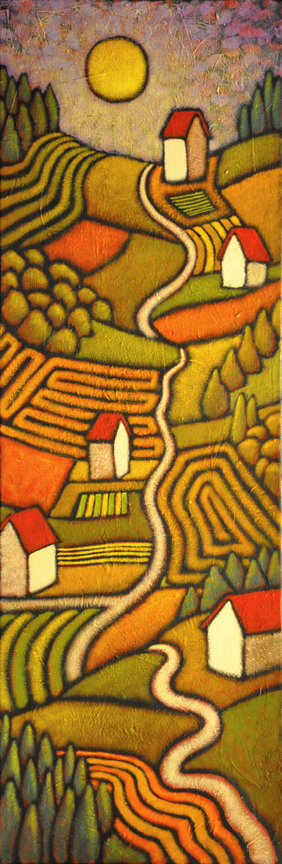
The piece shown here is such an example.  A 10″ by 30″ canvas, it is an extension of the work I have done recently, work that I have called internal landscapes.  Called Native Rise, it is painted very intuitively and speaks plainly.  It has an attractive harmony in its elements that lets it speak easily and be asorbed quickly – if you like this sort of voice.  For me, I see this piece as being very symbolic of my true voice,  how I see and express the world as I internalize it.  It is painted easily and in my own voice.   And like my own voice, it is far from perfect but tries to speak plainly.  And truthfully as to how I see my world.
At least, that’s the way I see it   It’s funny how much more difficult it is to describe  with words my own native painting voice, something that comes so easily on the canvas.  Perhaps one shouldn’t try…

Read Full Post »

On my way to deliver some new work to the Kada Gallery in Erie, I was driving across the empty part of western New York yesterday, a couple of hundred miles of very sparse traffic which leaves you lots of time to let thoughts just randomly weave in and out of your mind.  It’s funny, the things that settle at these times.  People you haven’t thought of for many years.  Things that you haven’t done since you were a kid.  Sometimes people and things that have little meaning for you.  Plans and things you want to do in the future.

Yesterday, I was thinking about the circus for some unknown reason.  Maybe it was a thought of one of the circus paintings from Pablo Picasso. like the one shown here, or the ones from Seurat that I wrote about here in the past.  There’s something very visually interesting in the circus, with it’s costuming and showmanship.

But more than that it made me think of how I have viewed the circus over the years.  Growing up, the circus and circus style acts were big staple of television in the early 60’s and, I’m sure, the 50’s.  Aerialists, jugglers, clowns of every shape and size, lion tamers and a variety of other animal acts were often part of many variety shows.  I can’t quite remember all the details, but there was even a show that was devoted to circus acts. 

 As a kid, I was enthralled by these acts and performers.  Even my first date with my wife involved going to a circus that was appearing in our local minor league ballpark.  It was one of those things that was sort of engrained in my young psyche.  But over time, the gloss faded from the illusion of the circus for me.  I no longer found the idea of performing animals charming in any way.  In fact,  it bothered me deeply.  It also  became apparent that the  lives of many of the human performers were not easy either.  Their moments in the spotlight in their shiny outfits were short and masked the hours spent in second rate motels and restaurant while crisscrossing the  backroads of this country. 

The illusion was gone for me.

But  still, the idea and ideal of the circus in the mind brings forth strong imagery.  The tension of a daring performance and the anticipation of the crowd.  The aura of the spotlight and how all eyes were focused hard on whatever was going on in that center ring.  It was a great illusion and was part of my childhood memories. 

That was part of my drive yesterday.  Don’t know exactly why.  Maybe someting will appear in my own work.  We’ll see.

Here’s one of my favorite Bruce Springsteen songs, one that fits this post to a tee.  It’s a 1973 performance of his image filled Wild Billy’s Circus Story

Read Full Post »

My post yesterday was about the guitarist Django Reinhardt and the beauty of the guitars he played.  I replied in a comment that I was surprised more painters didn’t use the guitar as a subject because, to me, it has a feeling of iconic expression.  It’s there in the shape of the instrument with its sensuous curves and neck.  The way the player holds- no, embraces the guitar.  The way they move their hands over the strings. 

It made me wonder how often the guitar had been used as subject and prompted to me to do a quick search. Now I don’t know what most people think and I don’t have a comprehensive knowledge of art history but for me the piece that must be the most recognized is Pablo Picasso’s The Old Guitarist from his Blue Period, around 1903.  I have used this piece as the inspiration for paintings of my own and love the expessiveness of the hands and the bow of the player’s neck.

Another was from Georges Braque, one of the prominent names in Cubism with Picasso.  His Woman With a Guitar from 1913, shown here, is a beautiful example of the Cubist style.  I’m not sure it carries the emotional impact of the Picasso piece above but it is a fine piece.

Many of the earlier paintings I found containing stringed instruments were not guitars but lutes.  Perhaps the best of these paintings is this gorgeous painting from Vermeer, The Guitar Player.  On closer examination, you can see that it is a lute.  But it’s such a beautiful piece of painting, does it really matter?

Renoir- Young Spanish Woman with Guitar

Edouard Manet used the guitar player as a subject in several paintings as did Auguste Renoir.  Renoir really seized on the romantic aspect of the instrument which worked well with his style.  His players, usually his female subjects, cradle the instruments in a number of paintings.

There are certainly many, many more paintings out there that I failed to see or mention.  If you come across one that strikes your fancy, let me know.  There are some new kitschy paintings out there that are painted to appeal to guitar owners, not to actually create a sense of emotion which is  what I’m discussing here.  I’m talking about using the guitar as a subject for expression in the paintings, not simply as an object.

Read Full Post »

« Newer Posts - Older Posts »