Feeds:
Posts
Comments

Posts Tagged ‘Painting’

No Mail?

I shake my head a lot these days.

And swear. I have always cursed a lot, probably much more than is necessary under any circumstance. But these days, it’s been an unending torrent of blue language. I feel like a gunfighter with my hand forever resting on the six-shooter hanging at my side, all six chambers loaded with curse words of all sorts and in every imaginable combination. Hey, just because I’m crude doesn’t mean I can’t be creative.

But the past day or two, the thing that had me shooting that six gun into the sky is the current president*** and his desire to see the US Postal Service fail, saying that he will veto any emergency bill that adds funds for this most essential service, one that has seen a number of its employees stricken with the covid-19 virus.

There has long been a desire among some on the right to privatize the postal service. In fact, in 2006 under the second Bush administration that was gung ho on privatizing as many government services as possible, they enacted a mandate for the USPS that required them to prefund the employee retirement fund for the next 75 years with a ten year period. It was a measure that added $5-6 billion to the USPS budget each year, sending a service that ran, for the most part, profitably for ages into a financial freefall.

This mandate of funding retirements for 75 years– basically for a generation not yet born– is not done nor required by any or other government agency or any private company. Can you imagine a private company having to pay for the entire retirement of a new employee within the next few years? It is a ridiculous requirement and one that is intended to drive the USPS into insolvency, as it would do for any other company required to follow it.

Why would they do this? Privatization, as I said. There is a firm belief in many on the right that government is inherently inept and can do nothing efficiently. This always strikes me as being funny because these same people often believe that big government is involved in conspiracies that would require it to be the exact opposite of that. Privatization takes them off the books and, sadly, would make them a new vehicle for corruption.

The USPS is often maligned but they are still a wonder of efficiency in my eyes. Throw a letter in an envelope, jot down an address and add a stamp and stick it in the box at the end of the driveway. A person picks it up and a day or two later it is delivered anywhere in this country for 55 cents. The people who complain about this are the same people who bitch that gas doesn’t cost thirty cents a gallon anymore. To me, accessing the infrastructure that can do such a thing for less than buck is perhaps the best bargain around.

The infrastructure to do this is incredible, a force of 600,000 employees who have been the lifeline for many for most of the time as a nation. Some say that most of our messaging can be done via the web now or through private carriers such as UPS or FedEx. Of course, there is a profit necessary in order to accomplish it with private companies. FedEx would certainly never be able to deliver a letter for 55 cents. So, any increase in the price of doing such would be a de facto tax.

I am one of those people who have always loved the idea of mail. It has always been a part of my life, a first life line to the outside world when I was child living in the relative isolation of our rural home. I have friends that I still write to overseas that I befriended through the mail. While we now email more, the hand written letters and notes that I still receive mean so much more to me than a n electronic message read on a screen. The fact that the sender put it in the envelope and addressed it and a different person picked it up and inserted it into this incredible system to get to me makes it a small miracle.

The USPS can easily be saved. Of course, the forces that be and their wealthy friends see it as a cash cow to be exploited. Whether we let that happen is up to us. Call– or better yet, write– your representatives in congress and tell them to keep their hands off the post office.

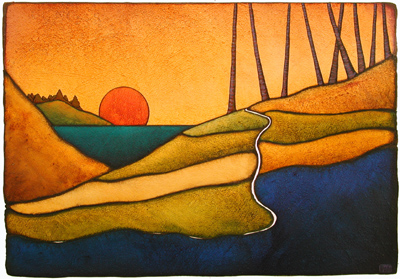
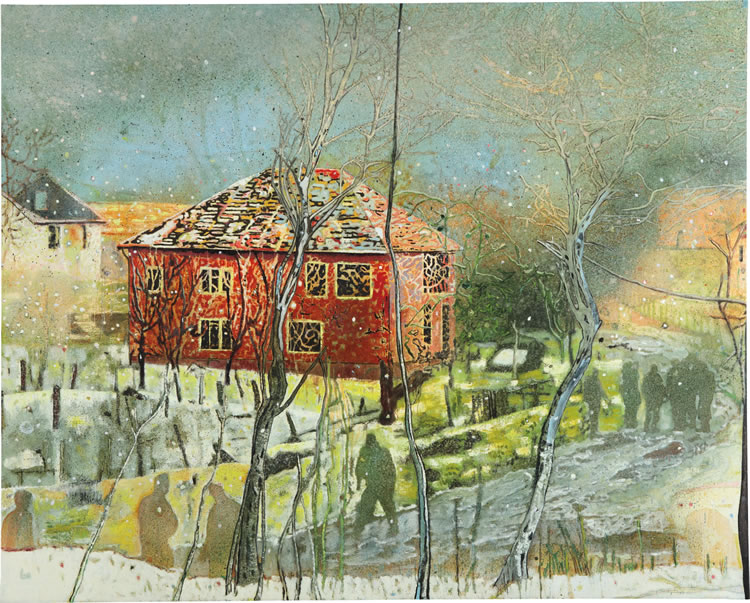
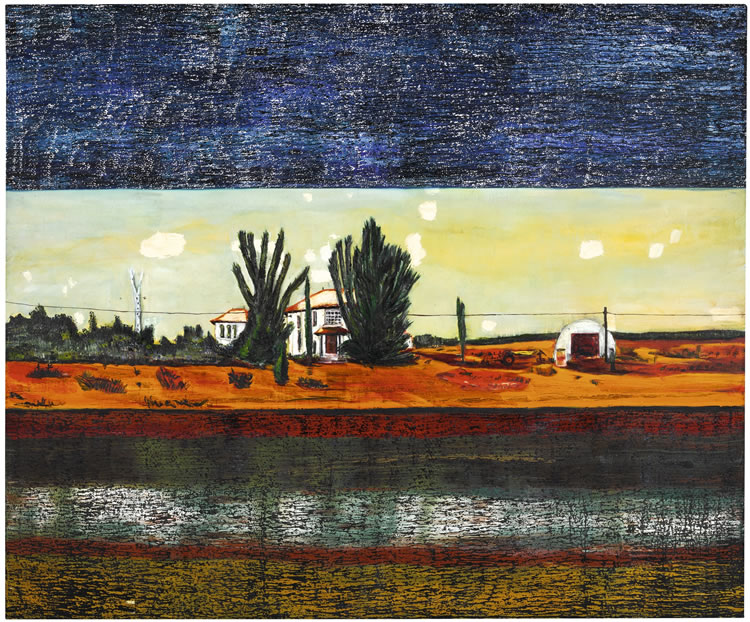
Here’s an older blog entry about the prospect of receiving mail as a kid. I have done a few paintings that reflect this memory, including the one at the top from back in 2009.

***************************

For me, this painting reminds me of my childhood and the house I consider my childhood home, an old farmhouse that sat by itself with no neighbors in sight. Specifically, this painting reminds me of exact memories I have of trudging to the mailbox as an 8 or 9 year-old in the hot summer sun. There’s a certain dry dustiness from the driveway and the heat is just building in the late morning. It’s a lazy time for a child. Late July and many weeks to go before school resumes. The excitement of school ending has faded and the child finds himself spending his days trying to find ways to not be bored into submission.

The trip to the mail box is always a highlight of the day, filled with the possibility that there might be something in it for me. Something that is addressed only to and for me, a validation that I exist in the outside world and am not stranded on this hot, dry summer island. Usually, the tinge of excitement fades quickly as I open the old metal mailbox and find nothing there for me. But occasionally there is something different, so much so that I recognize it without even seeing the name on the envelope or package label.

It’s mine, for me, directed to me. Perhaps it’s my Boy’s Life or the Summer Weekly Reader. I would then spend the day reading them from front to back, reading the stories and checking out the ads in Boy’s Life for new Schwinn bikes. Oh, those days were so good. The smell of the newly printed pages mingling with the heat and dust of the day to create a cocktail whose aroma I can still recall.

But most days, it was nothing. Just the normal family things– bills, advertisements and magazines. Or nothing at all. The short walk back to the house seemed duller and hotter on those days.

That’s what I see in this piece, even thought it doesn’t depict everything I’ve described in any detail. There’s a mood in it that recalls those feeling from an 8 or 9 year-old, one of anticipation and one of disappointment.

Childhood days with no mail.
Read Full Post »

I do a one-man show every June at the Principle Gallery in Alexandria, VA and have done so since the year 2000. This year’s show, my 21st such show, is slated to open June 5. I am keeping hope alive that the current situation will have subsided to some degree and that the show can go on by that time but the experts’ projections, based on what little data they can obtain from our inadequate testing, make it look a little shaky.

But I am continuing to work on this show on the premise that the show will go on.

It’s what I do. All I can do.

That being said, I have determined that this year’s show should reflect this time. At least, my take on it. To that end I am calling the show Social Distancing. It’s a term that, while it has really taken hold in this world in recent times, I don’t think I have encountered much before now.

I have practiced it and painted it in many ways but just didn’t know to call it that.

From my earliest days, much of my work has dealt with the duality that runs along that line between solitude and alienation. The yin and yang, the joy and the sorrow, that comes from being apart from others. Many of my series have focused on this separation, the Exiles and Outlaws series jumping to mind.

But even my most used archetype, the Red Tree, usually concerns itself with distancing.  It almost always is alone or at least apart from other trees. Most of the time, it is about finding strength in recognizing those things which makes us unique individuals but occasionally it is about feeling alienated from the rest of the world.

Some find empowerment in their solitude. I believe that’s been the case for myself as I have seldom felt loneliness, especially in my adult years. But for many, that line between simply being alone and lonely is a thin one.

Solitude and silence can be frightening to those unaccustomed to it.

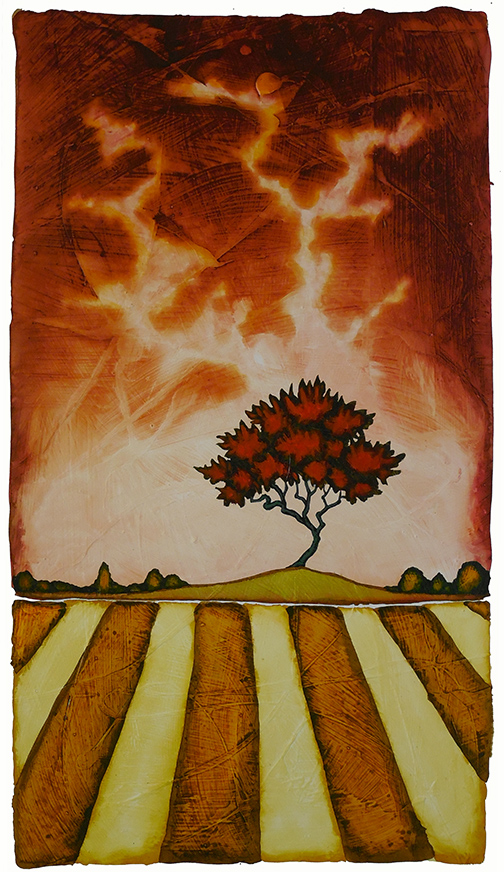
This being the case, there will be a pretty substantial nod to my earlier work, such as the painting at the top. It’s a 14″ by 24″ piece on paper that I call Social Distancing: Approaching Storm. I guess it’s a timely title.

For me, this return to that earlier method which focuses on sparse landscapes and big blocks of transparent color is like comfort food to me. The more I immerse myself in this work the more I understand what its appeal was to myself and those folks who were drawn to it in the early days. Working on this group over the past week or so has been steadying in the face of the great uncertainty we face.

I could say more but I think I want to stop. Hopefully, the show will go on, at least in some form.

I am going back to the solitude of my work now.

It’s what I do. It’s all I can do.

**********

Social Distancing, this year’s edition of my annual show at the Principle Gallery in Alexandria opens June 5.

Stay tuned for further details.

Read Full Post »

Jean Arp- Torso of a Giant 1964

Jean Arp- Torso of a Giant 1964


*****************

Soon silence will have passed into legend. Man has turned his back on silence. Day after day he invents machines and devices that increase noise and distract humanity from the essence of life, contemplation, meditation… tooting, howling, screeching, booming, crashing, whistling, grinding, and trilling bolster his ego. His anxiety subsides. His inhuman void spreads monstrously like a gray vegetation.

–Jean Arp

**************

GC Myers- Quiescence

****************

I had a quote on the last post with a quote from artist Jean Arp about man turning his back on silence. Rather than savoring the quiet, he runs from it, instead distracting himself with all manner of noise. Anything to keep him from facing the fears that the quiet represents to him.

It’s a theme that has been large in the background of my work. Early on, when I felt that I wanted to be a writer, I would find myself writing about large open spaces and the caverns of silence that rested in these places. I called it the Big Quiet. Of course, it’s a pretty limited subject and there is a certain redundancy in writing about silence and stillness. I mean, how can you use the noise of words to aptly describe the absence of noise?

So I gave up writing about it and went on with my life, always with an eye out for this Big Quiet. I don’t know that I was craving it or fearing it at most points. My life was pretty much filled with the noise of the world, all the snaps and pops of sound and distraction that creep into every living space. I was like so many others who needed the security blanket of sound to protect them from what they might discover if they were forced to face the silence.

But the sounds that I hoped would lessen my anxiety only seemed to feed it.

However, painting gave me a path to finding this Big Quiet. It was wordless and calm, creating an inner space absent of the sounds of the world that I was and am still occupying. It became a destination, an oasis to turn to when the din of world became too loud, too overbearing. It eased my fears of looking inward and allowed me to savor the quiescence of the brief moments I actually myself there in those scenes of stillness and calm. It became real and necessary to me.

I don’t know where this going, this wordy noise I’m creating about the stillness I find now. I just felt that I should add a bit of context to my work, to give a an understanding of what I hope to take from it for myself. This moment came about from running across the image above, a piece from several years ago that is called, fittingly, Quiescence. It’s a piece that brings me quiet immediately and seeing it at any time makes me again think of the main reason that I paint.

So, I am going to be quiet now…

********************

The post above is comprised of two posts that ran here on consecutive days back in 2013. They served a great purpose for me this morning when I read them again for the first time in many years which made me think they were worth sharing.

Read Full Post »

Corona


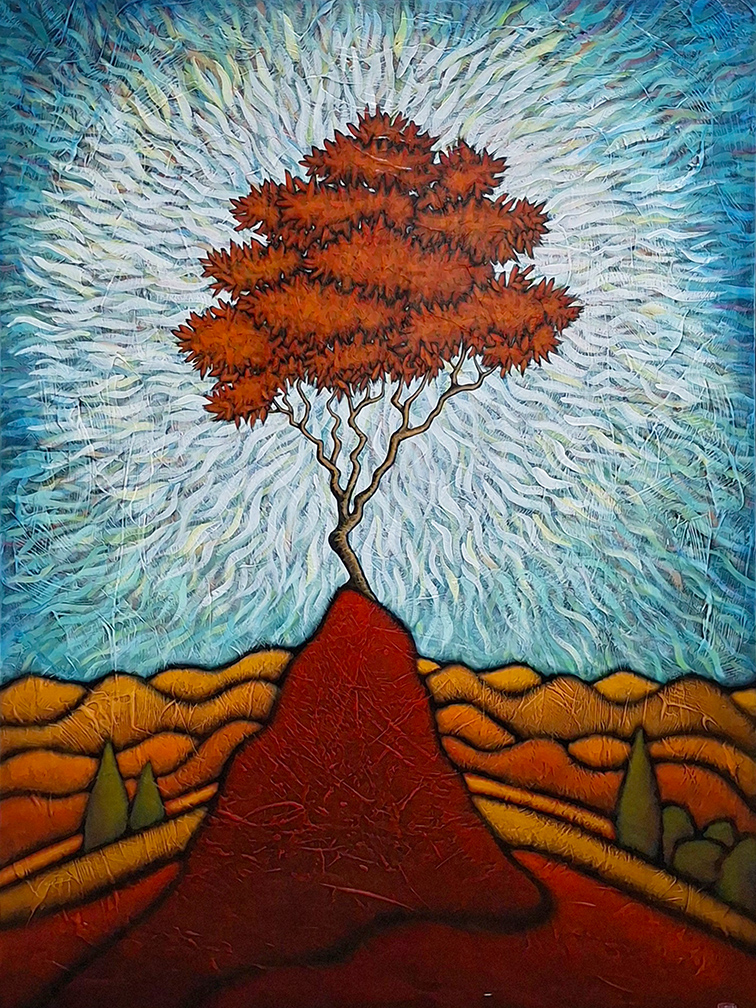
I have a large painting, 36″ wide by 48″ high, here in the studio, one that was done a couple of years back and which has had limited exposure in being displayed. I was surprised to find that I haven’t written about it or even shared its image here in the past. I say surprised because it’s one of those pieces that feels immediately at home with me.

I would consider it prototypical of my work, a single Red Tree pushed forward in the picture, almost a portrait rather than a landscape. There is a burst of light that appears in the sky behind it, creating an aura-like appearance around the Red Tree’s crown. This led to its title– Corona.

Unfortunately, this word, corona, has taken on a new meaning as most of you know. That poor Mexican beer of the same name is being blamed by some folks — those with small and defective brains, I would suspect– as the cause of the outbreak. They probably believe there are junkyards filled with old Toyota Coronas that are radiating the virus outward 24/7.

Even though this is just gross ignorance, it makes me think I might have to rename this piece. Maybe something close in sound?

How about Corrina? You know, like the old song Corrina, Corrina?

Hmm. Have to give that some thought.

As for the song, it’s an old chestnut that was written in 1928 and has been recorded by scores of artists in a wide variety of styles. It seems to work in every genre mainyl because it’s just a very good tune. Here’s a version of the song with kind of a Latin swing from Lloyd Price, who is best known for his big hit from the 1950’s, Stagger Lee. This is not the best known version but I’ve liked it since I heard it many years ago on a Lloyd Price tape that I found in a bargain bin at a discount department store.

When I think of this song, this version always comes to mind. Have a good day and stay away from that beer.

Read Full Post »

*************

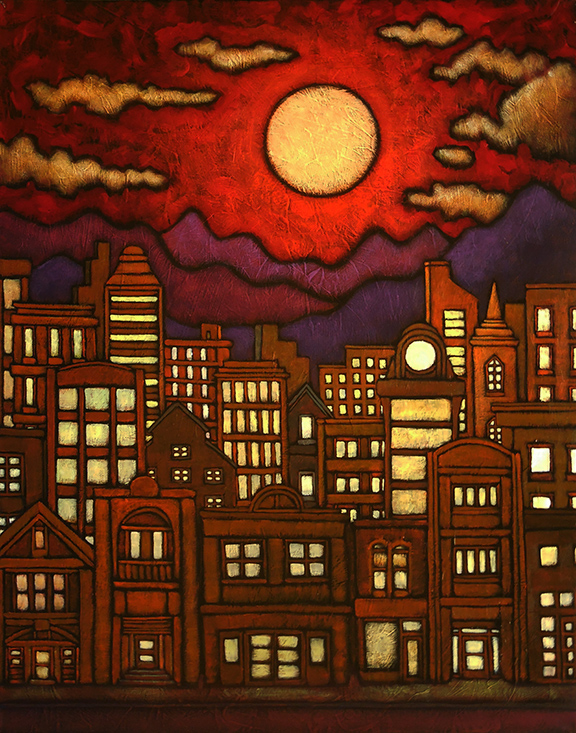
I showed a work in progress here a couple of weeks ago that featured a cityscape that I compared to a skeleton that spoke to me as I painted, telling me how to flesh it out. Above is a side by side comparison that shows where that skeleton led me.

It was one of those paintings where I find myself constantly trying to restrain myself from going too bright. As noted in recent posts, I am looking for more depth and darkness in the colors I employ right now. But I often still want to go the next higher and brighter tone. Holding back on that impulse is difficult but rewarding in the long run. Even though this is a painting with a lot of color, it is greatly restrained which allows the deeper colors hold court and show through clearly.

I was originally going to call this piece Light on Main Street. It works well but in the end I opted to adopt the title from the classic Rolling Stones album, Exile on Main Street. The reason for this change was that I saw this piece as being the view of the Exile, an important character in my work, standing on the other side of the street.

The Exile sees the blank  and anonymous eyes of the lit buildings. It’s a feeling of alienation that I described in a post last week, Inner City Blue, about another cityscape, where each building seems like its own alien world filled with lives and occurrences about which you know little, if anything.

I think this feeling of being the Exile, a stranger in a strange land, is enhanced by the reddish tones of the sky and the deep gem tones of the distant mountains.

They seem familiar but different somehow.

And it’s that familiar but different feeling that appeals to me. I think it is may be something I actively seek in my work. It might be described as a desire to have you feel the comfort of the familiar while at the same time thinking that there is something different at play.

I really don’t know for sure.

I’ve looked at this piece for a couple of weeks now and I am still taking it in. The fact that it makes me want to continue to do so is a good indicator for my personal judgement of a work. I look forward to continue doing so with this piece.

Hey, since I snagged their title, how about a track from the Stones from Exile on Main Street? Hard to decide which to use with so many great tracks from which to choose. However, I am going with a personal fave, Sweet Virginia, in honor of Virginia’s presidential primary taking place today. Plus, there’s something in it that matches up well with this painting. Can’t put a finger on it but…

Hey, have yourself a good day.


Read Full Post »

I don’t have much to say today. Oh, I have plenty to say but I am going to spare you having to hear it. I just want to get to work this morning seeing as it’s March 1 which translates to me as march forward as I prep for my annual shows. It’s total immersion time.

So, let’s keep it short today. I want to show a coupling of a song and a painting which I think works well together. The painting is above and is titled Blaze. It’s one of those pieces that have somehow found their way back to me and this one always confounds me. It felt so right and easy– graceful–off the hand. Even now, I always stop and look at this piece for the longest times, wondering why it is here. I guess it just hasn’t met its rightful partner yet.

The song that I matched up with Blaze is Wild Is the Wind from Nina Simone. It was originally recorded by Johnny Mathis for a movie of same title in the 1950’s. It’s a little overproduced for my taste but the song is undeniably strong. Nina Simone took it and made it into a spare and special song. It was used as the title track for her 1966 album which is considered one of the greatest albums of the 1960’s, remarkable in a decade filled with legendary albums. David Bowie also is noted for performing this song, which was done as a tribute to Simone.

Give a listen and have a good day.
*************

Read Full Post »

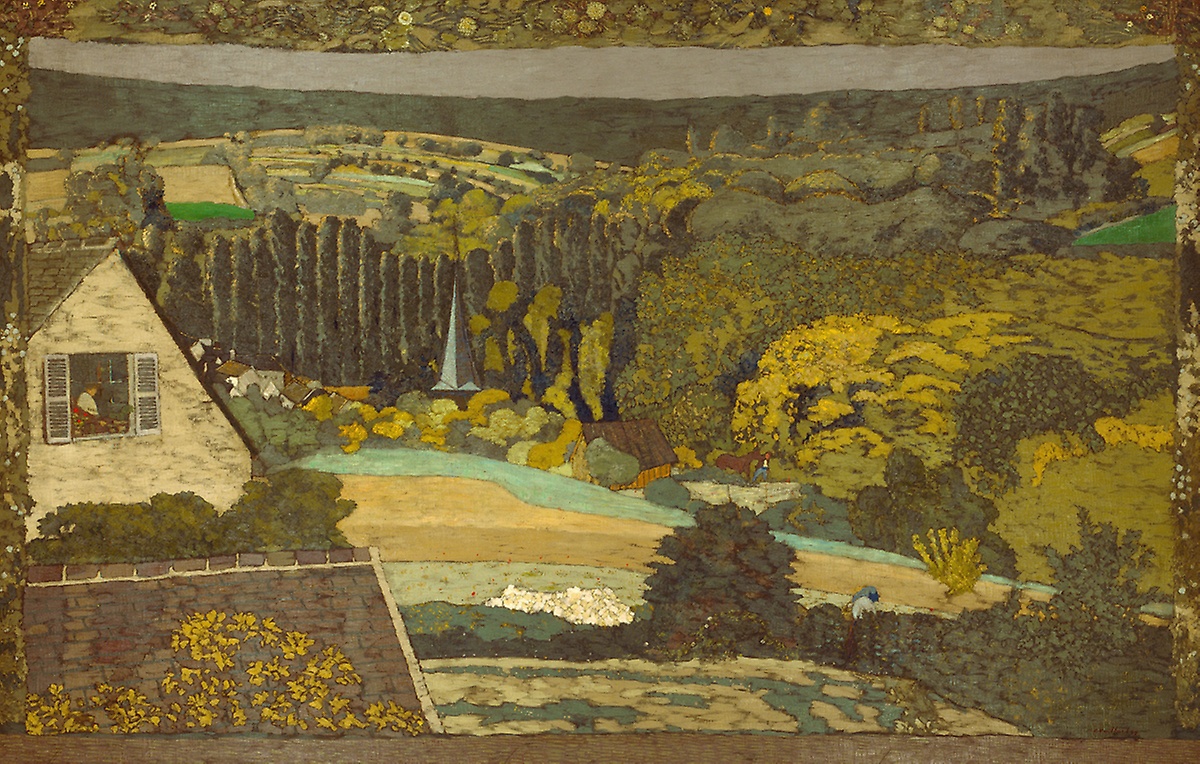
Édouard Vuillard – Landscape at Saint-Jacut

*******************

To say that a thing is beautiful is simply an act of faith, not a measurement on some kind of scale.

–Édouard Vuillard

*******************

If you asked me about my favorite painters, Édouard Vuillard (1868-1940) is not a name that would come to mind. In fact, I never even gave much thought to his work and didn’t have much of an opinion on it. I knew a little bit about the interior scenes for which he is well known but if you asked me to name or even describe his best known work, I would be at a loss.

But the more I look and the more I see of his work, the more of a fan I become of Édouard Vuillard. There is such a wide array of style in the body of his work that shows his exploration and growth.

The interior scenes I once shrugged over now seem to be wonderfully dense explorations into abstraction, pattern and color. There is so much to latch onto in each piece that a cursory glimpse doesn’t often suffice. I now see his work with a bit of a sense of awe and can honestly take that leap of faith and say that I see them as beautiful.

I even like a few of the things from him I have read, like the words at the top. Beauty is indeed subjective, not measurable with any set scale. My sense of beauty may well differ from yours. You may be moved by things that do nothing for me and vice versa. I don’t know that there is any one things, any one piece of art, that is absolutely beautiful to everyone.

Maybe there is. Who knows? Certainly not me.

He also wrote: I do not belong to any school, I simply want to do something that is personal to my self

These words depict that need to create something that is only mine, not something instantly attributable to a school or movement or any other artist, that has always been the driving force behind my own work. I don’t know that I have always been successful but I can say that Vuillard definitively did create a distinct body of art, beautiful work that is all his own.

Just good stuff. Here are a few examples from a sea of choices.


Read Full Post »

*********************

The writer operates at a peculiar crossroads where time and place and eternity somehow meet. His problem is to find that location.

–Flannery O’Connor

**********************

I think you could probably substitute artist in for writer in the words above from author Flannery O’Connor (1925-1964) without changing the gist of the thought too much. All art, and literature certainly falls into that category, is about transforming the now of the creation– the time and place— into something beyond that moment, into something timeless–the eternity to which O’Connor refers.

Finding that intersection where those two things come together is, as she points out, not such as easy thing to accomplish. And almost every instance the artist will never know if they have come to those crossroads that moves their work into the realm of the eternal.

I guess the finding is immaterial without the seeking. And seeking without any assurance of finding something that will ever reveal itself to you is an act of faith, a belief that there something eternal worth seeking.

I don’t know what else to call it. You keep trying. You think it is near sometimes but when you finally come to it, you’re not sure enough of what you’re experiencing to stop seeking.

Does one ever know when they have come to that crossroads?

That being said, here’s this week’s Sunday morning music from a longtime favorite of mine, Tracy Chapman. I think her body of work sometimes get overlooked in the deluge of the new but every time I come back to her, I wonder how I have let her slip out of mind. Here’s a song that fits the subject here, Crossroads, to accompany the painting at the top, Beyond the Crossroads, from back in 2004.

Have a good Sunday, okay?


Read Full Post »

Peter Doig- Swamped 1990

********************

I sometimes wish I had never had to sell a painting. Every painting you make represents the time it was made and how you were feeling and what your influences were… You are never going to feel that way again, so you can never repeat it…

–Peter Doig 

*******************

I shouldn’t make such a blanket statement but I doubt that most of you out there know the name of the contemporary artist Peter Doig. I know that I wasn’t fully aware of him until a decade or so back and even then only on a passing basis where I would stop and examine his work when I would come across it in an article. The piece at the top always made me stop and look a bit closer.

But the fact of the matter is that the Scottish born Doig (b. 1959) is perhaps the most sought after living artist working today with works selling for the tens of millions at auction. Of the 9 paintings shown here, only one sold for less than $10 million at auction. The most expensive sold for over $ 28 million. I won’t tell you which is which. There were many others on the auction sites that sold for between 1 and 4 million that I didn’t include.

These prices always open up a debate with lots of questions on the relative value of artwork. What makes a work worth $28 million? Does the auction value of the work determine its importance or does its importance determine its value? Is the working and thinking process of this artist that much different than that of an artist that sells for tremendously less?

You might think from the direction this seems to be heading that I am decrying Doig’s work selling for what I believe are ludicrous sums. I am not. I very much like and admire his work. I can see those elements in it that make it distinct. It is good and great work and might very well be among the most important work from this time. If his work can bring in that kind of money, I applaud him.

I am, if anything, criticizing myself for not having the ability– or knowledge or audacity– to command such prices. I know that the price of a piece of art sometimes determines how serious collectors view it and that a great piece can be overlooked simply because it is too inexpensive, at least by the standards of collectors.

That has happened to me at times.

In some galleries, my works sits at the top end of their market and in others, in the middle or near the bottom of their price ranges. While I am satisfied with that, I firmly believe that my work is greatly undervalued across the board, that it should be demanding much higher prices.

Now, that sounds like confidence, doesn’t it? Maybe even overconfidence?

Actually, it is the opposite of that. It is a lack of confidence and a bit of fear that keeps the prices of my work in the range where they are and have been. While I have the belief in the relative value of my work, I just don’t have the guts to make that jump.

I have been poor in my life and it wasn’t that long ago that I was dead broke and I think that tempers my ambitions, as far as pricing my work is concerned. I like to have my work sell and make a living from it. I take pride in being able to live off of the product of my own thoughts and imagination. And I find a sense of security in being able to provide what I consider high quality work at prices that make it obtainable for more people than if it were in a much higher range– it’s undervaluation generally means that the work will sell eventually.

Maybe I am too comfortable and seeing Mr. Doig’s prices just nudges me a bit, telling me to be less comfortable, to be more proactive.

I don’t know. Just thinking out loud this morning. I wrote this because much of what I have read about and from Doig jibes with my own experiences, including the quote at the top. For all the talk about prices, every real piece of art represents a certain time and place for that artist, one that is distinct and not repeatable. I know that I will sometimes look at a piece and remember the days I spent in front of it while painting it. That time, that thought process is burned into my psyche and will never happen again in the same way.

Anyway, lets’s push aside thoughts of money for now and just look at the paintings of Peter Doig a bit more.

Peter Doig- Rosedale 1991

Peter Doig– Red House 1995

Peter Doig– Island Painting 2000/01

Peter Doig– Grasshopper 1990

Peter Doig — Daytime Astronomy 1998/99

Peter Doig– Charley’s Space 1990

Peter Doig– Forestia 1996

Peter Doig– Almost Grown 2000


Read Full Post »

**********************

“I’m not sure this will make sense to you but I felt as though I’d turned around to look in a different direction so that I no longer faced backward toward the past but forward toward the future. And now the question confronting me was this: What would the future be”

― Arthur Golden, Memoirs of a Geisha

**********************

This small painting that is hanging as part of the Little Gems exhibit at the West End Gallery (opening Friday, February 7) is titled Memoir.

The thought behind that title was that that while the future seems uncertain as we look forward, our pasts as we recall them are often just as uncertain.

Our personal histories are a patchwork, like the sky in this painting, of half memories and dimly lit stories. Faces and names fade. Words once spoken are lost in the void. We have grainy snips and snaps of what we recall as significant moments and some surprisingly sharp images of insignificant moments that puzzle us, leaving us to wonder why they remain so clear.

Do they mean something more and we just don’t see their true meaning?

I looked at this small piece and wondered what I would include in my memoir. What would I pull from that haphazard patchwork that I would want to share now and into the future?

After sifting through the shards of broken memories, I come to the conclusion that I don’t want to write a memoir. Let my memoir show itself in my work, let my story be told in paint and line and shapes, a crude group of hieroglyphs that will no doubt go untranslated in generations to come.

Let the future, if it is so inclined, write my past. That shall be memoir enough for me.

For this Sunday morning music, here’s a song to go along with this painting. It’s the Nick Lowe pop classic, When I Write the Book.

Have a good Sunday.

Read Full Post »

« Newer Posts - Older Posts »