Feeds:
Posts
Comments

Posts Tagged ‘Painting’


**************************

“It has always seemed to me that so long as you produce your dramatic effect, accuracy of detail matters little. I have never striven for it and I have made some bad mistakes in consequence. What matter if I hold my readers?”

― Arthur Conan Doyle

**************************

Who would have thought that the creator of Sherlock Holmes would have some good advice to offer to artists?

The words above from Sir Arthur Conan Doyle about how he he would sacrifice accuracy of detail in order to gain greater dramatic effect in his work are very enlightening.

And reassuring.

I have been going through a lot of older work from over twenty plus years back when I was still in a formative stage with my painting. I hadn’t read these words from Doyle but one of the first conscious decisions I made about my work was that I would not be a slave to detail, that I would slash away as much detail as possible while still conveying a sense of what was being represented. Oh, I would use smaller details when they served the greater effect of the painting but the fewer the better.

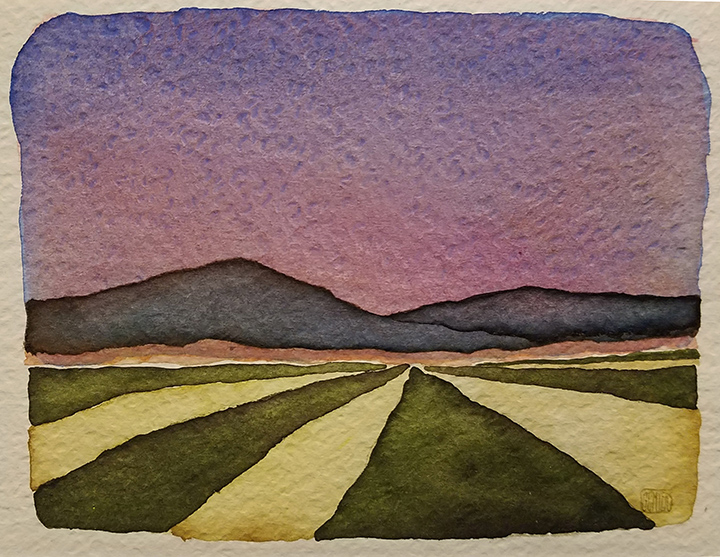
One example from this early work is the piece at the top that is from around 1997. I was surprised when I came across this small painting in a file folder that I hadn’t examined in many years. It was a solid example of the work I was doing at the time, mainly in watercolor with the beginnings of my relationship with the acrylic artist inks that have long been a staple of my work.

It is sparsely detailed with little consideration to trying to replicate natural color. It just allows the colors and the shapes do what they will in communicating a sense of place and feeling. It works pretty well for what I want from it.

Over the years, I sometimes have strayed from this credo of spareness but I always find my way back to it. There just seems to be more space for the expansion of feeling when details are cut away. It’s a good thing to keep in mind.

So, thanks for the reminder, Mr. Doyle. I can use all the help I can get.
Read Full Post »

Funny how the mind works sometimes.

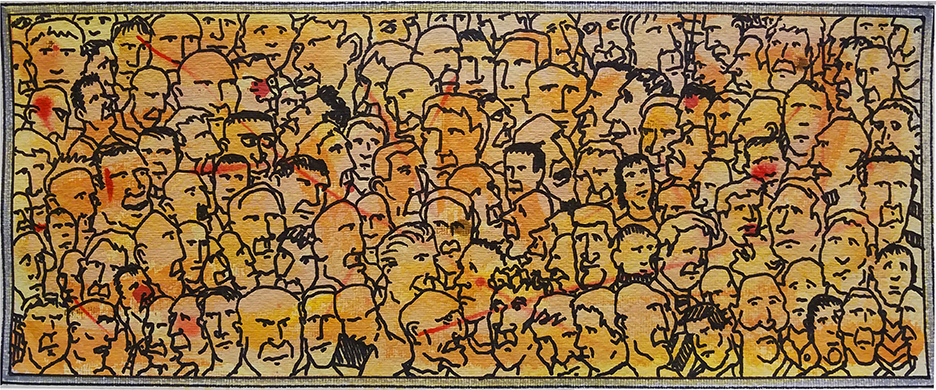
Lately I’ve been showing some paintings from a new series that features masses of faces. Last week I wrote that these groups of faces reminded me of the artifact from the subterranean layers from my Archaeology series. I thought that was a new observation as was the whole idea of this series.

But yesterday I was going through a bin of old work that I haven’t looked through in years and came across the piece shown above. It was done in the early days of 2008 when I was trying to break from a painting funk as I prepared for my annual show at the Principle Gallery that June. The Red Tree had been firmly entrenched as my trademark in the eight prior shows and I felt that it was boxing me in and that I was running out of gas.

It was becoming harder and harder to create the excitement in myself from the work that was needed to make it come alive.

So I turned to a task that a 5th grade art teacher had given me years before. He gave us large sheets of paper and told us to simply fill them, in pen and ink, with anything that came to mind. It could be simple shapes but he suggested making it a junkyard of objects. So I would start at the bottom of the page, drawing things piled on top of other things until the page was full.

It was an exercise that became a regular thing with me in adulthood as I would doodle this way in the margins of newspapers and in journals. Being blocked as I was back in early 2008, I pulled out a Sharpie and many sheets of watercolor paper. I spent a week or so just filling these sheets and at the end of that time the idea of the Archaeology series evolved from this work.

But since then I had completely forgot that I has did one of these sheets with simply drawn faces. It’s not particularly great in any way. It is rough and sloppy but I can see in it the beginnings of the Multitudes series. Around that time, I was drawing faces with a blunt Sharpie, trying to create an expressive face with as few lines and detail as possible. Here’s are two examples from that time taken from an old art business calendar that used as a sketchbook.

So, the idea that I am currently chasing is not new at all. It was forgotten, sitting in some far corner of my mind, biding its time until I was ready for it. Apparently that time has come.

Funny how the mind works sometimes.

Read Full Post »

Rothko/Experience

Mark Rothko- Red and Black 1968

*****************

A painting is not a picture of an experience, but is the experience.

Mark Rothko
.
*****************
This quote from Mark Rothko made me stop this morning. I hear a lot of artists talk about capturing a moment with their work. I am pretty sure those words have come out of my mouth when I am just blathering on. But a piece of art works best when it causes the viewer (for visual artists) to feel as though they are experiencing something new in that moment when they stand in front of it.
.
Not a representation of a moment but a moment in itself.
.
But how do you do that?
.
I can’t really say for sure. Maybe it comes in being fully engaged emotionally during the creation of the work. Perhaps that moment of emotion becomes part of the piece and it is that which the viewer senses and experiences in the work.
.
I don’t really know but it is something I will consider when I am in front of the easel in a few minutes.

Read Full Post »

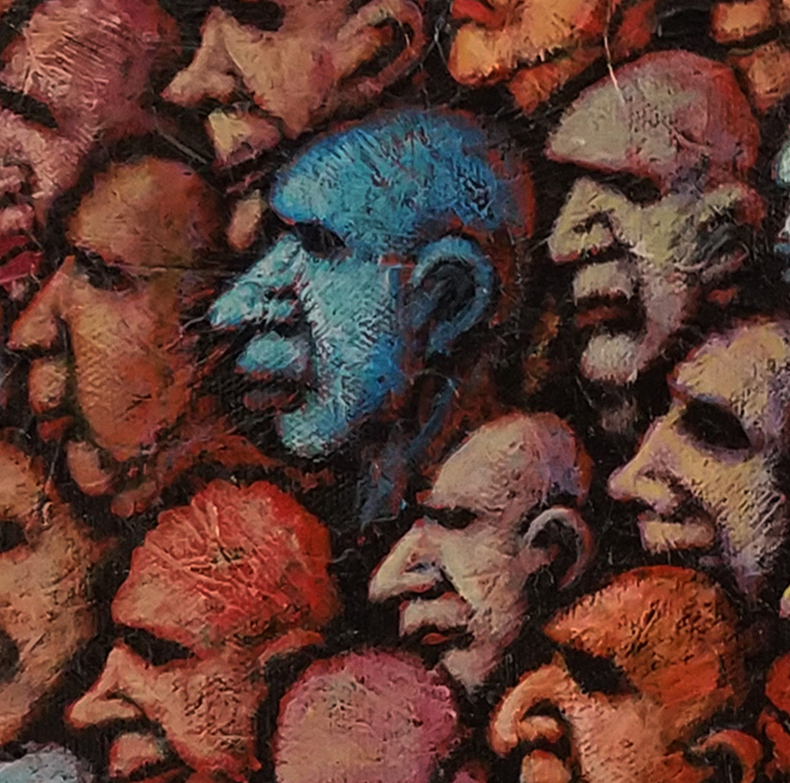
This Sunday morning’s musical selection is tied somewhat to a group of new work that has been rekindling my fire here in the studio. I’ve shown a couple of images of new paintings here and on social media of what I might call my Mask pieces.

Each has been a group of faces that is done in quick strokes from a single brush, starting from one point and filling the canvas. It is unplanned in almost every way. No color plan. No theme. Just intuitively and roughly formed faces that stem from a lifelong collection of faces that have been stacked in my head, culled from looking intently at clouds, woodgrains and patterns of all sorts through the many decades. Seeing them spill out in this way has been energizing in a way that I know from experience will spill over into the rest of my work even if this particular work remains for me privately.

I haven’t been thrilled with how the camera is catching the images thus far. They have been quick photos that don’t fully capture much of the subtlety in the closer parts of the painting. So when the musical selection came up this morning, this section of one of the paintings jumped out at me. I thought showing it in detail would better show how I am seeing the work.

The song selection is the jazz standard Born to Be Blue, written by Mel Torme in 1946. It’s been performed by scores of singers over the years but it became a signature piece for the late Chet Baker.which is the version I am sharing below. In fact, a 2015 film biography of his life starring Ethan Hawke as Baker uses the song title as the film’s title. This version highlights his vocals rather than his horn work and features great piano playing from Bobby Scott.

Hearing it made me think of a blue face that I consider a central character in one of these pieces. At least my eye always lands on him first before roaming across the rest of the picture. The image at the top is a detail featuring him and shows better some of the surface and textures that compose the painting.

That being said, I am eager to get back to work on a new piece in this same style. Enjoy the song and have a great Sunday.

Read Full Post »

********************************

“The sun –the bright sun, that brings back, not light alone, but new life, and hope, and freshness to man–burst upon the crowded city in clear and radiant glory. Through costly-coloured glass and paper-mended window, through cathedral dome and rotten crevice, it shed its equal ray.”

― Charles Dickens, Oliver Twist

********************************

I guess it’s wishful thinking to be discussing a painting based on light and warmth on a day when we are just beginning to feel the brunt of the bitter cold that has swept down from the polar regions. It’s below 0° right now and it won’t get much above that for the next few days around here. Brrr! So the hope contained in a rising sun and the light and heat from it becomes something to really think about.

The painting above is a new one, a 24″ by 24″ canvas, that I am calling Reaching For The Light. The jumble of upward rising buildings has a new addition to go with the regular roofs and spires–chimneys. This new element gives the effect of an appendage reaching upward from each building to get to the sunlight.

I like that feeling that it gives.

I thought the descriptive snip above from Dickens’ Oliver Twist fit this painting. I often have images based on Dickens’ vivid descriptions of cityscapes from Victorian England in mind when I am working on these type of paintings that are cramped and crowded with buildings. His words created an imagery that stuck firmly in my mind from when I first read them so many years ago.

It was a place of darkness, soot, and shadows. The idea of the sun cutting through the grayness with its cleansing light and warmth is one of hope, one of moving to a better situation beyond the squalor and despair of the moment.

That’s how I am seeing this painting with the Red Tree serving as the symbolic central figure acting out this idea of grasping for the light.

So, on this coldly bitter day, I have to find hope in the same sun that we have come to fear as the ever increasing effects of global climate change become apparent.

Stay warm, folks.

Read Full Post »

**************************

In these gaudy times, we think we will shortly reach the point where everything is known, but the fact is we are ignoring the essential, which is love of all living things, of all beauty both visible and hidden.

–Georges Rouault (France, 1871- 1958)

**************************

Looking at the work of Georges Rouault, I am as excited by it now as when I first encountered it many years ago. It is fearlessly painted and brimming with the fervor with which he imbued all his work. It makes me want to do better, makes me want to make marks that are absolute expressions and proof of my being in this world.

Inspiring stuff, indeed.

Read Full Post »

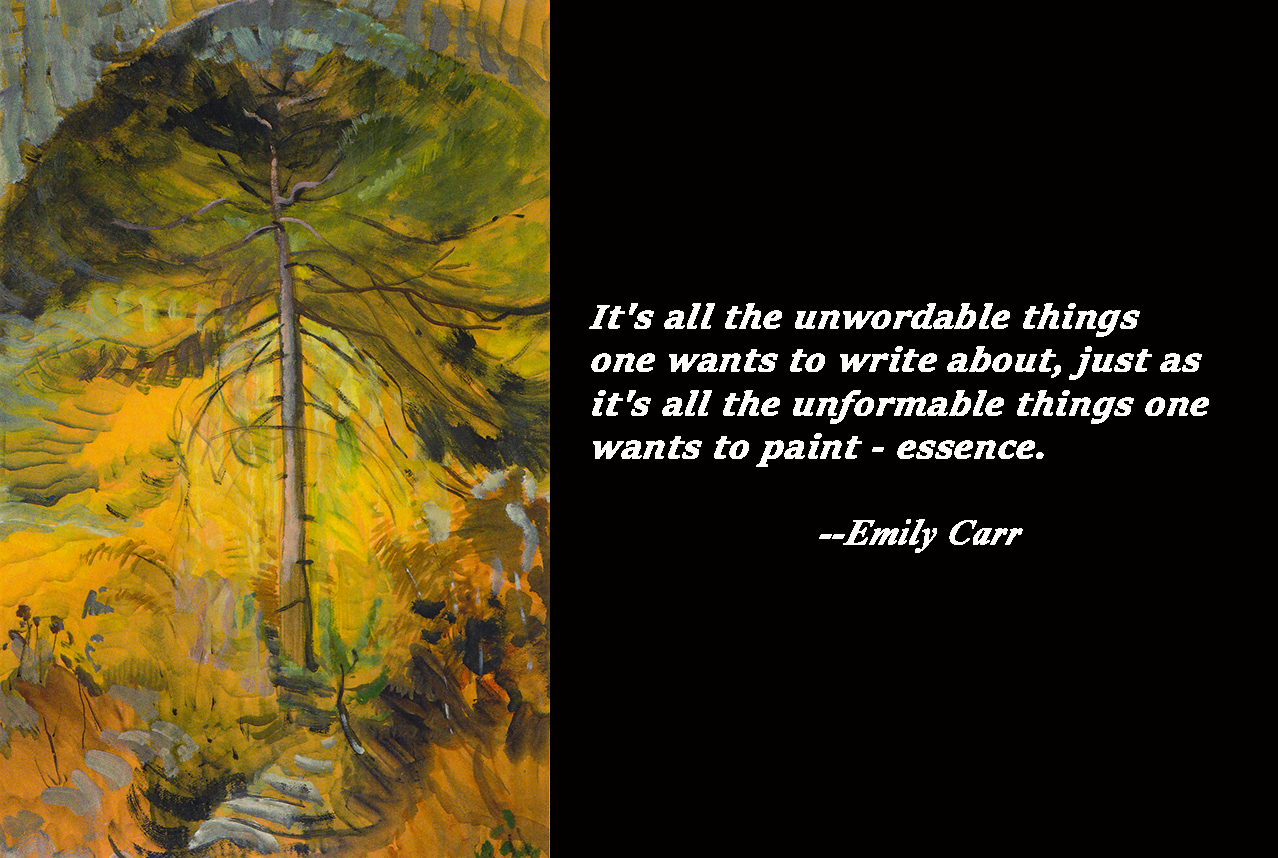
When I read the line above taken from the journal of the great Canadian artist Emily Carr (1871-1945), it really hit close to the bone for me. I thought about my early forays in my youth when I believed I wanted to be a writer.

I loved the words and their power, their ability to create emotion and reaction in the mind of the reader. But I cared little about creating narrative, about the details, the nuts and bolts, involved in storytelling. It was the essence of things that interested me, the atmospheres of silence and distance and empty space.

It was all too heady for an uneducated and inexperienced kid. I didn’t know what to do with writing that evolved into what seemed to be ethereal nothingness. More and more, it became a frustrating exercise.

And I think that is where painting came in for me, at a time when I truly needed it. I found that painting, especially landscape painting, was less about narrative and more about that essence, about capturing moments of atmosphere and perceived emotion and spirit.

The unwordable and the unformable, as Emily Carr put it.

I definitely see this evocation of essence in the work of Emily Carr and can only hope to find the same in my own.


Read Full Post »

My annual show at the Principle Gallery in Alexandria, Virginia, opens on Friday, June 7th. This year is my 20th solo show there, something that seemed out of the realm of possibility when this run began with the first Redtree show back in 2000.

Nothing seemed guaranteed at that time.

I was still a fairly new artist at that point, showing my work publicly for barely five years with the last two years as a full-time artist. Still had that new artist smell. I understood that the Principle Gallery was taking a chance on me and that this show was a great opportunity for me as an artist. Solo shows in great galleries don’t just come to artists on an everyday basis and the success or failure of such a show could dictate how my career moved on from that point. I knew that all too well.

I remember my trepidation in the months before that first show as I prepared for it. I was operating in abject fear of my own failure was having trouble visualizing what success this show would even resemble. My final goal for the show ended up being that I simply hoped to not be embarrassed.

Fortunately, it turned out to be very successful. That led to the next year and the next and so forth. There have been varying degrees of success with the shows along the way but one thing that seldom changes is the absolute fear of failure that comes with each show. So, here I am, twenty years in, and still feeling that same ball of anxiety in my gut. If anything, it might even be worse because I see this as a personal landmark of sorts. I want it to be a show worthy of twenty years invested by the gallery.

I’ve been looking at some of he work from those earliest Principle Gallery shows, trying to see similarities and differences between the work then and now. To see how it has changed, to see what has been gained and lost. One that struck me this morning was the piece above from 2001 called Symphony to Joy. It’s a piece with what I would term great organic appeal. I mean that it in the sense given by the linework within the piece and the way the colors and forms play off one another. It just seems very natural.

Maybe I shouldn’t try to explain such things.

But what I am looking at is how I can regain that natural feel, that organic sense present in the painting. Twenty years of painting have straightened some lines, taken some spontaneity out of some color choices, and softened some rough edges. Experience and knowledge has taken the place of the urgency of the pure emotion found in these early pieces.

I sit here this morning anxiously wondering how to find a way to merge the experience with that emotional urgency. Hope I can figure it out before June 7th.

Read Full Post »

Came across this post from six years back this morning and it made me stop. Reading it again, I realized it was what I was looking for this morning– a reminder of the why, the motivation behind what I am trying to do here in the studio. Thought it was a worth running here again.

*************************

All day I think about it, then at night I say it.
Where did I come from, and what am I supposed to be doing?
I have no idea.
My soul is from elsewhere, I’m sure of that,
And I intend to end up there.

— Rumi, 13th century Persian poet

************************

The other day, while going over some very early posts from this blog, I came across this short poem from Rumi.  It had been passed on to me by my friend Scott Allen from the Cleveland area after my 2008 show at the Kada Gallery. He told me that it was what he himself had felt in my work. The poem had, I’m sorry to confess, slipped my mind over the years and coming across it again immediately rekindled my  original reaction to it. Then and now, I felt as though this little wisp of a poem captured the motivation behind what I was trying to do in my work.

Like Rumi’s voice in this poem, I have spent most of my life in an existential quandary, filled with doubts about who I am and what I should be doing. I often felt like a stranger in a strange land, ill at ease in my surroundings and feeling, like Rumi, that my soul is from elsewhere. Initially, I felt as though my uncertainties and doubts could be allayed externally. I was simply not in the right physical location. But it was apparent after a time that it was not an external problem. Regardless of the location, I would not be at ease on the outside until I sought and found where I needed to be internally.

That’s where the act of painting came in and to fill this void in my life. If life were an ocean, painting gave me a hope, an endpoint for which to navigate. Without it, I would still be rudderless in an ocean of doubt. With it and through it, I feel that my soul is headed in the right direction.

I don’t know exactly why I feel the need to share this intimacy with you this morning. Perhaps that openness is part of the journey or even the destination. But for me, seeing this poem again reconnected me to the journey at a point when it felt as though I was going slightly off course. Sometimes in the process of seeking one forgets why they set out on the journey in the beginning. And that why, that motivation, sometimes needs to be revisited during the journey. It gives the destination definition and immediately puts you back on course.

This morning, I feel like I am sailing on smooth seas again, knowing why I am going forward.

*****************

Read Full Post »

+++++++++++++++++++

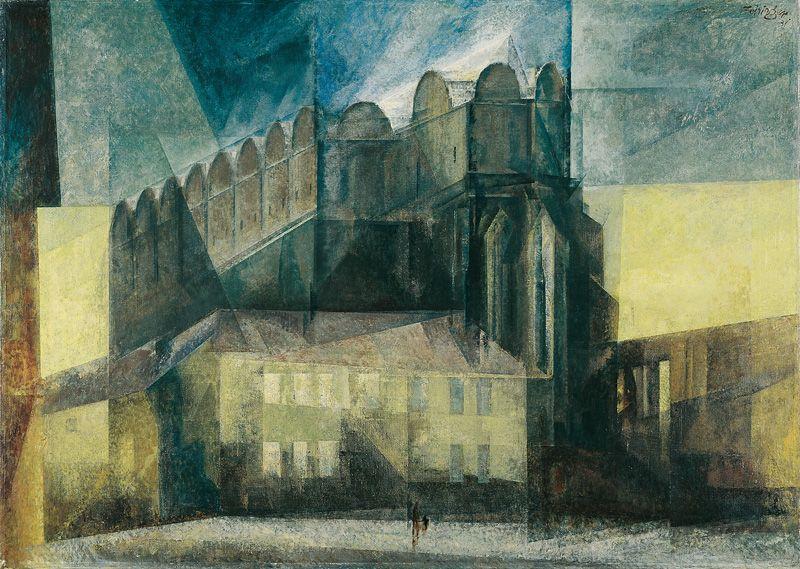
Where I used to strive for movement and restlessness I now attempt to sense and express the complete total calm of objects and the surrounding air.

Lyonel Feininger

+++++++++++++++++++

Earlier this year on this blog, I showed a few paintings from American painter Lyonel Feininger (1871-1956). Every time I come across one of his pieces I am struck by the harmony and calmness they present. That perception– and the seeking of it– of the quietude of object and place is something I understand. Or, at least, aspire to understand.

Read Full Post »

« Newer Posts - Older Posts »