
Whenever I find myself going through images from the past several years, I inevitably find myself stopping when I come to this painting from back in early 2011. It is simply put and spare in nature but it just has a quietly commanding presence that draws me in. It was part of my 2012 show at the Fenimore Art Museum and I received many comments from people about this painting who were also struck by it. I thought I’d rerun the post from back in early 2011 where I wrote about this painting:
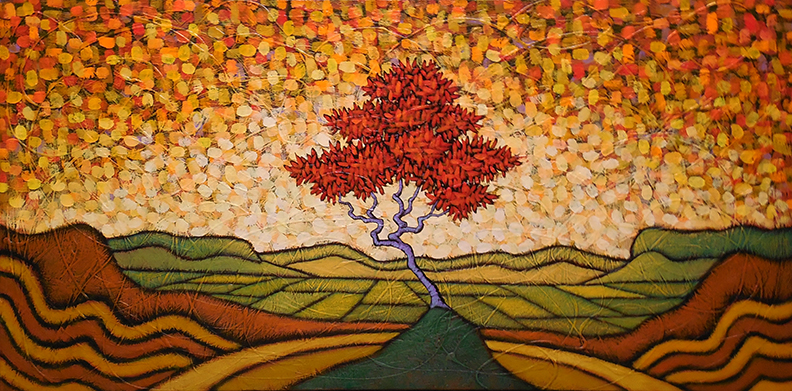
I call this painting Like Sugar In Water. It is a continuation of the group of paintings that I have been working on over the past few months and is by far the largest of the series at 36″ by 60″. The larger scale gives the piece a real sense of space and depth that I think carries the work.
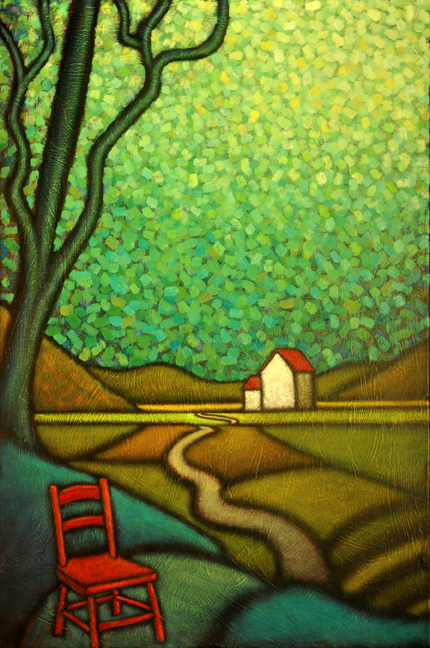
This painting evolved in a much different way than I originally thought it might. As I started, I first saw this as being a piece about movement and saw a large tree bowing in the gusting wind with leaves being released out into the large space created by the sky, which had its own sense of motion in the brushwork. But as the sky came into being it changed and I found myself sensing a much different feel for this piece. It became quieter and the sky didn’t feel frantic but rather had a sense of light breaking into particles and quietly dissolving into a multitude of colors. Because of this change, the central figure in the painting, the tree, changed for me. It had to have a calmness but it had to have a different function than my typical red tree. Here I saw it as a connection between the landscape and the sky, like a conduit of energy from the earth upward. It would have to be less dominate than my typical red tree.
At this point I set this piece aside so that I could fully consider it. I really felt that the landscape and the sky were strong and could stand on their own but I wanted to make sure in my own mind. So I went to work on other work and kept an eye on this piece, continually looking at it and pondering what lay in store for it. Finally, after a couple of weeks, I decided it was time to let this painting complete its metamorphosis. I had come to see the tree as being bare of leaves with the branches stretching up into the sky, almost dissolving into the particles of the sky. This feeling of dissolving is carried through in this piece by the landscape as well. I see it in the road that runs through the structured geometric pattern of the field of the foreground, moving up through the spreading branches of the tree and into the breaking sky.
I see the red chair here, not as I often do as a symbol of memory or of the dead, but as a symbol of the temporary nature of our existence here, living as we do between the solidness of the earth beneath our feet and the particulate nature of the heavens above our heads. This is reflected in the title as well. Perhaps the universe is like a large body of water and we are but a bit of sugar.
I don’t know about that. But I do that I think that there is a lot to be found in this piece and I find myself pondering over it quite often, taking in whatever message there is in it.
 This new painting, a commissioned 36″ by 24″ piece that is on its way to California, is called Between the Sea and the Sun. It’s a piece that I very much enjoyed painting , allowing the composition to grow in its own manner. It helped clear my mind and drew me back into my former self, at least in terms of confidence. I am thankful for that and eager to move on to other new work that has been forming in my mind.
 I’ve been a fan of the work of Chuck Close for some time, admiring the grand scale that much of his work assumes as well as his evolution as an artist, especially given his challenges after a spinal artery collapse left him paralyzed from the neck down in 1988. He regained slight use of his arms and continued to paint, creating work through this time that rates among his best. He also suffers from prosopagnosia which is face blindness, meaning that he cannot recognize faces. He has stated that this is perhaps the main reason he has continued his explorations in portraiture for his entire career. The piece shown here is a portrait of composer Phillip Glass that was made using only Close’s fingerprints, a technique which presaged his incorporation of his own unique form of pixelation into his painting process.
 I’ve been in a pretty deep funk lately. I wasn’t going to write about this at all though I am sure it seeps into the writing that I do post. But in the name of transparency I thought I would share a few words on the subject.





 Redtree Times