 You have most likely seen the work of Piet Mondrian, the Dutch painter who lived from 1872 until 1944.
Like the painting shown here. Seems so simple. Mainly black lines creating squares and rectangles that are mainly white but periodically filled with bright primary colors. Critics claim it is too simple, that it is something a grade-schooler with a ruler and some paints could replicate easily.
Maybe. Maybe not. Who cares?
But putting that side aside, his work has always remained refresh and modern through most of the last century up to this very minute. Outside of time, like it represents a future moment that exists just beyond this very moment at all times. And that factor in itself makes his work appealing to me.
I will never list Mondrian as a true influence or even a real favorite of mine, there is much to be gained as an artist from studying his work. The elegance of his structures and the space created within, for example. Or how he transformed his work through the years from a style of impressionistic realism into cubism and then into the style of his that we know so well, stripping away all detail and content down to the bare essence of being.
The video below shows that evolution beautifully, with musical accompaniment from Phillip Glass. I hope you’ll find it interesting to see how the work makes that transformation. Take a look below.
Let us note that art – even on an abstract level – has never been confined to ‘idea’; art has always been the ‘realized’ expression of equilibrium.
-Piet Mondrian
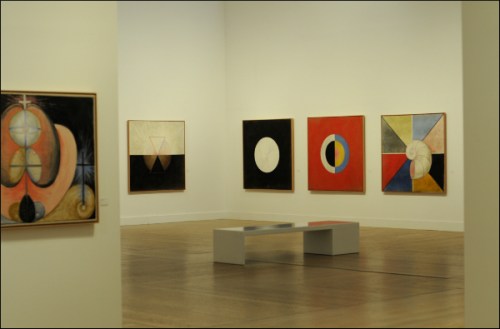
 Just a few days ago, a new exhibit opened at the Serpentine Galleries in London. It features a group of abstract and symbolic paintings from a Swedish painter by the name of Hilma af Klint who lived from 1862 until 1944. The images of her work on display are quite captivating and intrigued me enough to look further into her work. It’s an interesting case.
 Interested in spirituality and theosophy, Hilma formed a group of women who met on a regular basis to hold seances to attempt to contact and channel the spirits from other dimensions. She claimed to have been “commissioned” by one of these spirits to create a series of large paintings which occupied her for a number of years. These paintings consisted of geometric and organic forms and a distinct visual vocabulary expressing a deeply spiritual element.


 Redtree Times