Feeds:
Posts
Comments

Posts Tagged ‘Quote’

***********************
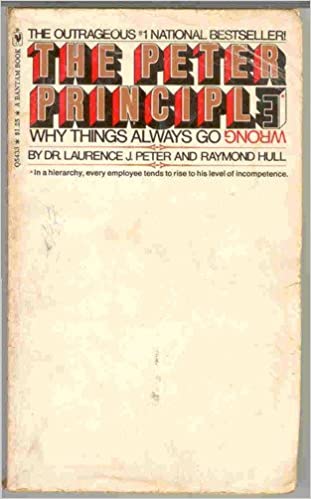
“In a hierarchy every employee tends to rise to his level of incompetence… In time, every post tends to be occupied by an employee who is incompetent to carry out its duties.”

Laurence J. Peter, The Peter Principle: Why Things Always Go Wrong

***********************

For those of you too young to have been around back then, The Peter Principle: Why Things Always Go Wrong was a book from Dr. Laurence J. Peter that came out in 1969 and was a huge bestseller. It was one of those books and ideas that became ubiquitous in their time. It seemed like everywhere I looked back then, that book cover was staring out at me from book racks in every grocery store, card shop and bus station.

Maybe the universe was trying to tell me something, even then.

In the book, a blend of practical business management principle and mild satire, Peter described every organization as a pyramidal hierarchy in which each member was eventually promoted up the pyramid to a position where they would be proven to be incompetent. The real work of the organization was always done by those within the pyramid who had not yet risen to their own personal level of incompetence.

Those not yet proven to be incompetent were like the mortar that strengthened and bonded the blocks of the pyramid.

It was one of those ideas that seemed so simple that it was hard to believe that nobody had voiced it in that way before. And just looking around at almost any organization, private or public, seemed to offer ample proof of its validity.

Why am I talking about this? I think anybody who has been closely following the US government’s response to the Covid-19 crisis could easily see it as the principle in action.

It is one of the first things that jumps to mind when watching the daily press briefings lately. They are maddeningly difficult to watch with their evasions, lack of information, blame placement, contradictions, empty promises and self-congratulatory puffery often along a raft of outright lies.

Not a shred of reassurance anywhere to be found. For me, it almost always brings on an unpleasant mix of disgust and rage combined with dread.

The dread can be explained by another line from Peter’s book: “Any government, whether it is a democracy, a dictatorship, a communistic or free enterprise bureaucracy, will fall when its hierarchy reaches an intolerable state of maturity.” 

That maturity is the point when most of the level of the hierarchy have been filled with incompetents and this administration has spent much of the last three-plus years removing apolitical professionals who had been competently handling many important positions within the pyramid. These are the people who had yet to reach their own level of incompetence, people were doing the real work that kept the governmental pyramid standing. In their place, they inserted political lackeys, people ill-equipped to handle even the most mundane requirements of their posts let alone a global crisis that requires the ultimate in competence from every level of the pyramid.

Watching closely as I have, it sure feels to me like every position in that pyramid is so packed with incompetence that there is little, if any, room left for the still competent to do the dirty, real work required to keep the pyramid standing.

Thus, the dread.

Here are a couple of other little snips from The Peter Principle that one might think were written solely for the here and now:

“Sometimes I wonder whether the world is being run by smart people who are putting us on or by imbeciles who really mean it.”

“Incompetence plus incompetence equals incompetence.”

“If two wrongs don’t make a right, try three.”

I know that writing this doesn’t accomplish anything. But it’s something I have to do once in awhile if only to try to organize what I am seeing in a way that I can comprehend so I can figure out how to look to the future.

And I do still look to the future, even with a little hope. But that hope is my own and owes nothing to the efforts of these incompetents who sit atop the crumbling pyramid.

Hey, have a great day! And be careful out there.

Read Full Post »

Social Distancing

******************

Through vigilance, restraint and control the wise will construct an island that no flood will overcome.

Gautama Buddha

******************

Being stranded on this island is looking pretty damn good right now.

Be careful out there, folks.

Read Full Post »

**************************

“For the first time in years, he felt the deep sadness of exile, knowing that he was alone here, an outsider, and too alert to the ironies, the niceties, the manners, and indeed, the morals to be able to participate.”

― Colm Tóibín, The Master

**************************

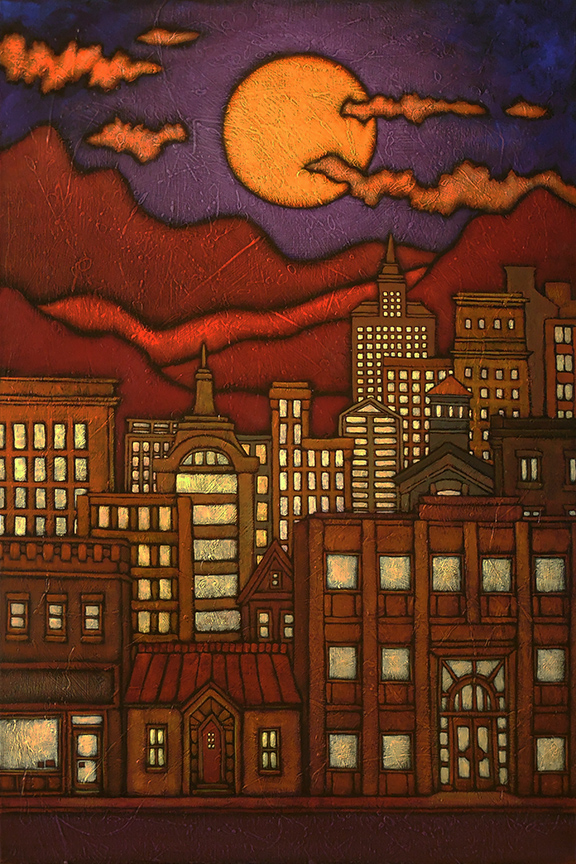
Another new cityscape, this one a 36″ high by 24″ wide canvas that I am calling The Exile’s Wilderness.

I’ve written a couple of times here about these new pieces and the anonymity provided by the looming buildings, shadowy streets and empty windows. It’s the perfect environment for the Exile, one that allows a person to slip by unheeded, almost as if invisible.

Like a ghost.

There but not really there. Constantly observing but never engaging or participating. Just as the words above from Colm Tóibín point out– the outsider who is so aware of the manners and niceties of this place that they are never comfortable enough to participate.

The odd thing about this form of exile is that the exile becomes comfortable in their isolation, their separateness. It becomes their comfort. And I think that level of comfort is what I see in this piece. It represents a feeling of estrangement yet it also feels warm and familiar with little menace. The mountains looming in the background represent the Exile’s desire for solitude and distance. They are hope.

The moon looking down on it all, for me, represents a spirit companion of some sort for the Exile, a distant presence that observes and enlightens without passing judgement. It, too, is a comfort for the Exile.

It’s a striking piece here in the studio, with the dark warmth of its colors and the Morse code-like feel, dots and dashes, of the windows’ lights. I have it in a central spot where I can see it most of the time I am at work at the easel or at my computer.

I find it comforting.

But, then again, maybe I am the Exile here.

Read Full Post »

Jean Arp- Torso of a Giant 1964

Jean Arp- Torso of a Giant 1964


*****************

Soon silence will have passed into legend. Man has turned his back on silence. Day after day he invents machines and devices that increase noise and distract humanity from the essence of life, contemplation, meditation… tooting, howling, screeching, booming, crashing, whistling, grinding, and trilling bolster his ego. His anxiety subsides. His inhuman void spreads monstrously like a gray vegetation.

–Jean Arp

**************

GC Myers- Quiescence

****************

I had a quote on the last post with a quote from artist Jean Arp about man turning his back on silence. Rather than savoring the quiet, he runs from it, instead distracting himself with all manner of noise. Anything to keep him from facing the fears that the quiet represents to him.

It’s a theme that has been large in the background of my work. Early on, when I felt that I wanted to be a writer, I would find myself writing about large open spaces and the caverns of silence that rested in these places. I called it the Big Quiet. Of course, it’s a pretty limited subject and there is a certain redundancy in writing about silence and stillness. I mean, how can you use the noise of words to aptly describe the absence of noise?

So I gave up writing about it and went on with my life, always with an eye out for this Big Quiet. I don’t know that I was craving it or fearing it at most points. My life was pretty much filled with the noise of the world, all the snaps and pops of sound and distraction that creep into every living space. I was like so many others who needed the security blanket of sound to protect them from what they might discover if they were forced to face the silence.

But the sounds that I hoped would lessen my anxiety only seemed to feed it.

However, painting gave me a path to finding this Big Quiet. It was wordless and calm, creating an inner space absent of the sounds of the world that I was and am still occupying. It became a destination, an oasis to turn to when the din of world became too loud, too overbearing. It eased my fears of looking inward and allowed me to savor the quiescence of the brief moments I actually myself there in those scenes of stillness and calm. It became real and necessary to me.

I don’t know where this going, this wordy noise I’m creating about the stillness I find now. I just felt that I should add a bit of context to my work, to give a an understanding of what I hope to take from it for myself. This moment came about from running across the image above, a piece from several years ago that is called, fittingly, Quiescence. It’s a piece that brings me quiet immediately and seeing it at any time makes me again think of the main reason that I paint.

So, I am going to be quiet now…

********************

The post above is comprised of two posts that ran here on consecutive days back in 2013. They served a great purpose for me this morning when I read them again for the first time in many years which made me think they were worth sharing.

Read Full Post »

This quote came from Hermann Hesse‘s most famous book, Steppenwolf. A great book but my favorite Hesse book is Demian, which I have referenced here a couple of times in the past. It was a book that I read at a time when I was at a crossroads in my life and it was very influential in my heading in the direction which led to this point. I think this quote very much jibes with my perception of the world portrayed in my work, that being that it is a real entity, a real place.

It has as much substance as the outer world to me. It has depth and layers. It has breath and light. It has emotion and its truth comes the fact that it is a precise portrayal of itself– not a replication of the outer world.

It just is.

That may sound nutty or perhaps egotistical to some. I get that. But without this belief in the reality of this inner world, the validity of the work to myself comes undone. It fades to nothingness and certainly doesn’t move across the void to the viewer. It loses all meaning for everyone, myself included, without this certainty in its being real.

I’m going to stop at this point. I may have said too much already, maybe too much for the outer world. In here, in my little inner world of colors and shapes, it sounds right…

*************

This post was from about five years back. I reread it for the first time again this morning and thought it deserved another run.

Read Full Post »

*********************

“And I can’t be running back and fourth forever between grief and high delight.”

J.D. SalingerFranny and Zooey

**********************

When I send a painting to a gallery it is with the expectation that it might very well sell.  As a result, I don’t usually announce or comment when a piece does actually go to a new home. I am usually very pleased when a sale of my work takes place. I mean, it’s my job and my livelihood plus the sale is a validation, in a way, that the work reached out beyond my own imagination and struck a chord with someone to the point that they chose to spend their hard earned money to obtain it.

What’s not to be happy about that?

But hearing that some paintings have been sold raises conflicting emotions. On one hand, I am thrilled to see the painting find a new home and to know that I can pay my bills for another month. That is a always a good thing.

But on the other hand, there are paintings that I see as being special, as being more significant to myself. Selling one of these paintings means that it is forever out of my hands, that it is no longer mine alone. Like a part of myself has been sheared off and sent away.

As a result, much like Salinger wrote above, I find myself running back and fourth between grief and high delight.

Such is the case with the painting at the top, Saints and Sinners. It’s a piece that I felt was personally among my best, one that was well beyond myself. I learned yesterday that it had sold and was very happy at first. Someone had seen that same special quality in it and was making it part of their life.

But after only a few moments, I had a sinking feeling in my stomach and a sense of loss came over me.

Even this morning, I am a little sad about it being gone forever.

Almost grief.

I say almost because, as grief goes, this is way down on the list of things that might cause one to grieve. For most people, especially non-artists, this sound ridiculous, I know.

So, let’s just call this artistic grief.

Don’t worry. I’m okay. I am not wearing black or tearing up this morning. I sold a painting, for chrissakes.

I am very happy about that but will still miss it, that’s all.

Okay, back to work. Maybe this next piece will be a worthy replacement.

Or better…


Read Full Post »

*************************

For this day’s work, lords, you have encouraged treason and opened the prison doors to free the traitors. A nation can survive its fools, and even the ambitious. But it cannot survive treason from within. An enemy at the gates is less formidable, for he is known and he carries his banners openly against the city. But the traitor moves among those within the gates freely, his sly whispers rustling through all the alleys, heard in the very halls of government itself. For the traitor appears no traitor; he speaks in the accents familiar to his victims, and he wears their face and their garments, and he appeals to the baseness that lies deep in the hearts of all men. He rots the soul of a nation; he works secretly and unknown in the night to undermine the pillars of a city; he infects the body politic so that it can no longer resist. A murderer is less to be feared. The traitor is the carrier of the plague. You have unbarred the gates of Rome to him.

************************

I have seen the words above online used as a meme, attributed to the orator Marcus Tullius Cicero from the year 42 BCE. I immediately thought they described to a tee the current situation at hand here in this country, especially with the revelations of continued Russian meddling for and collusion with our president*** from the last couple of days.

These words  certainly could be applied to this president*** and his enablers and to think they came from over two thousand years ago was enlightening. The ways of treason and the traitor have not changed much over the ages.

Taylor Caldwell

Taylor Caldwell

Unfortunately, though I feel resonance between those words and these times, those are not the actual words of Cicero. They are from a 1965 novel, A Pillar of Iron, from bestselling author Taylor Caldwell. The book is a fictionalized account of the life of Cicero and his fight to save the Republic from approaching tyranny. He was assassinated for his efforts at the urging of Marc Anthony in 43 BCE.

While the words as we see them are not the actual words of Cicero at the time, much of their intent is derived from his orations of that time. Caldwell did her research and scoured the words of Cicero to create her own fictional interpretation of what Cicero may have said when he addressed the Senate then.

So, while the traitorous treachery Caldwell’s version of Cicero called out in the words at the top of the page may have come from 1965, their meaning most likely was born in some part in the words of Cicero from over 2000 years back. And whether they are from 2000 years ago or just 55 years, fact or fiction, they are words to which we should pay attention.

Read Full Post »

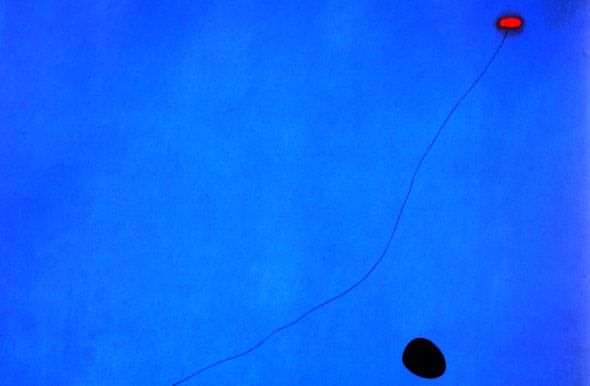
Blue II- Joan Miro

*****************

The picture should be fecund. It must bring a world to birth.

-Joan Miro

****************

This is a thought that I often keep in mind. Art succeeds when it creates its own reality, when it brings a world to birth in the mind of those who behold it. The artist’s own belief in the reality of that new world is a large determinant in whether this birth takes place.

For myself, I almost always feel like I am taken to a different world, one as real as the world I inhabit in my human skin, by whatever is on the surface before me.

That is, when it works. Sometimes it is difficult to climb into that new world and that new reality that wants to be born on the surface is nothing more than a lifeless mishmash of paint blotches and lines. That is frustrating, to say the least.

But when it works, it is an easy glide into that new world with its own atmosphere and landscape, so familiar yet new and fresh in the nose and to the eye. It’s a thrill just to be in there for that time when taking on its lifeform.

Joan Miro (1893-1983) did such a thing with such ease. I am showing his Blue triptych today. I find it interesting how intimate and alive they feel as single images on a screen where their scale fades away. These could easily be small paintings. But when you see them as they are in the two photos below, you can see their size and how it magnifies their lifeforce.

They are a world unto themselves.

Take a look for yourself. I have also included a video of Dave Brubeck’s Bluette below that is played over a slideshow of Miro’s work.

Just good stuff.


Joan Miro Blue I

Joan Miro Blue III


Read Full Post »

*********************

The writer operates at a peculiar crossroads where time and place and eternity somehow meet. His problem is to find that location.

–Flannery O’Connor

**********************

I think you could probably substitute artist in for writer in the words above from author Flannery O’Connor (1925-1964) without changing the gist of the thought too much. All art, and literature certainly falls into that category, is about transforming the now of the creation– the time and place— into something beyond that moment, into something timeless–the eternity to which O’Connor refers.

Finding that intersection where those two things come together is, as she points out, not such as easy thing to accomplish. And almost every instance the artist will never know if they have come to those crossroads that moves their work into the realm of the eternal.

I guess the finding is immaterial without the seeking. And seeking without any assurance of finding something that will ever reveal itself to you is an act of faith, a belief that there something eternal worth seeking.

I don’t know what else to call it. You keep trying. You think it is near sometimes but when you finally come to it, you’re not sure enough of what you’re experiencing to stop seeking.

Does one ever know when they have come to that crossroads?

That being said, here’s this week’s Sunday morning music from a longtime favorite of mine, Tracy Chapman. I think her body of work sometimes get overlooked in the deluge of the new but every time I come back to her, I wonder how I have let her slip out of mind. Here’s a song that fits the subject here, Crossroads, to accompany the painting at the top, Beyond the Crossroads, from back in 2004.

Have a good Sunday, okay?


Read Full Post »

************************

When men sow the wind

it is rational to expect

that they will reap the whirlwind.

–Frederick Douglass

************************

Amplified consequence.

In his 1892 essay, Lynch Law in the South, Frederick Douglass used the proverb from biblical book Hosea, to illustrate how man often sets things in motion that have results that extend far beyond– and often in stark opposition to– their intended goals. Douglass wrote that the deadly violence being shown against the black citizens of the south at that time would eventually come back to haunt those that perpetrated the deed or stood idly by, complicit in their silence.

The biblical proverb in Hosea was about how the the citizens of Israel of that time ( ca 725 BC, I believe) took to idolatry, the worship of false idols, and how their actions brought down upon them the wrath of God. In that book the author uses the concept of farming to make his point, that a  a single seed of grain sowed by a farmer returns to him many times over.

An amplified consequence.

Of course, the farmer can usually tell what the result of his sowing will be. X amount of seed will allow him to reap Y amount of grain at harvest under normal circumstances. Predictable.

But that same degree of predictability doesn’t apply to all other actions man sometimes sets in motion. While we might initially think we control the outcome, we sometimes put actions into motion — sow our seed– that we cannot control, that return to us with such amplification and intensity that we are overcome and sometimes decimated by the result.

One small, seemingly insignificant action, such as not paying attention to a rising dangerous wind, can sometimes turn into a maelstrom of destruction that we never saw coming.

Take that for what it’s worth, given the events in recent days in this country.

The painting at the top is called Into the Winds of Change and is part of the West End Gallery‘s annual Little Gems show that opens tonight with an opening reception from 5-7:30 PM. Hopefully, like the Red Tree here, we can stand against and overcome the whirlwind that may soon be upon us.

Read Full Post »

« Newer Posts - Older Posts »