Feeds:
Posts
Comments

Posts Tagged ‘Quote’

***************

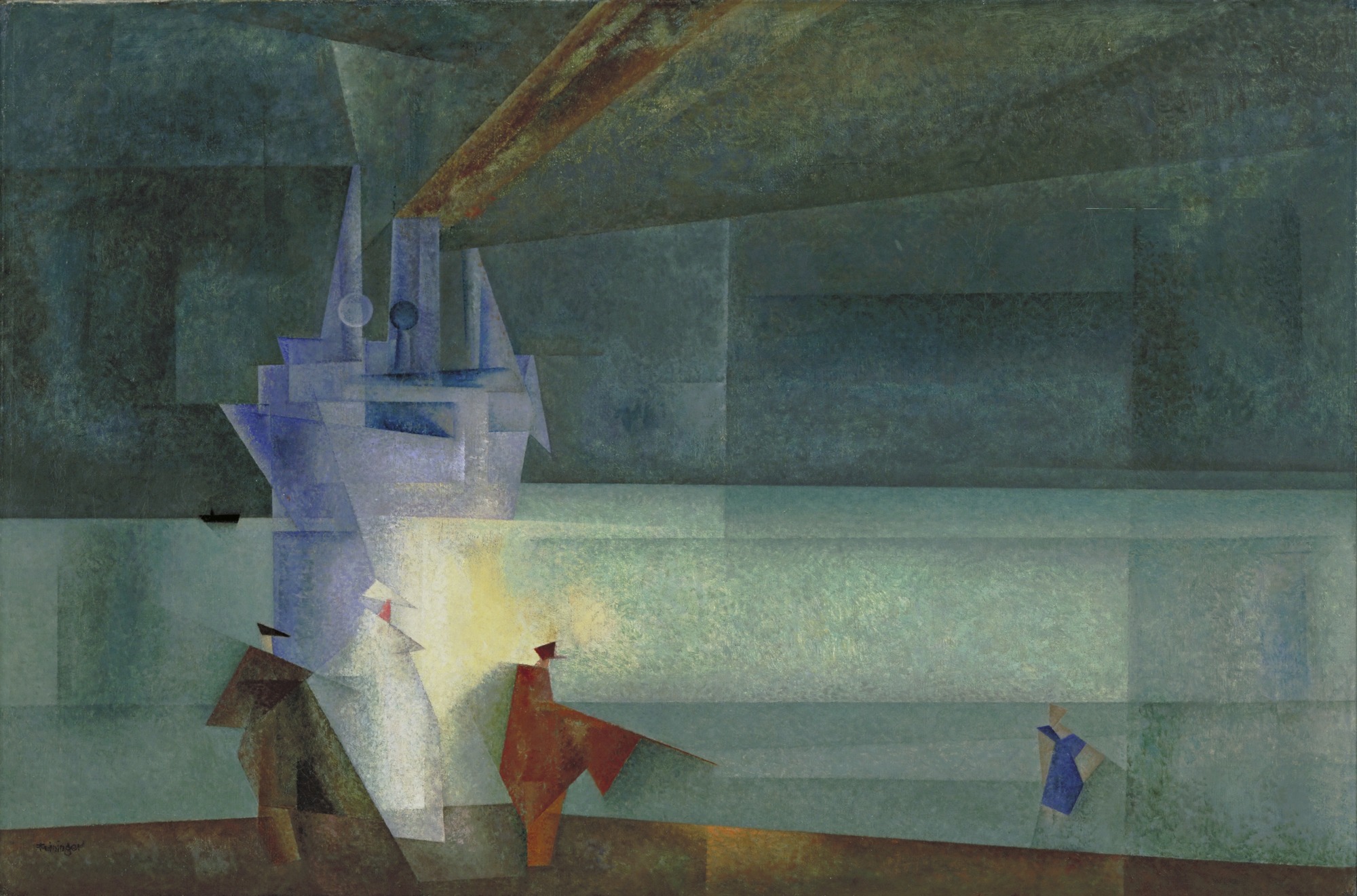
Each individual work serves as an expression of our most personal state of mind at that particular moment and of the inescapable, imperative need for release by means of an appropriate act of creation: in the rhythm, form, colour and mood of a picture.

Lyonel Feininger
***************
Busy today but wanted to share some work and a video from a painter, Lyonel Feininger (1871-1956),  whose work I believe has not received the attention I believe it deserves. For an artist who had a painting sell for $23 million at auction, it seems kind of absurd that his name is not more well known. I like his works for the very things he speaks of in the quote above– their rhythm, form, color and mood. Take a look.

Read Full Post »

*******************

“Fairy tales do not tell children the dragons exist. Children already know that dragons exist. Fairy tales tell children the dragons can be killed.” 

 G.K. Chesterton

********************

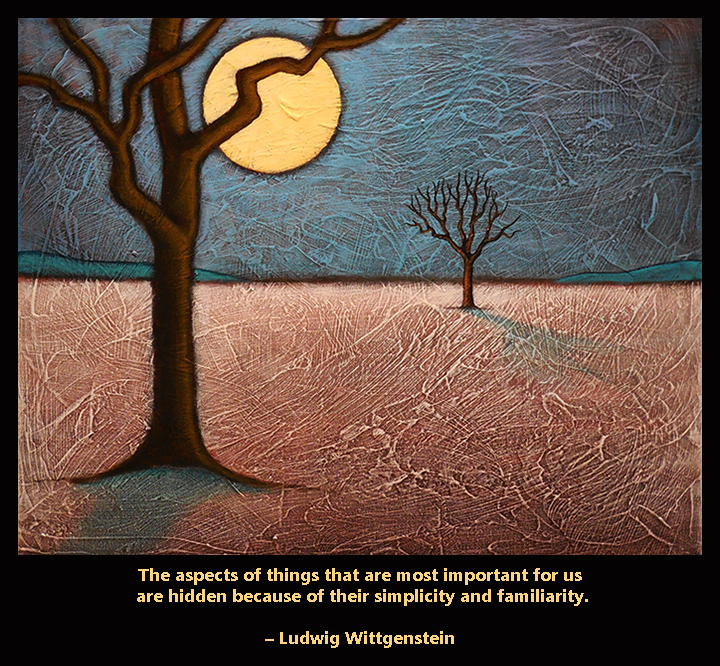
This is a new painting from my upcoming solo show, Haven, at the Principle Gallery. It’s 12″ by 24″ on canvas and is titled Hope Rising.

There are a number of pieces from this show that lean towards darker and deeper hues than much of my other work.  Generally, when these colors have appeared in the past it was the result of being in what I perceived to be perilous times.

Such is the case with this work for it feels as though we live in a time of dragons.

But as Chesterton points out, the lesson to be gleaned from the fairy tales is that while we may live among dragons, they are not invincible. They are always defeated by forces of goodness and righteousness.

I get that feeling of hopefulness from this painting. It feels like a quiet moment when the fear brought on my the dark of night is alleviated by the reflected light of the moon that announces that there is a new day soon arriving.

The dragons can be held at bay and the darkness will only be a temporary condition if we hold tight to what is true and right.

The light of truth ultimately overcomes the false light offered by the dragon’s fire.

And that is not only in fairy tales.

Read Full Post »

++++++++++++

I felt deep within me that the highest point a man can attain is not Knowledge or Virtue or Goodness or Victory but something even greater, more heroic and more despairing: Sacred Awe!

Nikos Kazantzakis

++++++++++++

I was all set to write something this morning about stupidity. I noticed that a post I wrote a year ago, On Stupidity, has been getting a large number of views lately. It is about the danger of stupidity, about how even the very highly educated can be stupid, especially in highly charged times when they can fall prey to social and political movements. This coincided with recent thoughts I have been having about how we have devalued intelligence and reason in this nation in recent times, to a point of vilifying the cerebral and elevating moronic behavior.

I was deflated by the whole thing and decided I needed to focus on something other than that, something that dealt with something far more uplifting. I came across the words above from author Nikos Kazantzakis from his book Zorba the Greek. It’s part of a scene where the narrator, a young, bookish Greek man is asked by Zorba, a raw and raucous peasant, to explain the meaning of the stars and the universe that they are sitting beneath. The narrator tries unsuccessfully to put this idea of  Sacred Awe into a form that Zorba will understand. While he doesn’t understand the given explanation, Zorba does recognize the depth of the mystery that he senses in that night sky.

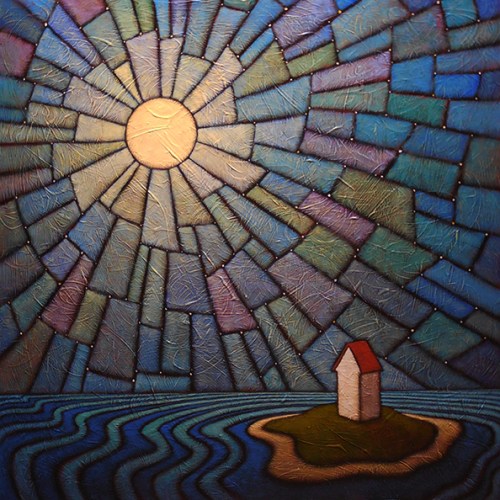
That brings me to this painting, a 36″ by 36″ canvas that I am calling Sacred Awe. It is part of my solo show, Haven, at the Principle Gallery in Alexandria, opening June 1.

This piece has been hanging in the studio for several months now and I have spent a fair amount of time in the space of this painting. Like Zorba, it is a painting that begs for an answer to the mystery of the stars and the constellations that swirl above. Yet all that is given in response is a sense of awe and nothing more.

And nothing more is needed.

Sacred Awe elevates the mind, stimulates the senses and is the beginning of all art and poetry. In it we connect to a mystic continuum that sees us as small as particles of dust and as large as the great waves of light that pass through the vastness of space.

It is all and it is nothing.

There’s a great meditative  and mysterious quality in this painting, at least for me. It both pleases and puzzles me.

A fitting response to sacred awe.

Read Full Post »

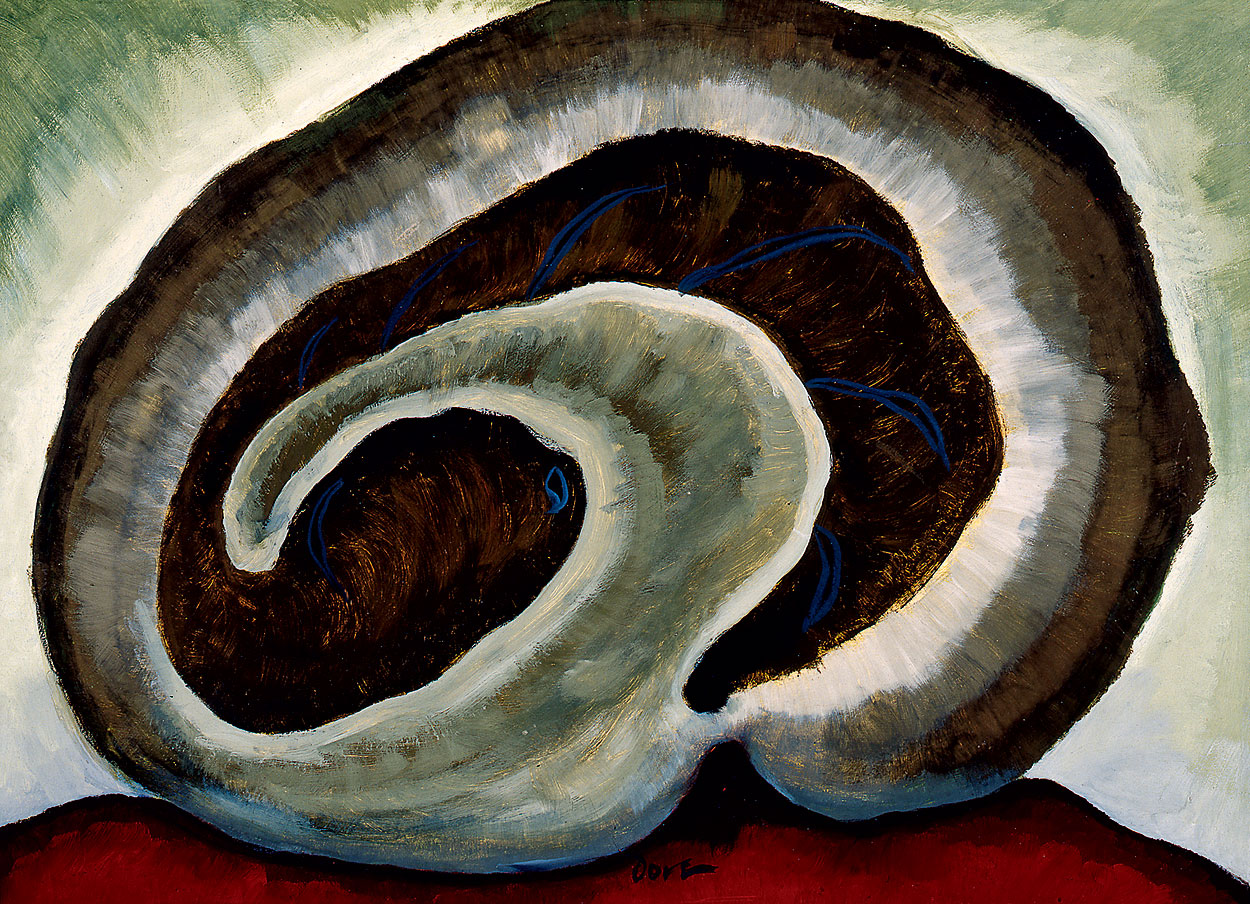
Arthur Dove- Me and the Moon 1937

******************
We cannot express the light in nature because we have not the sun. We can only express the light we have in ourselves.

–Arthur Dove

*******************

Really busy morning getting my upcoming Principle Gallery show ready. It seems there is just not enough time in the day and when there is, I don’t have the stamina to take advantage of it. Thought I’d share a few words from the Modernist painter Arthur Dove (1880-1846) who was someone I looked to when I was first beginning to paint. I liked the way he merged abstraction and representation in his work and how he used recurring elements in his work. The ball/circle shape that I use so often as my sun/moon always makes me think of Dove.

He was also from the Finger Lakes region of New York, born and raised in Canandaigua and educated up the road at Cornell. While that may hold no importance in his work, it interested me because it made me wonder how he saw the same things I have often seen in this area. How did this environment shape the way he saw and expressed the world?

Anyway, here are a few of my favorites along with a video of his work set to a nice Schubert piece.

Arthur Dove -River Bottom – 1923

Arthur Dove- Sunrise– 1924

Arthur Dove- Willow Tree — 1934


Read Full Post »

I have about two more weeks to get ready for my solo show, Haven, that opens on June 1 at the Principle Gallery so I have little time to spare at the moment. So excuse me for doing a little shorthand here by using an older painting (No Way Home from 2009) and a thought-provoking quote from the late historian Lewis Mumford.

This idea of endless becoming transforming into being intrigues me, making me wonder if the work I am doing has made that jump.

And how does one know?

That might be both my breakfast and lunch because I’ll be chewing on it for quite some time today.

Time to get to work.

Read Full Post »

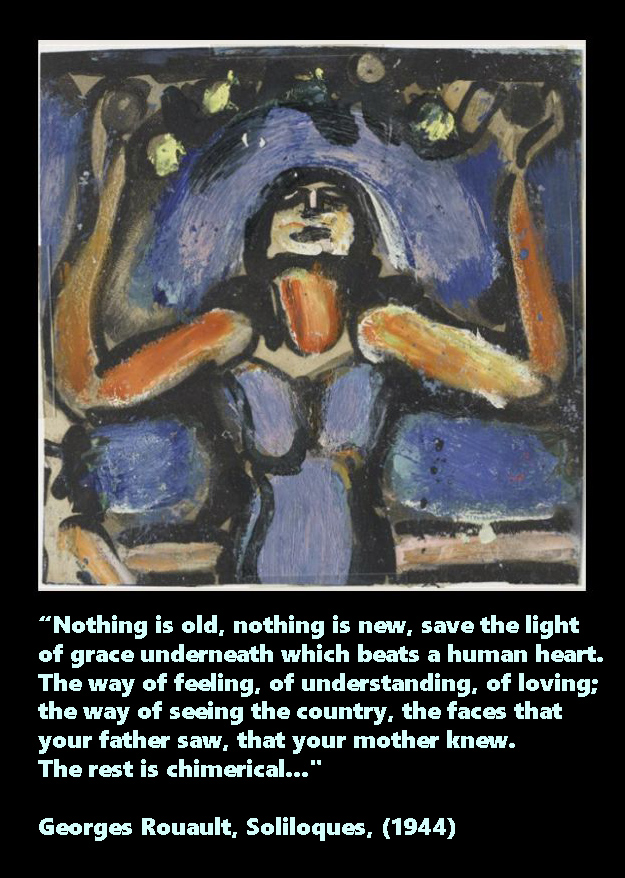
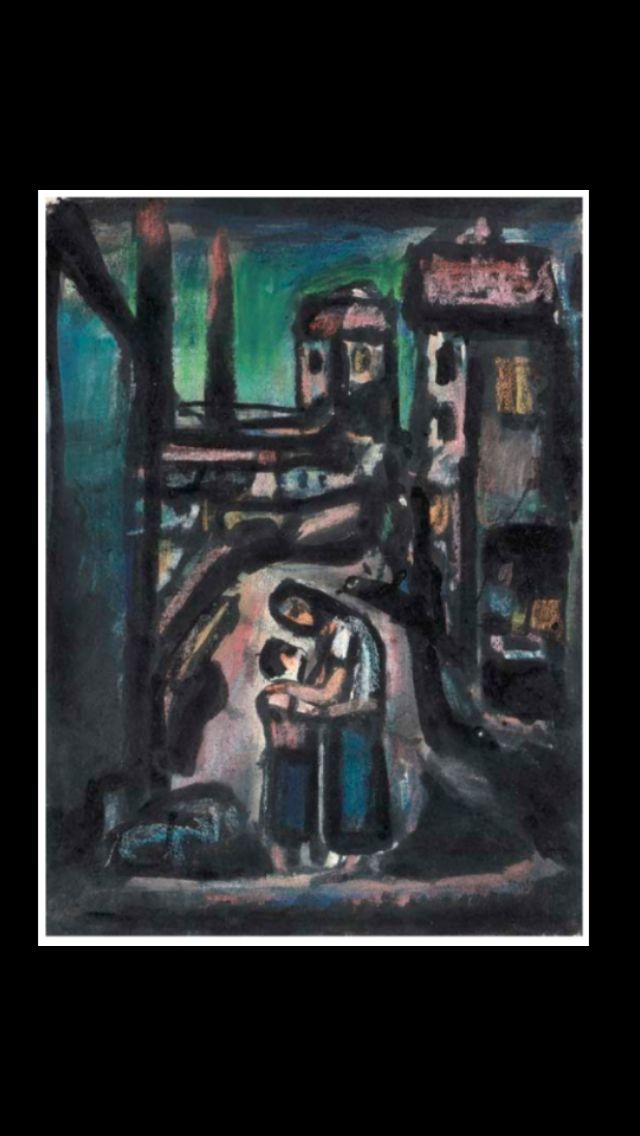
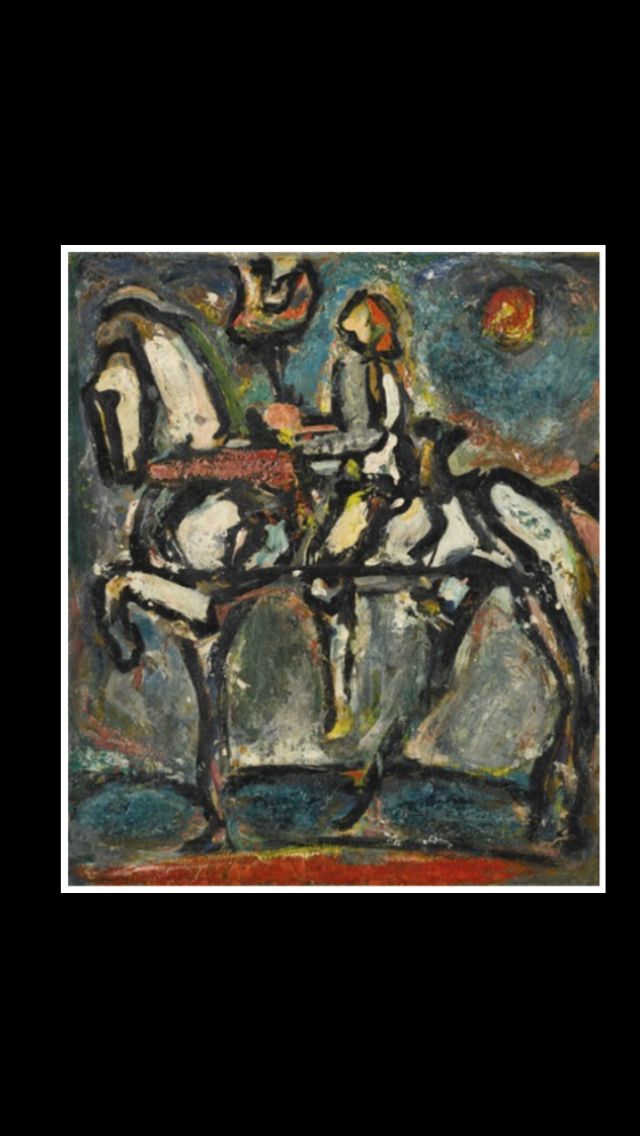
Too busy this morning but I can always find a few minutes to take in some work from Georges Rouault (1871-1958). His work has for me a real sense of rightness, a certitude that makes even his roughest brushstrokes seem both perfectly placed and necessary.

Read Full Post »


++++++++++++++++

How well do we know our own shadows?

Read Full Post »

Knowing Klimt

+++++++++++++

Whoever wants to know something about me – as an artist which alone is significant – they should look attentively at my pictures and there seek to recognise what I am and what I want.

Gustav Klimt

+++++++++++++

Read Full Post »


Whether this matters in the long term, I do  not know. But for the time being, it gives me the feeling that I am somewhat in control of my narrative. Here’s a post from a few years back that speaks a bit more about artists speaking about their work and the difference between doing so with words that actually say something substantive and those that are mere fluffy word clouds.

.

David Hockney- Mulholland Drive 1980

It is very good advice to believe only what an artist does, rather than what he says about his work.

 –David Hockney

*************************
.
When I first read this quote from the great British artist David Hockney, a painter whose work I admire and always find very interesting, I wanted to be offended. After all, I am an artist who has said plenty about his work through the years– this blog and gallery talks being evidence of that– and have tried to be always transparent and forthcoming when talking about my work. But even so, I nodded in agreement when I read his words.
.
Part of my own desire to be honest and open about my work came from the frustration I felt in reading other artist’s writings that were filled with ArtSpeak, that way of seeming to say something important and meaningful without really saying anything at all. The words danced around all form of meaning and never fully jibed with the images that accompanied the words, leaving me with a single word resonating in my mind.
.
Bullshit.
.
And I know bullshit. I was a longtime bullshit artist. I sold swimming pools and automobiles– yes, I was even a used car salesman!– to the public for quite some time. I knew that you could sell by focusing on the strengths of the product and by dancing around questions about its drawbacks. Fill any voids with words that sounded like they were filled with meaning but really made no commitment to anything.
.
For me, there came a time when I was determined to not deal anymore in that manner of speaking and when I finally came to painting, I knew I didn’t want my work to fall into that pool of bullshit.  I wanted to tightly control how I represented my work and to be completely open about it.  It’s whole purpose for me was my own honest expression and I want

David Hockney- Arranged Felled Trees

ed people to be able to witness that without a crap filter between them and the work.

.
For the most part, I feel that I have been able to maintain that through these last several years.  Oh, occasionally I feel myself straying off the path but I simply remind myself that the product I am representing is the core of my self and once I cross that line I would be betraying everything art has provided for me.
.
But these are just words and maybe you should take them with Hockney’s advice in mind.

Read Full Post »

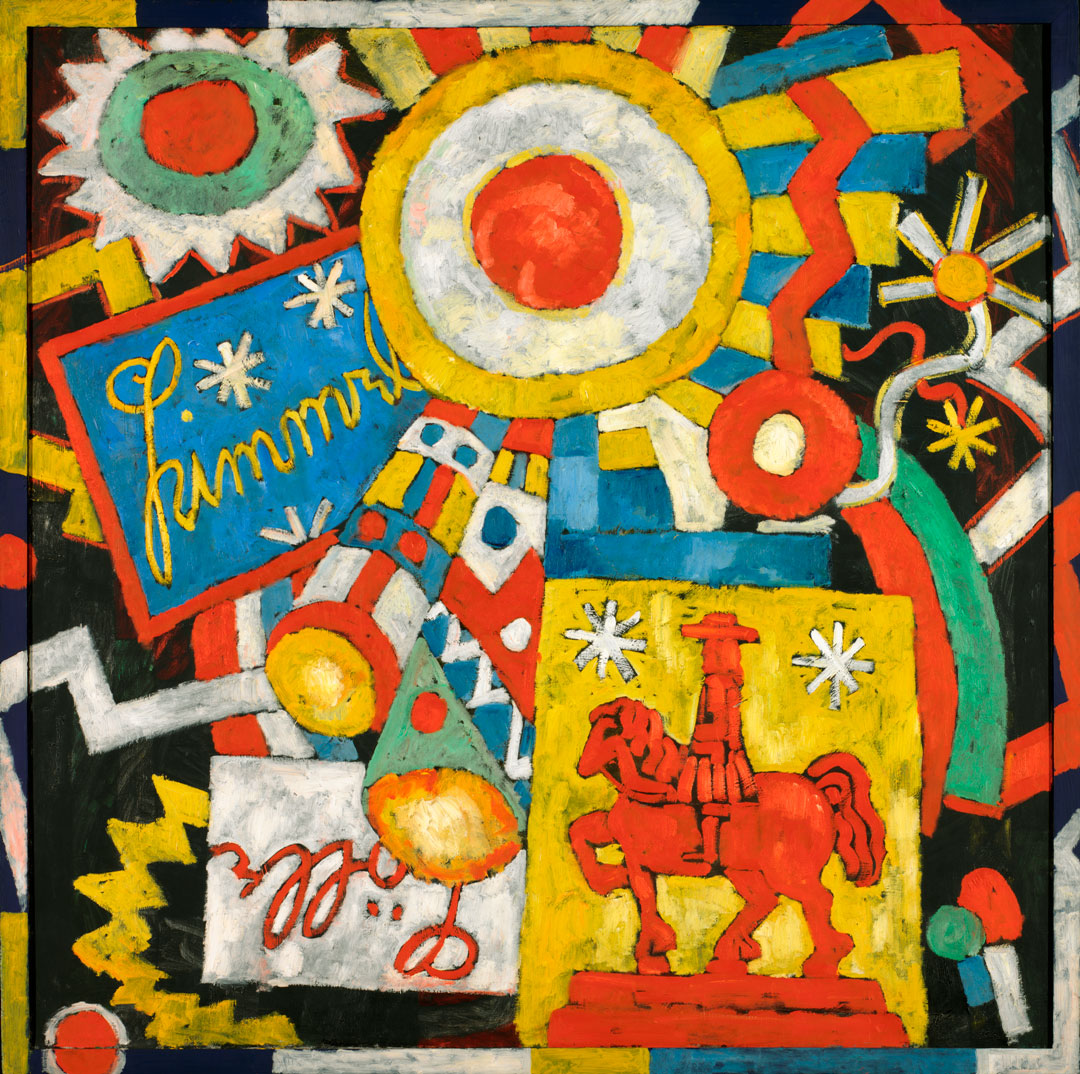
Marsden Hartley- Himmel 1915

++++++++++++++

I have come to the conclusion that it is better to have two colors in right relation to each other than to have a vast confusion of emotional exuberance. . . I had rather be intellectually right than emotionally exuberant.

–Marsden Hartley
++++++++++++++
I have been a fan of the paintings of Marsden Hartley (1877-1943) for some time now. I was reading about him earlier and came across this quote  that caught my attention, making me think about what I hoped to accomplish in my own work.
.
I often speak about creating work that has an immediate emotional impact achieved with colors and forms. But maybe, as Hartley’s words have prompted me to think, this first purely visceral and emotional impact is pure exuberance. Just a gut reaction that comes in that instant before the mind has time to engage.
.
A shout that makes you turn and look.
.
While that is good and desired, it’s doubtful that it can stand by itself and have a lasting effect unless it has an intellectual aspect to engage the viewer’s mind. There needs to be a balance between the mind and the gut.
.
If you turn at hearing a shout and the person doing the shouting is shouting just to make you turn and has nothing more to say to you, you keep moving and soon forget that person. But if you turn and the shouter has something more to offer, you might linger a bit to consider what is being said and engage in a conversation.
.
When you do move on, you take something from this engagement with you, something that will stay with you.
.
I am not sure this an apt analogy but it immediately came to mind on reading Hartley’s words. I don’t exactly know how this mind/gut balance works or how it can be accomplished in reality. Maybe even consciously trying to do so throws the whole thing off kilter.
.
It’s early in the morning and I am just thinking here. Time to go try to put it into action…

Marsden Hartley- Portrait of a German Officer 1914

Read Full Post »

« Newer Posts - Older Posts »