Feeds:
Posts
Comments

Posts Tagged ‘Quote’

GC Myers-Step Forward  By striving to do the impossible, man has always achieved what is possible. Those who have cautiously done no more than they believed possible have never taken a single step forward.

–Mikhail Bakunin

********************

There has been a lot of talk over the last few days about the new form of transportation proposed recently by entrepreneur-inventor Elon Musk, the man behind PayPal, Tesla Motors and SpaceX.  His idea is to have people shooting all over the country in a larger ( and more sophisticated) version of the vacuum tube system that you might see at your local bank’s drive-through, where the transaction is placed in a receptacle by the driver of the car and , once placed in the tube,  it is whisked with a whoosh to a waiting teller in the building.  Musk’s claims that you could shoot from San Francisco to LA in about 30 minutes, reaching speeds of around 700 mph in the tube.

It’s not a mind-bending idea in itself.  I mean, haven’t you wondered about the possibility as you sit waiting at the bank’s drive-through?  I know I have.  No, it’s not the idea but the sheer scope of such a project that raises eyebrows.  We look for any reason to not move ahead with big and bold innovative projects now.  The idea of pursuing the seemingly impossible, that trait that defined our last century, has for the most part disappeared from our psyche.

All you hear is how this project cannot succeed. And maybe the naysayers are right.  But at least there is a tap in this idea into the creative mind, the wellspring that allows us to dream bigger, something we seem to be backing away from.   But our world faces big challenges that require big ideas and big dreams.  Maybe this is not the ultimate answer to one of our challenges but kudos to Elon Musk for daring to dream big.

The painting at the top is in this same vein.  I see this piece as being about being bold and daring to step forward, away from the accepted normal.  Titled Step Forward, it is a 36″ by 24″ canvas that is part of my ongoing West End Gallery show, Islander, that hangs for a few more weeks there.  I’ve had a surprising number of comments about this painting over the course of the show.  Hopefully,  that is a good sign for us all…

Read Full Post »

You Are Here

Who are we? We find that we live on an insignificant planet of a humdrum star lost in a galaxy tucked away in some forgotten corner of a universe in which there are far more galaxies than people.

–Carl Sagan

Earth Seen From Dark Side of Saturn NASA-JPL-CaltechWhen I saw this recent photo taken from the Cassini  Spacecraft capturing Saturn and its rings as well as our own little blue speck of a planet, all I could think of was how utterly trivial my own worries and concerns were in the scope of all things.  I guess that can be a frightening thing, to feel so small and insignificant in relation to the universe, to realize that you are but a grain of sand on an immense beach filled with more grains of sand than you can possibly imagine.

 But to my surprise, I am not frightened.  If anything, I am pacified, knowing that  I am but a grain of sand subject to forces beyond my control.  And a grain of sand cannot alter the beach or stand up to the force of the ocean.  It goes where the tide carries it, where the wind blows it.

What good is worrying to a grain of sand?

So, go with the flow today.  We are all grains of sand and should enjoy our time on this beach while the sun shines down on us.

Read Full Post »

GC Myers- The Stand

Our deepest fear is not that we are inadequate. Our deepest fear is that we are powerful beyond measure. It is our light, not our darkness, that frightens us most. We ask ourselves, ‘Who am I to be brilliant, gorgeous, talented, and famous?’ Actually, who are you not to be? You are a child of God. Your playing small does not serve the world. There is nothing enlightened about shrinking so that people won’t feel insecure around you. We were born to make manifest the glory of God that is within us. It’s not just in some of us; it’s in all of us. And when we let our own light shine, we unconsciously give other people permission to do the same. As we are liberated from our own fear, our presence automatically liberates others.

— Marianne Williamson

*******************************

The quote above is an interesting example of how the internet sometimes creates its own mythology.   When I first came across this quote it was attributed in many places to Nelson Mandela, taken from his inaugural address in 1994.  That sounded right.  But I also saw that it was attributed to Marianne Williamson, the bestselling New Age guru.  And indeed, with just a short investigation, it was confirmed that Williamson was the author of this quote and Nelson Mandela had never uttered those words despite all those web followers who believed it so.

But regardless of authorship, it remains a good and inspirational quote.  I think it serves the painting at the top, The Stand, well as a description for what I see in it.  It is about letting your light shine and moving forward into a world of new possibilities.  Too often we are content to exist as less than we can be, to settle for a known mediocrity because we believe that the safety of this choice outweighs our desire for fulfillment.  Plus, it’s easier to stay put– no risk of stumbling in the spotlight and our friends are still there to commiserate.  Stepping up requires the risk of failure and the possibility of moving beyond those around you.

But, as the quote rightfully points out, we are doing no one a favor by denying our full potential.  Each of us serves as an example for those around us and to wallow in an unfulfilled life sets a bad example, denying inspiration to others.  No, we should dare to shine and let those around us look for their own potential in the light it provides.

There is a lot more that could be said here but I think brevity rules this day.  You can see this painting, The Stand, a 24″ by 48″ canvas, at the West End Gallery where my annual solo show, Islander,  opens tonight with a reception from 5- 7:30 PM.  I will be at the gallery so if you would like to stop out and talk for a bit, that would be great.  If not, come out anyway  to have a glass of wine and hear my friend Bill Groome play some wonderful parlor guitar music.  We’d love to see you there!

Read Full Post »

We must let go of the life we have planned, so as to accept the one that is waiting for us. 

-Joseph Campbell

*******************

GC Myers- Destiny AwaitsImagine us all as being boats on the oceans of the world.

 Some of us drift aimlessly, of course.  That was how I first set out.  No idea where I was going or even in which direction to navigate.  At any given moment, what might be my destination could have been  right in front of me or in a totally different hemisphere thousands of miles away and I would not know.  I had no idea what to even look for as I drifted.

But  some of us set out for a known destination and fully expect to arrive at that point.  We have studied the maps and charts and set a course, making all the needed preparations and taking every precaution.  We have sought out the advice of those who have made that voyage before and have formed an image in our mind of how the whole journey will go.

 But sometimes things don’t go as we plan.  Sometimes we get blown off course by storms and lose our way.  Or we were not as prepared as we thought for the hardship of the voyage.  Or the advice we received was mistaken.  Or sometimes we arrive and find that there is no room for us to dock or that our destination just wasn’t as we had imagined before we set sail.

 Perhaps ultimately that destination was not our destiny after all and we must set off once more in search of it.  It must be out there, that place, that one spot that we feel is totally our own.

I suppose this is how I see this new painting, an 8″ by 20″ on paper that I simply call Destiny.  It’s a composition that I have visited several times in the past and one that always attracts me for the simple elegance and balance of it.  There’s a confidence and clean sharpness in the way the image comes across that makes it very palatable– it immediately announces itself to the viewer, regardless of how they personally interpret it.

This piece’s destiny is my June show, Observers, at the Principle Gallery in Alexandria, VA.


Read Full Post »

GC Myers -High Sign  Every natural fact is a symbol of some spiritual fact.

— Ralph Waldo Emerson

*********************

I think I understand what Emerson is getting at with these words.  I know that when I look around I often see juxtapositions of natural elements– trees and stone and water and sky– which move me in ways that I can never fully explain.  Some fill me with inspiration.  Some with a sense of wonder  and great calmness.  Peaceful unity with the world.  And, with some, a sense of foreboding, a dread of the inevitable valleys that accompany all peaks.  Even those scenes which make me feel as being “in the moment” resonate because they have some underlying  connection to a deeper strand of thought or being.

I think it’s this sense of this symbology that fills in some of the gaps in my work, that gives it a little more depth than the surface offers.  I know that it is this greater sense of being that I am trying to capture in my work, hoping that perhaps others who feel this same type of  innate symbolism in the natural world  somehow sense it and connect with it.

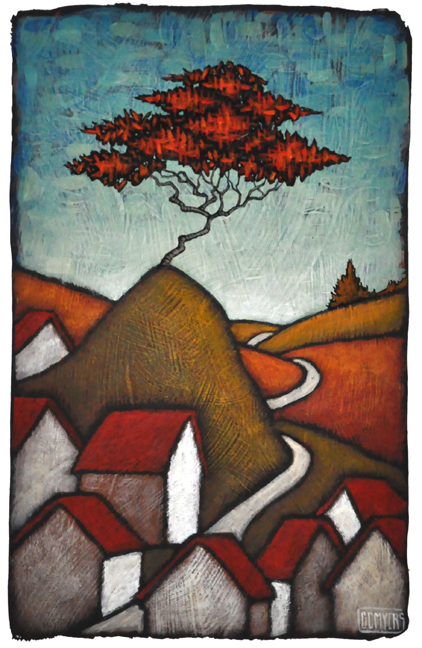
I think this newer piece, High Sign (6″ by 10″ on paper), is a good example of this.  It is a simple scene but, for me, is filled with symbolism.  Some is obvious and some subtle.   The tree and it’s position on the mound against the graded sky is obvious as is the road that winds through.  Less obvious are the upward pointing arrows of the houses’ peaks and the light and shadows of their walls.

The odd thing is that it’s not something I think about when I am painting the piece.  It’s all about achieving a sense of rightness in each move in the painting.  Each move is  step forward and if I can maintain  that feeling of rightness throughout the process, generally the painting will have this added depth, this layer of symbolism.  It comes of its own accord, naturally.   And I guess that the way it should be.

Read Full Post »

GC Myers-- Keyhole “Keyholes are the occasions of more sin and wickedness, than all other holes in this world put together.”

–Laurence Sterne

^^^^^^^^^^^^^^^^^^^

I had to chuckle when I came across this quote.  It had the timing as though it had been written by a modern comedy writer.  Then I noticed it was from Laurence Sterne who is best known for his comic novel Tristram Shandy from  mid-1700’s Britiain.  I wasn’t surprised at the humor then nor the truth behind it.

The idea of the keyhole being a glimpse into a world that is separated from our own, even if only by a locked door, has been the provenance of voyeurs forever and is the central idea behind this tiny new painting.  Except, I don’t see this as that same sort of voyeurism as the ogler who peeks for some sort of perverse pleasure.  No, this is different.

This 2″ by 4″ canvas, called Keyhole and done for the upcoming Little Gems show at the West End Gallery in Corning, is not about peering in, trying to see that which is secreted  away  in a room behind closed doors.  No, the viewer here is the one locked away in a room behind a closed door and the keyhole is a form of liberation. it reminds me a bit of my Outlaws series from a few years back where I had figures, often with handguns, that were standing by windows.  They appeared at first glance to be predatory but on closer examination show themselves to be the hunted, fearful ones.  They were not on the outside at all but were locked away inside, looking out the window as they cowered in their fear .

 And that’s kind of how I see this  piece although the viewer here is not looking out in fear but,  rather, in a longing glance for freedom for whatever keeps them trapped inside.  It could be as simple as a prisoner longing  to walk free in the sun.  Or it could be someone trapped in self-made prison who wishes that things could be different but can only see the possibility from within their captivity.  There are so many possibilities in such a small piece!

Read Full Post »

Every man’s memory is his private literature.

Aldous Huxley
 
 
**************
 
I like this quote from Huxley.  I have often felt that all of our personal lives fit into some sort of mythic template on which all literature is based and that we often fail to see the connections between the tales of our own lives and those stories which have come down through history in the form of myth and legend.  We all live lifes that are often filled with tragedy , comedy and drama.  Heroic, even.  But we seldom perceive them as such, instead thinking of our personal memories as being merely mundane. 
 
And that’s probably as it should be.  Life is spent, for the most part, moving forward in small, day-to-day steps with little time left to see the larger pattern of our lives.  Who has the time to reflect backwards, to see how our lives fit into the templates of eternity?  Very few of us, to be sure.  But what if we could take that time to look back fully and see the patterns set in history and to see that our lives own patterns mesh into that pattern, that we are all indeed connected to and part of the same fabric?
 
Would it make a bit of difference?  Would it make us appreciate the fragility and rareness of  each individual’s place in this world. make us understand that our own history is the history of all and that our memory binds us to the fabric of history?
 
I don’t know.  But it’s something to think about.
 
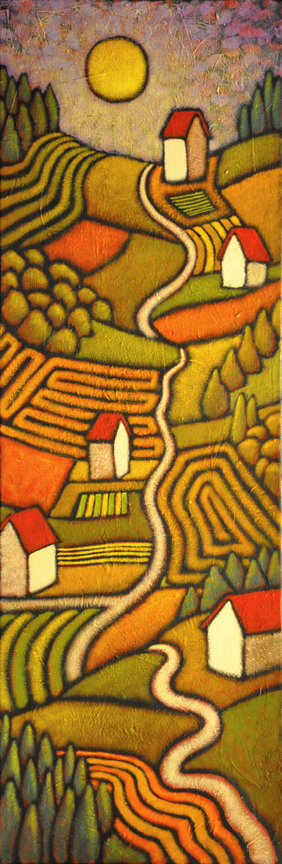
Funny how the mind works.  I meant to write about the painting above, a new piece  called Distant Memory (  10″ by 16″ on paper) set for my Principle Gallery show early next month and suddenly find myself off on a theoretical journey.  Maybe its the way the foreground of the painting, with the converging rows of the field,  relates to the house and tree across the water in the upper half of the painting.  I get a sense of looking back from the present, taking a pause from the labor of the moment,  which is represented in the rows,  to a personal past set around that house that reminds me very much of the farmhouses of my youth, often taking me back to different points of my own life, my own connections to templates of time.  Even the overall color of this piece sets that tone of memory for me.  There is  something in that green that reminds me of the ferns that my mother dug up many years ago from the hillside above the Chemung River and planted in the shade of the old farmhouse that we lived in for much of my childhood.  That green often brings back that memory, one filled with an air of  coolness and the smell of damp, rich soil.  A good memory.
 
Okay. Enough for now.  Work and the present calls.  I have my own fields to tend to now.


Read Full Post »

The object of painting a picture is not to make a picture– however unreasonable this may sound.  The picture, if a picture results, is a byproduct and may be useful, valuable, interesting as a sign of what has past.  The object, which is in back of every true work of art, is the attainment of a state of being, a more than ordinary moment of existence.

— Robert Henri

I love this passage that  Robert Henri wrote in his classic  book The Art Spirit, so much that I’ve taken the key phrase from it as the title for this new painting,  A More Than Ordinary Moment.  It is a tryptych on mounted paper  with the outside panel images measuring 10″ wide by 14″ high and the center 16″ by 14″.   It is set in a large frame with three separate windows that is about 24″ by 58″ in size, giving this piece a real sense of it  being, as its titles implies, more than ordinary.

This piece very much reflects the essence of what Henri was conveying in the passage, that art is not about capturing scenes or mere subjects but was instead about capturing a state of being, the  existential feeling behind the moment.  As I  have maintained for some time, my paintings are not about depicting the reality of the outer world.  They are more about capturing and mapping the emotions and sensations of our inner selves,  those rare things found all of us if we are willing to take the time to look.  They are internal landscapes.

I get a great sense of tranquility from this piece, a feeling that comes from the colors that somehow remind me of  the warmth of the crocheted afghans I knew as a kid with those sometime garish color combinations from the late 60’s and  early 70’s with olive greens, browns and  oranges.  When I think of those afghans, I don’t remember them for what they were as objects but for what they represented with those moments beneath them when I was warm and secure.  I didn’t see this in this painting until just now as I wrote this and now, looking at the painting, it is all I see.  I am instantly transported by it to those moments of supreme security as a kid, huddled under my mother’s afghan in my father’s house, carefree and safe from the world outside our doors.

It’s a feeling that I get less  as an adult and one that I need more often. 

Read Full Post »

It took me four years to paint like Raphael, but a lifetime to paint like a child.
–Pablo Picasso
****************
This short sentence from Picasso is  one of my favorite quotes.  It both makes me smile whenever I hear it and brings to mind my own struggles with recognizing my own creative voice, something that used to be a real internal battle in the early formative years.  There was always a pull between the craft side, as might be represented by Raphael in Picasso’s quote, and the side where one paints naturally and intuitively, as the child might.
 I knew I would never paint like a Raphael.   I never cared to tie myself to any one tradition of painting and wanted the liberty of free expression, the ability to freely display emotion, even in the most mundane scene.  Wanted my own voice, preferring the colloquial over the classical. Kind of like wanting to sing like Woody Guthrie versus singing like Pavarotti.  For as beautiful as Pavarotti’s voice might be I found a quality in Guthrie’s voice and songs that spoke more directly to me.  Native simplicity I suppose it might be called.  Over the years, my voice has evolved and there are pieces where there is often a bit of this native simplicity in the work that really pleases me, makes me feel as though I am somewhat painting in the way a child might.  Or at least in a way that might speak as well to children as it did to adults.
The piece shown here is such an example.  A 10″ by 30″ canvas, it is an extension of the work I have done recently, work that I have called internal landscapes.  Called Native Rise, it is painted very intuitively and speaks plainly.  It has an attractive harmony in its elements that lets it speak easily and be asorbed quickly – if you like this sort of voice.  For me, I see this piece as being very symbolic of my true voice,  how I see and express the world as I internalize it.  It is painted easily and in my own voice.   And like my own voice, it is far from perfect but tries to speak plainly.  And truthfully as to how I see my world.
At least, that’s the way I see it   It’s funny how much more difficult it is to describe  with words my own native painting voice, something that comes so easily on the canvas.  Perhaps one shouldn’t try…

Read Full Post »

Every picture shows a spot with which the artist himself has fallen in love.

— Alfred Sisley


********************

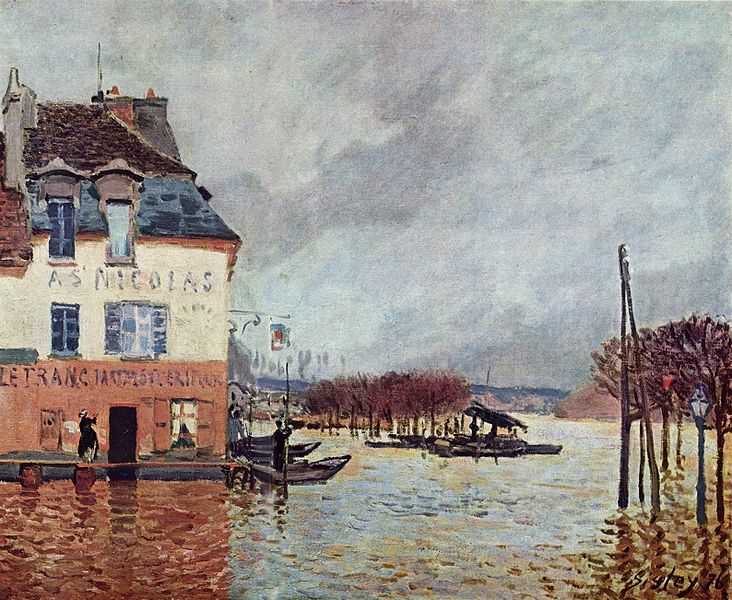
I’ve  loved the Impressionist landscapes of Alfred Sisley (1839-1899) for some time now.  I always liked the fact that he was solely a landscape artist that worked en plein air, never feeling the need or desire to paint still lives or figures.  He found his avenue of expression in the landscapes that he painted and always in the Impressionist style which fit his found voice.  There’s a sort of purity in his loyalty to his style and subject that I find endearing.

When I came across the quote at the top of this post, I thought at first he was talking about a physical location where the artist had actually fallen in love.  But reading it again, I realized that he meant a spot in each painting where the artist sees that stroke, that shape, that bit of color that made him want to express himself in paint in the first place.  I knew exactly what he meant at that moment. 

I am often asked to pick a favorite painting when I am at exhibits of my work, a question that I am often unable to answer fully. It is just for what Sisley expressed with these words that this remains juch an impossible task.  In nearly every painting that I have chosen to show over the years there is that spot that would shine out to me whenever I would look at it, a spot on the surface where the work seemed to take on its life for me.    It is usually something small and subtle, a small and simple line or the smudge of one brushstroke in what might seem an innocuous field of color.  Small but oh so important because when it meets my eye it rekindles a flame that is indeed love.

It’s a difficult thing to explain especially about a painting, something that many see only as an object.  But seeing that spot where it flares outward alive brings the artist that same excitement that seeing the one you love walk into the room brings to those in love. Seeing that spot in the painting is like meeting the eyes of your love and saying so much without uttering a word.  That may be the best way to put it.

Read Full Post »

« Newer Posts - Older Posts »