Feeds:
Posts
Comments

Posts Tagged ‘Quotes’

Ronnie Hawkins and the Hawks (Later known as The Band)I spent ninety percent of my money on wine, women and song and just wasted the other ten percent.

–Ronnie Hawkins

*****************

I wasn’t going to post anything today but while I was doing a few morning exercises a song came on that really sparked me.  I realized soon after that I had never played it on the blog which I found kind of remarkable since I consider it one of my favorites.  It’s a song called Come Love from the great Canadian  rocker Ronnie Hawkins.  I say Canadian because though he hails from Arkansas  he gained his greatest fame and settled down in Canada.

He played his music and lived his life on his own terms– that being hard and furious– from the 1950’s onward.  A lot of great musicians played behind him over the years as part of his band, The Hawks, most notably the entire group that later formed The Band.  You can see them in the photo above as they learned the chops that carried to their own greatness.  A renowned showman, Ronnie also was famed for his own version of the Moonwalk many years pre-Michael Jackson.

This song is not one of his hard chargers although its guitar lines do have a bite in them.  It has a really cool flow to it.  When  I hear it I think that it sounds how I would like to go through life, like a cool trickle of water in an easy flowing stream.

Just saying…

Give a listen and have a great day.


Read Full Post »

GC Myers- In the DreamlightI’ve dreamt in my life dreams that have stayed with me ever after, and changed my ideas: they’ve gone through and through me, like wine through water, and altered the colour of my mind.

Emily Bronte, Wuthering Heights

*****************

This is another new painting that is slated for my annual show, Part of the Pattern, at the Principle Gallery which opens June 3.  I call this piece, a 36″ by 12″ canvas, In the Dreamlight.  It has, at least to my eye, a contrasting feeling of vague dreaminess along with one of ultra-clarity.  Kind of like the feeling of those dreams that I have had that linger with me for years afterward.

I think we may have all had those dreams, those visions that reveal some mystery and spark some sort of inner questioning.  I still vividly remember several dreams from my childhood and, much like Emily Bronte’s Wuthering Heights character Catherine’s words shown above, they have altered the color of my mind.

Often, I find myself flashing back to those dreams, rerunning and experiencing once again portions of them in my present mind.  They are often enigmatic and filled with a mystery that begs to be answered.  And my mind believes they are answerable if I look long and hard enough.

In some ways I believe that is the purpose of my work– to somehow uncover the answers to these dreamed questions.  If the dreams are symbolic, might not the answer be found in a like symbolism?

As it is with all so  many things, I don’t know the answer.  But this painting reminds me of that feeling, that sense of being so near to the center of the mystery yet never quite being able to truly know the answer.

But maybe if I look once more, I will see what I’m seeking…

Read Full Post »

"Mr Wyndham Lewis as a Tyro"- Wyndham Lewis

“Mr Wyndham Lewis as a Tyro”- Wyndham Lewis

For many years now, one of my favorite books to just sit and flip through is my now very worn copy of  A Dictionary of Art Quotes by Ian Crofton.  It has great quotes by artists and critics about artists, schools of art and assorted other things that have to do with art.  The thing that I like most is that Crofton keeps it subjective, often having opposing points of view under each heading.  You might read one quote praising an artist while the very next might be one that portrays him as a hack. It’s interesting to see this contrast of perceptions, often by the artist’s contemporaries.

Some artists receive no negative words against their work or personality– Henri Rousseau, for instance, who was much beloved and respected by his contemporaries.  Most have positive quotes with an occasional barb thrown in their direction.  But the section concerning one artist, Percy Wyndham Lewis, really stuck out when I read it.  There is not anything that could be perceived as positive–Ernest Hemingway even said he had the “eyes of a rapist.”  Not knowing much about this artist, it prompted to find out a little more about Wyndham Lewis, as he preferred to be called.

It didn’t take much research to discover reasons behind the vitriol directed at him.

First, a little background.  Lewis was born in Nova Scotia in 1882, educated in England, lost his eyesight in the late 1940’s and died in 1957.  He was an extraordinarily talented painter and writer and the founder of the Vorticists, an art and literary movement derived from Cubism that flourished in the years before World War I but died out in the aftermath.   He painted and drew , wrote well received novels and published a ground-breaking art magazine, Blast.  No lack of talent, that is for sure

"T.S. Eliot"- Wyndham Lewis

“T.S. Eliot”- Wyndham Lewis

But from what I can deduct, he was a very contentious and very opinionated, always seeking an argument or looking to tweak those he viewed as his intellectual inferiors.  He ruffled more than his share of feathers.  As he said, “It is more comfortable for me, in the long run, to be rude than polite.”   But his biggest offense came in the early 1930’s when he wrote in favor of Hitler and the Fascists, believing them to be the keys to maintaining peace in Europe.  That was, to be sure, not well received and was for many unpardonable even though Lewis did reverse his views later after a 1937 trip to Berlin when it became obvious to him that he had gravely misjudged the intent of Hitler.  He wrote a number of items against Hitler and Fascism and in defense of the Jews of Europe but the damage was done: he was a persona non grata.
He basically disappeared from the art scene although he continued to write prolifically, even after the loss of his sight. There was a re-interest in his painting  and Vorticism in the mid-50’s , just a year or two before his death and in subsequent years his profile as an artist has regained some of its lost stature. He is consdiered among the finest of British portrait painters.  His painting of poet T.S.. Eliot, shown here, is considered one of his finest and one of the great examples of British portrait painting.

I picked up a book on his portraiture and find it very compelling.  The self portrait at the top of the page, Mr Wyndham Lewis as Tyro, really stood out for me as did the ominous Praxitella, below.  An interesting character.  I was glad to come across his work and will continue to explore it.

Wyndham Lewis -Praxitella

Praxitella– Wyndham Lewis

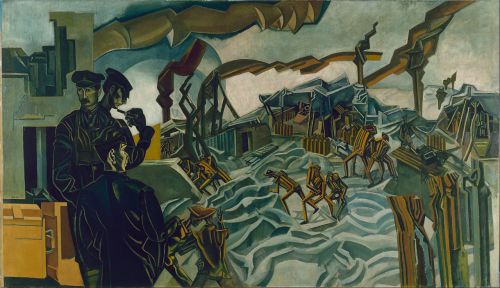
A Battery Shelled- Wyndham Lewis
A Battery Shelled- Wyndham Lewis

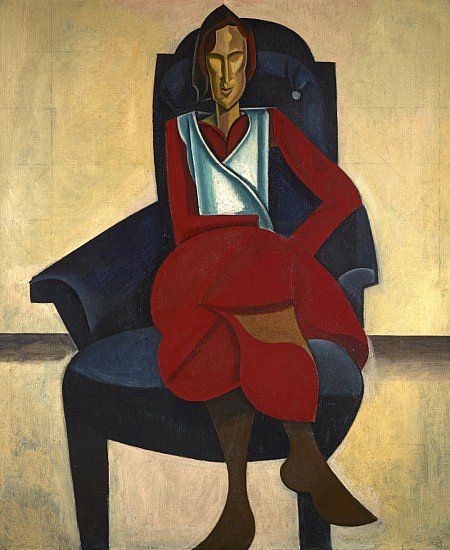
Wyndham Lewis- Seated Figure

Seated Figure- Wyndham Lewis


Read Full Post »

In everyone’s life, at some time, our inner fire goes out. It is then burst into flame by an encounter with another human being. We should all be thankful for those people who rekindle the inner spirit.

–Albert Schweitzer

*******************

GC Myers- Blaze smMy show, Into the Common Ground, has been delivered to the Kada Gallery, well in advance of the December 5th opening.  While it is a relief to complete the task and have the work out into the world, there are always those pieces that I wish I could spend a bit more time with.  This is especially true of the paintings that were completed in the final weeks.

These pieces usually are done in the midst of  a deep groove that has developed over the months leading up to the show and often feel effortless in their creation, a culmination of purpose and effort coming together.  But they are done and suddenly gone before I have fully taken in their fullness for an extended period of time.  And I am left wishing I could have spent more time absorbing their essence a bit more.

Such is the case with this painting, Blaze, a 20″ by 24″ canvas.  It was one of the last pieces completed and made quite an impression before it left soon after.

It is a simple piece, one that relies on its color , lines and texture to carry the weight of it.  For me, the Red Tree here is an example of the the inner fire coming forth and displaying itself to the world.  I felt that the quote at the top from Schweitzer was very fitting.  Most people have something inside that inspires passion, sets them ablaze.  It often goes untended, sputtering with that person left feeling that there is no one with which to share it — no one to take in the warmth of the fire.

I know this is true for my work, that thing which is an emanation of my own inner fire.  Without sharing it, without feeling that it is tended by others, it would likely sputter and go out.  Without the eyes of those fire-tenders my work, my fire,  would not exist.

So in this week of giving thanks, I send out a sincere thank you to those who have kept my fire alive through the years.  To my family and friends, to those who work with me at the galleries, to the collectors and the readers of this blog, I extend my deepest thanks for kindling this fire.  I have enjoyed the warmth and hope it has warmed you as well.

Read Full Post »

Men go abroad to wonder at the heights of mountains, at the huge waves of the sea, at the long courses of the rivers, at the vast compass of the ocean, at the circular motions of the stars, and they pass by themselves without wondering.
– Saint Augustine
**************************
GC Myers- The Richness of the Moment This new painting, a 20″ by 24″ canvas,  is titled The Richness of the Moment .  It was one of the last of the paintings finished for the Layers show which opens tonight at the West End Gallery.   I saw the show hanging together for the first time yesterday and this piece hangs in a group of paintings along the back wall of the space that glows like a bank of  backlit stained glass windows.  There is a luminosity and richness to these pieces that fills that space with warmth.   This work has just the effect as I had hoped it might have when I was looking at it in the studio.
.
I think this painting has a richness in it just as its title implies but it is the type of richness that Saint Augustine might have been  referring to in the passage above.  We often search wide and far for new wonders but don’t see the rich tapestry that is right before us in our own lives.  There is wonderment to be found in almost everything we see or touch– it is only its constant presence that has made it seem ordinary and unremarkable to us.  But if we pause to take in the world that within our reach at that moment with a greater awareness and appreciation, the richness becomes apparent.  Each life has the potential for wonder and each moment that may seem ordinary has an element of the sacred within it.
.
This painting, at least in my eyes, embodies this thought.  It is simply composed and stated– its subject is absolutely unremarkable at first blush.  But the colors and the juxtaposition of forms and tones that make this piece take on that feeling of the wonder in the surrounding richness to which I referred.
.
The Sacred Ordinary.
.
I hope you can make it in to the West End Gallery at some point over the course of the next month– the exhibit hangs until August 29th– to judge this for yourself.  The opening reception begins at 4:30 and runs until 7:30 today, Friday, July 25.  I will be in attendance for the duration to answer any questions you might have about the work.  Hope to see you there!

Read Full Post »

The human individual lives usually far within his limits; he possesses powers of various sorts which he habitually fails to use. He energizes below his maximum, and he behaves below his optimum. . . . it is only an inveterate habit — the habit of inferiority to our full self.

— William James

*************************

GC Myers- EnergizedThis is Energized, an 18″ by 36″ canvas that is part of the show opening Friday at the West End Gallery.  It was finished in the last days of preparing for the show and immediately lit up the studio with its bold colors and bands of texture that spin across it.  Even though it seemed  calm and placid in demeanor, it seemed filled with energy to me, every aspect of it appearing vibrant.

It was a struggle coming to terms with this combination of calmness and energy when I was searching for a title.  But reading the words above from American philosopher/psychologist William James brought it all into focus for me.  The painting was about being energized in an inner sense, using that energy to reach one’s highest potential and to live in each moment with great vitality.

I think the sun plays a symbolic part here representing the circular and regenerative nature of energy.  We often think of energy being used up like fuel being burned but often energy begets energy.  Effort creates inspiration and opportunity that brings forth new energy, forces that we never realized were waiting in store because we had avoided pushing to live at our optimum level, had  not dared to be our full self.

So Energized seemed like a natural at least in my interpretation of this painting.  You may see it differently and that is as it should be.  Hope ypu can make it out to the West End Gallery to make your own decision.

Read Full Post »

To have his path made clear for him is the aspiration of every human being in our beclouded and tempestuous existence.
–Joseph Conrad
****************
GC Myers- Glimpse and Aspiration sm
In the next week or so I will be featuring several of the new pieces that will be part of my show, Layers, which opens next Friday, July 25th,  at the West End Gallery.  This painting is titled Glimpse and Aspiration and is 24″ by 48″ on birch panel.  It has been a favorite from the moment that it began to take on its own life, midway through the time I was painting it.  Its size gives it a weightiness that fits well with the mood and  glow of the painting.  I find myself looking at it quite often in the studio with a great deal of internal satisfaction at the completeness of it.  It just does something for me.
.
I see the Red Tree here as a symbol of the aspiration for  a life of purpose and meaning, the desire for one’s own place in the world.  It is not always a clearly defined objective, as Conrad points out in the quote at the top.  Our life’s path winds through other places and lives but once in a great while there is clarity and we fleetingly see that thing which we believe to be our purpose.  Our aspiration.  Just glimpsing it and having it take a tangible form in our mind is fortifying, making our footsteps lighter and our path even more defined.
.
It is something  which we can hold in our minds to guide and inspire us on the path ahead.
.
There’s something in this idea  that fills this piece,  making it a very comforting piece for myself.  I am going to very much  miss this painting in my studio when it has went out on its own.  But it has done what it must for me and is destined to hopefully do the same for someone else.
.
Sending it out into the world is simply part of my purpose, my aspiration.  At least that is how it appeared to me in my brief glimpse.

Read Full Post »


There’s a lot going on so I am a little short on time.  I thought I would rerun a post from this day four years ago that jibes well with a thought that has been going through my mind lately.  A while back, my friend Linda Leinen (you might recognize her as Shoreacres in the comments section) referred to a Robert Frost line– No tears in the writer, no tears in the reader. No surprise in the writer, no surprise in the reader.  I have long contended that one of the most difficult parts of my job is maintaining that sense of excitement for myself in the studio, finding that thing that brings me wonder and surprise.  For me, that normally comes from varying the ways in which I work with the materials that I use in my work.  The materials always seem to hold the key to new surprises, new breakthroughs.  Which brings me to the post below.

*************************

Helen Frankenthaler- Savage Breeze

Helen Frankenthaler- Savage Breeze

There are no rules. That is how art is born, how breakthroughs happen. Go against the rules or ignore the rules. That is what invention is about.

–Helen Frankenthaler

************************

I’m using this quote from Helen Frankenthaler, the famed Abstract Expressionist, as a sort of follow-up or addenda to yesterday’s post about change.  I remember reading about Frankenthaler when I was first beginning to really paint with purpose.  In an article that I read but can’t locate now, she spoke of how she came to her trademark stain paintings where very thinned oil paint is applied to unprimed canvas.  She said it was almost by accident that she first experienced the absorbing of the paint by the raw cotton canvas and how that it caused a reaction, a breakthrough, in her thinking about how she wanted to express herself within her work. 

She felt that all artistic breakthroughs were the result of a change in the way one saw and used their materials.  It could entail changing the type of material used or using them in a more unconventional manner, as her above quote stating there are no rules infers.

This immediately clicked with me at the time I read it.  I had been trying to shape my way of thinking to fit the materials I was using at the time.  Unsuccessfully.  What I needed to do was change the materials to fit the way I was thinking.  Allow my thought process more free rein and not cater to the restraints of materials.

That may sound kind of abstract but it allowed me to start working with my paints and grounds in a much different way, forming my own process that worked well for my way of thinking and has become entrenched in my thought process.  Even though it may be outside more traditional forms of using these same materials,this process has over time become as rigid in my use as the techniques used by the most steadfast adherent of the most traditional school of painting.  This is sort of what I was referring to when I mentioned the end of the cycle, as far as art is concerned.  You reach a certain point, a mastery of your materials, where there are few accidents, few surprises in the materials’ reactions and, as a result, fewer surprises in your own reactions. 

For most, this is the goal.  But I want that surprise, that not knowing exactly how the materials will react and that need to solve the problem presented by the need to express with the limitations of the materials used.  So I try to continually tweak, create a little tension in how the materials react to my use of them, to create a sense of surprise.  Breakthrough.

Read Full Post »


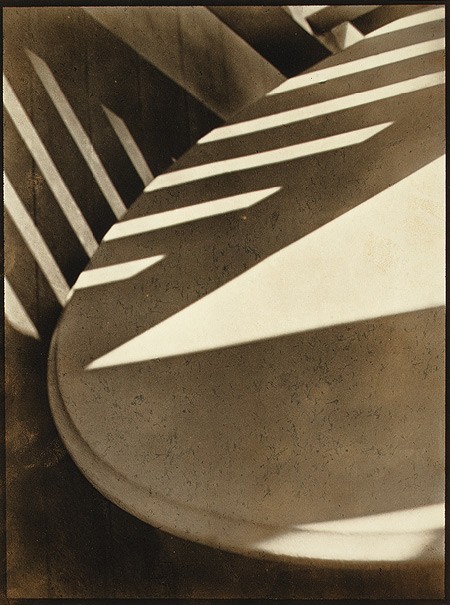
paul strand ny 1916No matter what lens you use, no matter what speed the film, no matter how you develop it, no matter how you print it, you cannot say more than you can see.

–Paul Strand

************************

I have featured the photography of Paul Strand here before, writing about his groundbreaking work in the early decades of the 20th century.  There is something about his work and his eye that is unmistakable, something that jumps from the surface.  When I saw this photo of a park in NY, here on the right, I knew immediately that it was Strand’s work.

I love this image, with the abstraction of the forms with the sidewalk forming a flowing diagonal through the picture plane.  The single figure in the lower third of the photo, cutting across the park in full stride,  becomes the focus for me, the soul of the picture.  He becomes the singular voice in a busy anonymous world.

Paul-Strand-The-Court-New-York-1924I think  the way in which he applies abstraction to the common forms in his work is wonderful and inspiring as an artist, something too many of us forget in our own work.  We become too concerned with simply capturing subject and not the emotion created in how that subject fits into its environment.  His best work speaks purely of emotion to me and he was able to find it everywhere.  As he said:  The artist’s world is limitless. It can be found anywhere, far from where he lives or a few feet away. It is always on his doorstep.

I think those are words to live by for any artist.

Paul Strand Abstraction Connecticut 1916


Read Full Post »

“When I am in my painting, I’m not aware of what I’m doing. It is only after a sort of “get acquainted” period that I see what I have been about. I have no fears about making changes, destroying the image, etc., because the painting has a life of its own. I try to let it come through. It is only when I lose contact with the painting that the result is a mess. Otherwise there is pure harmony, an easy give and take, and the painting comes out well.”

–Jackson Pollock

*************************************

Well put words from Pollock, words that very much fit with how I feel about my own work and process, even though our works seem to have little in common in appearance.  I think it’s the harmony that he speaks of that is our common ground.  At least, I hope.

Note:  The show, Internal Landscapes: The Paintings of GC Myers, has opened two days early at the Fenimore Art Museum in Cooperstown.

Read Full Post »

« Newer Posts - Older Posts »