Feeds:
Posts
Comments

Posts Tagged ‘Red Chair’

Marc Chagall Sun of ParisWhen I am finishing a picture I hold some God-made object up to it / a rock, a flower, the branch of a tree or my hand / as a kind of final test. If the painting stands up beside a thing man cannot make, the painting is authentic. If there’s a clash between the two, it is bad art.

–Marc Chagall

**************

I haven’t mentioned Marc Chagall  here but once over the 6+ years I have been doing this blog and I very seldom list him as one of my influences or even one of my favorite artists.   But somehow he always seems to be sitting prominently there at the end of the day, both as a favorite and an influence.

One way in which his influence takes  form is in the way in which he created a unique visual vocabulary of symbology within his work.  His soaring people, his goats and horses and angels all seem at once mythic yet vaguely reminiscent of our own dreams, part of each of us but hidden deeply within.

They are mysterious but familiar.

marc-chagall-fishermans-family-1968And that’s a quality– mysterious and familiar– that I sought for my own symbols: the Red Chair, the Red Tree and the anonymous houses, for examples.  That need to paint familiar objects that could take on other aspects of meaning very much came from Chagall’s paintings.

He also exerted his influence in the way in which he painted, distinct and as free-flowing as a signature.  It was very much what I would call his Native Voice.  Not affected or trying to adhere to any standards, just coming off his brush freely and naturally.

An organic expression of himself.  And that is something I have sought since I first began painting– my own native voice, one in which I painted as easily and without thought as I would write my signature.

  So to read how Chagall judged his work for authenticity makes me consider how I validate my own work.  It’s not that different.  I use the term a sense of rightness to describe what I am seeking in the work which is the same sense one gets when you pick up a stone and consider it.  Worn through the ages, untouched for the most part by man, it is precisely what it is.  It’s form and feel are natural and organic. There is just an inherent  rightness to it.  I hope for that same sense when I look at my work and I am sure that it is not far from the feeling Chagall sought when he compared his own work to a rock or a flower or his own hand.
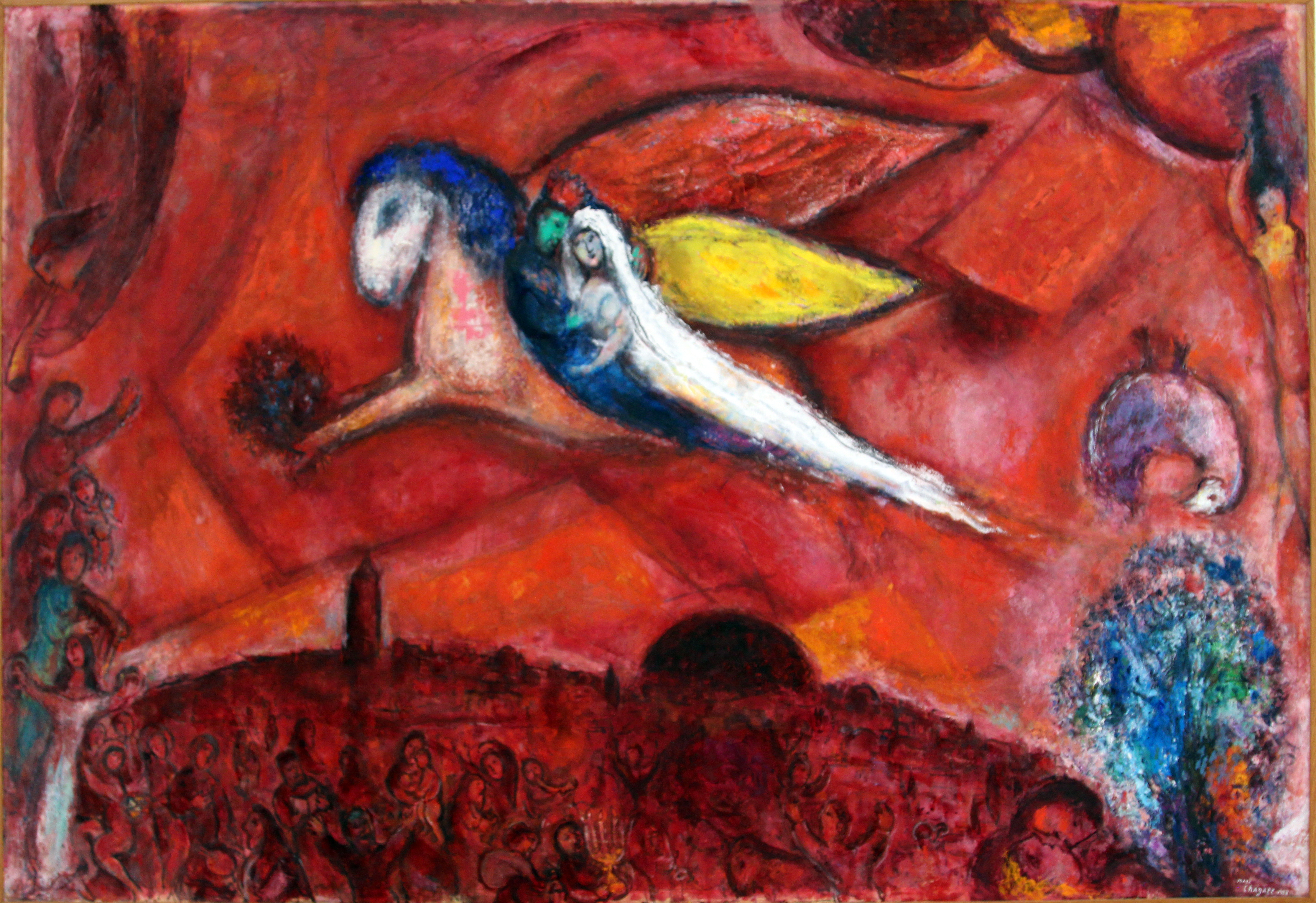
Marc Chagall Song of Songs

Read Full Post »

GC Myers- A Seat at the Table  smMan is a part of the world, and his spirit is part of the spirit of the world.  We are merely a peculiar mode of Being, a living atom within it, or, rather, a cell that, if sufficiently open to itself and its own mystery, can also experience the mystery, the will, the pain, and the hope of the world.

Vàclav Havel

*****************

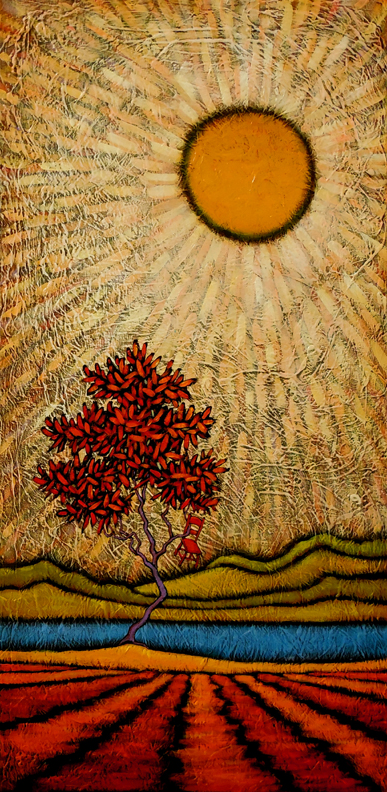
The Red Chair normally represents memory for me.  Often it is the form of familial memory with the chair lifted by the branches of what seems to be its family tree.  But in this newer painting, an 18″ by 36″ canvas that I call A Seat at the Table I see it as being part of a larger family unit, as a piece of the entirety of the world and the universe.

Oh, it may only play a small part but it is a part nonetheless, a link in the chained mesh of all things.  It belongs.

It has a seat at the table.

And that’s an important thing to remember for each of us– that we do belong, that we play a part in serving to hold together this universe.  We are not universes unto ourselves however much it sometimes seem.  We best function in our parts when we seek to serve others and in some way strengthen our part of  this universal mesh.

So play your part and involve yourself in the world, in the universe.  You do have a seat at the table, after all.

Read Full Post »

GC Myers- Family Lines smDuring the openings for most of my shows, such as this past week’s opening at the Kada Gallery,   I inevitably get a number of questions about the meaning of the Red Chair especially when it’s suspended in a tree such as in the painting shown here from the show, Family Lines.  The empty chair itself is a simple and powerful symbol in many cultures of past ancestors or someone who is absent.  I have personally attached the concept of one’s own inner memory to it as well, seeing the chair as a distinct memory or myself in the narrative of that memory.  It is not always the same thing in each different circumstance.

But how it came to be aloft in the tree is a story that began when I was a kid.  I’ve told it innumerable times over the years but here it is:

Wilawana Road BarnGrowing up, we lived in the country in an isolated old farmhouse with an old barn across the road.  I happened to drive by the old place yesterday and snapped this photo of the old barn, now in a much more advanced stage of decay than when I was running around there.  It was pretty solid and complete at that earlier time.   In front of the barn, to the left of it here and out of the shot, is a large and old stone chimney, all that remains from the home of an early settler to the area, a stage coach driver who was killed there in an Indian raid in the late 18th century.  A small cemetery with old slate stones was nestled in the edge of the forest nearby. For a kid, it was a place filled with memory, a great place to play and let your imagination run wild.

One summer when I was 8 or 9 years old,  I came across a dead woodchuck laying next to the barn.  I don’t know how he died– he was just there.  Dead.  As the summer progressed and he dried out, a vine passed through his body and by summer’s end was suspended a couple of feet in the air.  To the eyes of a child this was something magical.  I was struck by the power of the earth to reclaim its creatures.  Everything seemed very ephemeral after that…

The idea of a tree growing through an object such as a chair, which is very representative of human existence, is a continuation of that early fascination.  It wasn’t until I had painted several pieces with the hanging chair that I began to also see the symbolism of the empty chair, which in some cultures represents the recently deceased.  That is what I see now– the family members who have passed on.  Again, this is my interpretation of this work.  I enjoy hearing what other people see in the work because many times it’s completely different from what I see but just as valid.  I often look at some pieces in a whole new light after hearing a new view.

Read Full Post »

GC Myers- A Journey Begins

GC Myers- A Journey Begins

One of the interesting things about doing Gallery Talks, especially when there are a number of people who have followed your work for a while, is the feedback I get about the direction of my work or what has come or gone in it in recent times.  I hadn’t even noticed until someone asked that my Red Chair was lacking from the walls of the Principle Gallery and upon thinking about it I realized  that it had not appeared often in recent times.  I wasn’t surprised.  After doing this for a while, I’ve come to understand that themes and imagery cycle in and out of my work, attaching for a while to my psyche then falling to the back, only to resurface at a later time.

GC Myers- Night Watch

GC Myers- Night Watch

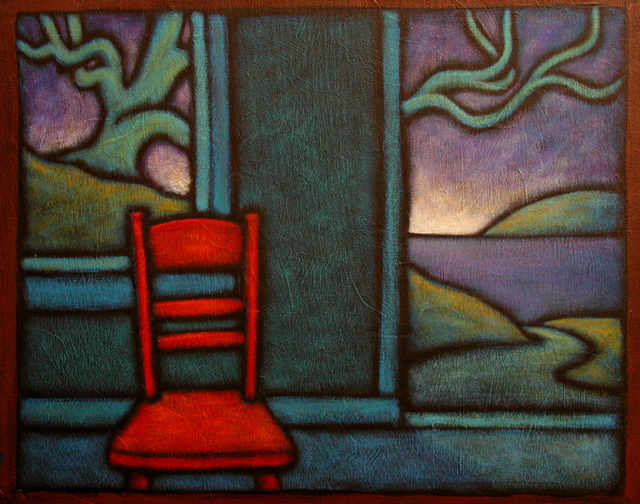
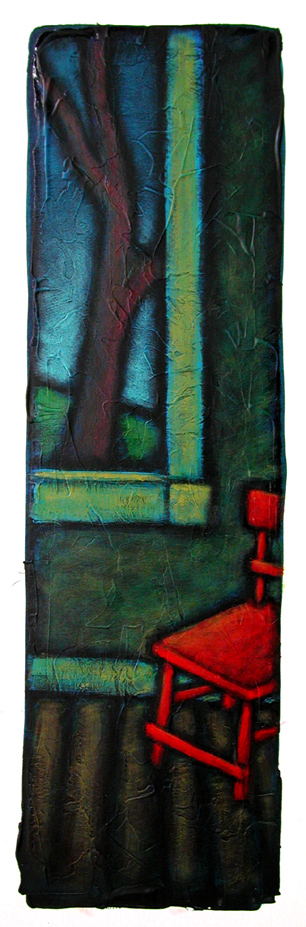
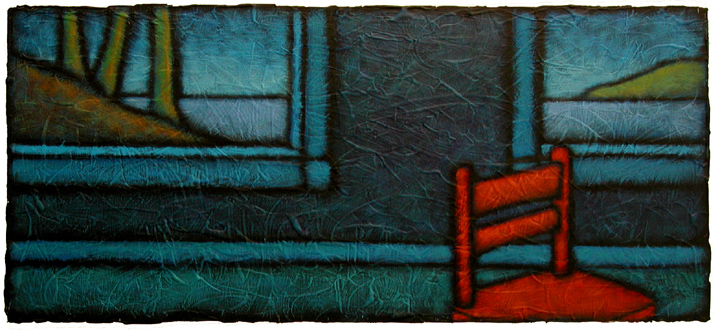
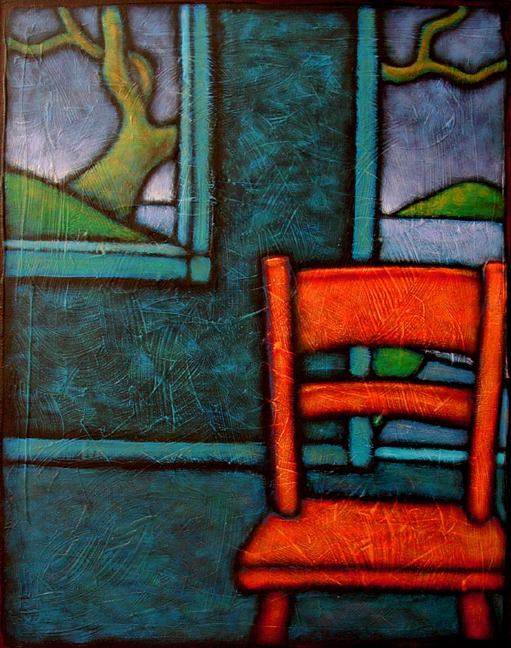
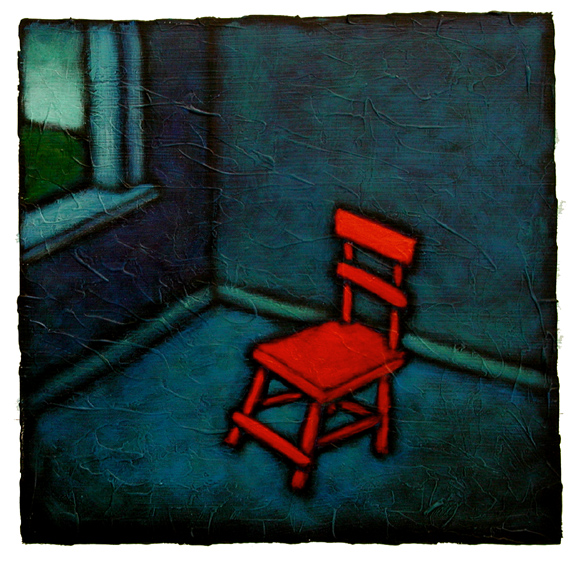
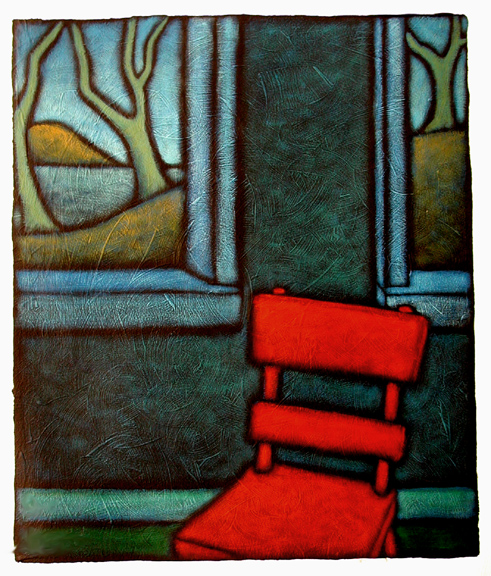
But having someone raise that point prodded me a bit and that Red Chair is in my mind again.  I have a few images swirling that will soon be out, I am sure.  But it also made me go back through my files looking for that Red Chair.  2002 was the high water mark for its appearance, especially in interior scenes painted in that style I refer to as my Dark Work— dark blues and greens over a black base.  Several of them remain with me and are among that work with which I will not part.

But I thought it would be interesting to show how a series of specific imagery, in this case the Red Chair,  goes through a specific time period, how certain elements are added or highlighted or fall away.  The one constant is the weight that the Red Chair brings to each image.  There is a tangible sense of  presence in each, as though the Red Chair alive and contemplating in the moment.  I think that is the appeal for me in these pieces– they don’t feel like still lifes but more like portraits.

Anyway, here is how the Red Chair moved through 2002:

GC Myers- Galvanic Memory

GC Myers- Galvanic Memory

GC Myers- Little Red Riding Chair

GC Myers- Little Red Riding Chair

GC Myers- Inner Sanctum

GC Myers- Inner Sanctum

GC Myers- An Inward Look

GC Myers- An Inward Look

GC Myers- Small Piece pf the World

GC Myers- Small Piece pf the World

GC Myers- Reason to Believe

GC Myers- Reason to Believe

GC Myers- Introspection

GC Myers- Introspection

Read Full Post »

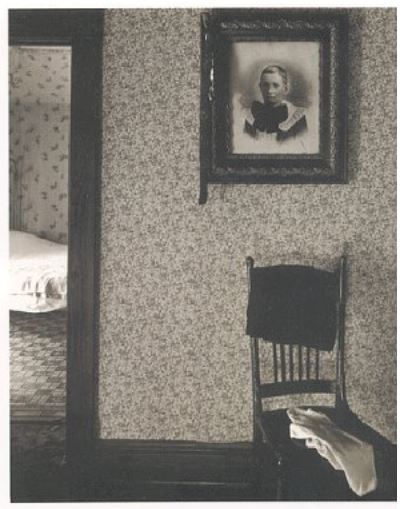
Writght Morris- Straightback Chair, The Home Place

Writght Morris- Straightback Chair, The Home Place

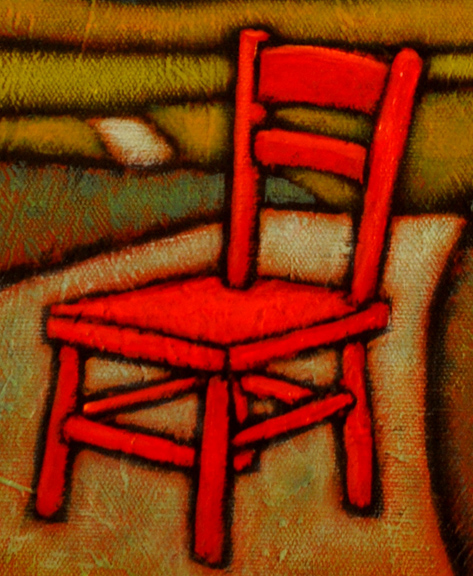
One of the most common questions I am asked at gallery openings or talks is about the meaning behind the Red Chair in my paintings.  I always struggle to answer.  Maybe because the answer is always changing for me.  I don’t really know.  I do know that I use it in my work because the chair is such an identifiable image that is known to anyone in nearly any culture and has an inherent meaning in its form.  A place to sit and rest. Or eat. Or converse. Or any number of things.  It is simply an icon of human existence.

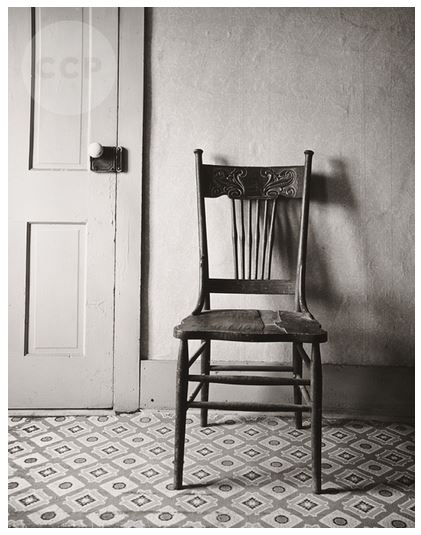
But looking through some photo sites I came across the work of Nebraska-born photographer/writer Wright Morris (1910-1998).  His stark and striking images of the Plains will seem very familiar to anyone who saw last year’s Alexander Payne film, Nebraska.  I don’t know but would not be surprised if Morris’ imagery was a big influence on the visual look of the black and white film.

Wright Morris- Chair, The Home Place

Wright Morris- Chair, The Home Place

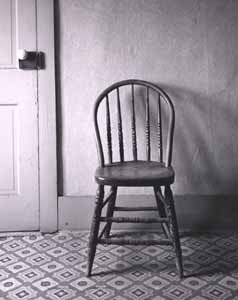
But while looking at some of these photos I came across a few images of chairs in a farmhouse.  They were from a book of his titled The Home Place, a photo-novel telling the story of a man’s one-day visit to where he had spent his childhood in Nebraska, the home place.  The images were very evocative and looking at them, it dawned on me that the meaning of the Red Chair was the same.  It was so obvious– it was the Home Place.  The place where you have a chair in which to sit, accepted as a part of that place.

It is simple yet powerful, like Wright Morris’ photos.

It’s good to have an answer to give now when someone asks…

Wright Morris Picture of Boy- The Home Place

Read Full Post »

Stanley Wolfson  (NY World Telegram & Sun ) Bullet Holes in back of stage where Malcolm X was shot

Stanley Wolfson (NY World Telegram & Sun ) Bullet Holes in  back of stage where Malcolm X was shot

I wrote  here several months back about coincidence, those strange moments of synchronicity.  You know, those times when someone who you haven’t spoken with in quite some time suddenly calls you just as you about to pick up the phone to call them.  Or an old song comes into your head and you flip on the radio and there it is.  There seems to never be a reason and the coincidences are seldom  remarkable enough to wonder about for more than a moment.

I had one of those this morning when I was looking for a photo on one of my favorite sites, Luminous Lint.  While scanning through a page of  many small, unrelated images, the photo above caught my eye.    Looking quickly at the small image on my screen it reminded me for a moment of one of my Red Chair paintings.  It was an overturned chair set against a landscape.  There was an immediate sense of loss, of someone having died in my quick reading of the shapes in the photo.   It wasn’t until I looked at the larger image that I could see that the landscape was theatrical backdrop and the chair was on a stage.

The caption said that the circles on the backdrop were bullets holes and this was where Malcolm X was shot at Harlem’s Audobon Ballroom.  I immediately wondered, for some unknown reason, when exactly that was.  I knew it was around 1964 or 65 but wasn’t sure.  I looked it up and there the date– February 21, 1965.  Today’s date, forty nine years ago.

I am sure there was nothing in this. No deeper meaning.  No connection or synchronicity with the movements of the universe.  Just coincidence.  But it makes one wonder why this photo and this date coincided this morning.  I will try to keep my own chair upright today.

Read Full Post »

GC Myers-Memory Way smEvery man’s memory is his private literature.

-Aldous Huxley

***********

As I have stated in the past here, the Red Chair, an icon that often appears in my work, is a symbol to me of people and places and experiences from the past.  In short, my memory.  In this new piece, Memory Way, that is most certainly the case.  This little painting, 2″ by 5″ on paper, is another of my pieces from the Little Gems exhibit which opens Friday at the West End Gallery.

The road here represents to me the continuum of time.  The landscape is almost idyllic, perhaps representing my tendency to block out the worst parts of memory.  At least, to downplay them and keep them in the background and to put what good there was there in the best possible light.  I like to revisit the past occasionally and I have to make it a place where I am comfortable.  A past filled with nothing but dark and fear-filled memories is no place to venture on a regular basis.

Anyway, this little piece makes me happy and fills my mind with a feeling of good memories.  As Huxley said  above, our memory is our own private literature, filled with the memories of our lives and the lives of our ancestors.  I sometimes edit, embellish and redact my life’s literature, all to make it an interesting read for myself.

That’s what I see in this little guy.

Read Full Post »

I have completed my show, In Rhythm, for the West End Gallery and will deliver it today in advance of the opening next Friday.  While it’s a big relief to finish a show and have it in the gallery, there is always a pang of loss in seeing works that mean a lot to me personally move out into the wider world.  Some are paintings that resonated with me immediately, almost from the first lick of paint hit the surface.  Those are the instinctual, native pieces that just emerge without a struggle and seem to have their own perfectly natural rhythm.

Others are paintings that show their meaning long after they are completed  Such is this painting shown here, Ribbon and Memory, a 12″ by 16″ piece on paper.  When I was done with this and was searching for a title I wondered what it might mean.  It still seemed to be a mystery even though I liked it very much without knowing its meaning.

I knew that the Red Chair often represents memory for me so I felt that the title would have something to do with memory.  And the path that runs through the foreground seemed more like a ribbon than an actual road so I immediately tied the two words together for the title.  Done. Enough said.

But early this morning I looked again at this piece and I more fully saw a meaning in it for myself, one still rooted in the title words but with more depth.  I have a friend whose wife has early-onset Alzheimer’s and it has turned their lives upside down as they try to cope with the changes and stresses that it brings.  Their struggles are in my thoughts quite often.  So when I saw this painting this morning it suddenly seemed plainly obvious to me that this could represent their situation.  The Red Chair is the wife, the Red Tree is the husband and the Red Roofed House is early memory of home and family.  The path, the ribbon, is that remaining memory that still tenuously connects her with this past that has began to recede into the distance.

The Red Tree, the husband shown here in a heroic stance, is apart from her and everything else, alone in his struggle to stay connected with that ribbon and to oversee her welfare.  The Red Chair, the wife, is also alone, facing  a solo journey forward with little connection to her past, separated here by the water.

I have to reiterate that this is my personal meaning that I see in this piece.  You may see it in a completely different way with your own personal meaning.  As it should be.  But for me, seeing this painting this morning with this new perspective made it seem  deeper and more precious than just a day earlier.  One that gives that pang of loss that I spoke of above.

Read Full Post »

Origin

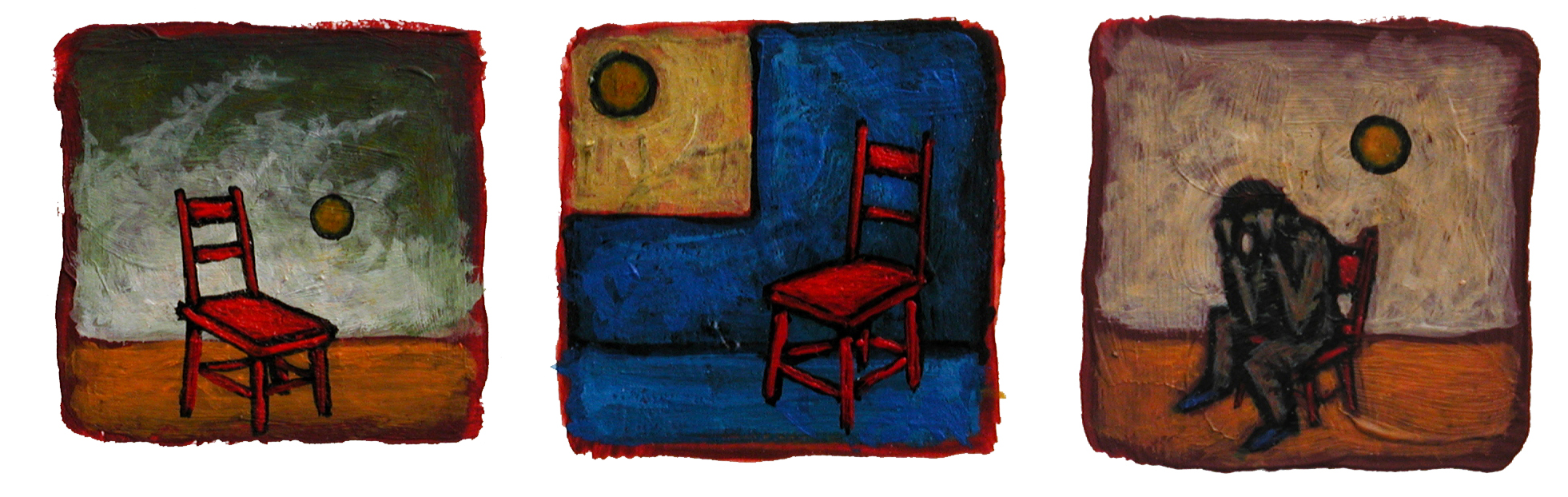
I was asked recently when the Red Chair that is sometimes used in my paintings first appeared.  I really wasn’t sure how and when it found its way into my vocabulary of images so I decided to look back in my files.  The very first images of the Red Chair that I can find so far appeared in early 2002 in a group of very small pieces.  The three above were all just over an inch, maybe an inch and a half square in size.   Just a few little guys that seemed to strike a chord with me.

I don’t know why they showed up at that time.  We, as a nation , were in the immediate aftermath of 9/11 and I know my work was affected by the collective psychology of that time. It was hard to have it not affect something that often reflects one’s feelings.  Perhaps, it was an unconscious symbolization of the chair  to represent what I felt had been lost from that turbulent time.  I can’t honestly say for sure.

The middle piece above was an early hint at the dark blue work that defined that year for my work, which also featured the Red Chair in several pieces.   These pieces were framed and sold separately although I think this group would have made any interesting little trytych.  I really like the way they all relate to one another, how they convey smoothly from one to another the emotion of each. 

It’s a small beginning for something that has gained such importance and meaning  in my personal visual vocabulary.  Maybe I should consider them as acorns that grew…

Read Full Post »

Collective Memory

At last week’s gallery talk at the West End Gallery, I was asked what meaning the Red Chair that is a part of some of my paintings held.  It’s a question that I get often but is one for which I have no pat answer.  I described how it came to be in my work and how it had evolved in meaning to what I now see it as now.

I have come to view it as a symbol or icon for the memory, both personally and collectively.  By personal, I mean memory that is distinct to each of us, moments and perspectives that only we hold.  For instance, if I personified the Red Chair as being the memory of my deceased mother, it would be based on my personal recollections of her.  My brother or sister’s memories might be quite different and perhaps might even be contradictory to the point that this Red Chair wouldn’t strike the same emotional chord with her.

The collective memory that I spoke of and tried to explain with little success at the talk is based on a cultural accumulation of memory, an icon for those group memories of events that have affected masses of us, directly and indirectly.  For example, as we approach the tenth anniversary of 9/11, there is a collective memory for that day.  We all have personal memory of our reactions but there is a unified memory that holds for the event as well, a sort of collected emotion that could be represented in an icon.  What that icon would be, I have no idea at this point as I’m just writing off the cuff.  I’m sure there is one, one item or image, that captures that memory of the event for a wide swath of us.  I will have to think about that.

It’s this collective memory that I often see in the Red Chair.  Our collective memory of our past.  Our experiences in war, both here and abroad.  Our struggles as a growing nation with issues of race and social injustice and our westward expansion.  Our saddest days and our days of triumph and joy.  In short, all those thing that make up our cultural identity and define us as a people.

It doesn’t stop with a national identity.  It also applies to the collective memory of us globally, to those events that bind us together as a species, to the memory of ur common bonds and ancestries.  When I see the Red Chair now I see our entire past captured in the bare bones of it. 

 Our past is the seat on which we sit.

Maybe that still doesn’t capture the whole idea but, hey, I’m just thinking here.  I think I have more thinking to do.

Read Full Post »

« Newer Posts - Older Posts »