Back in June, I wrote about going to the Smithsonian’s American Art Museum to see the painting shown above, Achelous and Hercules, a wondrous mural from the great American painter Thomas Hart Benton. It was commissioned to hang in a now-defunct Kansas City department store in 1947 and after the store closed in 1984 this masterpiece was given to the Smithsonian. It is a 5′ high and 22′ wide wooden panel that Benton painted in egg tempera. It’s a piece I could stand in front of for hours, losing myself in the rhythms and colors.
That being said, I came across a video taken from an old film that shows the incredibly elaborate process that Benton used in the making of this mural, which took about eight months. It is fascinating and unusual to see a known masterpiece coming together in all its stages. It makes me appreciate this painting even more.
Here is that video. It’s about 11 minutes long and worth the time spent.
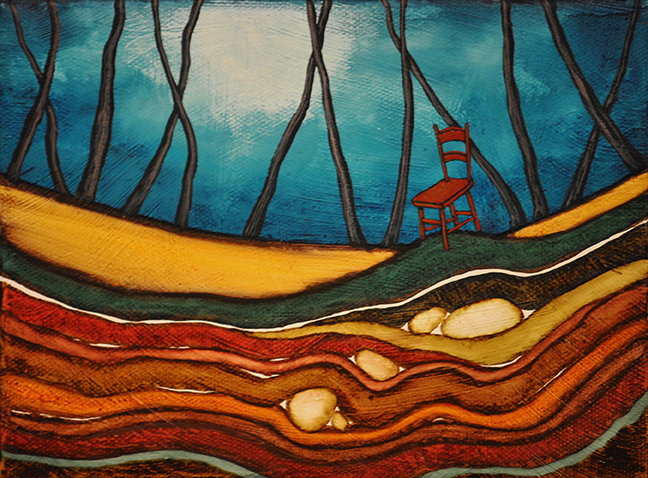
One of the interesting aspects of doing what I do is seeing where the images eventually finds their way. They have ended up in American Embassies in several countries, in magazines and on book covers here and abroad as well as on several CD covers. One was even included in a recent history text book. They have found their way to most corners of the globe, making them much more well traveled than their maker. And in 2016 a couple of images from my Archaeology and Strata series will be part of the annual calendar for the Spanish Society of Soil Science.
It’s gratifying for me to see the work spread out as it has. You hope, as an artist, that your work has a wider appeal, that there is some common denominator in it that speaks across geographic and cultural boundaries. You never know when you are in front of the easel if your work will be anything more than a blob of pigment on a bit of canvas destined for the trash or will take on a life of its own and move on. So to see it move around the globe in some small way is a form of validation for the work, making the next crisis of confidence easier to fight through. And that is no small thing.
Being Sunday it’s time for a little music and I thought I would play a song that kind of jibes with the soil theme of the work here. It’s one of my favorite songs to sing along with from one of my all-time favorites, John Prine. It’s called Please Don’t Bury Me and it’s about as upbeat a song on the subject of dying as you’ll ever hear. Give a listen (and sing along if you know the words!) and have a great Sunday!
I was looking for something else and came across this post from back in 2009 about one of my favorite songs and the unusual man who wrote it. I thought it deserved a replay. Plus I just felt like hearing “Nature Boy”this morning. Here’s how it goes:
Sometimes when you look a little more behind something that’s been in front of you for years you find out things you might have never imagined otherwise. Such is the case with the song, Nature Boy.
Nature Boy, as recorded by the great Nat King Cole, has long been one of my favorite songs. It has a wonderful haunting melody and tells the story of a “strange enchanted boy” and his search to find love. It always has had a sort of mystical feel to me, a real oddity in the world of popular music in 1948 when Nat King Cole recorded and had a huge hit with it, staying at #1 on the charts for eight weeks.
I was going to just have a short post and put up a YouTube video of Cole’s version but in doing so I saw the name of the songwriter, eden ahbez, and was intrigued. Doing a little research I came across some photos of him such as the one above, from the late 40’s sitting with Cowboy Jack Patton ( who wrote Ghost Riders in the Sky) and a spaniel. I’ll let you figure out who is who in the photo. ahbez’s long hair and attire seemed really out of place for me in thinking of 1948 so I read on.
eden ahbez was a real one of a kind character in the world of music and in general. You could probably guess that from the name which he adopted and wrote only in lower case letters. Born in 1908, he is regarded as the first hippie by many, a long-haired and bearded wanderer who crisscrossed the country on foot, wearing robes and sandals, maintained a vegetarian lifestyle and slept out under the stars. In fact, when Nature Boy hit the charts he and his wife were living under the first L on the Hollywood sign, which stoked a bit of a media frenzy around ahbez. He worked in and frequented a vegetarian restaurant (that’s where he met Cowboy Jack Patton, another interesting character) in 1940’s Los Angeles whose German owners preached the gospel of natural and raw foods. Their followers became known as the Nature Boys.
He was not really what I was expecting from a pop songwriter in 1940’s LA. ahbez died in 1995 from injuries sustained in an auto accident. He was 87. His was a truly unique life, just waiting for a biographer to tell the story, and reading the little I discovered makes me find the song even more interesting. Hope you’ll do the same now that you know a bit more about eden ahbez…
I am sort of fascinated with the time around the turn of the 20th century, those years when the country was being transformed by new technologies. The first airplanes were flown, instant long distance communication was now the norm, electricity was becoming more and more common in homes and cars were showing up in the most remote of locations, more and more replacing horses as our primary mode of transportation. . Movies were being made and distributed around the country and recordings of music were heard playing in homes. It was a vibrant,quick moving time filled with seemingly infinite possibilities for those willing to take advantage of the opportunity.
Around that time, my grandfather was a young professional wrestler here in my home town. Matches often took place at one of the many vaudeville theaters in the city, the match ending the night’s bill of dog acts, acrobats, singers, dancers, jugglers and maybe even a movie thrown into the mix. Like the time, it was a fast paced mix.
I read an account of one of his matches that took place at a local Athletic Club which were basically Men’s Clubs that had a number of teams in different sports that competed with other clubs throughout the area and also provided a place for guys to congregate and drink. This particular night his match was a Smoker ( which was just a night of entertainment) at the Kanaweola Club. There was a singer then a short boxing match followed by a traveling family of acrobats. Then came a gentleman who danced, putting on a “demonstration of Ragtime.” The wrestling match was the final event, probably because the matches were untimed meaning they could last for quite some time. This night’s match didn’t go too long but my grandfather once had a match that ran for several hours one night and was suspended until the following evening where the match finally ended after over two more hours of grappling.
It was just a wide open time. A young nation feeling its oats.
Of course, this wasn’t true for everyone. Women were still limited in their opportunities. They could not vote and for the most part were subjugated to minor roles in the work force. The nation was only three or four decades removed from the Civil War and while slavery was eradicated , black Americans were still fighting prejudice and suppression, struggling to find their own opportunity in a time when the Ku Klux Klan was taking root around the country. There was widespread poverty and disease and alcoholism. Work conditions were often appalling which led to the rise of the unions which brought about labor laws which removed the children from the mills and mines which were so common at the time.
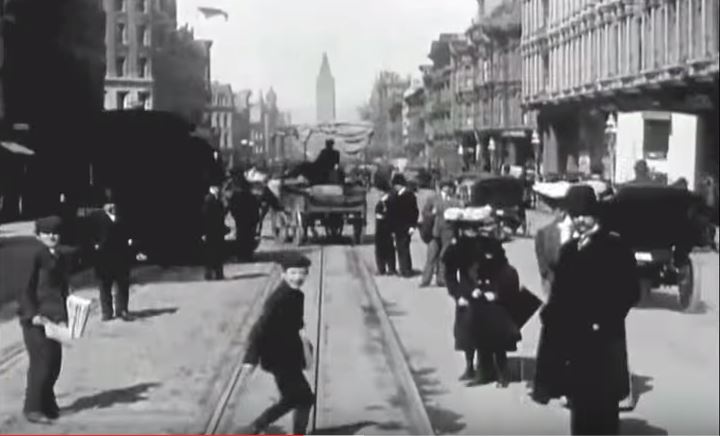
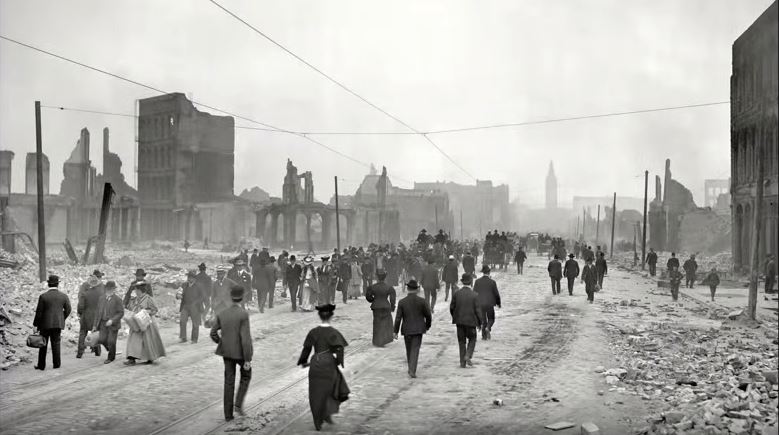
In short, it was a tough but exciting time. Which brings me to the film below and the two images at the top of the page. This is a nearly 12 minute film of a streetcar jaunt up Market Street in San Francisco on April 14, 1906. Only four days later the fabled Earthquake of 1906 would destroy the city and leave over 3000 people dead. The two photos at the top show the before and after, the tower at the end of Market Street still standing in both. This film was a mystery for many years, the date lost in the fog of history. But careful research uncovered the date which made an already interesting film even more so.
Even though the journey is slow by today’s standards, it’s a dizzying ride with cars and people and horse-drawn vehicles all weaving and swerving in a chaos that is a little unnerving. I think it represents the time very well– fast-paced and a little dangerous. I watched and wondered how many of those people perished in the next week and what the survivors ended up doing in later days. Take a look and wonder for yourself.
God strengthen me to bear myself; That heaviest weight of all to bear, Inalienable weight of care.
All others are outside myself; I lock my door and bar them out The turmoil, tedium, gad-about.
I lock my door upon myself, And bar them out; but who shall wall Self from myself, most loathed of all?…
– Christina Rossetti
>>>>>>>>>>>>>>>>>
The painting at the top, I Lock My Door Upon Myself, is from Belgian Symbolist painter Fernand Khnopff who lived from 1858 until 1921. The title is taken from a verse of a poem, Who Shall Deliver Me? (shown in part above), from Christina Rossetti, the pre-Raphaelite poetess whose brother, Dante Rossetti, was an influence on the work of Khnopff.
It’s a haunting painting, one that always makes me stop a bit when I stumble across an image of it. Perhaps it is the symbolist elements in it but for me it is probably the beautiful construction of forms and color that give the overall piece an almost abstract feel. Just a great image in so many ways.
I came across a video from the free educational series Khan Academy that offers a short and insightful exploration of the painting’s symbolism. Very interesting if you have five minutes or so.
Well, the opening for my Home+Land show at the West End Gallery was Friday evening and went very well– just a perfectly wonderful night with plenty of people and lots of conversation. It was a pretty large crowd, especially for a summer opening, but it still was one that met my criteria for a good show: most of the attention was focused on the work on the wall.
I have been to plenty of crowded openings where the work is sometimes an afterthought and all the people there are facing inward in private conversations. For me, a good show is one that is outward focused, one where the eyes oriented to the wall. And even though there was a good number of people, it seemed to me that most were there for the work.
And that really satisfies me in some deep way and for that I would like to thank all of you who took time from your summer schedule to spend a little time to take a look at the work. I could not be more appreciative. And thanks to Linda and Jesse once again for hanging the show in a way that seems to bring it all together in the gallery. Again, I could not be more appreciative.
That said, it’s time for a Sunday morning music and this week I felt like something older and mellow and, for me, the voice of the late and great Sam Cooke can often fill that bill. This is a song he wrote that has been covered by many artists but his version always seems the real thing for me. It’s from 1962 and has very recognizable backing vocals from Lou Rawls. Here’s Bring It on Home to Me.
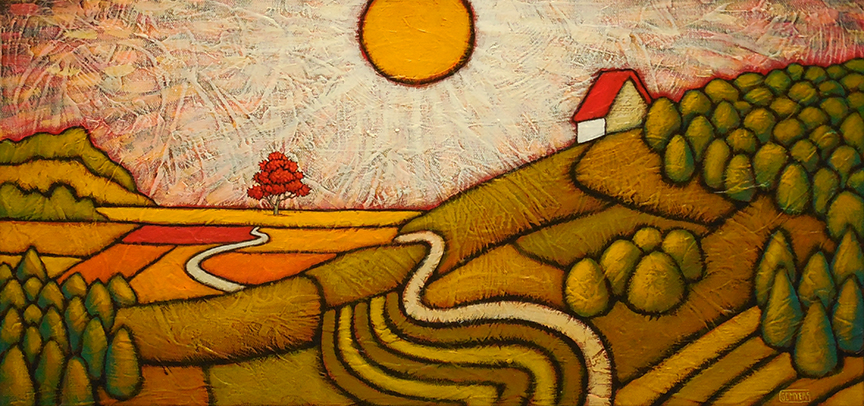
PS: The painting at the top is from the show and is 12″ by 24″ canvas piece titled Back to the Land.
One never reaches home, but wherever friendly paths intersect the whole world looks like home for a time.
—Hermann Hesse
*********************
Well, my show, Home+Land, is now hanging at the West End Gallery ahead of this Friday evening’sopening reception. Feedback has been very strong thus far which alleviates some of the jitters that normally accompany the run-up to any of my shows, something I’ve written about here a number of times in the past.
This period between delivering the show and the opening is always one of uncertainty. Even though I may feel confident and truly satisfied in the work, in this time period a lingering doubt always seems to rise up that perhaps my perception of the work will not jibe with that of the general public. After many years and many of these shows, I know this an irrational fear, that how others see the work is beyond my control and so long as I feel that the work speaks honestly and confidently for me there is nothing to worry about.
And that is something that I definitely feel the work does in this show. I feel completely invested in this show with a certainty that this group is an authentic representation and extension of my work and my self. For better or worse, it just feels honest.
This was something I found to be true when I was putting together the short video preview below as I wanted to keep it shorter and didn’t want to include everything. It was difficult deciding which pieces to include and which to leave out– each would add something and none which be out of place.
But in the end I felt pretty good about the group I chose and hope you’ll take a moment to decide for yourself.
I am coming into the last week of preparing my solo show, Heart+Land, which opens July 17 at the West End Gallery. It’s at this point every year, after the second show in a matter of a couple of months, that I begin to feel a bit worn down. I really see it in trying to write the blog. A lot of mornings I find myself sitting here just staring at the screen and feel that my mind is blank as well, as though the wheels in my mind feel like they will never turn again. I am preoccupied with with those pieces that still need work and other tasks that are waiting for me just out of my sight. Out of sight but not out of mind.
So, I thought I would start the holiday a day early with a little music and one of my favorite Springsteen songs. Some know it as Sandy from the name of the girl to which Bruce’s character is singing but it’s actually titled 4th of July, Asbury Park from his 1973 (yes, it was that long ago) album The Wild, The Innocent and the E Street Shuffle. It’s a song that immortalized the Jersey boardwalk culture of that time, like the fortune teller Madam Marie whose real life shop is shown above, with its bittersweet lamentation about lost love and outgrowing the lures of youth’s easy pleasures.
So, I am giving it a listen then heading back to those tasks that are beginning to tap their toes with impatience. Have a great 4th of July.
There was an interesting video recently online called Art of the Storm from photographer Nicolaus Wegner that featured a fantastic time lapse of a super cell forming over the Black Hills of South Dakota earlier this month. While it was beautiful and awe inspirng, it was a link at the end of the video to some of his other time lapse films that caught my eye. One in particular stood out.
Called AERMETRY, it features storm and cloud formations and movements that are mirrored as they move across the screen, creating kaleidoscopic images that are fascinating. Definitely hard to look away, especially if, like me, you are one of those people who try to identify things in random patterns. There is however a photosensitive seizure warning attached so if you are susceptible to such things please take note.
You can see more of the work of Nicolaus Wegner, including more sensational time lapses, at his website, Light Alive Photography.
I wasn’t going to write anything today. Getting ready for the new show at the West End Gallery has kept me exceedingly busy but I came across a clip from a Viktor Frankl lecture that I liked and wanted to share. Frankl ‘s book, Man’s Search For Meaning,has been an important book in my life and his ability to find hope in the darkest of times always provides inspiration. The clip, from 1972, shows this optimism and even though it is from 1972, it speaks for any time. Honestly, the idea that this man who has experienced the worst side of mankind can find hope for mankind makes me slightly ashamed at the cynicism I sometime find in myself when I consider the future of this planet.
You can find Frankl’s book on YouTube as a free audiobook by clicking here.
To preface the clip I thought I would share a blogpost and painting from five years back:
We who lived in concentration camps can remember the men who walked throughout the huts comforting others, giving away their last piece of bread. They may have been few in number, but they offer sufficient proof that everything can be taken away from a man but one thing: the last of the human freedoms — to choose one’s attitude in any given set of circumstances, to choose one’s own way.
———-Viktor Frankl
************
I don’t know why this came to mind today but it did. Viktor Franklwas an Auschwitz survivor who, after the war, createdlogotherapy, one of the important schools of psychotherapy alongside those of Freud, Adler and Jung. It was a therapy based on finding meaning in one’s life, a reason to struggle onward. In his best known book, Man’s Search For Meaning, he recounts his time in the concentration camp and how he and others who survived seemed to have something in common– the discovery of a purpose and meaning in living. It might be love. It might be the will and drive to create. Just something to set on their horizon to pull them ahead despite the horror around them.
Maybe it was this painting, Lifeblood, that brought back Frankl for me. I had come across his work a number of years ago and and his words and example have helped me through some desperate, foundering times of my own. There is a certain power in knowing that we all are fated to suffering of some sort, just by the sheer nature of existence. There will be pain, there will be death. No one is exempt from the distresses of life. But these can be endured through the knowledge that we have the choice in how we react to such events, how we perceive the deprivations of our lives. We can choose to wallow, to give in, or we can forge ahead.
Maybe that’s how I see this painting, as a path through the pains of living, symbolized by the blood red of the ground. All the leaves, everything it had, have been stripped from the tree yet it still stands. It reaches for the light above, seeks a meaning for its suffering.
I didn’t see it that way when I first painted this. It was simply color and form. Simplicity and harmony. But sometimes there’s an associative power to a piece that gnaws at you, begs you to look deeper and find what it’s trying to say. And maybe the ideas of Viktor Frankl hide in this piece for me…
 Back in June, I wrote about going to the Smithsonian’s American Art Museum to see the painting shown above, Achelous and Hercules, a wondrous mural from the great American painter Thomas Hart Benton. It was commissioned to hang in a now-defunct Kansas City department store in 1947 and after the store closed in 1984 this masterpiece was given to the Smithsonian. It is a 5′ high and 22′ wide wooden panel that Benton painted in egg tempera. It’s a piece I could stand in front of for hours, losing myself in the rhythms and colors.





 Redtree Times