Monday morning. For me, it’s not like the start of the week. Just another day in a continuum that is more a straight line than circular. At least, that’s how I usually view it. Today, it feels like the start of a week. Maybe it’s the fact that I’m in full work mode or just that I’m a little tired this cool morning. Whatever the case, I find myself at a loss for meaningful words. So instead of agonizing for any appreciable time searching within, I’ll simply depend on someone else for meaningful words.
Here’s a song from Jimi Hendrix, May This Be Love which most people know as Waterfalls. Don’t want to even talk about it this morning, just give a listen. Nice stuff…
This is a piece that I finished in the last few days. It’s a real throwback to my first forays into painting, done in a very watercolor way on untreated paper. It’s 13″ by 23″ and is very transparent. I’ve tried to maintain a certain complexity of color and strength of line yet the colors are lightly saturated, almost delicate. I’m not sure how well this will translate on a computer screen.
I’ve started doing a handful of paintings in this manner in order to focus on subtlety of the color and to allow the forms of the landscape and sky to carry the weight of meaning in the the piece. It’s a tricky proposition to pull back from deep colors and texture yet still maintain strong edges. I find that this type of painting works best with simplified forms that seemingly act as abstractions, giving the work an almost organic feel, if that’s the right word. This feel plays well with the red tree which maintains its role as the focal point and inviting presence in the piece.
I like this work . While it has a slightly different appearance based on technique, it fits easily into my body of work. There is an ethereal feel, something I strive for in much of my work, that is enhanced by the transparency of the paint.
I was working in the studio yesterday with the television on, set to one of the news channels. After a while, the constant drone of bad news from every corner of the world- unstable economies, Wall Street panic, oil spills. floods, terrorist bombings, wars and on and on-became more than I could bear. I flipped over to a movie channel and there it was. Meet John Doe, the Frank Capra classic from 1941 starring Gary Cooper and the great Barbara Stanwyck.
Meet John Doe is one of Capra’s visions of American idealism wherein the main character hesitatingly fights the malevolence and greed of those in power for the rights of those with little power. Think Jimmy Stewart in Mr Smith Goes to Washington or It’s a Wonderful Life. In these movies, the hero often has the very people he champions turn on him, usually as the result of those in power twisting the truth to suit their own dark agendas. But in Capra’s world, the hero perseveres and is vindicated by the truth. Sure, it’s naive but it’s a wonderful place to let your imagination rest for a spell.
The hero here is Cooper who plays a drifter who is enlisted by a newspaper to play the part of John Doe, a character in a publicity stunt who threatens to kill himself on Christamas Eve because of the state of the world. This was 1941, folks. Europe was at war with the Nazis marching and we were on the verge of entering the fray. We were still reeling after a decade of the Great Depression. It was not a pretty time.
The John Doe character was supposed to disappear after Christmas but it hit a note with the common note and a populist movement grew from it, funded by the newspaper mogul (played to perfection by Edward Arnold who I will someday highlight in this blog) who seeks to usurp and mold it to suit the political agenda of his powerful cronies and himself. Sound familiar? The mogul tries to destroy the movement and Doe, who has come to believe in the ideals that he is supposed to represent as John Doe, by turning the movement against, portraying him as a fraud and an opportunist.
Eventually, right prevails, of course, and Doe overcomes the powerful and the people’s movement continues. I know it’s a fantasy but after day after day of watching newcasts filled with nothing but darkness and dire pessimism, I’ll choose this fantasyof hope and possibility anytime. I never fail to be moved by these movies from Frank Capra, and the day that I’m not, I will truly be worried because that means I will have lost all optimism. And that is a dark day for anyone.
Here’s one of my favorite scenes with the great Walter Brennan, who plays John Doe’s traveling companion. Here, he gives his theory about heelots…
I’m about a month away from my annual show at the Principle Gallery and my studio is a mess. There are paintings scattered about in varying degrees of completion. Some are done and many need little touches here and there. Some are still in early stages of development, still having many different potentials. Some are still in my head, the result of ideas that blossom in this chaotic time of my year.
It’s hectic and I always seem to be behind my time schedule. So much to do. But it still remains one of my favorite times of my painting year if only for those new paintings in my head. The intensity of the painting that comes with a looming deadline always seems to inspire new concepts and ambitions for my work which keeps me excited in the studio which makes my time spent alone there very easy to bear.
This new excitement may come from working with a simple color or form or from a slight tweaking of my technique. It may come from revisiting concepts from the past that I haven’t used recently. Or by a change in the materials I use. A different canvas, paper or gesso often spurs me on.
This need to feel excitement in my own work is very important for me. The main reason is simple. If I cannot be stimulated by my own work, how can I expect others to be excited by it? I’ve always believed that you can usually tell when a painter is inspired by their work. There’s a confidence and surety in the rhythm of these pieces. Perhaps this excitement is that which gives their work a signature “look”.
The other reason for this need to excite is that it fosters growth and change in the body of my work. The changes may be small and imperceptible to many but they mark subtle expansion for me. I see it when I scan back through the work over the last decade. Each year brings something new which changes the overall face on my body of work. It may often seem much the same but it is actually an evolving continuum. And I find excitement in this evolution…
I’ve been offline for the last few days with computer problems which were finally cleared up late yesterday. I find myself caught in a love/hate relationship with the computer. I fully appreciate its incredible utility as a tool and its ability to spread information quickly via the internet. Or the web. Or interweb or whatever you wish to call it. That thing that infamous Alaskan Senator Ted Stevens once called a series of tubes.
But the technical aspects still evade me, for the most part. I try to learn what I can to make my time online easier and less frustrating but I still find my eyes rolling back into my skull when I have to get into the technical jargon. When I speak with techs and others in the know about computers I feel as though I am trying to maintain conversations in a language that i don’t know or understand. Complete sentences and phrases fly by and I’m still trying to pick up the one or two words I understand and put them into some kind of context that makes some sort of sense to me.
I suppose that’s why I’m drawn to the world of art. Oh, there are technical terms and some love to toss them around to prove their supposed mastery and understanding of the subject. But for the most part, you can navigate the world of art without being immersed in terminology and such. Art is totally subjective. There is no right or wrong. You like what you like and you feel what you feel. There is a place in art for all tastes and attitudes. What an awful thing it would be if someone were able to break down our appreciation of art into a science of exactitude, where you could only understand a piece through the knowledge of arcane phrases and concepts.
Oh, well. My computer’s up and running once more and that’s okay, I guess. The couple of days it was down were very productive for my painting and I’m beginning to see my quickly approaching show in Alexandria take shape. The painting above, a 24″ by 24″ canvas, is a newer piece. The red chair is very evident in this show. It’s an icon that has been in my visual vocabulary for many years now and one that still is an enigma at times. It takes on many different meanings for me that change from piece to piece, never letting me fully know what it means. Kind of like most people.
Okay, I have much work to do today so I can’t sit here and babble incoherencies. I’ll be back…
Just looking through some old things, mostly little pieces that are from the time when I first started painting, and I came across this. At the time I was playing around with color and masking, where you put something such as tape on the painting surface and paint over it then peel it away to reveal the unpainted surface underneath. It can be a big part of traditional watercolor painting and I wanted to see if it fit with the way I thought and wanted to paint. It didn’t. But I did come up with this little abstraction that always catches my eye and makes my mind’s gears turn.
It’s always interesting to see these little pieces because it inevitably triggers memories of that time when every day was bringing new discoveries as I tried to learn more and more about color and different mediums. Sometimes things clicked and it was revelatory to discover my strengths. Other times, it was a struggle and the end product was muddled, labored. But there was still something to be learned there. Like identifying my weaknesses and learning how to strengthen these areas or, at least, downplay them.
I guess that this is the process for development in any area of your life, playing up your strong suits and trying to cover your weaknesses. Perhaps that is why I like to see these old experiments, to be reminded of my growth, artistically and personally, through the years.
Relief of cool air on a Sunday morning. I’m about a month or so out from my next show and there’s so much to do. I’m itching to get at some new work that I started yesterday so I think I’ll just play a tune today. It’s Two Angels from Peter Case.
I’ve been looking for a decent version of this song to put on the blog and finally came across one that does it justice. It’s been one of my favorites for a long, long time but doesn’t seem too well known. I’m always surprised at its relative anonymity. The good part of not being too well known is that it doesn’t get played to death, so that when I hear it it sounds fresh. Retains all its beauty.
By the way, the engraving shown here is Durer’s Sudarium Displayed By Two Angels. FYI, the sudarium here is supposedly the piece of cloth that covered the face of Jesus as he was being transported from the crucifix to his tomb. Sort of a pre-Shroud of Turin relic.
It’s the first day of May and I’m entering the stretch run in my preparations for my upcoming June show at the Principle Gallery in Alexandria. The body of work is starting to take real shape and I’m getting a feel for how it will hang together during the show. Themes emerge.
This year, I am devoting part of the show to work that is a return to my earlier work, painted in more transparent layers and more subdued tones of color.
The piece shown here is indicative of this work. I call this piece The Past Returns and it is 18″ by 18″ on treated cotton rag paper. This piece to me is very much an homage to the first Red Tree paintings in color and form.
This piece even has the visible spew line at the upper left corner where the liquid paint sometimes breaks free as I’m working it and rushes out of the picture plane. I remember an older gentleman approaching me at an early show and pointing out this feature on my painting. He told me how much he liked the spew lines, a term I had never heard. He explained that he had worked in a foundry and that was their term for the excess metal that broke free of the mold. I liked that and have called them spew lines since then. I haven’t shown spew lines for some time, choosing to scrub and paint them out. But seeing this one brought back the feeling of those earlier pieces and gave it an organic feel, exposing more of the process. It had to stay.
Sometimes the past returns and it is a good thing…
 Monday morning. For me, it’s not like the start of the week. Just another day in a continuum that is more a straight line than circular. At least, that’s how I usually view it. Today, it feels like the start of a week. Maybe it’s the fact that I’m in full work mode or just that I’m a little tired this cool morning. Whatever the case, I find myself at a loss for meaningful words. So instead of agonizing for any appreciable time searching within, I’ll simply depend on someone else for meaningful words.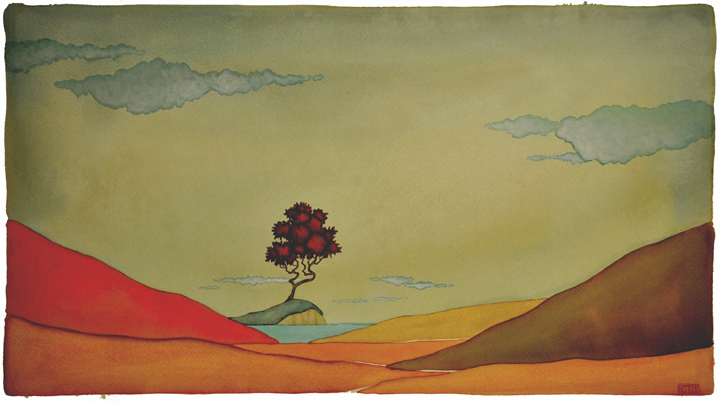


 Redtree Times