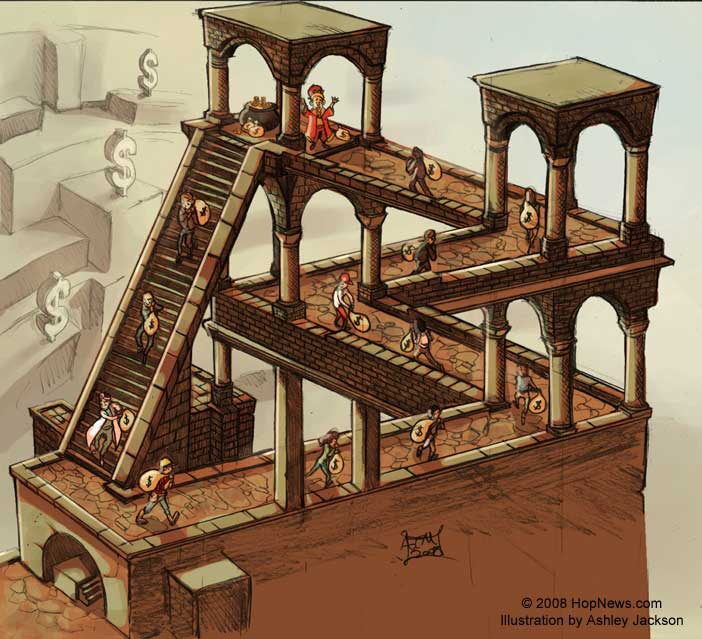
 When I first heard the term trickle down used to describe supply-side economics, the idea that giving tax-relief to those at the highest income levels will cause them to create more jobs for those in the economics classes below them, I was around twenty years old. I was working in a factory where the management was constantly striving to get more and more from its workers for less and less. There was no sense of any sort of paternal feeling from this company.
Their job was to extract the most financial return from us at the lowest possible expense.
I had no problem with this concept. That is just a fundamental of business.
But I knew that without the protection of our labor union and governmental agencies like OSHA, they would pare away at us without mercy. They would pay us less and less. They would change job specs to require less and less manpower, to the point where many jobs became exceedingly difficult and dangerous. It was a neverending struggle to maintain our status quo, to keep a fair, decent wage and a safe workplace, against their onslaught.
So when I heard about the trickle down theory, I was somewhat suspect. Even at that age, with little life experience, I could see what would happen. Oh, there would be a tiny trickle in the form of a few jobs but most of the cash would go into the coffers of those at the top and stay there. They were at the top because they had a drive to continually make more and more. Giving them more wasn’t going to make them spend more. It would only serve to whet their appetite for even more wealth and power.
It seemed so obvious.
Now , the term is being bandied about again as the talk of the day turns to extending the Bush Tax Cuts of the early part of the decade. Don’t get me wrong. I don’t enjoy paying taxes any more than the next guy. But the wealthiest 3% of the population are paying less now than at any point in the last 70 years. The real income of the average American has been flat for over 20 years yet the growth rate for this top level over this same time period has been astronomical, creating a wealth gap between the haves and have-nots that rivals the days of the robber barons. Our national deficit is growing and there is a need to raise revenues. Oddly enough, many of the same deficit hawks who think it is our number one economic priority at this point to cut our deficit are calling for the Bush Tax Cuts to be extended. I say oddly because this will add a cool trillion dollars or so to our deficit.
You can’t have it both ways, folks.
It’s always perplexed me how this concept of giving money to the wealthy will somehow benefit the lower classes and over the decades since I have seen no proof that this works in any way. Interestingly, yesterday on CNBC I saw one host, Erin Burnett, interviewing a proponent of extending the tax cuts , ask him if he had any proof, any real data, that this idea of trickle down economics had ever worked. He was at a loss for words and basically said no but taxes are bad. You see, that’s the problem. This is a theory that doesn’t work but is easy to sell to the masses by simply spouting the taxes are bad mantra over and over, even though the masses are little affected by the relatively small tax raises in the higher brackets. There was a good article on the Financial Times of London’s website from Martin Wolf called The Political Genius of Supply-Side Economics. Very good read.
If you’re not sure how trickle down economics work, here a little primer from Stephen Colbert:
| The Colbert Report | Mon – Thurs 11:30pm / 10:30c | |||
| The Word – Ownership Society | ||||
|
||||
 Redtree Times
I was so delighted to find and subscribe to your blog based on a love of your artwork, but I’m finding that I love more and more your jaunts into culture and politics. I feel even better knowing that the soul on the other side of the art that I love shares my values and beliefs. This post was brilliant.
Thanks, Rebecca. It’s a tricky thing, mixing politics into a site that basically focuses on my work, always being a little wary of appearing too partisan in my politics for fear of offending someone to the point it might affect how they see my work. But I try to only make points that appeal to some sort of common sense and belief in common good that is obvious to those of all political persuasions. There’s enough rhetoric out there already.
I could write for days about how we’ve been sold down the river by the followers of Ayn Rand and Milton Friedman. But I won’t. It only raises my blood pressure.
So I’ll leave it at this:
Rebecca, don’t toss around words like brilliant when referring to one of Gary’s posts. It will only swell his head and soon he’ll be so enamored with himself that all he’ll paint are self-portraits.
And no one wants that. I mean, have you seen Gary?
Don’t worry about my head swelling, David. Cheri keeps a long hatpin at the ready, poised to poke whenever I get too full of myself. At this point, my head looks like a bloody connect-the-dots puzzle.
I know what you mean about writing for days about the likes of Rand and Friedman. I only mean to write a paragraph or two but there is just so much opposing data that I just never know when to pull away and even then, I feel as though I’ve left out crucial points. So, like you, I try to stay away from writing about such things. I just can’t believe how hard they keep trying to sell us supply-side economics, even though it’s obvious a failed concept. I think they had it right in the late 19th century when they called it horse-and-sparrow, meaning that the more oats you fed the horse the more that would find its way through the horse for the the sparrows to glean from the horse-apples. 120 years ago and even then they could see it was a load of crap.