Feeds:
Posts
Comments

Archive for March, 2012

“Known in New Orleans art circles as a sort of ‘Goya of the ghetto,’ Ferdinand has described his work as rap in pictures, while some critics have placed his utterly honest depictions of inner city decay within the social realist tradition of Courbet.” —Times-Picayune

****************************

I was on a site that had a few images of some self-taught and outsider artists and saw one of the pieces from Roy Ferdinand.  In a lot of the work from outsiders artists there is often a child-like quality in the work, a feeling of naivete expressed in the rendering and brushwork.  Looking at Ferdinand’s work, there was a definite sophistication and stylization that really differentiated from the typical outsider.  It made me want to know more about this guy and, in my search, I came across the quote above calling him the Goya of the ghetto,  pretty high praise, I was really intrigued. 

Ferdinand was born in 1959 and hedied from a long battle with cancer in 2004 in New Orleans.  Though his work showed more sophistication, he did share much in common with other outsider artists.  Coming from a world of poverty, for example.  He depicted the hard world of the urban streets of New Orleans.  Often, there was implied violence and explicit sexuality in his work, with gangsters, drug dealers and junkies, pimps and whores often populating his images.  The pictures were gritty and tough snapshots of his time and place.

And while much of his work dealt with the harsher elements of his life, Ferdinand also painted the everyday gentler side of his world, providing a full view of his New Orleans.  I particularly love this piece, showing an older woman holding a piece of corrugated metal with a rough outsider-ish image painted on it.  I suspect it is her own painting she is holding from the gentle smile of pride on her strong face, which is rendered with tenderness, and the other piece of corrugated metal in the bottom corner with a simlilar painting on it.  Moreover, it’s just a lovely image and moment, far removed from the world he often painted. 
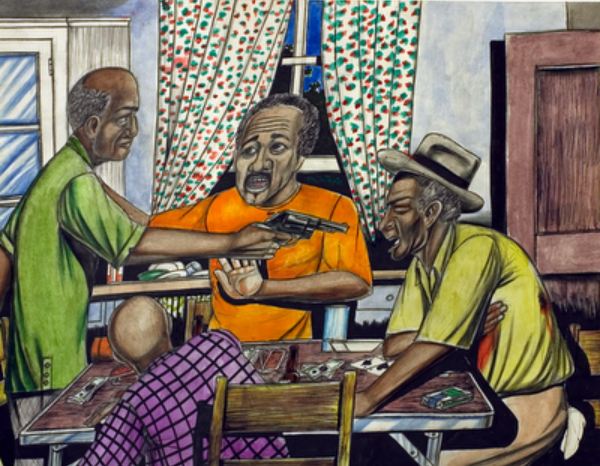
To my eye, his work has real eye appeal.  The colors work well together and there is a real harmony in the images as a whole.  The drama of many of his scenes only serves to make these images more compelling and probably will make them grow in stature through the years.  It would have been interesting to see what Roy Ferdinand would have painted in the aftermath of Katrina.  It would have been epic work for an artist so tied to the streets of New Orleans.  It’s a shame such a distinct and powerful voice wasn’t around to document it.

Read Full Post »

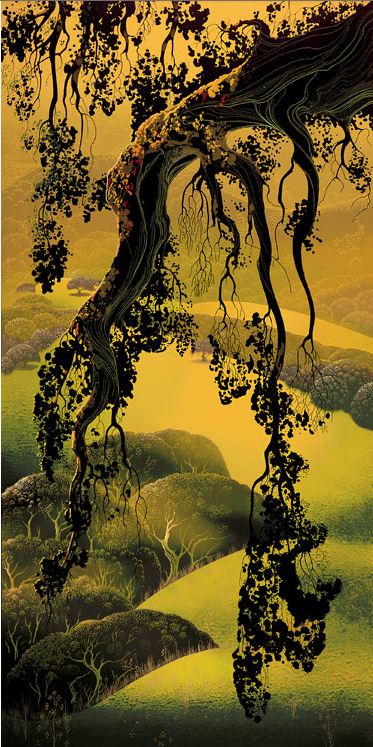
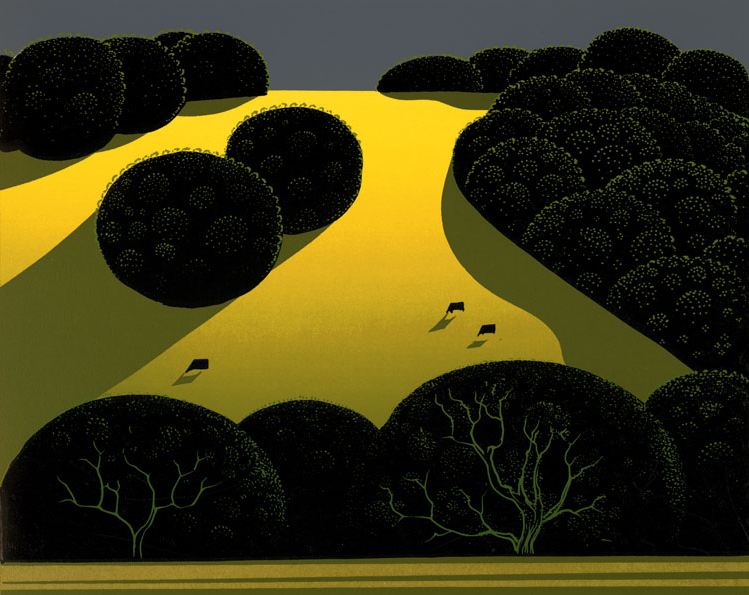
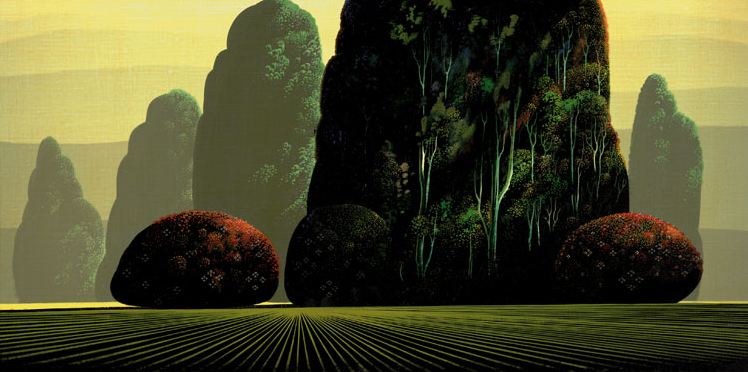
I recently picked up  the second volume of The Complete Graphics of Eyvind Earle, a 9-pound behemoth of a book featuring the work of the artist who I have written about here once before.  It’s an incredible book, full of spectacular imagery and pure color that I find both inspring and humbling.  He had a tremendously long career, about 70 years, that began with a one-man show at the age of 14 and continued through stints as a fabled Disney artist and graphic artist known for his  highly stylized greeting card design.  Through it all, there was an amazing consistency and brilliance to the many pieces produced by a prolific artist in such a long career.  I find myself overwhelmed by the variety and quality of his work as I go through the book which only covers a small part of work.

Just incredible.

There’s great clarity in the work of Eyvind Earle.  The compositions are often both complex in design but come across as simple, a duality that I really find appealing.  The color is bold and could be a little sharp in tone if it weren’t harmonized so masterfully within the picture plane.  He is a pure genius at handling harmony and contrast– another duality that strikes me. 

I also like the fact that Earle was an unabashed landscape artist, feeling no desire to express himself  through figurative work.  He found total expression in his handling of the landscape around him, often depicting the open spaces and coastlines of California. They are not mere scenes but have emotion and a depth that goes well beyond the surface, another aspect that appeals greatly to my  desires for my own work.  In short, it’s just beautiful work and an inspiration with every look.

Read Full Post »

And therefore as a stranger give it welcome.
There are more things in heaven and earth, Horatio,
Than are dreamt of in your philosophy.

Hamlet, Act I, Scene V

^^^^^^^^^^^^^^^^

I call this new painting Heaven and Earth.  It’s about 7″ wide by 35″ tall on paper and is very much in the same vein as the very  large painting that I recently completed and featured here, The Internal Landscape.  This piece features a nocturnal scene however with a deep blue sky punctured by the light of stars.

The title might refer, in a way, to the lines above from Shakespeare’s Hamlet, where Horatio and Marcellus barge in on Hamlet’s conversation with the ghost of his father.  Horatio is a rationalist, philosophically, and to him  the idea of ghosts seems absurd so that when Hamlet asks him to swear to not  speak of what he has seenl he is mystified.  Hamlet then utters the lines — There are more things in heaven and earth, Horatio,/ Than are dreamt of in your philosophy.

I suppose this painting is saying much the same thing, that we live both in the world that we know and in a world of which we are unaware.  The stars above are, and have been, always with us but we know little of them, really.  The river  runs but we often know little of its journey and the roads travel to places we shall never see.  And around us at all times are radiowaves carrying voices and images from every corner of the globe, unseen and unheard.  And perhaps among all this  are the ghosts like Hamlet’s father, moving unnoticed by our eyes focused on that which we know and see.  Or, at least, are trying to know.

I guess the takeaway here is that there is often more than meets the eye, even when the scene before you might seem enough.

Read Full Post »

He draws earth as another might draw the exciting and desirable strong body of a man or woman.  His earth is essentially a naked savage earth living out of doors, not so much a cruel and terrifying savage as a wild and free one.

–Grant H. Code on the work of Rockwell Kent

**************************************************

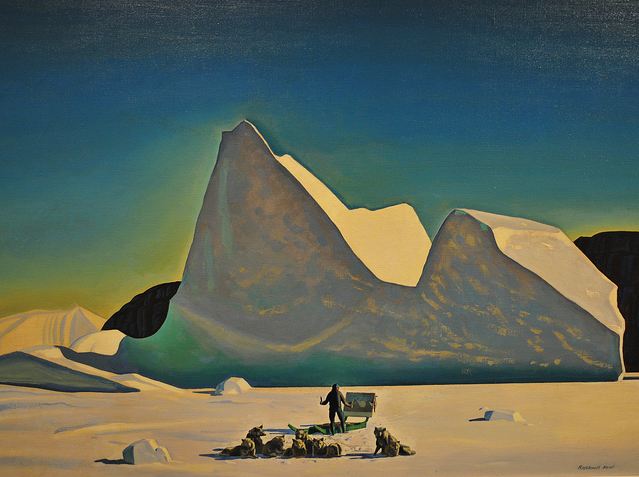
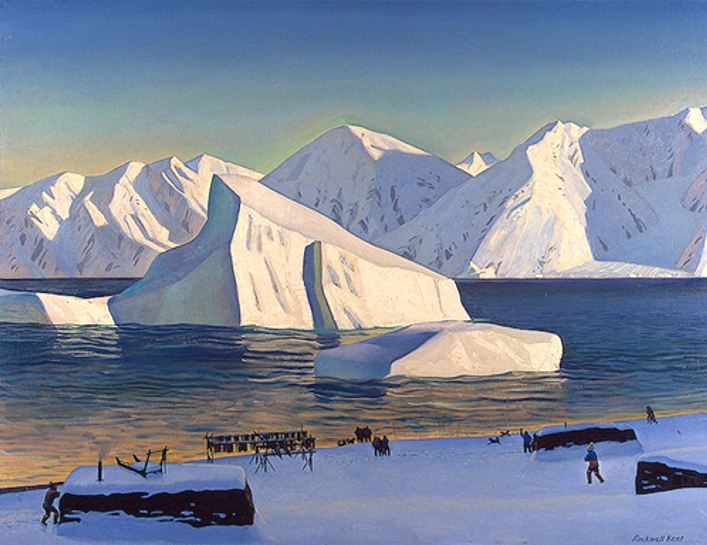
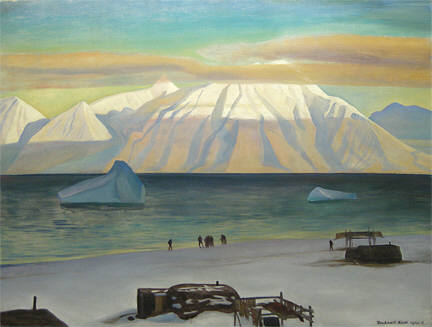
I’ve written about my admiration for the work of Rockwell Kent here in the past, about how his landscapes have a mystic feel, seeming more than mere depictions of this world.  There is an existential aura about them so that when I look at them there seems to be  an added layer of mood and emotion.  It reminds me of the paintings of Edward Hopper that have that peculiar feeling that hints at more than the scene depicts. 

Some of my favorite pieces from Kent are his Greenland paintings, done during the several extended periods that he spent there during the late 1920’s and 30″s.  The colors are beautiful and clear with subtle gradation in the sky that gives it a light and free feel with massive icebergs and mountain faces providing a wonderful counterweight.  As the writer Grant Code wrote above in 1937, Kent  depicts a landscape that is wild and free, not a cruel and terrifying savage.  It’s just spectacular work that has an ethereal air that I can only hope for in my own work. 


Read Full Post »


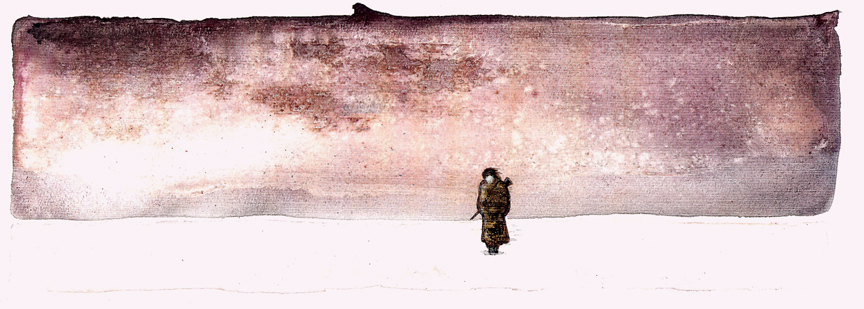
I woke up very early this morning with many things running through my mind.  All sorts of thoughts and  imagery crowded my thoughts and I found myself thinking of this painting above, Strange Victory.  It was painted many years ago and this is the only image I have of it, a bit more washed out than the original so it doesn’t quite catch the subtlety of the snowfield.  It has long been a favorite of mine as well as of my wife who calls it the Dr. Zhivago painting.  It is perhaps the piece I regret letting go most of all but at least I know where it is and know that it is well cared for with its current owner.

I particularly like the barren feel of the snowy plain and the way the sky dominates and sets the emotional tone of the piece, its red tones set against the cold setting in a way that makes the moment seem large as the figure trudges slowly forward.  The rifle slung over his shoulder with the gun  barrel down gives it an ominous sense, as though this figure was returning from battle or returning empty-handed from a hunt for sustenance.  The moment just seems to loom large in this piece.

The title came after the painting was complete and was based on a favorite poem from Sara Teasdale, the great and tragic American poet.  It is short and elegant, filled with the grand emotional swing of going from the depths of despair to an elation in finding someone familiar who has somehow survived where others have not.  To find this simple discovery as something to rejoice of in the face of  what seems to be total loss.  Just a powerful statement of existence.

So, while I am up much earlier than I normally would be, I find myself thinking of this painting and these words.  There are worse things…


Strange Victory

To this, to this, after my hope was lost,

To this strange victory;

To find you with the living, not the dead,

To find you glad of me;

To find you wounded even less than I,

Moving as I across the stricken plain;

After the battle to have found your voice

Lifted above the slain.

Sara Teasdale


Read Full Post »

Triumphant One

A new painting, this a 16″ by 20″ canvas that I call, for now,  Triumphant One.  I’m still mulling some other titles, most concerning some form of the word triumph or alluding to the word labor as symbolized to me by the various patterns running through the fields.  I originally considered The Triumph of Labor but felt that it might be too easy for the casual viewer to read that as a political statement.  And, though I have long sided with the cause of organized labor and the aspects of  it that have long benefitted us as a people,  that is not what I saw for  this piece.  It was smaller in scale, more personal in how it spoke to me.

To me the triumph of labor I saw was both in the final product, as I see here in the Red Tree as it basks under a brightening  sky, and in the sheer act of the labor itself.  The fields, to me, represent not only hard work in how they are shaped and developed.  They also symbolize a sense of joy in the actual doing, a pleasure inherent in the sense of purpose that is acquired from this labor. 

And that’s what in see in this piece– both joyful triumph and a sense of purpose.  The joy of simply working at what gives one pleasure and meaning.

Read Full Post »

I don’t want to get into the habit of revisiting past blogposts here, as I did the other day when I reposted a blog on the similarity between a painting of mine and the trees from Dr. Seuss’ Lorax.  But there is a painting that I wrote about back in March of 2009 called Endless Time that I really wanted to revisit today.  It’s a personal favorite and one that hangs in my studio, always giving me pause when I let my eyes rest upon it, as it did in the very early hours of this morning.   It has dwelt here for a couple of years now and remains special for me, always making me think. 

Or better yet, not think.

   There is something in it that is as definitive of all that  I desire from this world and of myself as anything I have ever painted.  It makes no overt appeal to the viewer, like nature, not giving a whit if you enter or not.   It has gifts to offer for those who make the effort to enter but there is no path inviting them in.  No beckoning tree or clusters of humble homes.  It simply is. 

Here is what I wrote back in March of 2009:

I wanted to talk a little about the piece shown here, Endless Time, which is a 24″ X 30″ canvas. This is what I consider a performance piecemeaning that I have performed several paintings that have a similar palette and composition in different sizes.

Each piece has its own character and feel, distinguished by differing color intensities and textures. The colors of each are similar but have their own peculiar colors due to the factors that make my color palette differ from day to day. Things like humidity and temperature, different gessoes that I use with differing absorption rates and my own lack of consistency in mixing color.

I call these performance pieces because I equate painting them to a musician performing their own composition. The musician may often change bits of their own compositions, changing things like tempo or intensity. Changing the coloration of the notes and how they’re played. The composition is intact and is identifiable but each individual performance has its own character, its own wealth.

You may notice something quite different in this piece as well.

No tree. No red tree. Nothing…

This is really a direct descendent from my earliest work that focused on open spaces and blocks of color, work that was meant to be spare and quiet. The weight of the piece is carried by the abstract qualities of the landscape and the intensity of the colors.

With this piece, I have chosen to forego the kinship that the red tree often fosters with the viewer, acting as a greeter inviting them to enter and feel comfortable within the picture plane. In Endless Time the viewer is left to their own devices when they enter the picture. There is no place to hide, no cover. They are exposed to the weight of the sky and the roll of the landscape. They are alone with not a sound nor distraction.

It becomes, at this point, a meditation. One is not merely looking at a landscape. To go into this painting one must be willing to look inside themselves as well.

And I think that is where the strength of this piece dwells. I hope this is evident to some viewers and they feel welcome to enter this quiet space…

Read Full Post »

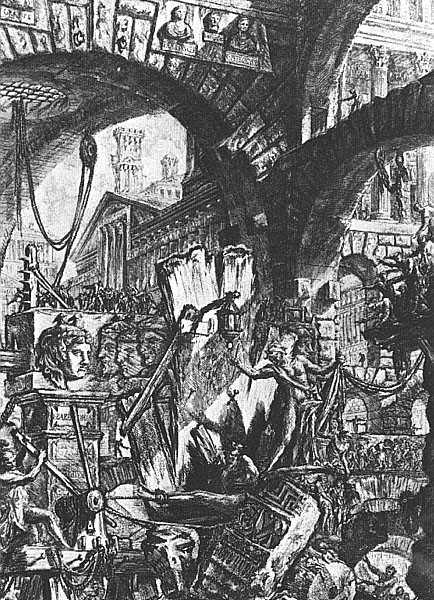
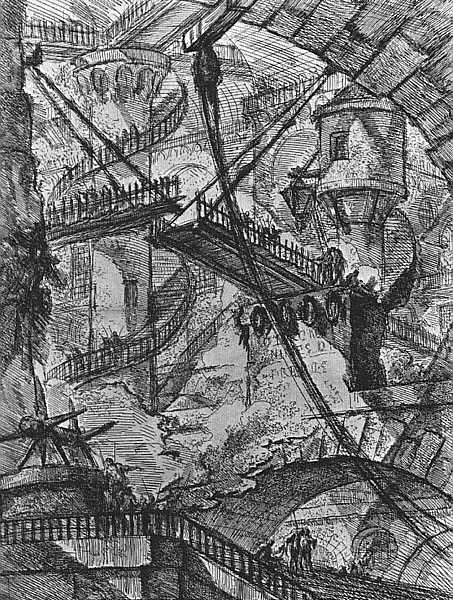
I consider my landscapes to be internal, which is to say imaginary. Places that represent a place where I wish to be or at least have the feeling of it in my real world.  Places that act as refuge from the sometime harshness of the real world.  Giovanni Bauttista Piranesi had a much different sort of internal world.  Piranesi (1720-1778) was an Italian artist who gained fame for his engravings of the views and architecture of Ancient Rome.  He meticulously measured the ruins of Rome and would recreate them as they had once stood.  Beautiful work.

But he is also well known for a series of engravings issued  in 1745 and reworked and reissued in 1761.  These were his Carceri  d’invenzione, or Imaginary Prisons.  They were dark and foreboding visions of cavernous subterranean prisons with twisted , strange stairways that foretell the work of the M.C. Escher and ominous machines of torture.  Over the centuries they were cited as being very influential on the writers and artists of the Romantic and Surrealist movements. 

They’re very intriguing and they are filled with layers of detail, the result of his time spent among the architectural wonders and ruins of Rome.  There is a site, CGFA, which has the entire series of prints online.  Below is a wonderful video created by Gregoire Dupond that takes you on an animated  journey though the details of these internal  prisons. It’s really interesting and worth a look.  It’s in high-definition so you can put it up full screen to capture all the details.  

Piranesi Carceri d’Invenzione from Grégoire Dupond on Vimeo.

Read Full Post »

I saw a news analyst yesterday discussing the ongoing Republican presidential primary who was discussing the general lack of enthusiasm for this group of candidates, both within the party and across the country as a whole.  None of these characters had sparked any real fires in the hearts and minds of the populace. The analyst admitted that he was a Democrat so he was somewhat pleased but he then made a point that really stood out for me. 

 He said this group of candidates’  lack of imagination and the ability to produce a single big idea were the most disturbing aspect of this whole fiasco.  They had not given us, the citizenry of this country, anything that made us dream forward, made us want to rally behind them.  They had not challenged us in any way, save for one feeble effort from a damaged and bitter Newt Gingrich who pandered to the Florida space community by proposing what I think amounted to senior citizen housing on Mars.

This lack of vision and imagination is not only bad news for the Republican party effort but is detrimental for the entire country.  It allows the Democrats to not have to respond with an even bigger vision of their own, lets them run simply on a smaller scale, missing a grand opportunity to unite the citizenry behind the type of grand idea that might define us as a people.  Think of JFK proposing the Peace Corps as a candidate in 1960 or his challenge to us to  put a man on the moon by the end of the decade.  Or FDR and the sweeping New Deal porposals of his 1932 campaign.  Ideas that put our vision forward in a united way instead of focusing on the divided present.

I don’t see any of this group of clowns coming up with a grand vision of where they wish to steer this country.  They offer the same old proposals of  trickle down economics and tax cuts for the wealthy that have been a drag on this country for over 30 years.  They offer no hope, no inspiration for betterment  for anyone trapped in the lower classes of our society.  They certainly don’t give us a vision of the future that unites us as a people, bound together by a single large goal. 

I know that it may be asking too much for someone running for president but I  wish they would come up with a single  big idea.  Perhaps I couldn’t get behind it but at least it might spur an even bigger and better idea that would excite me and millions of others to action. 

 And that would be something to see.  Just imagine what we might accomplish…

Read Full Post »

« Newer Posts - Older Posts »