Feeds:
Posts
Comments

Archive for March, 2013

GC Myers 2013- Redemption BayEarly last week, I wrote about spending several hours working on a piece that seemed to go nowhere, had no rhythm or flow.  I was trying to force things that just weren’t there and the whole thing gave me an anxious feeling.   I  decided to count  it as a momentary setback and painted it over, erasing the failure and creating a clean slate on which to build something new .  I then went to work, trying to quiet my mind and letting the piece grow bit by bit.

This is what has emerged.

I am temporarily calling this painting, a 36″ by 36″ canvas, Redemption Bay.  It’s obviously named for the effort in reversing a failure but the name may fit in other ways, as well.  I’m still reading it and trying to decipher exactly what it says to me.  I can see many themes in it.  Cycle of life, external guidance and so on.

It has the flow and rhythm that was missing in the first attempt, elements meshing together to create a movement that takes the eye through and into the piece.  It’s exactly what I was trying to force in the failed attempt and came once I let the piece go on its own.   It’s been my experience that my best work comes when I trust   instincts over intellect.  I’m going to spend some time with this piece and see how it grows on me now.

So far, so good.

Read Full Post »

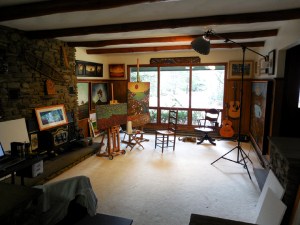
GC Myers Studio March 2013Well, the folks from WSKG came to my studio  the other day and filmed my segment for their Artist Cafe program.  As I mentioned the other day, I was somewhat ambivalent about the whole thing, never feeling comfortable painting in front of people.  I generally concentrate on the surface and often completely block out much of the world around me.  If I am listening to music or have a movie on the TV, I often miss whole passages because I am so focused.  I can never really get to that point with people around.

But the people that came to film and interview me, Tina Reinhard and Christy Lantz, were very easy to work with and I did paint for them to film.  I did limit myself to one of the primary layers of brush marks  that make up the sky on a painting that I had started a day or two before but they were able to film me while I painted.  It’s work that requires just random strokes, most of which will never be seen but are integral to the way I work.

Overall, the interview went fairly well.  At least I think it did.  Both Tina and Christy seemed to think it went well, although based on their genial natures, I would be shocked if they told me it was awful.  The questions were basic and I stumbled several times even on the questions that I’ve been asked a hundred times before, with some answers less complete than I wished they might have been when I thought about it later.  It’s good that it’s not a live segment so that a lot of tape and editing can make me at least sound coherent.  It’s only a 5 or 6 minute segment so you never really know what clips are going to be chosen to be shown.  So even though there seemed to be a direction in which the interview was moving, I won’t know until I see the final product if it was the same one that I thought it might be.

Again, thanks to Tina and Christy for being so gracious while working with me.  Both are seasoned pros so they weren’t flustered by anything.  I am currently cat-sitting my brother-in-law’s round tiger cat, Lucky, in the studio.  I thought she might run and hide when they showed up but she was instantly attracted to both of them, swatting at cables and climbing in their gear bags.  Lucky for Lucky that they were both cat people.

During the shoot Lucky began running through the studio, between me and the camera which made me look and laugh as well  as provide loud thumping noises from her paws which were audible on the film.  I decided to confine her to a bedroom at the other end of the studio but while we filmed, her pleading meows came through loud and clear on the recording.  we took a short break and Lucky was sent to cat prison, Cheri coming to take her safely out of earshot.  Tina and Christy took it all in stride, thankfully.  You can see Lucky under the window in the photo above as well as the painting on the easel on the left that I worked on during the shoot.

Tina said that she thought it would be sometime in mid to late May.  I will let you know when the program will definitely air and when it will be available on their YouTube channel.  Maybe…

Read Full Post »

Norman Rockwell- Breaking Home TiesI was looking at the shelves above my desk yesterday and spotted two books of Norman Rockwell paintings that I haven’t looked at in some time.  It made me realize that I’ve barely mentioned Norman Rockwell here on the blog which seems all too fitting– his work was so consistently brilliant and ubiquitous that it is often easy to overlook him. Or downplay his talent, as it was such a common thing to do among critics, especially in the 70’s and 80’s when Rockwell was definitely not cool in any sense of the word.

Norman Rockwell- The HomecomingThe critics of that time saw his work as often being overly sentimental and trite, a painter of  an idealized American dream that didn’t deal with the quickly changing world.  But that was merely the result of Rockwell meeting  (and exceeding) the requirements of the multitude of  illustration assignments he received throughout his career.  He painted to meet the desires of his clients and they wanted narrative images that were immediate and deep in their meaning, images that were not ambiguous in any sense.

Which is exactly what they got along with a magnificent chronicle of the last century.  Along with some incredibly beautiful painting, work that elevated these images from simple  illustration to grand art.

Norman Rockwell - The Four FreedomsI love  the immediacy of Rockwell’s work, the fact that you are easily swept into the narrative that he creates.  It is instantly accessible and speaks in a universal language of emotion.  But it’s the color of his work, the darks and lights and the way in which he handles them and places them within the compositions, that moves me.  They are something out of a rich and pure dream, colors that give me a deeply felt satisfaction.  I certainly don’t paint in any way like Norman Rockwell but I still long for his colors.

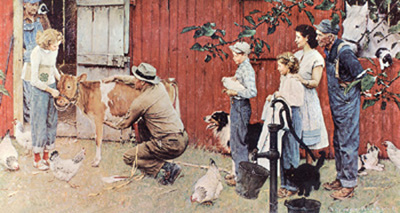
I remember seeing his scene of a farm family during a visit from the vet who is checking out the young daughter’s calf , shown below.  The painting was hanging at our local museum as part of a traveling exhibit and from a distance it was instantly recognizable as Rockwell’s work.  Tight and illustrative.  But as you came closer, you could see the beautiful marks, loose paint strokes that made up the ground on which they were standing.  It was just a wonder to see how he was able to put the piece together and have it read as it did.  It really made me more appreciate his work.

Norman Rockwell- Farm Family Scene


Rockwell’s life  (1894-1978) and long career  spanned perhaps of the great periods of change in the history of our world.   He captured us at our best and at our worst, with images that were often poignant as well as humorous.  We are so fortunate to have had such a masterful eye keeping tabs on us. Looking at his images, there are literally hundreds that I could have used for this little post.  I’m sure most of you will have images of his in your head that will immediately come forward.  It is a most remarkable body of work, one that inspires awe from my perspective as an artist.  I’m sorry it took so long to acknowledge your brilliance, Mr. Rockwell.

Norman Rockwell- The Problem We All Live With


Norman Rockwell- The Art Critic

Read Full Post »

WSKG Artist CafeI spent yesterday afternoon straightening up my studio a bit, something that I’ve been putting off for some time now.  It really needed tidying and I really did want to de-clutter the place just for the calming effect it normally has but it took the threat of  having a television camera coming in today to put me in action.  Our local PBS channel, WSKG, is showing up here this afternoon to shoot a segment for their Artist Cafe program.  It’s a weekly half hour program with three or four short stories featuring artists from a wide variety of fields.  Some stories are local and some feature folks of national prominence.

I am somewhat ambivalent about the whole thing, to be quite honest.  I am never too comfortable with anyone in my studio space, let alone a stranger with a video camera. Add to this the fact that  I am always wary of anything where I have no control over the final outcome, especially when it comes to my work, and I am made even more anxious.  I always like to set the narrative and while I may know what I will say today, I will not know how it will be presented.

But it will be good to get an idea of how my space looks to the outside world and I am to see how someone who is only slightly acquainted with my story and work will put together the segment.  So perhaps there is a positive spin to be put on this whole thing.  I have been impressed with the shows I have seen so far from this program that debuted late this past year.

Here’s a recent episode that features writer R.L. Stine, known for his Goosebumps  book series;   artist Allen Denny Smith, an Elmira artist whose recent forays into color abstractions has produced some really powerful work ; and  Lady Fiona Carnarvon , the real life resident  of the estate better known to the world as Downton Abbey– hey, it is PBS and that series has paid a lot of bills for them over the last few years!  I will let you know when my episode airs but for now enjoy.

Read Full Post »

GC Myers -High Sign  Every natural fact is a symbol of some spiritual fact.

— Ralph Waldo Emerson

*********************

I think I understand what Emerson is getting at with these words.  I know that when I look around I often see juxtapositions of natural elements– trees and stone and water and sky– which move me in ways that I can never fully explain.  Some fill me with inspiration.  Some with a sense of wonder  and great calmness.  Peaceful unity with the world.  And, with some, a sense of foreboding, a dread of the inevitable valleys that accompany all peaks.  Even those scenes which make me feel as being “in the moment” resonate because they have some underlying  connection to a deeper strand of thought or being.

I think it’s this sense of this symbology that fills in some of the gaps in my work, that gives it a little more depth than the surface offers.  I know that it is this greater sense of being that I am trying to capture in my work, hoping that perhaps others who feel this same type of  innate symbolism in the natural world  somehow sense it and connect with it.

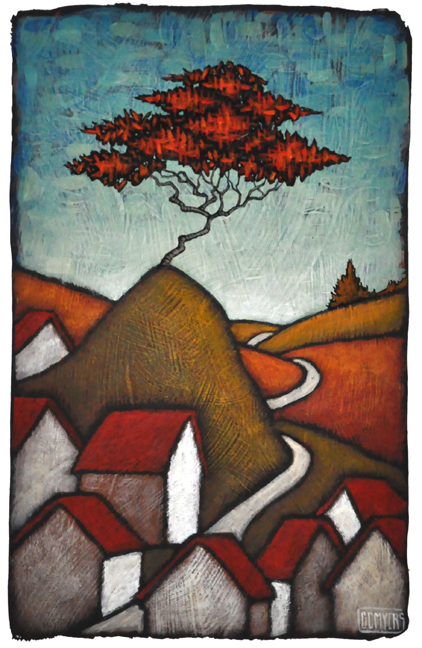
I think this newer piece, High Sign (6″ by 10″ on paper), is a good example of this.  It is a simple scene but, for me, is filled with symbolism.  Some is obvious and some subtle.   The tree and it’s position on the mound against the graded sky is obvious as is the road that winds through.  Less obvious are the upward pointing arrows of the houses’ peaks and the light and shadows of their walls.

The odd thing is that it’s not something I think about when I am painting the piece.  It’s all about achieving a sense of rightness in each move in the painting.  Each move is  step forward and if I can maintain  that feeling of rightness throughout the process, generally the painting will have this added depth, this layer of symbolism.  It comes of its own accord, naturally.   And I guess that the way it should be.

Read Full Post »

Locust Folding Bicycle Desined by Josef CadekI worked one summer many years ago as a janitor on the campus of Syracuse University. I worked in the men’s gymnasium that was attached to old Archbold Stadium, on the site where the Carrier Dome was erected a few years later. Cleaning the gyms was part of my duties there and it was interesting to watch some great athletes work out. But for me the more interesting aspect cam in the the lower level of the building where the Industrial Design department was located.

This was where the future was being designed by young, inquisitive minds who were always looking for new ways to streamline product designs for efficiency.  I worked in the lab where they created prototypes and, as they had adjourned for the summer, was able to spend a lot of time wandering around among the clay rooms and drawing boards,  gawking at the drawings and plans that had been left behind.  They were a messy bunch but it was fascinating to see how their minds perceived the function and design of  everyday items

It gave me a greater appreciation for the way products evolve.  We have a use for an item and generally start a first impression of how it should function, creating a product to fit that function.  But as time passes the function changes as does the technology and materials we employ in making these items and the design evolves.  I think this folding bicycle designed a few years ago by Czech designer Josef  Cadek is a great example.  Called the Locust, it is a lightweight bike that folds into an efficiently transportable unit.  The chain (actually a heavy belt) is fully encased so there is no oil to rub on your pant legs  and it features a circular frame into which the whole bike  folds.

I don’t know about how well this bike rides but the Dr. Seuss factor of its design sets it apart for me.  I could see the Whos in Whoville spinning around town on these contraptions.  Maybe a Dr. Seuss-like future is in store for us, after all.  There are worse things…

Read Full Post »

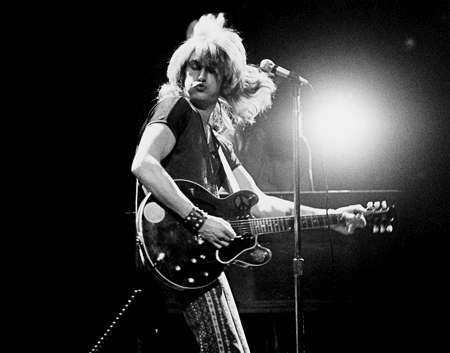
Alvin-Lee-III heard last night that guitarist Alvin Lee had died, at the age of 68, on Wednesday in Spain  from surgical complications.  I am sure the name doesn’t mean much to a lot of you but to those of you who grew up in the time of Woodstock, his name brings up memories of one of the more memorable  performances from that show.  Lee was the leader of the British band Ten Years After and their frantic version of  I’m Goin’ Home  took off when the documentary and soundtrack of that festival came out soon after.  It was electrifying stuff , then and now, and was one of the definitive moments of that landmark show.  I know that it really stood out for me even with all of the the many other incredible performances.

Unfortunately, he always felt that the attention that the Woodstock performance brought forced them in a different musical direction, more pop and away from the electric blues that he so loved and which their earlier success was built.  It’s one of those instances where success is a double-edged sword.

Lee’s biggest hit here, besides the Woodstock performance, was the 1971 song I’d Love to Change the World, which hit the Top 40 here.  It has a great sound and  in many ways expresses the chaos and uncertainty that marked the late 60’s and early 70’s.  Lee’s playing on this cut is memorable.  Here it is, in memory of Alvin Lee.

Read Full Post »

Garrett-Mcnamara-100-Foot-Wave-Nazare-PortugalThere was a story on 60 Minutes Sports last night that featured surfer Garrett McNamara‘s ride in late January of a wave outside of a small fishing village in Portugal that may have been 100 feet tall, a world record when and if it is certified by the Guinness people.  McNamara already held the world record for riding the largest wave, a mere 78 footer.  But this is a one of a kind monster.  If you’ve never seen the ocean or seen much more than a small swell, it may be hard to imagine how big a wave we’re talking about here.  It is awe inspiring and to think that someone would look out at this moving mountain of mayhem that is breaking so close to the shore and think that they might want to put themselves out in it seems like madness.

And maybe it is.  But I have to admit to being envious of the guts and ability of the big wave riders, the guys who take on the challenge of these wave behemoths that other world class surfers would run from.  To put yourself at the mercy of nature’s fury  on such a grand scale is truly elemental.  I could sit and watch these guys all day, captivated by the way they dart across the waves.

Here’s a video that I showed about four years ago that feature the penultimate surf song, Pipeline, from the Chantays.  The setting for the video is a bit odd, however.  It’s hard to imagine this music that symbolizes the wildness of the surf culture on The Lawrence Welk Show but   here it is.  It adds to the kitsch factor.

Read Full Post »

Hans Memling

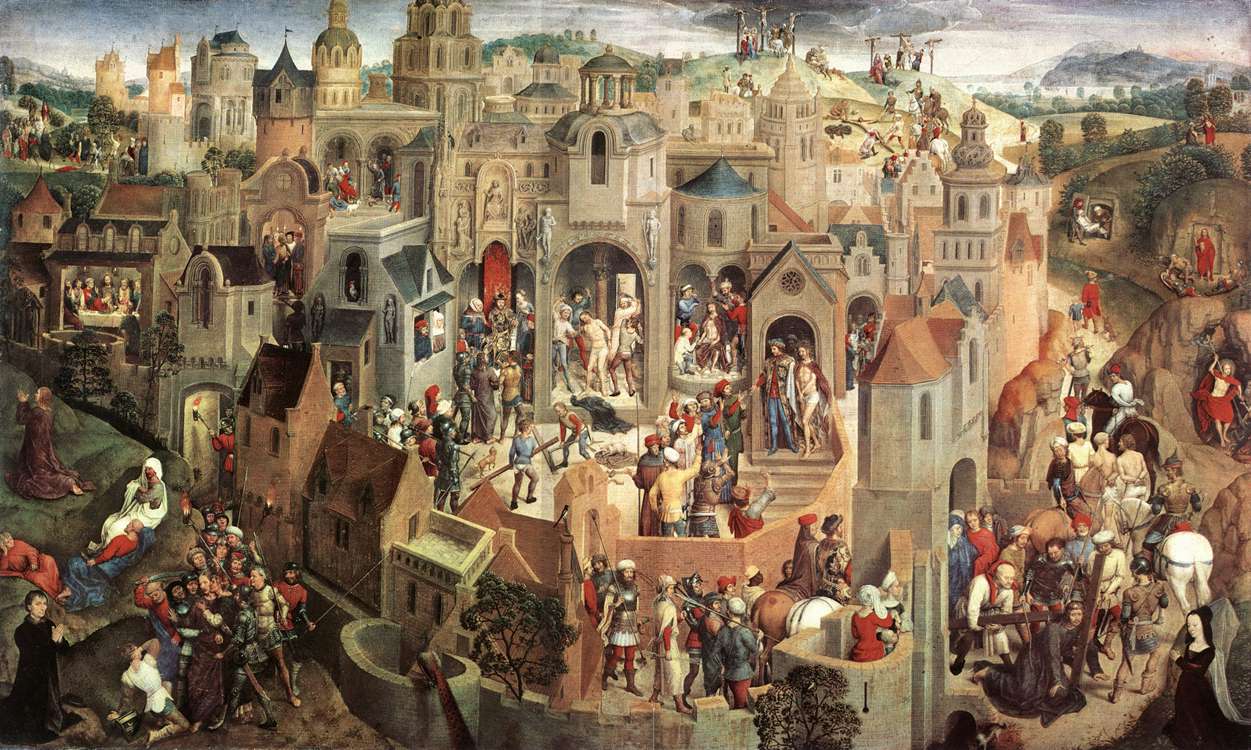
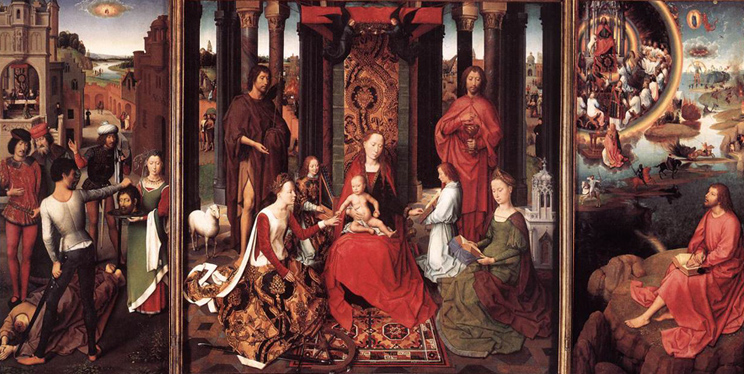
I’m not an art historian.  I try to maintain a certain knowledge about artists, especially those work I have seen and taken something from in the form of influence for my own work.  But  I am often reminded by how little I really know.  A friend recently stopped by the studio and, while looking at a couple of my large landscapes, said that their compositions reminded him of some of the panoramic pieces from Hans Memling.Hans Memling- scenes-from-the-life-of-mary-1480

I hesitated before responding, running the name through my mind, wondering if it was someone that I should really know if I wanted to call myself an artist and deciding if I should just feign knowledge of the name– “Memling? Oh, yeah…”   But I finally admitted that I wasn’t familiar with the name or the work.  Of course, after my friend left, I was online looking for Hans Memling.

And was pleasantly surprised at the beauty and power in his work.

Memling was a German-born painter who lived in the 15th century, painting in the style of the Dutch masters.  Painters, not cigars.  His work employed beautiful contrasts and deep, rich colors.   His panoramas, such as Scenes From the Life of Mary shown above, were feasts  for the eyes. Every glance offered a new and compelling vignette, each which would make a powerful painting on it’s own.  Just beautiful stuff, to use a technical term.

I know  many of you will look at his work and wonder how in the world my friend could see any equivalency between his and mine.  And that’s a fair question because they are worlds apart  in time, expression and style.  But I see  a similarity in the rhythm of the composition, the way each part plays off the other to create a harmony of movement throughout.  That’s what I take from them because I have no desire to paint like Memling or express the things he conveyed in his work.  I want to paint in my own way and express feelings that dwell within me now.  But I am moved by the rhythm and  the way they’re put together.  Looking at them made me aspire for even more in my own work.  More detail.  More areas of concentrated interest.  Greater depth into the picture plane.

Just more.

Now I know who Hans Memling is and another item is taken from the list of things I don’t know.  Hey, you do what you can…

Here are some other magnificent Memlings-

Hans Memling- Scenes from the Passion of ChristHans Memling- St John Altarpiece Hans Memling- The Last Judgement

Read Full Post »

Abraham Lincoln Tintype Medallion  1860I’m always intrigued whenever I come across images of Abraham Lincoln.  There aren’t many I haven’t seen  as his image has remained in the public eye on a regular basis throughout my life.  Growing up, in our family photos there was a small image of Lincoln that was mixed in with a handful of early photos from my great-grandmother.  I didn’t yet understand the place that Lincoln held in the heart of the American people   and wondered why it was there.  I actually felt more related to his image in that I at least recognized who he was which was something I couldn’t say for some of the folks in those old photos of people standing in front of what appears to be 1920’s automobiles in some totally unfamiliar rural farm setting .  Maybe that’s why I am drawn to his image even now.

So when I come across an image that doesn’t seem familiar, I take notice.  It’s part of trying to capture another part of the prism of the man, to fill him out as a human rather than as the icon he has become.  The token shown above, obviously a souvenir from the 1860 campaign, is new to me.  Lincoln is still youngish in appearance, not yet showing effects that the ravages of the weight of a nation at war would  appear  in later photos.

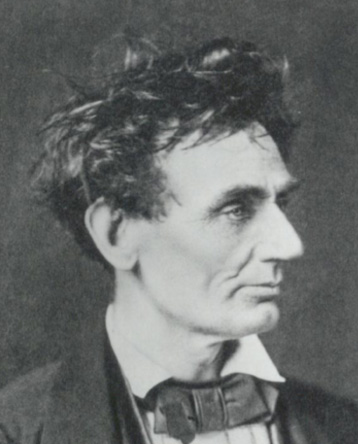
Abraham Lincoln- Early with Wild hairThis photo on the right brings up questions.  Why was his hair so wild?  Would he not have been aware of that when he agreed to sit for the photo?  It’s not like there was a paparazzi at that point snapping candid shots at every turn or a White House photographer documenting every moment.  You had to more or less pose for most photos.  But I like it.  Again, it fills out the man.  And it makes me feel a little better about my own crazy professor hair as I sit here.

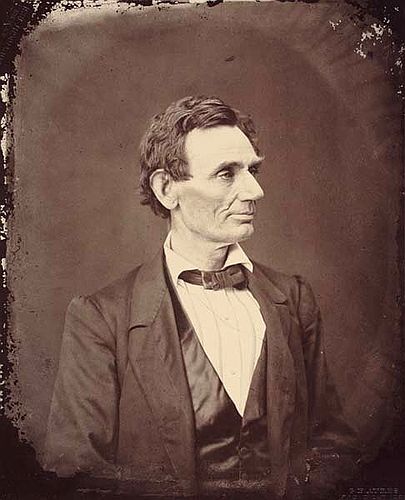
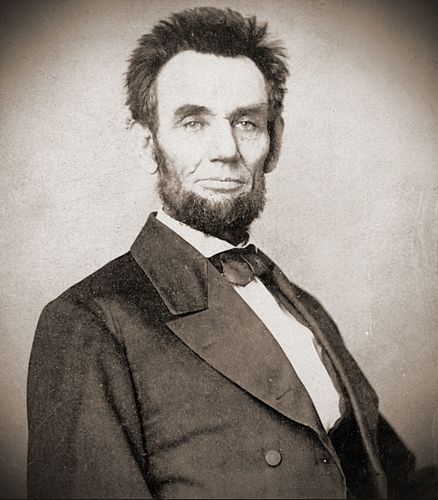
There are a few more images below and some of them are a bit more familiar.  The first one seems to be a shot from the same sitting as the wild-haired one above.  Maybe the photographer noticed and offered up a comb.  I don’t know.  The second is from the War years and he has began to age.  But it’s a noble and strong image with that steely look of determination staring directly into the camera. The last is an earlier image when he is obviously not as consumed by the tasks before him.   But all are interesting in their own way and give us more insight into this most compelling character.

Abraham Lincoln George Ayres 1861

Abraham Lincoln- Alexander Gardner 1860s

Abraham  Lincoln-attributed to Nicholas H Shepherd

Read Full Post »

« Newer Posts - Older Posts »