Feeds:
Posts
Comments

Archive for November, 2021

Imitatio

Imitatio sm


Life imitates art far more than art imitates life.

— Oscar Wilde, The Decay of Lying, 1889


Mimesis. The act of imitation.

The classic philosophers Plato and Aristotle both held that all art was reflective, imitating nature or the world of life around us.

Art imitates life.

Oscar Wilde and other writers throughout the years have challenged this thought. Wilde’s assertion was that humans are basically imitators whose aim is to express themselves and that Art offers a variety of forms or templates in which they might realize that aim.

Life imitates art.

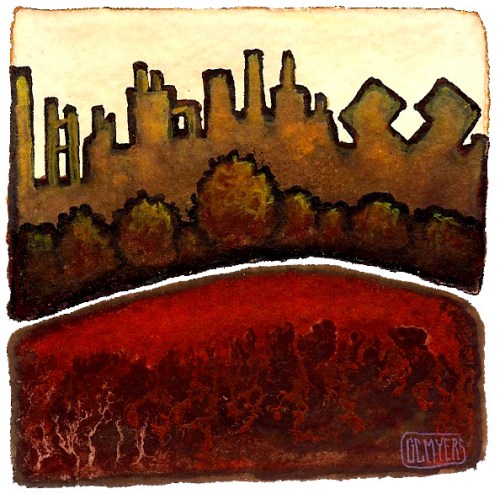
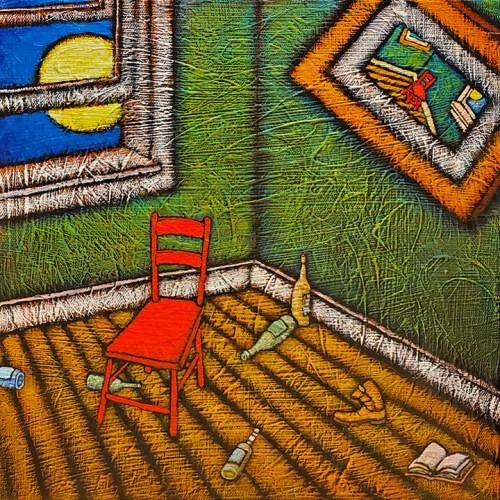
This question of whether Art imitates Life or vice versa is the idea behind this new painting, a smaller 12″ by 12″ canvas that I am calling Imitatio. I am not sure which side this piece takes.

Maybe both?

Life imitating Art might make the most sense here. The scene in the painting– the Art here–is much more orderly while the scene representing Life is cluttered and in disarray. Life, even in its best attempts to imitate Art, is generally messier and subject to the whims of character and conflict.

But again, I can’t be positive of this in this case.

Maybe it should be a little of both, with a flow running back and forth between the two, Life and Art. This in turn forms an endless cycle, a sort of perpetual energy creator.

Now, that sounds like the best option. We may have a winner here.

And I can live with that…

Read Full Post »

Skyline Blues

996-404


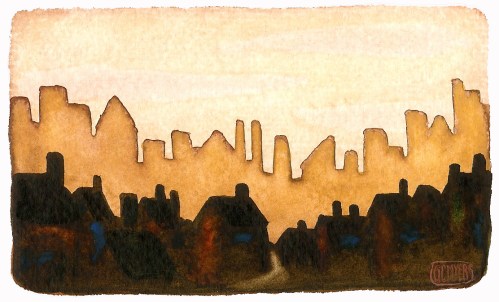
GC Myers-  There Is Still a Sun...I’m a little behind this morning and my computer is acting sort of wonky so I am going to keep it short. Maybe just play a piece of music to accompany an older piece or two from a group that I painted about 15 years ago.

They were small cityscapes, mainly simple skylines that were actually more about color and shapes. I always enjoy going back to these and wonder why I don’t revisit this.

Maybe I will sometime soon. You never can tell.

To go along with these pieces here’s a bit of  piano from contemporary boogie woogie pianist Henri Herbert. It’s New York Skyline Blues and features a great view of NYC from where he’s playing. Even with the spectacular views, I still find myself watching those hands.

A little boogie woogie– it’s always a good way to kick off the day, right? Get’s the blood moving.

I feel mine moving right now…


996-430 Moving On Up

Read Full Post »

The Last Paintings

artists-last-works-Stuart davis 1964

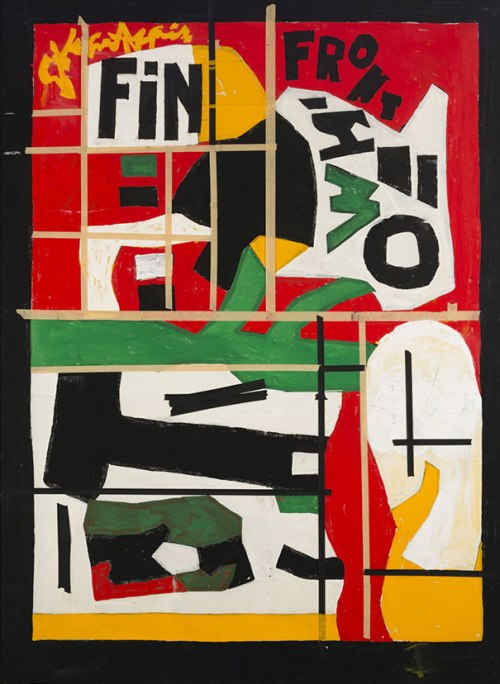
Stuart Davis — Fin ,1964


We had dinner with our good friends last night and somehow the conversation came around to the idea of me painting until the last moment of my life. No retirement here, I guess. We agreed that my final painting should have a big slash of paint, most likely red,  going down through it, made while I slump to the ground for the last time.

I suggested that maybe I paint one now just to insure that I am not caught off guard. Death can sneak up on you sometimes and foil your best laid plans. 

Of course, that was all in fun but it made me think about the final paintings of well known artists. There are plenty of great examples. Some are complete and well known pieces by these artists in their final days. For example, Claude Monet‘s last work was the completion of his massive multipart mural the Grande Decoration. An epic and fitting way to finish to his painting life. Or you can look to the final painting Edouard Manet, A Bar at the Folies-Bergère, which may be the best known of his works. Or there’s Paul Klee and his The Last Still Life, which was titled by his son after his death.

My favorite final painting is the one shown here at the top, Fin, from Stuart Davis. On a June night in 1964, after watching a French movie on TV that concluded with the word “fin” (which means “the end” in French), he added the word on the painting on his easel before going to bed. He suffered a stroke that very night and died in the ambulance while on the way to a NYC hospital. It truly was the last painting for him. Fin.

Both Diego Rivera and Frida Kahlo painted watermelons the subject of their final paintings. This is fitting because the watermelon is a symbol associated with the Mexican Dia de los Muertos, the Day of the Dead. In Rivera’s case, he didn’t want to paint it but did so at the insistence of a collector. Maybe he knew it would be his last painting?

There are some final paintings that are unfinished, the process cut short by death. I don’t believe Keith Haring‘s final piece, Unfinished Painting from 1990, shown below, falls in this category. I think it was meant to appear unfinished as a statement on the lives, his included, being cut short by AIDS at that time.

A favorite of mine from the unfinished last paintings is The Bride from Gustav Klimt, shown below, mainly because it reveals an interesting part of his process which was that he would paint his figures as completed nudes before painting on their clothing. I don’t know if that was simply part of his process or part of his deeper sexual obsessions. Either way, it’s kind of interesting.

There are plenty of other examples and there will be plenty more in the future, I am sure. Artists don’t really ever retire, after all.

Now, I have to go. There’s an unfinished painting waiting for me put a red slash through it…


artists-last-works- monet The Grandes Décorations 1920 26

Claude Monet- The Grandes Decorations mural

artists-last-works-haring 1990 Unfinished Painting

Keith haring- Unfinished Painting 1990

artists-last-works-Klee the last still life 1940

Paul Klee- The Last Still Life, 1940

adorn the bride with veil and wreath by Klimt.jpg

Gustav Klimt- The Bride, 1918

artists-last-worksKahlo Viva La Vida

Frida Kahlo — Viva La Vida, 1954

artists-last-works-Rivera The Watermelons 1957

Diego Rivera– The Watermelons, 1957

Read Full Post »

Won’t Get Fooled Again

Secret Policemans Ball 1979


I’ll tip my hat to the new constitution
Take a bow for the new revolution
Smile and grin at the change all around
Pick up my guitar and play
Just like yesterday
Then I’ll get on my knees and pray
We don’t get fooled again, no, no

Pete Townsend, Won’t Get Fooled Again


Things are finally beginning to click a little in the studio. Even though I have been through this process for twenty-plus years, it’s always surprising how quickly one or two good days of work completely washes away that feeling of mental stagnation that comes with being creatively blocked.

It’s like the blockage is a dam and once you make a crack, a trickle comes through that soon turns into a torrent And in what seems to be the blink of an eye, the dam, the blockage, is gone.

I want to say it’s forgotten but like I said, I have been doing this fo awhile now and know there’s another blockage waiting in the wings, somewhere downstream. The trick is in putting that out of mind and enjoying the ride until it comes. And maybe when it does come, the memory of this most recent blockage will help me get past this new one a little more quickly.

We all hope we absorb these little lessons in our lives so that we don’t have to constantly ( and needlessly) go through the same traumas over and over, right?  I would like to think that, like the song says, we won’t get fooled again. Unfortunately, our memories are flawed or we just ignore our own recollections and history. We often seem destined to continuously renew our relationship with the same sufferings that have haunted us for eons.

But on a personal level, maybe this time, I will finally learn this lesson and avoid the next blockage that rises up before me.

Probably not. My memory and ability to learn is no better than that of anybody else. Maybe worse than most, in fact.

But I can try to remember. It’s the best I can do.

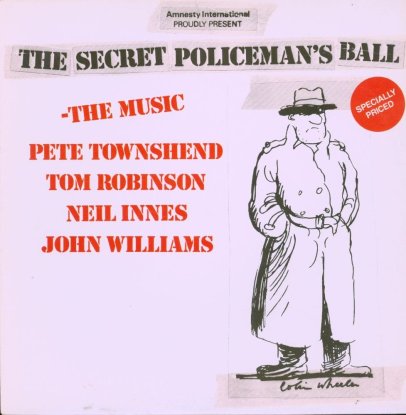
That brings us to the aforementioned song that I featuring as this week’s Sunday Morning Music. It’s Won’t Get Fooled Again from Pete Townsend. It was originally released by The Who in 1971 on their Who’s Next album and became a true rock anthem. This is the first acoustic version that Townsend performed of this song, with accompaniment from the great acoustic guitarist John Williams. It came at The Secret Policeman’s Ball in 1979.

The Secret Policeman’s Ball was a series of benefit shows featuring comedy and music performances that were given many times over the years to benefit Amnesty International. The last show was in 2012 at Radio City Music Hall to commemorate Amnesty International’s 50th anniversary. Many of the performances, like this one, were memorable.

I hope the message of this song is memorable, as well.


Read Full Post »

Style Is Character

Georgia O'Keeffe Sky Above Clouds IV

Georgia O’Keeffe- Sky Above Clouds IV, 1965


I recall an August afternoon in Chicago in 1973 when I took my daughter, then seven, to see what Georgia O’Keeffe had done with where she had been. One of the vast O’Keeffe ‘Sky Above Clouds’ canvases floated over the back stairs in the Chicago Art Institute that day, dominating what seemed to be several stories of empty light, and my daughter looked at it once, ran to the landing, and kept on looking. “Who drew it,” she whispered after a while. I told her. “I need to talk to her,” she said finally.

My daughter was making, that day in Chicago, an entirely unconscious but quite basic assumption about people and
the work they do. She was assuming that the glory she saw in the work reflected a glory in its maker, that the painting was the painter as the poem is the poet, that every choice one made alone– every word chosen or rejected, every brush stroke laid down or not laid down– betrayed one’s character. Style is character.

— Joan Didion, Georgia O’Keeffe


This anecdote opens the essay Georgia O’Keeffe that is included in author Joan Didion‘s 1979 book of essays, The White Album. I can only imagine the wonder in the eyes of her daughter along with the awe and the questions it inspired, on seeing O’Keeffe’s huge painting– it’s 8 feet high by 24 feet wide!– in a large open space.

It raises an interesting question: Is style character?

That’s a tough question. I am not positive it holds true for all artists across the spectrum of artistic disciplines but, for the most part, I would like to believe this is true if the style of the artist is genuine and true to their self.

Determining what is genuine and what is contrivance is another question.

I think the reaction of Didion’s daughter is one reliable indicator of authenticity. There is something about the reaction of a child to art that I trust implicitly. Their perception is still unclouded and intuitive and they usually don’t yet feel the need to categorize or rate everything that they come across. They have an ability to see things clearly that I sometimes think we lose in adulthood.

They just react on a gut level, quickly and decisively, to some inner intuitive cues.

In my experience, I generally am most pleased with my own work when it catches the eye or mind of a child. It’s perhaps the purest form of validation, letting me know that the work speaks on an emotional level.

But is this, the style that speaks to that child, character?

I can’t say for sure. I know a number of artists for which this holds true and I believe it is true in my own case.

Or at least I want to believe that. A person can’t attest to their own authenticity without some form of bias. That puts it out of my hands.

But I hope so. My intention for my work has always been to be transparent and open, for it to be an expression of my character, for better or worse. It is work that is meant to communicate. Or so I hope.

I don’t know that an artist’s work can ever fully mask the strengths or deficiencies contained in their character.

For myself, I am okay with that. I am willing to be judged because I know that few will be as critical of my work and my character as myself.

As Georgia O’Keeffe said:

To create one’s world in any of the arts takes courage.

And don’t we all aspire to have courage?

Read Full Post »

Past, Present, Future and Beyond- GC Myers 2021

“To live on a day-to-day basis is insufficient for human beings; we need to transcend, transport, escape; we need meaning, understanding, and explanation; we need to see over-all patterns in our lives. We need hope, the sense of a future. And we need freedom (or, at least, the illusion of freedom) to get beyond ourselves, whether with telescopes and microscopes and our ever-burgeoning technology, or in states of mind that allow us to travel to other worlds, to rise above our immediate surroundings.

We may seek, too, a relaxing of inhibitions that makes it easier to bond with each other, or transports that make our consciousness of time and mortality easier to bear. We seek a holiday from our inner and outer restrictions, a more intense sense of the here and now, the beauty and value of the world we live in.”

― Oliver Sacks, The New Yorker, August 27, 2012


I read this passage from a 2012 Oliver Sacks article and attached it in my mind to this new painting, a 10″ by 20″ canvas that I am calling Past, Present, Future, and Beyond. The meaning I pull from this piece is that we are ensnared in the three known phases of time– the past, present and future.

And none are totally satisfying. We have a need to move beyond our states of being.

The past has an appeal for some. It seems complete, set in stone, so it must be easy to comprehend and place our own roots and existence in the context of our past. But it is anything but solid. It is subject to the whims, desires, and prejudices of whoever looks back on it. Exaggerations, mischaracterizations, and pure fictionalization make history malleable as soft clay. It is and will always be shaped to fit some narrative for those in present or future times.

As for the future, it is subject to all sorts of factors from a a variety of sources.  It can only be predicted which makes it as pliable as the past though at least with the past we know the general outcome. The future is a big and broad question mark which makes it terrifying for many. However, there are some who believe there is hope in the future but it is largely a mystery due to the things yet unknown to us– people, circumstances, scientific advancements, and specific monumental events.

H.G. Wells made a speech in 1902, The Discovery of the Future, where he stated that while individual futures were not predictable, the general future could foretold, that we could take the knowledge gleaned from science and history and accurately predict what might be in store for us as a species. Though he speaks briefly about what might be in store for this world after humanity has departed, his speech was an optimistic take on his belief in the greatness of our  human destiny. I don’t know that he would say the same today.

This was, after all, 1902. It came before two world wars, before two modern pandemics, before popular fascist movements, and before nuclear weaponry. Hell, it was before tanks, mustard gas and automatic weapons. They were still fighting with swords and horses at times.

The future will always be nebulous, always a moving target that is just beyond us despite our desires to meet it. Or avoid it.

The present is, as it should be, the most important phase in this web of time. It is the only one of the three that we can physically change or effect. The only one in which our reactions and responses are genuine and not yet edited. The only one that we can experience. People, myself included, are always saying that we have to live for the present. But the trick is being able to do that, to block out the echoes of the past and ignore the ominous storm clouds — or the beautiful cleansing sunlight for those more optimistic among you out there– of the future.

How do we get beyond the three phases of time? Maybe the question should be can we?

If you’ve read my blog for any time at all, you know I don’t have any answers. The Buddha spoke of the empty mind, one freed from human desire, as the way to a higher state of being. That sounds pretty good to me but I suspect though my head is fairly empty, it will take a lot of practice to shake out all the stuff that inhabits that space.

And even then, I don’t know. The anticipation of what it might be like with the timeless existence of an organic particle might in itself be a stumbling block to ever reaching that state of being.

But who knows? All I know is that my second cup of coffee is getting pretty cold and I’ve went on way too long about something that you might not even see for yourself in this new painting. Whatever the case, I like this piece and it makes me think and that makes me feel as though I am human and alive.

And somedays even a simple reminder like that is enough to meet the new day…

Read Full Post »

And No More Shall We Part

GC Myers- Enduring Bond sm

Enduring Bond“- Now at the West End Gallery


My brother asked the birds to forgive him: that sounds senseless, but it is right; for all is like an ocean, all is flowing and blending; a touch in one place sets up movement at the other end of the earth. It may be senseless to beg forgiveness of the birds, but birds would be happier at your side –a little happier, anyway– and children and all animals, if you yourself were nobler than you are now. It’s all like an ocean, I tell you. Then you would pray to the birds too, consumed by an all-embracing love in a sort of transport, and pray that they too will forgive you your sin.

― Fyodor Dostoyevsky, The Brothers Karamazov


There is much to be done this morning so I am sharing these few things this morning– a painting from my Baucis & Philemon series that depicts the eternal bond given to them by Zeus, a passage from Dostoyevsky on the interconnectedness of all things and a Nick Cave song, And No More Shall We Part. Sense a theme here?

Anyway, this will have to suffice for this morning.

As the old saying goes: beats a stick in the eye.

At least, I think that’s a saying. Maybe we will look into that tomorrow.

Maybe not…


Read Full Post »

NRBQ drawing for The Simpsons

NRBQ from The Simpsons


Few words today. Just want to get to work. Finally beginning to fall into a groove that finds me focused and isolated from the outer world– where I want to be at the moment.

Let’s have a little music , a little Shake Rattle and Roll to get things rolling, eh? Like the song says: Get out of that bed, wash your faces and hands... Here’s a version of that classic from NRBQ, one of the many great covers they’ve produced ( along with their originals) in the 57 or so years they’ve been around.

They just keep on keeping on. A good thing to do. Sometimes it’s all you can do.


Read Full Post »

Accepting Uncertainty

GC Myers--Facing Mystery 2021

Facing Mystery– Now at the Principle Gallery


I think it’s much more interesting to live not knowing than to have answers which might be wrong. I have approximate answers and possible beliefs and different degrees of uncertainty about different things, but I am not absolutely sure of anything and there are many things I don’t know anything about, such as whether it means anything to ask why we’re here. I don’t have to know an answer. I don’t feel frightened not knowing things, by being lost in a mysterious universe without any purpose, which is the way it really is as far as I can tell.

― Richard P. Feynman


It’s an uneasy alliance when you live with uncertainty. The whole world sometimes seems filled with people who are so certain in their beliefs to the point that they have no compunction about expressing their certainty in a loud and sometimes violent manner. To not have that same degree of certainty in my own beliefs often makes me feel like an outlier, like I have perhaps overlooked some vital clue to the mysteries of our existence that all these others have somehow discovered.

But the more I watch those folks with an absolute high degree of certainty, as they stomp their feet and wave their fists and guns, the more comfortable I become in my uncertainty.

They don’t have any more answers than me. They might even have fewer.

Again, I can’t even be certain of that.

One thing I have noticed is that certainty leads to entrenchment of thought and a closing off of one’s mind and imagination. When you have all the answers why do you need to imagine anything more?

When I am uncertain, when I realize I don’t have the answers, I am sometimes now comfortable in that knowledge, much like idea behind the passage above the late and fabled physicist Richard Feynman. In fact, when I feel too certain, too confident, an unpleasant wave will then sweep over me, leaving me a little queasy at the prospect of my own hubris.

Now, don’t get me wrong here. I  do have beliefs. I believe that all people deserve respect, that all people have some redeeming quality and worth. That I –or anyone else, for that matter– am not above any other person nor am I beneath any other. I believe in my responsibility for my actions and for the affects of those actions on others.

I try to keep my certainly limited to the more positive aspects of this mysterious world these days. Then if I am wrong, nobody is hurt, nobody is the worse for my certainty.

That I can live with…

Read Full Post »

Magritte Monday Mashup


People who look for symbolic meaning fail to grasp the inherent poetry and mystery of the images.

Rene Magritte


Today I am featuring a compilation four posts from the past several years that feature the words and works of painter Rene Magritte. I thought they worked well together as a group. And if not, the images are always interesting to examine. You be the judge.


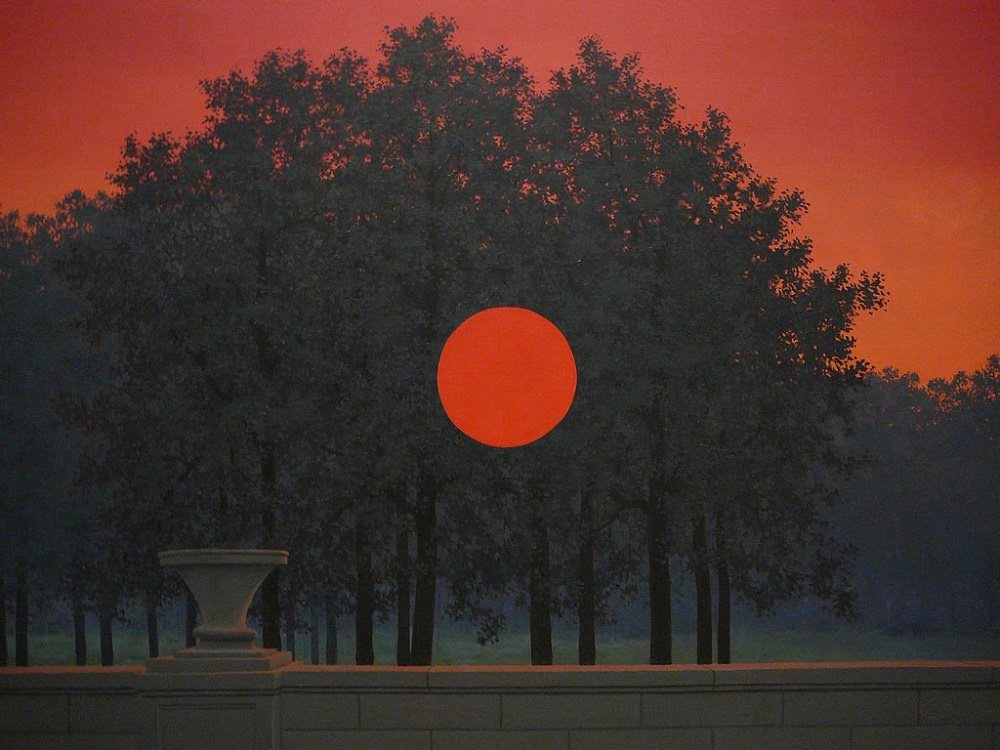
I absolutely love this painting, The Banquet, from Rene Magritte in 1958. It has the effect where I don’t question anything about it. I just accept it as it is presented. I am not looking for symbolism in it at all, not looking for a reason why the red ball of sun is hovering low in front of the trees. The colors, the contrast, the composition– they create a whole sensation doesn’t need a why or what or how.

As Magritte points out, it contains poetry and mystery.

And that is something to try to understand. I know I often feel the need to try to explain my work, to point out where I find an emotional base in a piece. Sometimes that is easy, almost jumping out at you. But sometimes it is not so obvious and it is simply the mystery of the created feel, a great intangible pulse, that makes a particular painting work.

You see it, feel it, accept its reality yet you don’t fully understand the why and how.

And maybe that is just as it should be. Not all we behold can or should be explained. Sometimes, maybe we simply need to experience poetry and mystery.

.


Visible things can be invisible. However, our powers of thought grasp both the visible and the invisible – and I make use of painting to render thoughts visible.

― René Magritte


It’s an interesting thought, that our power of thought grasps both the visible and the invisible.

I, a seemingly visible thing, have sometimes felt invisible.

And I have sometimes seen things that turned out to not be there at all.

Thought is a magical thing.

And maybe that is why some folks paint, to attempt to capture those things they think they see and to take away their own invisibility.

Gotta chew on that one for a while…

Magritte -- the-happy-donor-1966

Rene Magritte- The Empire of Light – Guggenheim Museum


Life obliges me to do something, so I paint. 

–Rene Magritte


I wasn’t sure what this post was going to be about when I started. Still don’t know, to be honest. I was simply going to put up a short quote with a painting or two by an artist, as I sometimes do. In this case the artist was the famed Surrealist Rene Magritte.

I liked the quote above. Simple. Concise. Right to the point.

Plus, I think it lines up with an answer that I sometimes give when someone asks how I became a painter: “Hey, everybody has to do something.

That opens up what could be a whole philosophical discussion about what our obligations really are in our lives as humans.

Are we really obliged to do something?

I don’t know.

Maybe. I guess not doing something is, in it’s own way, doing something. I know that when I am not a painter I am, among many things, sometimes a lazy slob.

Life obliges me to do something, so I do nothing.

That doesn’t have quite the same cache as Magritte’s statement but it is sometimes true.

But for the most part, when life obliges me to do something, I paint.

Not like Magritte. In my own way, at my own pace and of my own choosing.

Hey, life can push me around but only so far.


PS: I was going to write about the painting at the top which is one version of a painting, The Empire of Light, that Magritte painted fourteen times. The subject was not going to be about the night scene of this painting with a blue sky above. Rather, it was to be about the repetition of forms by artists, a subject to which I am well acquainted. Maybe next time.


Rene Magritte- Decalcomania-1966

Rene Magritte- Decalcomania – 1966


I conceive of the art of painting as the science of juxtaposing colours in such a way that their actual appearance disappears and lets a poetic image emerge. . . . There are no “subjects”, no “themes” in my painting. It is a matter of imagining images whose poetry restores to what is known that which is absolutely unknown and unknowable.

–Rene Magritte, 1967,  in a letter two months prior to his death


The quote above from Belgian Surrealist Rene Magritte reminds me of an instance where I didn’t fully get across what I was trying to communicate in response to a question.  While speaking to a regional arts group consisting of enthusiastic painters, some amateurs and some professional, a question was brought up about the importance of subject.  Magritte elegantly stated in his words what I was trying to say that evening, that the purpose of what I was doing was not in the actual portrayal of the object of the painting but in the way it was expressed through color and form and contrast.  To me, the subject was not important except as a vehicle for carrying emotion.

Of course, I didn’t state it with any kind of coherence.  Hearing me say that the subject wasn’t important angered the man who  was a lifelong painter of very accomplished landscapes.  He said that the subject was most important in forming your painting.  I fumbled around for a bit and don’t think I ever satisfied his question or got across a bit of what I was attempting to say.

I think he was still mad when he left which still bothers me because he was right, of course.  Subject is important.  It is the relationship that you have with the subject that makes it a vehicle for accurately carrying the emotional feeling  you are trying to pull from the painting.  While I am not interested in depicting landscapes of specific areas, I am moved by the rolls of hills and fields and the stately personae of trees and that comes through in my painting.  Yes, I can capture emotion in things that may not have any emotional attachment to me through the way I am painting them, which was part of what I was saying to that man that evening, but it will never be as fully realized as those pieces which consist of things and places in which I maintain a personal relationship.

It is always easier to find the poetry of the unknown in those things which we know.


Rene Magritte- The Beautiful Relations 1966

Rene Magritte- The Beautiful Relations 1966


rene magritte the-mysteries-of-the-horizon 1928

Rene Magritte- The Mysteries of the Horizon 1928


Rene Magritte- The Son of Man 1964

Rene Magritte- The Son of Man 1964

Read Full Post »
« Newer Posts