Feeds:
Posts
Comments

Archive for the ‘Biographical’ Category

One of the benefits that come from writing this blog for nearly 12 years now is that on those days when I am super busy and have to get to work early, I can go into the archives and pull out a favorite. Below is a such a favorite from back in 2013, made doubly so in that it is in itself a reposting of an even earlier entry from 2009. Give a look ( and a listen) if you have a few minutes.

*********************

farmer[2013]– Yesterday, I checked my blog with a search to see if I had ever written here before about that day’s subject, Long John Baldry. I found that I had only mentioned him once in a post from back in 2009. I read the older blog and it made me chuckle. It was titled You Can’t Judge a Book… from a song that Baldry had once covered and had to do with how our preconceptions are often wrong about people. It immediately brought to mind something that had happened over the weekend here at the studio.

My niece, Sarah, brought a friend and her husband to visit the studio from their NYC home. Sarah didn’t share much about her friend outside of saying that they danced together and that she was a filmmaker for one of the large big-name auction houses in NYC.  I had no idea about what her husband did for a living. That was the extent of my knowledge outside of knowing they had been married the year before in New Orleans.

But they arrived and we had a wonderful visit. Both were charming and inquisitive, asking real questions and relating their own experiences in response to my answers. They were easy to speak with and made me feel comfortable in describing my work and process, not something that a lot of people can do easily. We visited for a couple of hours and they headed back to the city.

During our visit we learned a bit about the friend’s husband, whose name I won’t use out of respect for their privacy.  He was in the music business in some fashion, performing as a DJ, and had spent a lot of time touring here and abroad. He also was working on soundtracks for films. When I asked what sort of music he worked in, he said, in an almost apologetic way, that it was mainly rap and hip-hop. The manner of his response struck me in a curious way. He went on to explain that it was the music of when and where he grew up, in the neighborhoods of NYC. Again, this was said in an apologetic manner.

I didn’t think much about it until after they left and I decided to see if I could find out more about his music.  Googling him, I discovered that he had a prodigious reputation in the rap genre, with over twenty years in the business as a DJ and producer for a pretty big name rapper. He had recently started his own record company and had released an album  of his work only weeks before our meeting. I watched a couple of videos of his work and listened to several songs.

I am not an authority on rap/ hip hop in any form but this was powerful stuff. I was really impressed and thought back to his apologetic description of his work.

I understood it then.

He didn’t want to be judged and was trying to make it easy for me to not judge him. I mean, here I was, a middle-aged white guy with gray hair out in the country— not exactly a prime candidate for a hip-hop connoisseur. He had surely heard the venom directed toward his musical genre before from people who looked like me.

So, he judged me before I could judge him. I understood that.  It’s most likely what I would have done had I been in his place. My only regret is that it robbed me of an opportunity to ask the many questions that I formed in looking up his work after they had left the studio. It would have been fascinating to compare our creative processes, to see how he synthesized his influences. I got the impression from our talk that, though we worked in vastly different environments with disparate influences, we both working on a similar creative rhythm, expressing emotion within the framework of our own personal environments.

Well, the next time we will both know and won’t worry about judging one another. Here’s the original post from back in 2009:

I’ve just put the final details on a couple of paintings that will be part of my solo show at the Principle Gallery in Alexandria, VA. The show opens June 12th and I’m scheduled to deliver the work to the gallery a week before so I’m in the final stages of preparation. This is my tenth one-man show at the gallery and before that I did two shows as part of a group of painters from the Corning , NY area that was dubbed the Finger Lakes School.  

I particularly remember one moment from the first show with that group. There was a pretty good crowd and several of us from the group mingled, answering questions and such. I had a small break in the conversation and I heard a female voice from behind ask her companion where we were from. Her friend answered that we were from the Finger Lakes region in New York, pointing out that it was a pretty rural area with a lot of wineries and farms.

“Well, you know, they do look like farmers,” she replied.

I think I did a spit take. Over the years I often think back to that lady’s comment and sometimes laugh. Maybe we shouldn’t have all worn our overalls and straw hats that night. It just reminds me how people judge others by that initial glimpse and how often they end up being wrong. Actually, I’ve come to the conclusion that, in the end, I would prefer being mistaken for a farmer than an artist anyhow. Offhand, I can think of more positive attributes for the farmer. So, if you can make it to the opening look for the guy who looks like a farmer…

That brings me to a song, You Can’t Judge a Book, that was originally written by blues great Willie Dixon and made popular by Bo Diddley. This is a personally favorite version from Long John Baldry, one of the pioneers of the British blues/rock movement in the early 60’s and a guy who had real panache. Give a listen and be careful before judging someone, okay?

*************
https://www.youtube.com/watch?v=exANll1Mk7o

Read Full Post »

Since I have much to do this morning, I am running this post from back in 2013 that concerns a few early pieces. I came across one of these pieces, Doug’s First Day on the Job, early this morning and, while it made me chuckle, it reminded me of current events. Thought this post was worth looking at again.

*******************

GC Myers Early Interior sm“Can you remember who you were, before the world told you who you should be?”

Charles Bukowski, Post Office

***************

I have often shown early work here, stuff from when I was still trying to find a path forward. Most of it is from before I ever thought  that showing my work in public was a possibility. As I have pointed out, I still revisit this early work on a regular basis in an effort to stay connected with that time in which the need to create was the only motivation needed. There’s also an element of backtracking in this as well, trying to put together how this work somehow led to what I do now.

Sometimes it is hard to see the connections as the work is so singular and never followed up on, then or now. I think those are the pieces from that time that intrigue me the most, making me wonder how my journey forward from that time would have been different had I chosen and stayed on that path.

For example, here are three pieces from around the same time, all painted within a month or so of each other back in 1994. None really lead directly forward to the current time but I really always enjoy seeing these three pieces, wondering what my motivation was at the time. The first , shown above, is an interior scene that just formed on the paper. I had no idea what was going to be there, outside of the checkered tablecloth. I remember that the cross on the wall was a last minute addition, one that changed the whole feel of the piece. I can understand why I didn’t follow this path but it still makes me wonder.

GC Myers Still Life smThe next was this still life, here on the left. I remember this piece well, having ambivalent feelings about it as a whole. I liked the clear graphic look of it but it was almost too clean, too sharp. It had really good eye appeal but it seemed all surface to me. I see things from this piece that I did bring forward, such as some of the clearness of the colors which I like in some instances. The thing that always strikes me is that I see a face in profile, looking to the right. Faces subconsciously built into the composition are something I often look for in my work, feeling a curious satisfaction when I find them. I wish I knew why. Maybe that’s what draws me back to these early pieces.

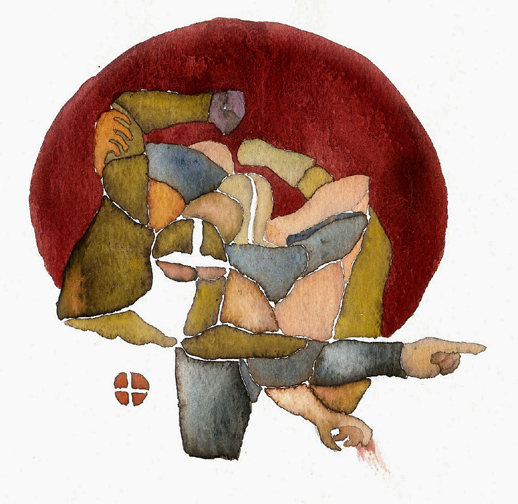
GC Myers- Doug's First day on the Job smThe last was one that had a title, Doug’s First Day on the Job.  I remember this as a piece that I viewed as an exercise even as I started, experimenting with forms and color. The resulting scrum of arms and fists with the strange authoritarian figure in the foreground, hooded and  pointing ominously out of frame reminded me of the chaos and confusion of  a kid’s first day on a new job. A strange environment with new procedures to learn and strange new people who struggle with each other and boss the new guy around. I knew even as I painted this that this was not my path but I enjoyed this piece anyway. It had a cleansing effect and was a wonderful lesson in color and form .

Plus it made me chuckle.

I don’t know that there is any great connection between these pieces or to my future and current work. I always wonder though at how these disparate  pieces formed in such a short time, wondering if I have that same burst of energy within me still. Maybe that is the reason for this backtracking, looking for that energy source, that fount of inspiration.

I don’t know…

Read Full Post »

The Classic Bob Gibson Followthrough

This is an edited version of a blog entry from way back in 2009:

It’s that time of the year.

Catchers and pitchers are reporting to spring training. Baseball is in the air. Is there any better time of the year?

Baseball has always held a special place for me. Oh, I was no more than an average player– decent bat, lousy arm and a so-so glove– but there was pure magic in seeing the heroes of my youth and hearing the stories of the early legends of the game.

I remember my grandmother telling me of going with my grandfather to New York City on their honeymoon in 1921 and seeing Babe Ruth play with the Yankees. Ruth hit a double and a triple as she recalled.

I remember sitting with my grandfather, the mythological Shank, so called for the holds he would apply to his opponent’s legs during his time as a professional wrestler, and watching the World Series in the afternoons of 1968. I had my tonsils out and was still recuperating and we watched the St. Louis Cardinals play the Detroit Tigers, who won the series. It was great watching with my grandfather plus I was introduced a player who became one of the heroes of my youth, Bob Gibson, the Cardinal’s pitching ace.

Gibby was it for me. The toughest guy out there, one whose competitive fire was, and is, legendary. So dominating as a pitcher that baseball changed the mound height because they felt the hitters needed help since he was practically unhittable. I read his early autobiography, From Ghetto to Glory, numerous times as a kid and that made him an even bigger hero to me. He was eloquent and college-educated, a rarity for ballplayers of that era, and his story was compelling, going from abject poverty onto college then a stint with the Harlem Globetrotters then on to baseball stardom.

He remains a hero.

Baseball was always played at our house. My dad was a pretty fair pitcher who had promise as a youth. In subsequent years, I have uncovered numerous news stories in old newspapers about his exploits on the mound and in the field. But later, as a dad, he would occasionally play catch with me and my friends. Eventually, he would break out his knuckleball, a pitch he was known for in his younger days. It was practically uncatchable, having a spectacular drop that would appear to be entering your glove only to end up hitting you in the stomach. Or lower. I was never able to master the pitch but still appreciate the awkward grace and dance of a well thrown knuckler.

Other times, I would pitch to him and he would hit flies to my brother in the outfield. Periodically, he would hit hard liners back at me. They would bang off me or make me dive out of the way and he would cackle. I would then try to drill him with the next pitch, which would make him laugh even more because he had gotten my goat.

I would calm myself and wait until he would pitch to me, waiting for the perfect pitch when I could send a hard line drive back at him, making him duck or dive. At such times, after having to jump out of the way or  defend himself with his glove, he would yell out a Hey! and give me a harsh look. Then he would usually laugh because he knew that I was just paying him back for his earlier actions. Payback was just part of the game.

Even my work has been somewhat affected by my experiences with the game. I remember the first time coming out of tunnel during a night game at Shea Stadium in the late 1960’s and seeing the field spread out before me. I was stunned by the colors that were so rich and lush under the warmth of the lights. It was a feeling that I think I wanted to replicate in some manner which ultimately led me to art.

Over the years baseball has become my calendar for the passing of the year and is a comforting friend on the days when the world seems ready to implode. I am still captive to the numbers and legends of baseball, one of those romantics who see poetry in a game based in tradition.

To that end, here is a wonderful version of Take Me Out to the Ballgame from Harpo Marx, played on I Love Lucy. It is delicate and graceful.  It’s the essence of the memory of baseball for me…

Read Full Post »

Peter Doig- Swamped 1990

********************

I sometimes wish I had never had to sell a painting. Every painting you make represents the time it was made and how you were feeling and what your influences were… You are never going to feel that way again, so you can never repeat it…

–Peter Doig 

*******************

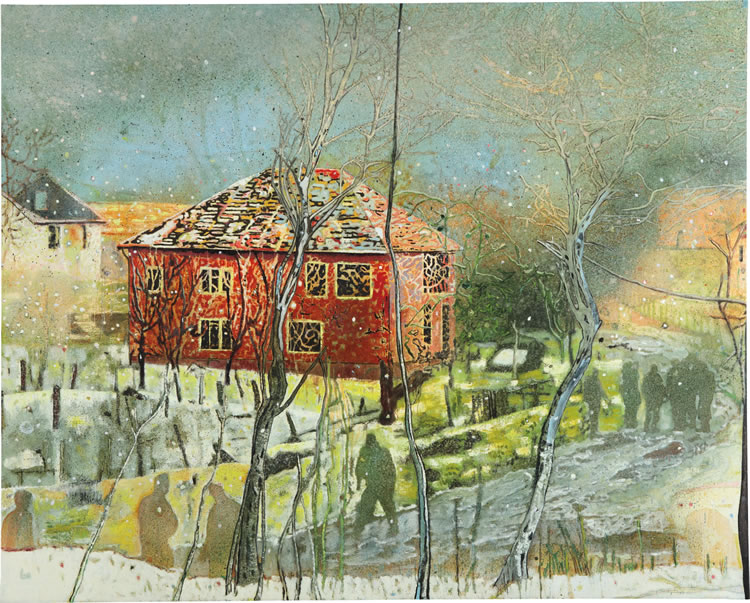
I shouldn’t make such a blanket statement but I doubt that most of you out there know the name of the contemporary artist Peter Doig. I know that I wasn’t fully aware of him until a decade or so back and even then only on a passing basis where I would stop and examine his work when I would come across it in an article. The piece at the top always made me stop and look a bit closer.

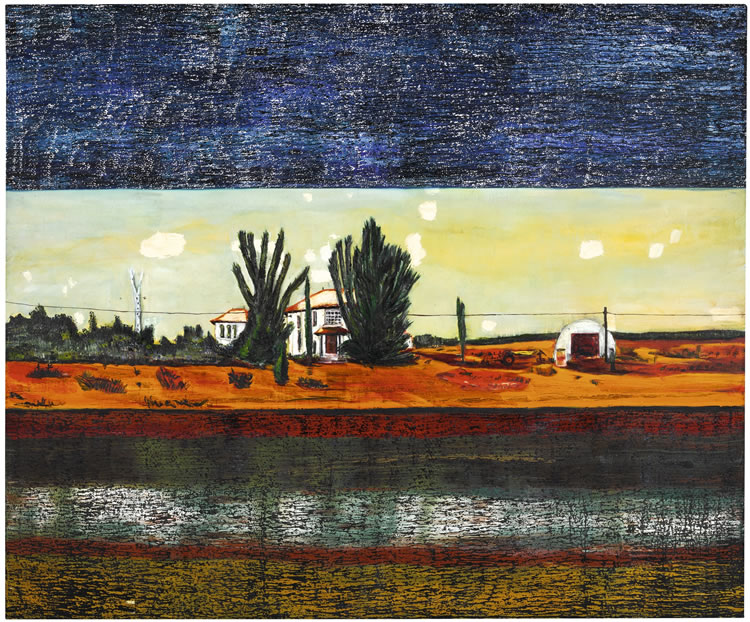
But the fact of the matter is that the Scottish born Doig (b. 1959) is perhaps the most sought after living artist working today with works selling for the tens of millions at auction. Of the 9 paintings shown here, only one sold for less than $10 million at auction. The most expensive sold for over $ 28 million. I won’t tell you which is which. There were many others on the auction sites that sold for between 1 and 4 million that I didn’t include.

These prices always open up a debate with lots of questions on the relative value of artwork. What makes a work worth $28 million? Does the auction value of the work determine its importance or does its importance determine its value? Is the working and thinking process of this artist that much different than that of an artist that sells for tremendously less?

You might think from the direction this seems to be heading that I am decrying Doig’s work selling for what I believe are ludicrous sums. I am not. I very much like and admire his work. I can see those elements in it that make it distinct. It is good and great work and might very well be among the most important work from this time. If his work can bring in that kind of money, I applaud him.

I am, if anything, criticizing myself for not having the ability– or knowledge or audacity– to command such prices. I know that the price of a piece of art sometimes determines how serious collectors view it and that a great piece can be overlooked simply because it is too inexpensive, at least by the standards of collectors.

That has happened to me at times.

In some galleries, my works sits at the top end of their market and in others, in the middle or near the bottom of their price ranges. While I am satisfied with that, I firmly believe that my work is greatly undervalued across the board, that it should be demanding much higher prices.

Now, that sounds like confidence, doesn’t it? Maybe even overconfidence?

Actually, it is the opposite of that. It is a lack of confidence and a bit of fear that keeps the prices of my work in the range where they are and have been. While I have the belief in the relative value of my work, I just don’t have the guts to make that jump.

I have been poor in my life and it wasn’t that long ago that I was dead broke and I think that tempers my ambitions, as far as pricing my work is concerned. I like to have my work sell and make a living from it. I take pride in being able to live off of the product of my own thoughts and imagination. And I find a sense of security in being able to provide what I consider high quality work at prices that make it obtainable for more people than if it were in a much higher range– it’s undervaluation generally means that the work will sell eventually.

Maybe I am too comfortable and seeing Mr. Doig’s prices just nudges me a bit, telling me to be less comfortable, to be more proactive.

I don’t know. Just thinking out loud this morning. I wrote this because much of what I have read about and from Doig jibes with my own experiences, including the quote at the top. For all the talk about prices, every real piece of art represents a certain time and place for that artist, one that is distinct and not repeatable. I know that I will sometimes look at a piece and remember the days I spent in front of it while painting it. That time, that thought process is burned into my psyche and will never happen again in the same way.

Anyway, lets’s push aside thoughts of money for now and just look at the paintings of Peter Doig a bit more.

Peter Doig- Rosedale 1991

Peter Doig– Red House 1995

Peter Doig– Island Painting 2000/01

Peter Doig– Grasshopper 1990

Peter Doig — Daytime Astronomy 1998/99

Peter Doig– Charley’s Space 1990

Peter Doig– Forestia 1996

Peter Doig– Almost Grown 2000


Read Full Post »

*********************

“Look at everything always as though you were seeing it either for the first or last time: Thus is your time on earth filled with glory.”

Betty Smith, A Tree Grows in Brooklyn

*********************

In times like these, it is even more important to consider the words above from the classic book A Tree Grows in Brooklyn. In days that often filled with anger, anxiety and sometimes despair, we must remember to take in the simple wonders that surround us, to pay notice to the beauty and magic of the natural world surrounding us.

As the death of the great actor Kirk Douglas yesterday reminds us, how much time is guaranteed for any of us here? Do we want to leave this world not having paid attention to the simple wonder within our reach?

I’e been in my current studio for over twelve years now and have looked out its windows tens of thousands of times. But even after all that gazing I still am able find new things to see. Trees I have never noticed. The way the sunlight comes through and hits certain limbs at a certain times. The way the wild turkeys gather under the maple trees beside the studio when its raining and face the house, sometimes gobbling at it as though they believe I can come out and shut off the rain.

If I could, I would do that for them.

Small things. Simple things. But wonders nonetheless.

I find myself sometimes stopping in the woods and looking around, taking notice of the small wonders within my sight. I try to take a snapshot in my mind of that place in that moment, thinking that if I were to suddenly pass away, I would have as an image to carry with me from my last day.

You would be surprised how much comfort I take in that little moment, standing still on a woody path.

This is the gist of what this painting at the top of page is saying to me. Titled In Simple Wonder, it’s part of the Little Gems exhibit at the West End Gallery that opens tomorrow evening.


Read Full Post »

**********************

“I’m not sure this will make sense to you but I felt as though I’d turned around to look in a different direction so that I no longer faced backward toward the past but forward toward the future. And now the question confronting me was this: What would the future be”

― Arthur Golden, Memoirs of a Geisha

**********************

This small painting that is hanging as part of the Little Gems exhibit at the West End Gallery (opening Friday, February 7) is titled Memoir.

The thought behind that title was that that while the future seems uncertain as we look forward, our pasts as we recall them are often just as uncertain.

Our personal histories are a patchwork, like the sky in this painting, of half memories and dimly lit stories. Faces and names fade. Words once spoken are lost in the void. We have grainy snips and snaps of what we recall as significant moments and some surprisingly sharp images of insignificant moments that puzzle us, leaving us to wonder why they remain so clear.

Do they mean something more and we just don’t see their true meaning?

I looked at this small piece and wondered what I would include in my memoir. What would I pull from that haphazard patchwork that I would want to share now and into the future?

After sifting through the shards of broken memories, I come to the conclusion that I don’t want to write a memoir. Let my memoir show itself in my work, let my story be told in paint and line and shapes, a crude group of hieroglyphs that will no doubt go untranslated in generations to come.

Let the future, if it is so inclined, write my past. That shall be memoir enough for me.

For this Sunday morning music, here’s a song to go along with this painting. It’s the Nick Lowe pop classic, When I Write the Book.

Have a good Sunday.

Read Full Post »

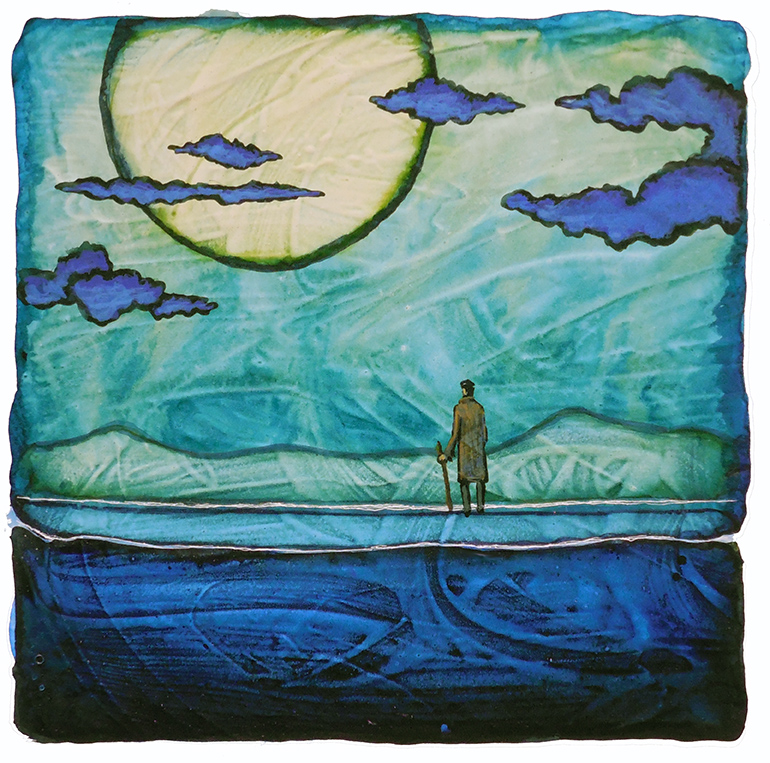
This is a new piece, Walking Blues, that is headed to the West End Gallery for the annual Little Gems exhibit, which opens on Friday, February 7. As I have mentioned here before, the Little Gems show occupies a special place in my heart. The 1995 show was the first time my work was ever shown to anyone outside of my family and a very few friends.

It was a life changer for me, the first real big step in moving from what felt like an old life into a new and altogether different life.

And it felt like that at the time. It was abundantly evident for me. It wasn’t one of those things that happens without you really feeling the gravity of what is taking place. I didn’t know where this path would lead me or if I could even stay on it for long. But I knew it was a new path that had, if I was willing to really commit and work for it, the potential to change my life in some way.

And it has.

While this coming show is actually my 26th Little Gems show, it marks 25 full years of doing this, of transforming my feelings into paint, embedding thought into material. Standing at that first one back in 1995, anxiously watching to see if anyone even looked at my work let alone showed interest, there was no idea that it would lead here.

Like so many things, I just didn’t know.

But I am glad for it. And thankful.

Hopefully, I will be reminiscing about that first show on the occasion of my 50th Little Gems exhibit, 25 years (well, actually 24 years) from now.

I don’t know but we’ll see.

Here’s a version of the great blues classic, Walkin’ Blues, whose title I pinched for this painting. It originally recorded by the legendary Robert Johnson but I thought this very unique performance by contemporary bluesman Guy Davis amidst the stark beauty of the snow and ice of Uummannaq, Greenland, 369 miles north of the Arctic Circle fit this little gem of a painting pretty well.

Have a good day.

Read Full Post »

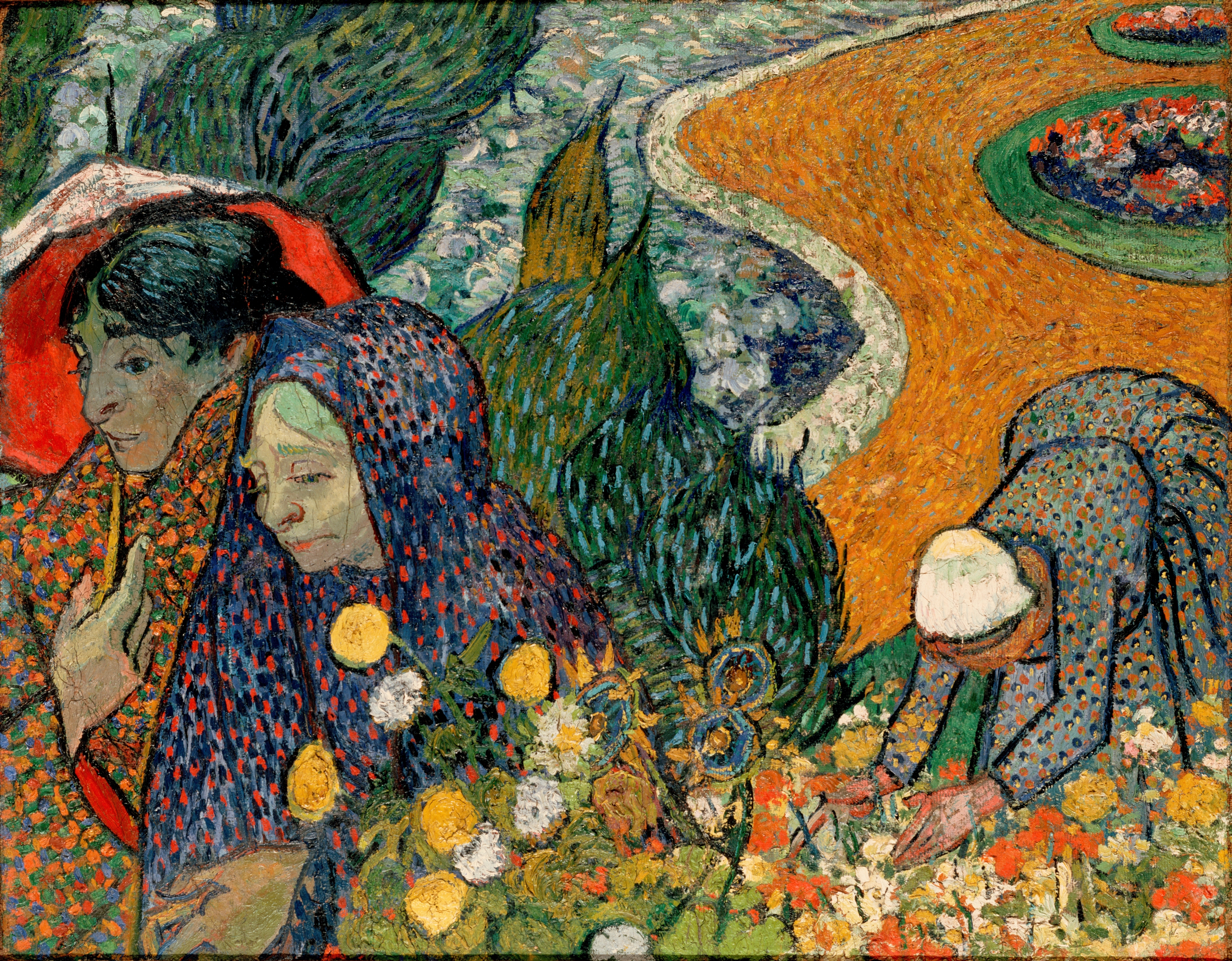
Vincent Van Gogh- Memory of the Garden at Etten 1888

*******************

My aim in life is to make pictures and drawings, as many and as well as I can; then, at the end of my life… looking back with love and tender regret, and thinking, ‘Oh, the pictures I might have made!’ But this does not exclude making what is possible…

–Vincent Van Gogh

*******************

Love this painting from Vincent Van Gogh with its wonderful color and the abstraction of the forms that comes from eliminating the horizon line. It was a piece that came to mind when I ran across this passage from Van Gogh. The words reminded me of something else, a thought that has been on my mind in recent times.

I was asked at my Gallery Talk at the Principle Gallery this past September if I ever had thoughts of retiring from my painting career. I think I made a bit of a joke about it, saying that I would no doubt die working away at a painting.

And that’s most likely true. I couldn’t imagine ever saying I am done as a painter.

It goes back to Van Gogh’s words above. I still see my artistic future brighter than my past, still envision important projects and better works to come. I still see my best work as being in the future, not dwelling in the distant past.

I can’t imagine that feeling ever changing. I can see myself on the day of my death, if I am capable of taking a moment to reflect on that day, will have that same regret that Van Gogh expressed: Oh, the pictures I might have made!

That being said, I must get to work. I am not retired yet and there are pictures to be made. The future is calling.

Read Full Post »

Yves Tanguy – Indefinite Divisibility – 1942

*******************

I found that if I planned a picture beforehand, it never surprised me, and surprises are my pleasure in painting.

–Yves Tanguy

*******************

Thought we’d start the new year with a quick look at the Surrealist painter, Yves Tanguy. I can’t say I know a lot about Tanguy, who was born in Paris in 1900, raised in Brittany and died in Connecticut in 1955. He first was attracted to painting in 1922 after seeing a Giorgio De Chirico painting in the window of a Paris art dealer as he was riding a passing bus. He jumped off the bus and went back to study the painting. That was the experience that set off his career.

But with the little info I could quickly glean, I found that we shared a few similarities. One was coming to painting with little training. I consider myself basically self taught and, while he had did some sketching before his brush with De Chirico’s work, Tanguy basically set out on his career as a painter with no formal training. His self taught style developed quickly and was recognizable and celebrated within several years.

He also practiced automatism in his work, which is just a more formal word for having no real plan as you start a painting. I actually didn’t know there was a word for this though I’ve been practicing it for decades now. Much like he said in the quote at the top, I also take great pleasure in the surprises that come from working this way. There’s a form of revelation in working this way that I can’t get when beginning a piece with a predetermined outcome.

Tanguy also described the effects of his automatism this way: The painting develops before my eyes, unfolding its surprises as it progresses. It is this which gives me the sense of complete liberty, and for this reason I am incapable of forming a plan or making a sketch beforehand.

I understand this completely.

He also said: I believe there is little to gain by exchanging opinions with other artists concerning either the ideology of art or technical methods.

I hate to admit it but I kind of agree with this. Don’t get me wrong, I very much enjoy talking with other artists, hearing about their experiences and their breakthroughs. But I don’t really like to talk about my own process or my ideology with other artists. Oddly enough, I am more likely to do this with a group such as at a gallery talk. There, I feel like I am simply describing what I do and not giving advice or direction, which I dislike giving to other artists.

I think art comes from having an idea of what one wants and needs to get from their art as well as their individual knowledge of their strengths and weaknesses as applied to technique and materials. I can’t tell someone what they need from their own art or how it should make them feel. Nor can I tell them how they will better understand what they know about the paints or tools they use. I can give little ideas but they must gain their own insights through their own experiences.

I’ve often said there is no right or wrong in art and this hesitancy to exchange opinions is just an extension of that. What might be right for me or Yves Tanguy might not be right for another artist.

Okay, I know there is a that can be debated here but I am tired of even talking about this right now. Let’s just look at few Yves Tanguy paintings, okay?

Yves Tanguy- The Sun In Its Jewel Case – 1937

Yves Tanguy- There, Motion Has Not Yet Ceased – 1945

Yves Tanguy – Azure Day – 1937

Yves Tanguy – Mama, Papa Is Wounded – 1927

Yves Tanguy – Promontory Palace 1931

Read Full Post »

**********************

Every saint has a past, and every sinner has a future.

–Oscar Wilde

***********************

Yesterday, I wrote about trying to go back through my work from the past decade and choose pieces that best summed up each year. It’s a difficult, if not impossible, task. There are often many different directions that the work moves in over a given period of time or sometimes pieces that strike a chord most for me may not represent the larger body of my work for that time period.

This past year, for instant, had many tentacles. The landscapes began appearing with multiple beds of flowers. The sailboats took on larger and more expressive waves. A new female figure emerged to paddle across flat waters. And, of course, the faces from my Multitudes series began to appear.

All of these elements will no doubt remain in play for the near future and maybe well beyond that. Who knows? And who knows what new things will emerge to grab my focus?

I sure don’t.

The piece shown here, Saints and Sinners, is from this year’s Multitudes series. It’s a favorite of mine, one that I might consider as a piece to represent this past year, at least for its particular tentacle. It’s a painting that I think works well for ending this year and welcoming the next. It has a feeling of looking backward and forward. Of examining what we have been, what we are and what we might someday be.

As I like to say: What I was then is not what I am now and what I am now may not be what I will be in the future.

None of us are fully saints or sinners. There may be a few who are fully sinners well beyond redemption ( ** comes to mind) but most of us are in that boat that drifts between the two opposite shores.

I am hoping that we drift closer to the saintly shoreline in 2020.

Have a good and safe New Year’s Eve.


Read Full Post »

« Newer Posts - Older Posts »