I am busy getting things around today for a workshop that I am leading up at Penn Yan in the beautiful Finger Lakes tomorrow and Friday. This is only my fourth year doing this but every year I say that this is most likely the last time I will do this. The words have already left my mouth this year.
I do not feel that I am a natural teacher and get somewhat stressed out doing these, much more so than giving a talk. Because the folks at the workshop are paying to be there, I worry that they won’t get their money’s worth. That’s where the anxiety comes in for me. I probably overcompensate in response to this but if it helps me feel that I have given something of value to these folks, then I can accept that.
Even though it’s stressful, I have to say that I am glad to be doing this workshop this year, given what might be happening in the next couple of days in DC. I would rather be teaching a few of my techniques to willing and friendly faces than yelling and swearing at my television.
Now that is stress.
So, I am taking a few days off from the blog. The image and Helen Keller quote at the top speak very much to the trials this country is currently experiencing. Whatever character we possess as a nation, now is the time it will be truly revealed.
The painting above is The Sea, Watched from artist Jamie Wyeth. I came across the quote from Wyeth that is below the image and it really struck a nerve with me, especially in the moment.
Being back in the studio after the Gallery Talk at the Principle Gallery, I am conflicted by two desires. One is to just be bone lazy and do nothing, to simply enjoy the good feelings generated by the talk and my own sense of my work at the moment. The other is to dig back in with even greater fervor, to move the goalposts ahead and begin the next step towards reaching those goals. What exactly those goals are is yet to be determined but I do know they are there.
I do feel that I do have to move forward, to not be lazy and rest on the work that is out there at this point. Part of that comes from doing these talks and getting real feedback on what I have done. I don’t want to come before these folks next year and have nothing new, no advancement in the body of the work, to point to.
That is the one of the addictive parts of this painting thing– a fear of falling short.
But sometimes the lazy part is appealing. I look at the work so far and I feel good about it. I tell myself to take it easy. Relax. Coast for a while. That would certainly be easy to do.
But part of me knows that’s the wrong way to go. If for some reason my career ended today, I can’t say I would be satisfied with what I have done. I don’t feel that my story is completely told yet, that the work hasn’t yet revealed all that it has to yield.
So, I dig back in.
I was asked after the talk the other day if I planned to retire and I laughed. First, I said I couldn’t because all of the paintings I have given away at these talk represented my retirement funds. But I said I couldn’t imagine not doing this to the day I either die or become incapacitated in a way that would prevent me from picking up a brush and making a mark.
Realistically, I figure I have a good twenty five years in which to be productive. And if I am fortunate and take care of myself, maybe thirty. I notice more and more older artists working into their 90’s and beyond, producing new work that are exclamation points on long careers.
That would be good. But it won’t happen if one lets laziness creep too much into the equation. Fortunately for me, the credo, “Live to work, work to live,” is not a scary or depressing idea.
So, that being said, I’ve got a lot of work to do. Have a great day.
I am a being of Heaven and Earth, of thunder and lightning, of rain and wind, of the galaxies.
–eden ahbez
+++++++++++++
The painting shown above is a new piece, a smallish 6″ by 12″ canvas, that will be going to the Principle Gallery on Saturday for my Gallery Talk there. Its title is And the Sky Cracked and is part of a small recent series that features my interpretations of lightning strikes. How accurate they are in a realistic or scientific way, I can’t say. That doesn’t really hold much sway for me, at least not as much as capturing how the lightning feels to me.
Lightning is an amazing thing, a natural wonder that inspires awe and fear like it was some sort of god. No wonder so many religions give their main gods the power to wield lightning. It can destroy yet can also illuminate, bringing clarity to a course of action. Being struck by lightning is how we often describe moments of the revelation of great truths, of moments of self-discovery that alter the lives of those who experience these moments.
Like the finger of a god pointing the way and giving light to the path forward.
Powerful stuff.
Walking through my woods I often see the traces of past lightning strikes etched in the bark of the trees. Some have splits that run from their tops all the way to the way to the ground, blackened by the heat of the electricity that surged through them. In the case of some recent strikes, the ground at the base of the tree is burnt where the cracked bark of the trunk runs into the soil.
We had one strike several years back that was like a multitude of shotgun blasts going off outside our door, so close there was not thunder to give us warning. The next morning I saw that an old, large white pine down our driveway had been hit by the lightning. A deep crack ran down one of its thick upper branches down into the main trunk.
About forty feet away I noticed a chunk of pine the size of a large brick laying in the grass. Looking back at the trunk I immediately saw the spot where it had been blown away from the tree, no doubt the boiling sap of the pine finding a weak spot there in which to explode.
About a year later, that large branch, the size of a mature tree in itself, came down in another storm. The power to destroy.
Here is another in this lightning series that will also be with me on Saturday. It is called Real Power and is an 18″ by 18″ canvas.
The quote at the top is from eden ahbez, perhaps one of the earliest hippies back in the 1940’s and the man who wrote the song Nature Boy, most famously recorded by Nat King Cole. I wrote about ahbez here back in 2009 and Nature Boy remains a favorite of mine. Below is the Nat King Cole version.
Hope you can make it to the Gallery Talk at the Principle Gallery in Alexandria on Saturday. It starts at 1 PM and there is at least one painting to be given away along with some other goodies. Oh, and some good conversation. See you there!
I spent some time yesterday at an event that I would have never thought of going to before I started exploring our family lines a number of years back. This was the dedication at the Colonel Lindsley Burying Grounds in Lindley, NY by the Daughters of the American Revolution (DAR) of a plaque honoring the service of an ancestor, Samuel Lindsley. I believe he is my 6th or 7th great-uncle.
Kitty Pierce Speaking at DAR Plaque Dedication
Samuel was a young soldier in the Revolution fighting for his local militia out of New Jersey. After the war a number of his family members headed into the new western frontier and settled on a very large tract in a fertile valley containing the Tioga River in what now is currently the towns of Lindley and Presho. His father was a man I have mentioned here before, Col. Eleazer Lindsley. A bit on that later.
I had no idea to expect when they invited me to attend this event as one of the Lindsley descendants. I thought it would be a group of 10 or 12 folks and there would be a few words then we would all take a look at the plaque, shoot a couple of photos and chat a bit. Done. But coming on the scene I saw signs for parking and men in Revolutionary era garb climbing out of their cars.
It turned out it was a real event.
A History of the Flags of the Revolution
There were about 60 attendees, including members of the DAR, local historians and several direct descendants of Samuel Lindsley who came from as far away as San Antonio, Texas and Columbia, South Carolina. There were also members of the Sons of the American Revolution in full period garb. One brought a part of his collection of Revolutionary era flags and gave us a lesson on the history an meaning of each. They then proceeded to raise their muskets and give a resounding salute to honor Samuel. There were several speakers including Kitty Pierce, the Lindley town historian who is a walking encyclopedia of the genealogy and history of that town.
Another speaker was Phil Cirulli, who is a direct descendant of Samuel and whose research and persistence was responsible for the event. Phil, who now resides in South Carolina, told abut his journey in getting Samuel this recognition, about the long process involved in attaining documents and certification. Our paths have crossed a number of times while doing our respective genealogy so it was great to meet and talk with Phil along with a number of other newly discovered distant relations.
I wouldn’t have been at this event if it weren’t for a painting I did a couple years back. It was from my Icons series which were my imagined images of how I thought some of my ancestors might look. There was no research or source material. Pure imagination. One was of Eleazer Lindsley, the patriarch of the Lindsley family that came to this area around 1790. The blogpost about Eleazer, a most interesting character, came to the attention of historian Kitty Pierce and soon spread to Phil and other members of the family.
I was surprised how many people mentioned the painting. But even more surprising was that upon meeting Phil, I saw a striking similarity between Phil and my imagined image of Eleazer. Similar bald head, similar nose and chin. Even the ear looked familiar. Here’s a photo so that you can make your own determination.
Phil Cirulli and his Ancestor, Eleazer Lindsley
All in all, a most interesting event and one that further confirmed my ties to this area and this land. It was pleasure to meet these folks and send them good wishes from their newly found distant cousin.
For this Sunday music, I have fittingly chose the song Ode to My Family from The Cranberries. Have yourself a good Sunday.
Another August passes by and September mercifully comes through the door. I am no fan of the month of August as I have documented here in the past. Just the saying the word brings up pangs of anxiety and unease, images of hazy heat rising under a glaring sunscape.
September, on the other hand, has connotations of coolness, shortening daylight and a quiet calmness. The cycle of life has the leaves on the trees beginning to take on color and they will soon be drifting to the ground. September has that same drifting to the ground feel that eases some of the angst of this world, at least for me.
A sigh breathed in August is different than one in September. August’s is one of frustration and in September it is one of relief.
So, as you can see, I am pleased to be in the first days of September where I can sigh freely.
As has been my habit for a number of years, I generally play a version of one of my favorite songs, the classic September Song, at the beginning of the month. It has been recorded by so many artists that it’s not hard to find different performances of it each year. This year we are going with one from the legendary jazz singer, Sarah Vaughan. Beautiful version.
Art is not a handicraft, it is the transmission of feeling the artist has experienced.
-Leo Tolstoy
_________________________
I don’t know about the accuracy of this quote. Tolstoy did write about art and the transmission of emotion through it but I can’t vouch for the precision of the wording in the widely accepted quote.
But I do heartily agree.
Craftsmanship– handicraft– definitely has a part to play but that alone cannot transport the viewer to that inner spring from which their emotions flow. Something might be beautifully crafted but unless it is constructed from the empathy, the love, the awe, the wonder and the wide assortment of feelings that define tour humanity, it remains just a lovely object. Beautiful but coolly devoid of feeling.
And there is nothing wrong with that.
But the aim of the artist, at least to my mind, should be to engage the the emotions of the viewer ( or listener or reader, whatever their medium might be) with their own. To create a sort of communion of feeling between the artist and the recipient.
Can this be taught? I don’t know. I try to tell students to read, to look, to listen, to practice a sense of empathy in their daily lives. Widen their view and become a fuller person. I think art comes from an equal blend of one’s handicraft and their sense of humanity.
That’s just my opinion and it may be as flawed an idea as the mind that thinks it. But I can stand behind that thought and hope, in some small way, to achieve that blend in my own work.
The painting at the top is Find Your Light, a 36″ by 36″ canvas, that is a central part of my show, The Rising, at the West End Gallery that ends tomorrow.
I was not sure where I was going, and I could not see what I would do when I got there. But you saw further and clearer than I, and you opened the seas before my ship, whose track led me across the waters to a place I had never dreamed of, and which you were even then preparing to be my rescue and my shelter and my home.
― Thomas Merton, The Seven Storey Mountain
+++++++++++++++++++++
Well, my annual show at the West End Gallery comes down in just a few days. This year’s edition is called The Rising and Thursday is the last day to see the show.
It is a show in which I feel a real sense of pride. When I am prepping for a show, my goals for it are often vague and undefined. I feel that I want certain things for it and from it but when I try to verbalize these goals, the words evade me. I find myself like the sailor in the Thomas Merton quote above: I was not sure where I was going, and I could not see what I would do when I got there.
I knew it was going somewhere. I just didn’t know where. I let intuition and reaction guide me and it often worked out fine.
But this show, much like my June show at the Principle Gallery, felt more preordained and focused and less haphazard in it’s final edited version, the one that hit the walls of the galleries. I still allowed for the role of intuition and the unconscious in the process of painting each piece. That is a necessity.
But where I could make conscious decisions, I did just that. I chose to simplify forms and chop out the fussiness of detail. Deepened colors. As much as I like them and appreciate their popularity, I reduced the number of small paintings and went with works that were a bit larger. It streamlined the look of the show on the wall, made it feel less cluttered, and gave each piece a bit more room in which to expand.
They weren’t big things but enough to make the work in the exhibit to be presented with fuller impact. I felt like this and the Principle Gallery show were my most mature and complete exhibits to date.
The response to the show has been great which is gratifying on many levels. A number of the original paintings from the show have flown the coop to their new homes but there are a few replacements that I feel fill the void they leave behind. One new piece is shown above. It’s Star Navigator, a 24″ by 8″ canvas that feels very much like it jibes with the words of Merton at the top.
I hope you can make it out to the West End Gallery in the next few days, if you haven’t had a chance to see The Rising.
Life is very short… but I would like to live four times and if I could, I would set out to do no other things than I am seeking now to do.
—William Merritt Chase
+++++++++++++++++
+
I find this to be a very interesting quote from the American master William Merritt Chase (1849-1916). I don’t think about it very often but given a choice of doing what I am doing with my life and being able to freely pursue any other life, I would continue, like Chase, on the path I am currently on.
.
I know there could be greater adventures, greater importance, greater rewards, wider travels and so on in other pursuits. But this life meshes with my character and my preferences so well that the thought of doing anything else seems almost absurd at this point. It never even enters my mind.
.
And there is something calming in the certainty of this. It’s one less thing that might gnaw at me, to make me question my own decisions. One less thing in which to find uncertainty in a world overflowing with it. When I enter my studio, I know I am in my proper place. Oh, I might question my decisions, my actions, in that space but I can no longer imagine myself being in any other place. And like Chase, I find myself wishing I could live four more of these lives.
.
And that’s a good thing.
.
Here are some more painting from William Merritt Chase. Hope his words somehow apply to you. Have a great day.
This morning, I was looking at the wall in my studio that is directly in front of the desk where I write this as well as the easels where I paint. It’s a large stone fireplace that is about fourteen feet wide made from local creekstone. There are bookshelves built into the wall, the shelves formed by thick slabs of bluestone. There are also three half round ledges that jut out from the wall that were obviously placed to show off tchotchkes.
I have a number of personal things littering the wall. There are several of the carvings from the years before I began to paint. An old snowshoe. A carved crow from a well known regional sculptor shares one of the half round shelves with a cheap carving of Don Quixote that my sister gave me as a Christmas present when I was still a kid . There’s a Buddhist prayer wheel given to me by a friend along with a thumb piano made from koa wood, picked up on a trip to Hawaii many, many years ago.
But in the center is a painting from a few years back, an abstract comprised of colorful blocks. I knew when I did this piece that it was strictly mine and wasn’t surprised that it didn’t find a home. There are several such pieces here in my main painting space. Maybe it’s the fact that I did them just for my own satisfaction that make them favorites of mine. I know this painting catches my eye several times a day and there is definitely a sense of satisfaction in each glance.
Even with that, I don’t know that I would do such a piece again. If I did, the scale of the painting would be much larger, maybe four or five feet square, so that its colors and forms had the size to make a real statement. A bold yelp whereas this small painting is a whispered wish. But that whisper is mine and I wish on it every day.
Below is a post from back when it was made. The quote totally aligns with how I see the key to creativity– finding that medium and process that corresponds with the way one thinks and feels.
____________________
The artist is a man who finds that the form or shape of things externally corresponds, in some strange way, to the movements of his mental and emotional life.
—Graham Collier
****************
I have been working on dream inspired patterned forms, as I’ve noted here several times recently. I have been incorporating into the layers that make up my skies in simple landscapes where they serve to give added depth and texture. It works really well in that context and it would be easy to just use it in that way.
But there is something about some of them that make me just push them to the forefront alone without masking them with any representational forms over them. Something beyond narrative. Elemental. Like it is somehow tied to my own internal shapes and forms and patterns.
I was thinking this when I came across the quote at the top from the late jazz musician/composer Graham Collier. It made so much sense because I think that is, in general, the attraction of art for me– it’s an external harmony of internal elements.
I didn’t know much about Collier who died in 2011. He was a bassist/bandleader/composer who was the first British grad of the Berklee College of Music. He played around the world and also wrote extensively on jazz but he still wasn’t on my radar. While I like jazz, my knowledge, as it is in many things, is pretty shallow. So I decided that I should listen to some of Collier’s music.
The first song I heard was titled Song One (Seven-Four) and it just clicked for me. It was so familiar and seemed to be right in line with the piece at the top, a 12″ by 12″ painting on masonite panel. It made me think about the connection with music, how sounds often take the form of shapes and colors in the minds of both musicians and listeners.
Again, very elemental.
So I began to think of these newer pieces as music. It creates a context that makes sense for my mind, one that gives me a way of looking at the work without seeking representational forms. It’s an exciting thing for me and I look forward to some newer explorations in this realm in the near future. For Graham Collier’s clarification, I am calling the piece at the top Jazz ( Song One). Here it is :
What does the artist do? He draws connections. He ties the invisible threads between things. He dives into history, be it the history of mankind, the geological history of the Earth or the beginning and end of the manifest cosmos.
—Anselm Kiefer
++++++++++++++
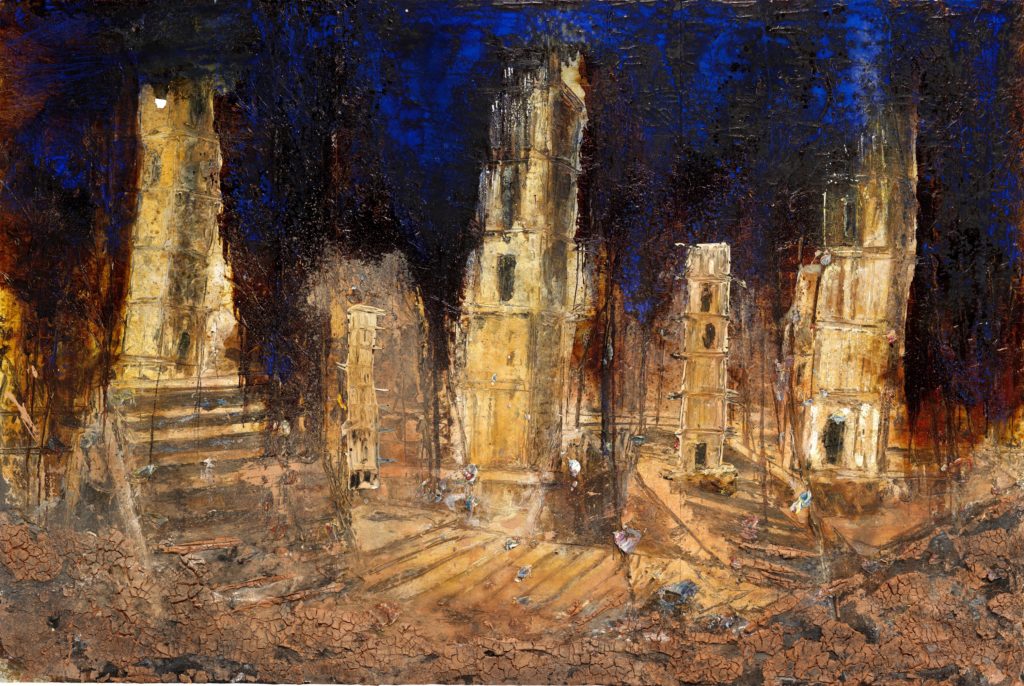
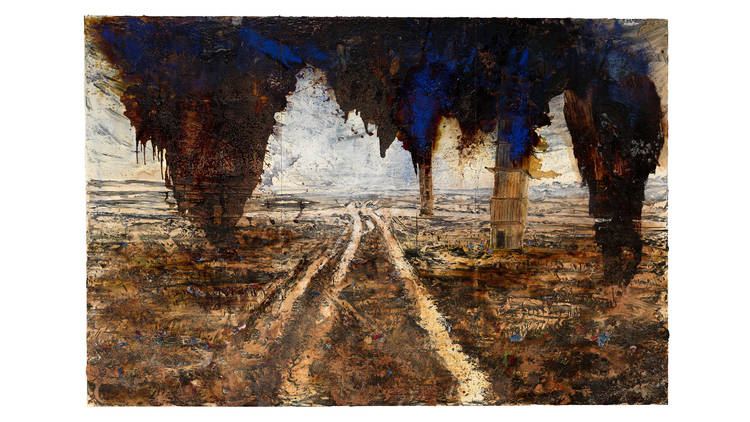
Anselm Kiefer (born 1945) is a contemporary German artist whose work is often epic in size and scale. You can see this in one of the photos below. Many of his more recent paintings use molten lead as a medium which creates these large ominous and heavy (obviously!) areas in the paintings. Over his long career he has been controversial, especially in confronting his German heritage and the events of the first half of the 20th century. But it is always interesting.
.
Several things he has written or said have really resonated with me, including one quote from which I stole a bit to use as the title of a painting, The Palace of My Memory. The quote summed up perfectly how I view the body of my work. I believe I am creating a place, a palace if you will, where my collected memory can be preserved and survive, hopefully, long after I am gone.
.
Here is that quote:
.
But I believe above all that I wanted to build the palace of my memory, because my memory is my only homeland.
 I am busy getting things around today for a workshop that I am leading up at Penn Yan in the beautiful Finger Lakes tomorrow and Friday. This is only my fourth year doing this but every year I say that this is most likely the last time I will do this. The words have already left my mouth this year.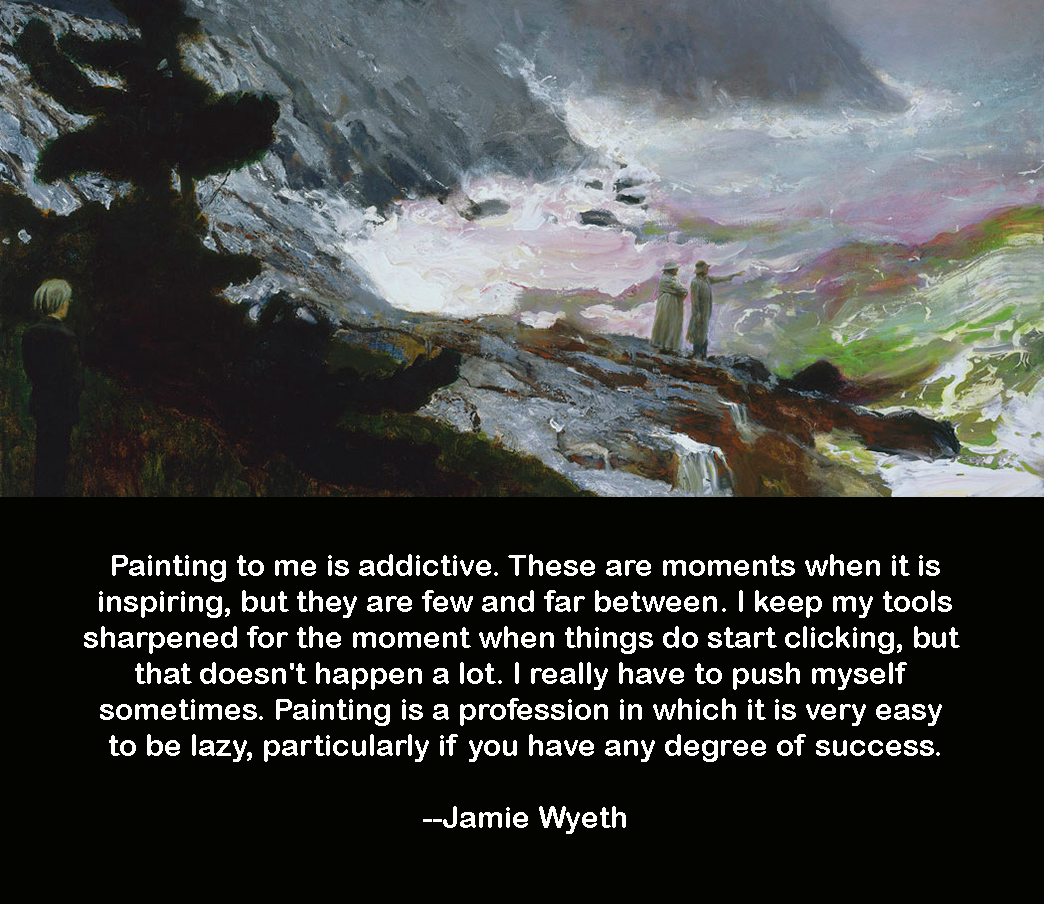


 Redtree Times