An artist only has so much control over how their work is seen and spoken of by others. The creation itself speaks loudest for the artist, of course. But it is also represented in words by gallery personnel, museum staffs and others. Each individual interpretation adds to or detracts from the work. The artist has little say unless they make an effort to control the narrative with their own words.
I know that I have tried to do this, with varying degrees of success. I felt that in order to do this I would have to try to be honest with my own assessments of the work and what I was seeing in it so that the viewer’s experience might be honestly enhanced. Hopefully, a little more depth into the work would be provided.
Whether this matters in the long term, I do not know. But for the time being, it gives me the feeling that I am somewhat in control of my narrative. Here’s a post from a few years back that speaks a bit more about artists speaking about their work and the difference between doing so with words that actually say something substantive and those that are mere fluffy word clouds.
.
David Hockney- Mulholland Drive 1980
It is very good advice to believe only what an artist does, rather than what he says about his work.
–David Hockney
*************************
.
When I first read this quote from the great British artist David Hockney, a painter whose work I admire and always find very interesting, I wanted to be offended. After all, I am an artist who has said plenty about his work through the years– this blog and gallery talks being evidence of that– and have tried to be always transparent and forthcoming when talking about my work. But even so, I nodded in agreement when I read his words.
.
Part of my own desire to be honest and open about my work came from the frustration I felt in reading other artist’s writings that were filled with ArtSpeak, that way of seeming to say something important and meaningful without really saying anything at all. The words danced around all form of meaning and never fully jibed with the images that accompanied the words, leaving me with a single word resonating in my mind.
.
Bullshit.
.
And I know bullshit. I was a longtime bullshit artist. I sold swimming pools and automobiles– yes, I was even a used car salesman!– to the public for quite some time. I knew that you could sell by focusing on the strengths of the product and by dancing around questions about its drawbacks. Fill any voids with words that sounded like they were filled with meaning but really made no commitment to anything.
.
For me, there came a time when I was determined to not deal anymore in that manner of speaking and when I finally came to painting, I knew I didn’t want my work to fall into that pool of bullshit. I wanted to tightly control how I represented my work and to be completely open about it. It’s whole purpose for me was my own honest expression and I want
David Hockney- Arranged Felled Trees
ed people to be able to witness that without a crap filter between them and the work.
.
For the most part, I feel that I have been able to maintain that through these last several years. Oh, occasionally I feel myself straying off the path but I simply remind myself that the product I am representing is the core of my self and once I cross that line I would be betraying everything art has provided for me.
.
But these are just words and maybe you should take them with Hockney’s advice in mind.
I didn’t have it so I used a red instead of the blue.
–Pablo Picasso
++++++++++++++++
This year’s edition of the Geniusseries begins this coming Tuesday on the National Geographic Channel. This well done series premiered last year with a season dramatizing the life of Albert Einstein. This year it focuses on the life of Pablo Picasso, with Antonio Banderas portraying the artist. Given Picasso’s knack for pushing boundaries and stirring the pot, it could be an entertaining series.
He is probably the most quoted of artists, though many things are mistakenly attributed to him. It’s a case that if it sounds interesting and you’re not sure who might have said it, you credit him or Shakespeare or Lincoln or some other iconic figure.
But I have a feeling that the quote I chose here today is actually his. I can’t see Lincoln saying it.
I certainly know the circumstance to which he refers.
Been there, done that.
In a pinch, you just make do with what you have because you can’t always wait until you have perfect conditions, all the materials you desire and a moment of inspiration are in complete alignment. Sometimes inspiration is there and you don’t have what you would ideally want to use but you still want to make that mark.
A number of years back, I was having some real back problems. I had to that point always painted in a standing position but the pain forced me to sit. I found that there were points where I would reach for a color that I would normally use in certain instances and find it out of reach, across the room. Instead of straining out of my seat and limping to get it, I would take whatever was within my reach and try to either replicate the color or completely substitute another color.
In many ways, it was a good experience. Where I had used reds before, there were blues or greens. Turquoise tended to turn to purples and maroons.
Because my work doesn’t depend on accuracy in depicting natural color, it actually stretched the work a bit more and reinforced that idea that one must make do with what one has at hand. It’s something I have often tried to impress on young artists, that they should never use not having everything they think they need to start as an excuse to not start.
If they have a real creative urge, then they will make do, they will find a way.
The results may exceed what their mind had imagined.
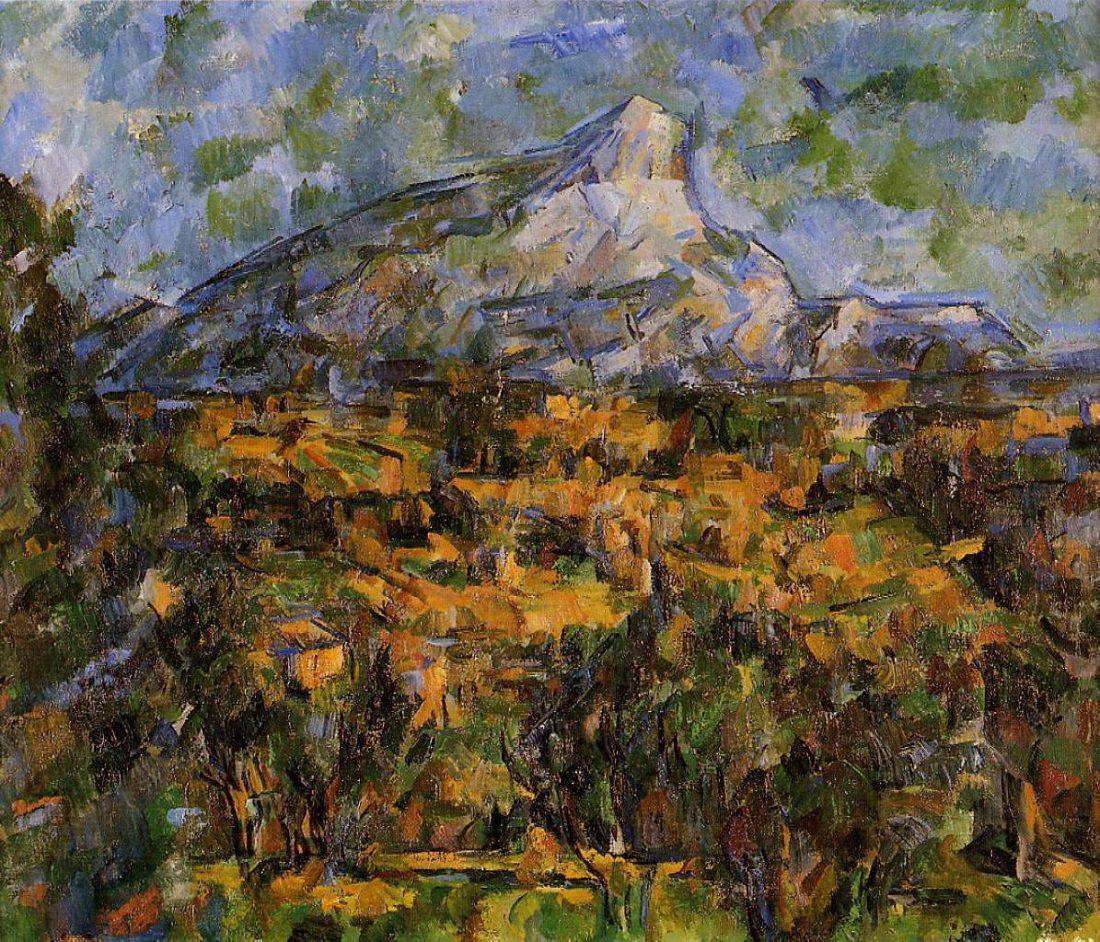
If isolation tempers the strong, it is the stumbling-block of the uncertain.
–Paul Cezanne +++++++++++++
I spend a lot of time alone in the isolation of my studio. Fortunately for me, it is the place in the world where I am most comfortable and feel completely myself.
It is the place where I can feel unrestrained to free the mind and go wherever it takes me. The place where I can shed the uncertainty I find in the outer world and feel free to daydream. The place where I can summon up pictures that exist only inside myself. A place to study. To listen. To see.
It is my my university, my library, my theatre, my monastery and my place of refuge.
My haven.
When I am out of the studio, I am all the while trying to get back to it.
When others come into my studio, the dynamic of that place changes and I feel myself suddenly self-conscious and a bit uncomfortable, like I am standing in someone else’s home.
The visitors’ eyes become my eyes and I notice things I never see on a day to day basis. The cat hair on the floor that needs to be swept up. The paint splatters on the wall or a fingerprint in paint on the wall switchplate. The windows that need cleaning. The piles of papers that I have been meaning to go through for too many months. The paintbrushes soaking in murky water scattered throughout the place or the start of a not-too-good painting that will most likely never see the outer world.
In that moment, my perfect castle of isolation becomes a hovel of uncertainty.
But the castle remarkably reappears once I am alone again. The uncertainty recedes and I begin to feel myself once more.
My isolation is my default state of being.
I understand exactly what Cezanne is saying at the top. I have been more comfortable alone than in the company of others since I was a child. I don’t know if that is a strength or just a neurotic peccadillo. But I know that if I ever find uncertainty in my isolation, I will have lost my footing in this world.
Look up at the stars and not down at your feet. Try to make sense of what you see, and wonder about what makes the universe exist. Be curious.
–Stephen Hawking
++++++++++++++
I’ve been working on a series of paintings recently for my June show at the Principle Gallery that feature fragmented skies with stars appearing at their junctures. Some are very geometric and angular while some– like the one, In the Stars, shown here–have more organic shapes with more randomness in their arrangement.
Both satisfy some part in me, in their creation and in the appreciation for them I feel once they reach a point of completion. Maybe it’s that there is a meditative stillness in both aspects. Painting them definitely creates a deep sense of quietude for me that I also find in studying them after they are done.
It is the kind of stillness that spurs wonder and curiosity, the kind that makes one look into the night sky with hopes that extend beyond our present time and place. Are we alone in this vast universe or are we the end-product– the flowers, perhaps — of one of those shining stars?
I don’t know and most likely will never know. But I will always have the need to wonder…
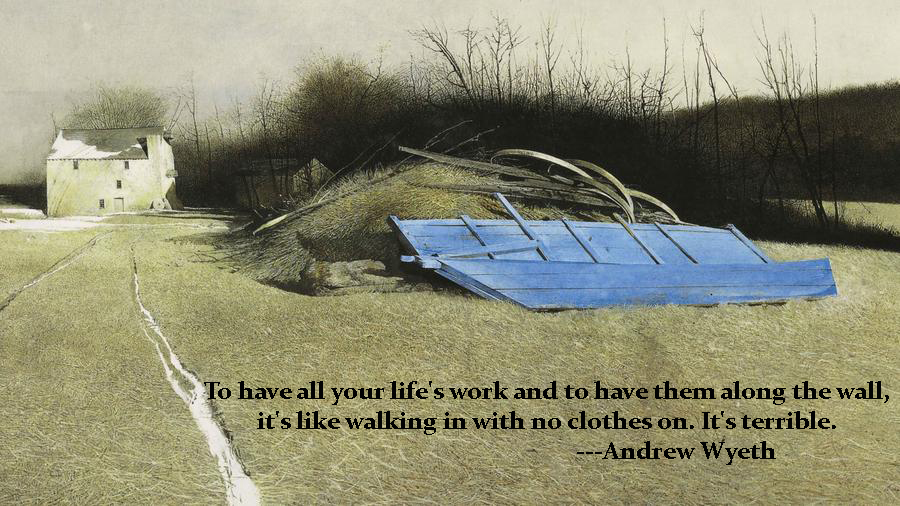
I was looking for something this morning and came across the above quote from Andrew Wyeth which really rang true for me.
I am in the midst of working feverishly towards my June 1 show at the Principle Gallery in Alexandria. my 19th solo show there. I’ve done over 50 solo exhibitions over the years so you would think that I would be over any uneasiness that comes with showing my work. But I still get that terrible queasy feeling in my gut whenever I first see each show hanging. It really is a feeling much like Wyeth describes, like standing there with no clothes on.
The worst of these feelings came at my first show at the Principle Gallery back in 2000. It was called Red Tree, which was the real introduction of the that signature tree that populates much of my work. I had only been working as a full-time artist for two years and had only two small solo shows at regional art centers under my belt at that point, so I had no expectations for such a show. But I had developed a solid base of collectors at the Principle since I began showing there in early 1997 and they felt I might do well with a show.
I understood at the time that this was a wonderful opportunity and put a lot of pressure on myself to put everything I could into that show. The rustic studio that was my home for the first ten years that I worked as an artist was much smaller than my current studio so when the show was done every space in it was filled with new work. I couldn’t get a real idea of how the show might look together, especially since this was pre-digital for me, all my work documented in slides rather than JPEGs.
I felt good about the work but maybe I was just being delusional. It happens.
So on the day of the opening we first walked into the gallery several hours before the reception and the then burnt orange walls of the gallery were filled with these paintings. There was a dizzying vibration to it that gave Cheri and I both an overwhelming feeling of nausea. It was like the inner self that I tried to keep hidden from the world was suddenly splashed through the gallery and I was trapped there amidst it, like someone standing naked in a dream with no way to escape and nothing with which to cover up.
Thankfully, that night exceeded all my expectations. If it had not, I don’t know that I might even be writing this blog now or where I would be in my career. If it had not done well, that horrible feeling would surely have stayed with me forever. As it is, it still visits me with every show but to a lesser degree and for shorter time span.
I suppose you get used to public nudity after a time.
I was writing a new blog entry for today when I looked back at this one, written a couple of years back. It pretty much said what I was struggling to put down this morning so I thought I’d just replay it with a different song at the end. Have a great day.
+++++++++++++++++
Slovakian Resurrection Icon circa 1640
It’s Easter Sunday.
The day of the Resurrection.
I’ve said it before here, I am not a religious person. I wasn’t raised with religion and much of my knowledge of it as a kid came from a local church lady, Nellie Beidelman, who used to come to our little elementary school on a regular basis. We would assemble in the cafe-a-gym-a-torium (a space that served all three functions) to hear her tell Bible stories with the aid of a felt board with beautifully painted cut-out figures.
I know it’s not something that could ever take place today in a public school. But she was a very warm, gentle person and a fine storyteller without being preachy. I always found the stories interesting as they introduced me to the classic tales of the Old and New Testament and still vividly remember her telling of the Resurrection. It didn’t make me feel any more inclined toward religion but at least I knew the stories and the lessons that they contained.
I just never had that certainty of belief. I admired it in others and sometimes wished I had it, wondering why I didn’t. But that same certainty made me uneasy. What would someone do in the name of their belief, that thing that seemed so certain to them and so distant to me? The news is filled with horrors perpetrated by those with this certainty firmly in place, whether it’s ISIS inspired suicide bombers or radical Fundamentalists killing physicians who have performed abortions.
And reading history doesn’t make this uneasiness with certainty go away. How many of millions have perished at the hands of those who were certain in their beliefs, however misguided and wrong they may seem to us now? Even in doing my genealogy I have come across so many atrocities done by my ancestors in the name of their beliefs that it makes me question the decision to look into the past at all.
That being said, I still sometimes envy those with that certainty and the comfort they seem to find in it. My own beliefs, as they are, are always subject to questioning, always filled tinged with a bit of uncertainty. But they still offer a degree of comfort. Sometimes stopping as I walk and feeling the sun on my skin and gazing into the blue of the sky fills me with a feeling that seems transcendentally reverent in that moment. The outer world fades for a brief second and I seem connected with something greater than this time and place.
That moment is my certainty, that thing on to which I hold as proof of something greater. And that moment once in a great while is all I ask of it.
So, with or without that certainty, whether you observe Easter or any other religion’s activity today, I wish you a great day. But stop once in a while and just feel the sun on your skin and notice the color of the blue in the sky. For this week’s music, here’s a great cover of a Bob Dylan song, Times Have Changed, from the great soul singer Bettye Lavette, who recently did an album of her interpretations of Dylan songs. This song won an Oscar for Best Original Song in 2001 for it’s use in the movie Wonder Boys.
I am really busy this morning but wanted to replay the post below from a few years back. I am currently at a point where I am just emerging from a period of great uncertainty and doubt, which had me questioning the path I had followed. But with each painting comes a bit more confidence, a bit more energy and a renewed sense of purpose. It makes me realize once more that the work itself is a sort of perpetual motion machine– it produces energy beyond that put into it.
The trick is in simply trusting the work and just doing it. Which is what I must do right now.
What still concerns me the most is: am I on the right track, am I making progress, am I making mistakes in art?
–Paul Gauguin
******************
At one of my gallery talks a year or two ago, I was asked about confidence in my work. I can’t remember the exact wording but the questioner seemed to imply that at a certain point in an artist’s evolution doubts fade away and one is absolutely certain and confident in their work.
I think I laughed a bit then tried to let them know that even though I stood up there and seemed confident in that moment, it was mere illusion, that I was often filled with raging doubts about my voice or direction or my ability. I wanted them to know that there were often periods when I lost all confidence in what I was doing, that there were days that turned into weeks where I bounced around in my studio, paralyzed with a giant knot in my gut because it seemed like everything I had done before was suddenly worthless and without content in my mind.
I don’t know that I explained myself well that day or if I can right now. There are moments (and days and weeks) of clarity where the doubts do ease up and I no longer pelt myself with questions that I can’t answer. Kind of like the painting at the top, Where Do We Come From? What Are We? Where Are We Going?, the masterpiecefrom Paul Gauguin. Those are tough questions to answer, especially for a person who has little religious belief.
And maybe that’s the answer. Maybe my work has always served as a type of surrogate belief system, expressing instinctual reactions to these great questions. I don’t really know and I doubt that I ever will. I only hope that the doubts take a break once in a while.
There was another quote I was considering using for this subject from critic Robert Hughes:
The greater the artist, the greater the doubt. Perfect confidence is given to the less talented as a consolation prize.
I liked that but it feltkind of self-serving, like saying that being aware aware of your own stupidity is actually a sign of your intelligence. I would really like to believe that all those times when I realized I was dumb as a stump were actually evidence of my brilliance. I think many of us can claim that one.
Likewise, if Hughes is correct then I may be one of the the greatest artists of all time.
The older I get and the more I master the medium, the more I return to my earliest experiences. I think that at the end of my life I will recover all the force of my childhood.
–Joan Miro, from 1960 at age 67
———————–
It’s the young people who interest me, and not the old dodos. If I go on working, it’s for the year 2000, and for the people of tomorrow.
–Joan Miro, from 1975 at age 82
————————-
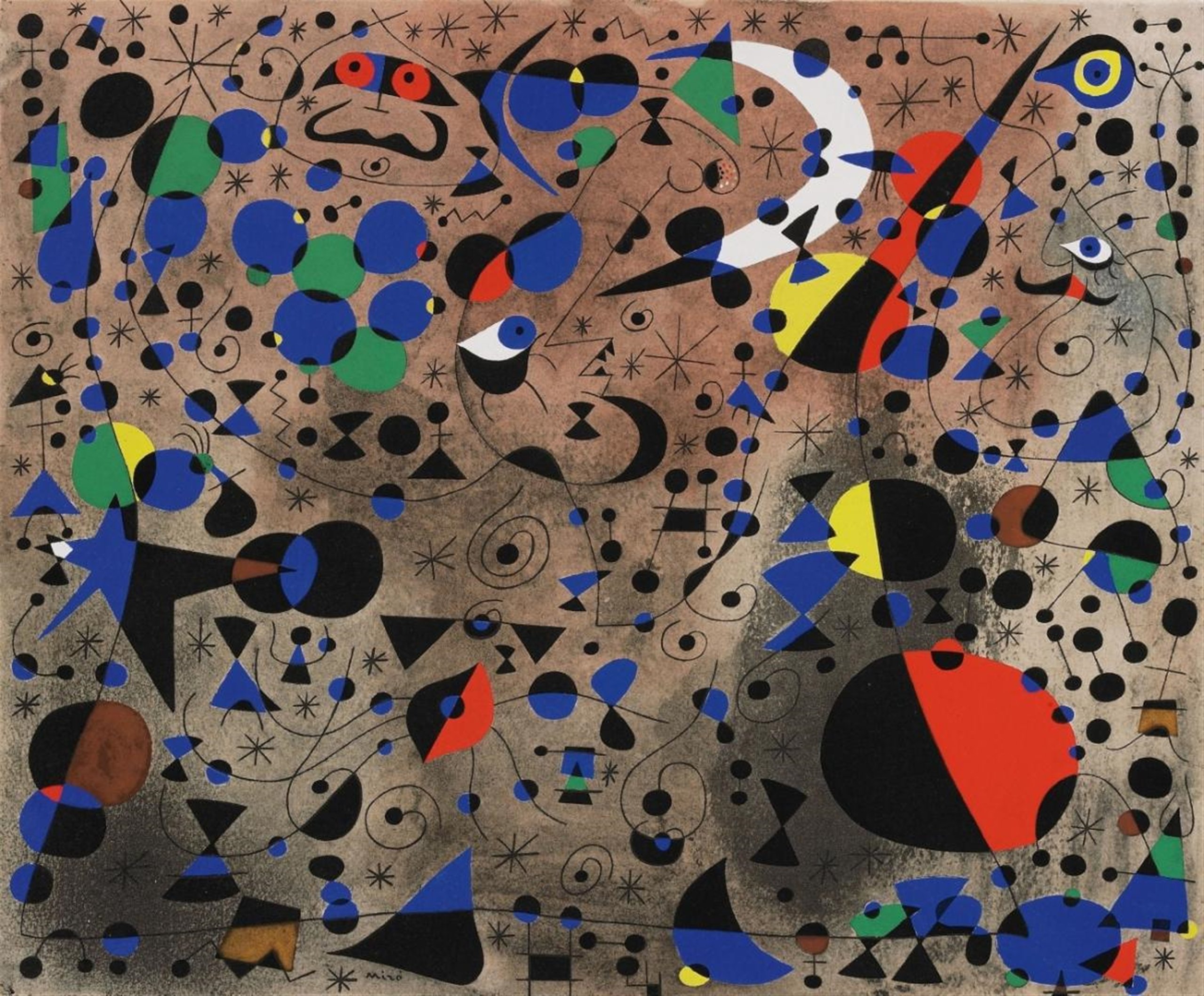
There are two quotes here from the great Spanish painter Joan Miro (1893-1983) that really strike a chord with me. Both come from him when he was older and both speak very much to the way I feel about my own work.
In the first he speaks about gaining more mastery over the medium through the years while simultaneously moving closer to the vibrant energy that one has in their youth. I have felt the same feelings. The more one gains control over their form of expression, the more they are freed from the constraints of conscious thoughts and decisions. The work becomes reactive to the feel and emotion of the moment.
Now, I will add that with this acquired mastery there is also a new barrier erected to overcome. Well, at least, in my experience. I have found that with years of work, which is, in effect, rehearsal and practice, there is sometimes a loss of spontaneity and passion in the actual making of the marks. They become a little too precise, a little too mannered and a bit too clean and neat. They don’t have that feeling of wanting to burst off the surface. I have found ways to get past this–using bigger brushes and making strokes quicker with more urgency, for example– but every so often I will get near the end of a piece and it just feels too neat, too precise, for the underlying emotion.
It needs the innate exuberance of a child at play.
The second Miro quote, made when he was 82, speaks of painting not for those of his age but for the younger and the future generations. I certainly understand this sentiment. I am most thrilled when children react to my work, knowing then that it is speaking to the aforementioned innate exuberance.
It means I am not dealing with intellect or acquired knowledge or conscious thought. It is a pure and uninformed reaction. It means the work is communicating emotionally across and out of time.
And I think this is important because I believe most artists wants to break free from their own era, to not be consigned to any single period of time. To be known for what they were at their inner and eternal core, not where or how they were categorized in their time.
Maybe like the Miro painting at the top, a single small voice among the multitude of stars and constellations in the universe.
I don’t know but that might be my primary goal in doing what I do.
While writing a reply to comment made on yesterday’s blog early this morning, I stated that for me, there was a connection with energy of these young people that were behind this weekend’s March For Our Lives and that of the presidential campaign of RFK in 1968. I was only 9 years old but was fully aware of RFK , watching intently every day as his campaign was covered on the evening news, in our case NBC’s Huntley-Brinkley Report.
Robert Kennedy campaigning for a seat in the Senate, 1964. Elmira, NY
His youthfulness stood in stark contrast to the other politicians that I saw such as LBJ and Nixon, older stodgy looking men in dark suits. Kennedy looked young enough to be their sons and the crowds that turned out to see him were always filled with kids. Many photos of his campaigns show him standing amid swarms of young people. One of my favorites is from his 1964 senate campaign, with him in a shopping plaza in my hometown that I know well. He is standing in car with his shirtsleeves rolled up with a crowd of kids reaching out to shake his hands.
The idea of dreaming things that never were and thinking they could actually happen still seemed like a possibility in those moments. And why not? We were on the brink of putting a man on the moon, something that only a few years before seemed impossible. We had passed sweeping Civil Rights legislation, overcoming centuries of ingrained prejudice and the darkest efforts of those who claimed supremacy.
Anything was possible.
And that thought is what seems to be taking root in these kids. They don’t feel bound to history. They see only the present and the future and in that, they recognize that they will be the ones occupying the future.
Why simply accept the wreckage we are leaving them as our legacy? Why not make it a time and a place of their own making? Their vision, their world. Not one forged by old men who only see things in terms of money and privilege.
Another St. Patrick’s Day, that celebration of all things Irish– parades, pints and more Kelly green than the mind can fully process. They say that well over 30 million Americans claim to have Irish roots.
Growing up, I always believed we did as well because my grandmother was an O’dell, which certainly seems Irish. But doing genealogy over the last decade I have discovered that the O’dell was changed through the years from Odell and before that from Odle and, most likely, before that from Woddell, It turns out that it was not Irish at all.
No, it was British. And for the Irish that is a big distinction.
But I also discovered that my father’s great-grandparents were Irish immigrants during the Great Migration of the middle of the 19th century. It was something I wasn’t sure of before I started my genealogy work. I still haven’t found where they originally came from in Ireland.
Icon: Mary T.
Their’s was a pretty stock story. The father, Michael Patrick Tobin, worked on building the railroads in central New York, ultimately settling in the Binghamton area, where most of his family worked for the next several decades in the tobacco industry there. Most were tobacco strippers or cigar makers.
I am not positive that his wife was actually born in Ireland. There are conflicting accounts but her parents definitely were. She was the subject of one of my Icon paintings from a couple of year’s back shown here on the right. Her story is an interesting one, one that I wrote about on this blog. You can read it by clicking here.
So, it turns out I am one of those 30-some million with a bit of Irish blood, about 25 % according to the DNA tests. I don’t give it much thought except on this particular day and even then, I realize that these folks were not much different than most of my other ancestors from other countries who left the hardships of their homelands for what they hoped would be a better life in America. I can’t say they all found wonderful lives but perhaps they were a bit better off than they might have been had they stayed put.
Okay, here a bit of Irish music for the day, a nice reel, The Glen Road to Carrick, from a contemporary Irish group, FullSet. I like the feel of this- it has a fresh edge that makes me want to drive too fast. By the way, the painting at the top is from a late Irish painter, Paul Henry, who painted primarily in the first half of the 20th century. I am a fan of his work and featured it here a couple of years back.







 Redtree Times