Feeds:
Posts
Comments

Archive for the ‘Biographical’ Category

GC Myers- Observers frm smI am in the last stages of putting the finishing touches on the work for my Principle Gallery show before I deliver it later this week.  It’s always a thrill to see the work move from the raw image into its finished state, like seeing a raw gem put into a proper setting that focuses the light and color.  The piece above is a good example.  I showed it here  back in the first days of April in a fairly finished state but lacking the frame and the gold edge that surrounds each panel.  I really liked it then, liked the interaction of the elements and the way the color popped off the wood panel.

But these finishing touches have really transformed it for me.  Though it is pretty large, measuring in at about 28″ by 52″, it seems larger and demands the eye more than before.  Amazing how how little things can change the whole effect and feel.

Like the show, this piece is called Observers.  I think many many of us are observers, those people never quite in the middle of things, just off to the side as they watch the action take place.  They never have much control over and seldom set the course of anything but note how it proceeds. Some members of this group, artists and writers among them,  notice this as well, along with little details that give their accounts depth and meaning.  Things like how the light was and what the air smelled like at certain moments, the facial expressions and body language of those around them.  Things like patterns and shapes and quality of color in the environment of the moment.

Growing up, I often felt like I was watching things from a distance, never in the center of things.  Oh, I had those moments of being the center of attention.  I was the baby of our family and at times got more attention than I warranted.  But often  I felt like a third party watching things from the outside.  A lot of this came from spending a lot of time in the adult world, kind of a tagalong.

I remember spending several days one spring break when I was maybe 9 years old at my aunt’s house.  My cousin and best friend of the same age was still in school as their spring break was a week later than ours so I didn’t have him for companionship.  While he was in school I would go to work with my uncle who was a water well driller.  I just followed along for several days, not saying much and just watching his world.  I still remember vividly the coldness and thickness of the mud we slogged around in  around the drilling site.  I remember the smell of the cheese and dried blood in an old country store where we stopped to grab some lunch, a rich cheddar stench that blossomed when the proprietor pulled the heavy glass cover off the huge cheese round.  I remember the small glass of soda with the huge ice cubes that I drank at the tavern while I stood next to him at the bar, all the time reading the goofy plaques behind the bar with risque quips and jokes on them.  I can still see the lettering and words of those plaques and my uncle’s face when he asked me what I was smiling about.  I pointed out the one that had something to do with male genitalia and itching (that’s all the info I’m sharing about this although I remember it well) and he chuckled and told me not to read so much.

It wasn’t much fun for those few days but the memory is vivid and there is something there that I hold on to.  I think that is what observers do , hold onto fleeting bits of memory and detail.  And that’s a bit of what I  see in this work.

Read Full Post »

Out of Bounds with Tish PearlmanJust a quick reminder that the public  radio interview that I did back in February is now available  and permanently archived online at the Out of Bounds website.  It’s a  conversation with the host of the show, Tish Pearlman, who expertly and gently guides me through a half-hour concerning the beginnings of my career and the evolution of my work.   It’s a good introduction to those who are interested and have never been able to make it to one of my gallery talks.  If you have been to a gallery talk, you may recognize some of the  stories and anecdotes from this interview.

Either way, it’s there for you to access.  Hopefully, there’s something in there for you to enjoy.

Read Full Post »

GC Myers- Geometry of the HeartIt was Opening Day for Major League Baseball the other day, which is always  a red letter day for me.  It’s sort of like 2013 has officially began, that my day to day life now has something with which to synchronize, something to fall in rhythm with.  So, even though I have been feeling under the weather for several days,  I was able to complete a new piece, one that had been banging around in my head for a long time.  It incorporated the perfect geometry of the baseball diamond nestled among a tightly clustered neighborhood of Red Roofs.  It’s an odd piece, one that feels both typical and atypical at once.  That’s a quality that I like.

ralph_fasanella_sandlot_baseball_1373_356I have been wanting to incorporate the baseball diamond into one of my landscapes, perhaps influenced by some of the folk art paintings that did it so well.  I have featured some of these here, such as Malcah Zeldis’ Homage to Hank Greenberg, shown at the bottom of this page or Ralph Fasanella’s Sandlot Baseball,  shown here on the left.  These are paintings I like very much as much for the baseball aspect as for the wonderful folk art manner in which they are painted.  There is something in the sight of a diamond that has a hypnotic effect on me, something I hoped to capture in a painting.

I always remember the feeling when I was a kid and we went to Shea Stadium to see the Mets play, especially for night games.  You would head out from the dim light of the concourse and emerge into the brightness of the field lights.  The green of the field was so vibrant, the brownish red of the infield dirt so rich.  There was something perfect in looking down on that diamond, a design that made so much sense to a child’s mind.  A beautiful geometry, one that equalizes weaknesses and strengths.  The length of the basepaths, for example, are such that  on a hard hit  ball to the infield a fast runner can be easily thrown out at first but a slower runner can often beat out a soft groundball.

Here, a small man could easily conquer a much larger man from a distance of 60′ 6 “, the distance from homeplate to the pitching rubber.   Skill overcomes pure strength, size and athleticism.  If you ever saw Michael Jordan flailing helplessly at minor league curveballs, you’ll know what I mean.

I could write a lot more here.  And I probably should.  But I simply want to show this new piece, a 20″ by 24″ that I’m calling Geometry of the Heart.  Here, the ball park, a Little League sort of field, represents the heart of the neighborhood, the openness of the field stands in direct contrast with the cramped houses.  This is a painting that I have really enjoyed painting, one that is probably more for myself than for anyone else but one that I needed to paint.

malcah-zeldis-homage-to-hank-greenberg

Read Full Post »

Gravestones, Early and FolkI have always been attracted to cemeteries, which is probably why they have been popping up in several of my recent landscapes.  Even as a child, I found the stones in cemeteries irresistible.  There were several old family plots around our home, small groupings of  stones set in the edge of the woods where early settlers in our area were laid to rest.  Most had death dates, when you could make them out on the weathered slate, that dated from around the late 1700’s and early 1800’s.

One small plot across the road from us was reportedly the family of a coach driver that had resided in the home that had once been attached to an old stone chimney that still stands there to this day,  almost like a monument in itself.  It was rumored that the family had been killed in an Indian massacre, although I believe it to be just that– a rumor.  I found the small graveyard tucked on the edge of a forest hidden from the road a very serene place.  It had a calming  air around it that I found appealing, even as a child.  Plus it played to the imagination, the stones conjuring up the names of those  that I would try to envision and bring to life in my mind.

This fascination has carried through my life.  I am always eager to walk in cemeteries, to look at the stones and read the names.  I sometimes wonder, as I walk through with a name on my lips, if that name has been spoken in years.  I somehow imagine that I am conjuring their spirit, their memory of their life,  back into form by virtue of simply saying their name.  It seems like their is a power in this simple act, even if is a mere act of respect.

Grave, Lion GardinerAs I have done more and more genealogy, this interest has continued as well.  There are numerous sites where I have found images of  ancestors’ graves.  Some are unique, like this elaborate monument to Lion Gardiner that was designed by architect James Renwick, famed for his design of St. Patrick’s Cathedral  in NYC, when Gardiner’s body was re-interred in 1886.  Others are crudely simple, a slab of stone with the name crudely carved with what looked to be a nail.  Many have no stones at all, which I find sad because there will be no possibility that someone will walk through the graveyard one day and read their name aloud.

Eleazer Mulford- Lindley NYThere’s a great site online that has the entire Farber Collection available for viewing.  The late David Farber and his wife, Jessie Lie Farber, were even more enthralled than I am with cemeteries.  They amassed a huge collection of images of the sculpture and carvings on early American graves, most dating before 1800.  It’s a treasure trove of imagery and a great site to spend a few moments browsing, especially if you have anything like my interest in how cemeteries relate to our history.

Read Full Post »

Locust Folding Bicycle Desined by Josef CadekI worked one summer many years ago as a janitor on the campus of Syracuse University. I worked in the men’s gymnasium that was attached to old Archbold Stadium, on the site where the Carrier Dome was erected a few years later. Cleaning the gyms was part of my duties there and it was interesting to watch some great athletes work out. But for me the more interesting aspect cam in the the lower level of the building where the Industrial Design department was located.

This was where the future was being designed by young, inquisitive minds who were always looking for new ways to streamline product designs for efficiency.  I worked in the lab where they created prototypes and, as they had adjourned for the summer, was able to spend a lot of time wandering around among the clay rooms and drawing boards,  gawking at the drawings and plans that had been left behind.  They were a messy bunch but it was fascinating to see how their minds perceived the function and design of  everyday items

It gave me a greater appreciation for the way products evolve.  We have a use for an item and generally start a first impression of how it should function, creating a product to fit that function.  But as time passes the function changes as does the technology and materials we employ in making these items and the design evolves.  I think this folding bicycle designed a few years ago by Czech designer Josef  Cadek is a great example.  Called the Locust, it is a lightweight bike that folds into an efficiently transportable unit.  The chain (actually a heavy belt) is fully encased so there is no oil to rub on your pant legs  and it features a circular frame into which the whole bike  folds.

I don’t know about how well this bike rides but the Dr. Seuss factor of its design sets it apart for me.  I could see the Whos in Whoville spinning around town on these contraptions.  Maybe a Dr. Seuss-like future is in store for us, after all.  There are worse things…

Read Full Post »

I listened to the Out of Bounds interview yesterday with a squirming knot in my stomach.  Fortunately, it seemed to go okay and  most of the knot subsided immediately.  Not all of it, however, as I had a lingering, nagging feeling about  an omission on my part that I need to correct .  When Tish Pearlman, the host of the show, asked about the time when I first showed my work to  the gallery owner at the West End Gallery she didn’t use his name.  As I listened yesterday, I kept saying to myself as the interview went on, ” Say his name, for chrissake!“, hoping that I was about to utter the name.  I was positive I had used his name during the interview.

But it turns out that I had not.


Tom Gardner's Artemus  the  Buffalo Bursting from Rockwell Musuem

Tom Gardner’s Artemus the Buffalo Bursting from Rockwell Musuem

The name was Tom Gardner, who owned the West End Gallery at that time with his then wife Linda Gardner, the current owner who I did mention during the interview.  Besides owning the gallery, Tom has  been a mainstay  and engine of the art scene in the Finger Lakes  region for decades.  He is well known for his oil paintings with collectors all over the country, his teaching of aspiring painters and his public sculpture.  Visitors to downtown Corning are well familiar with his sculpture of the buffalo, Artemus,  that bursts  through an upper exterior wall of the Rockwell Museum of Western Art there.  Or the Dali-esque melting clock that adorns the front of the West End Gallery.

Tom Gardner-  Amish Drive-By

Tom Gardner- Amish Drive-By

He is a non-stop ball of creation and a great and amiable character, to boot.  You can’t walk twenty feet down the street with him  in Corning without someone stopping him to talk or someone yelling at him from across the street.  It was this amiability that made me comfortable enough back in January of 1995 to bring in my milk crate filled with scraps of paper and board for him to critique.

As I said during the interview as well as many times during  gallery talks through the years, my life would have been vastly different if not for Tom’s willingness to look at my work with an open mind.  I really don’t know where I would be right now if Tom had not seen something that day and had not encouraged me.    I don’t even know if I would have continued painting for long if he had told me there was nothing there.  I doubt very much that I would be in my own studio, writing this blog.   I’m sure I would not be as contented in my life as I now am and,  for that alone, I am forever indebted to Tom Gardner.  Even if I do absentmindedly overlook mentioning his name on a radio interview.

Thank you, Tom, for opening a door of opportunity for me when I wasn’t even aware that there was one in front of me.

Read Full Post »

GC Myers- Eternally FreeJust a reminder that you can hear a radio interview I did with Tish Pearlman for her program Out of Bounds this morning on WSKG-FM in New York and Northern Pennsylvania.   It  can also be heard on a live stream online at wskg.org.  The show airs at 11:30 AM,  just before Ira Glass and This American Life comes on at noon.

One of the questions asked was about what sort of music I listen to in the studio and the one specific piece I mentioned was Tabula Rasa from composer Arvo Pärt, one that I’ve mentioned here in the past.  It always inspires me and reminds me of the drive to find the big silence of the open landscape in my work.  The piece above, Eternally Free, is a favorite of mine that hangs in my studio and is one that I am always reminded of by this music.

I hope you can tune in this morning but for now, here’s the second movement from this wonderful piece of music which is title Silentium: Senza Moto which translates as Silence: Motionless.   The big quiet.

Read Full Post »

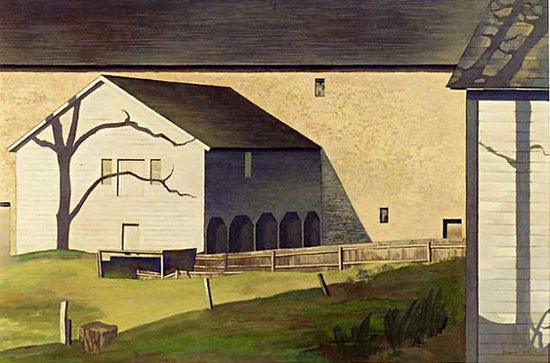
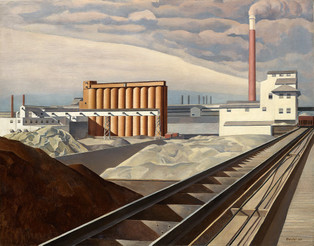
166_1934_CCI find it hard to believe that I haven’t mentioned the work of Charles Sheeler here, outside of a mention of his collaboration with Paul Strand on the film Manhatta, a landmark American art film from 1921.  Sheeler (1883-1965)  is one of my favorite artists who as  a pioneer in photography and painting in the early decades of the 20th century is often called the father of Modernism.  Oddly enough, I am particularly drawn to his industrial imagery which replaces almost all evidence of things natural in completely man-made factoryscapes.  This  might seem to be the antithesis of my own work,  which often omits all evidence of human intervention in my landscapes.

Charles Sheeler River Rouge PlantSome of his most potent work came from an assignment where Henry Ford hired Sheeler to photograph his factories, wanting him to glorify them in an almost religious manner, as though they were cathedrals for the new age.  As Ford had said at the time, “The man who builds a factory builds a temple. The man who works there, worships there.”  Sheeler was impressed with the factory complexes and felt that, indeed, they represented a modern form of religious expression.  His painted work from this time glorified the machine of industry in glowing forms and color.

Charles Sheeler Shaker BarnHe saw the factory as a continuation of the American idea of work as religion, one that was rooted in the sense of  reverence and importance of the barns and structures of the farms of the earlier pre-industrial age.  He   painted many scenes of farms and barns, abstracting the forms as he had with the factory scenes.

Charles Sheeler Classic LandscapeI don’t know that I completely agree with Sheeler on his idea of the factory as cathedral but I do have to admit to being awestruck in the presence of large factory structures.  I remember working in the old A&P factory, a huge building that was said to have the capability to produce enough product each day to feed everyone east of the Mississippi.  It no longer exists.  Some of the huge rooms in the building were amazing to stand in, as the machines hummed and throbbed while workers hustled about servicing their needs.  I particularly remember the tea room which was a huge ca cavernous space with row after row of steampunk  looking machines that bagged the tea then sewed it shut.  I cleaned these machines for several weeks and, standing in the grand space in silence after most of the workers had gone and the machines turned off, felt that feeling of awe.   I would sometime walk around from area to area, just taking it in.  I didn’t necessarily adore it in the manner of a religious zealot but there was no denying the  power in its magnitude and the power of the machine.

Maybe that’s why I’m drawn to Sheeler.  Maybe its his use of form and color.  I don’t know.  I guess it doesn’t really matter.  I just like his work. Period.

Charles Sheeler Conversation Sky and Earth

Read Full Post »

In the Shadow

GC Myers  In the ShadowAs I wrote a few weeks back, I’m in the middle of my process where I spend some time both looking backward and forward through my work, looking at pieces from the past for bits of inspiration that might lead to some new synthesis of  the original creative driver.  In doing so I sometime come across paintings that are unlike anything that was done in the time period around them, paintings that stand out in sharp contrast.  This is one such piece, called In the Shadow. a 9″ by 12″ sepia painting from six or seven years back.

As I scanned through my files, mostly quiet and placid pieces with warm colors and calming compositions, I came across this dark piece that seemed so out of place.  Nothing before it in that year showed any evidence of this piece’s coming.  And nothing after it showed any signs of its influence.  It was a complete anomaly for its time.

I showed it a few times but it never sold which did not surprise me at all.  It wasn’t that I didn’t think it was a good piece  because I did think it had a unique quality that made it good. I often use good to describe my work, meaning that it has a complete feel, a life all its own, and this painting had it.   But I wasn’t surprised at the lack of interest because of the quality but because it was too personal, too reflective of my own angst.  I knew at the time that it was only meant for me because of this.

Most of my work deals with alleviating the angst that is often consuming for me.  It is all about escaping that shadow and bringing light.  I have often said that my work is not a reflection of who I really am but is instead a goal of who I want to be.  It is aspirational work.  This, on the other hand, was not filled with hope but was instead a snapshot of  the reality of the moment for me.

It was personal and too narrow in its meaning to easily connect with those who see the better parts of themselves in my work.  I understood that from the moment I created this piece.  But I felt that I had to show it just to be honest about my own reality, my own journey.  We are all prismatic figures  that only show certain facets to the outside world at any given  time and I wanted to let people see this often hidden facet just to let them know that  it is there.  Perhaps one day, it will fade from the light of the other, more hopeful facets.

But it is there and every now and then it shows itself just to remind me from where I came.  But not where I am going.

Read Full Post »

I was in Cooperstown yesterday, picking up my paintings after my show at the Fenimore Art Museum there had finally ended.  After packing up and heading home, Fenimore  Art Museum Exhibit- GC Myers2012 2I couldn’t shake a song from my head, it’s refrain running over and over again.  It was Is That All There is? by Peggy Lee.  It had been a hit for her in 1969 and was played regularly on the AM radio stations of the time.  If you were listening to an AM station back then , there was no telling what you might here next.  After Peggy Lee you might hear the Beatles or the Stones and then maybe something from Otis Redding followed by Roger Miller or the  Doors or Johnny Cash.  It was all over the place, stylistically, but that was the norm then before music on the radio became relegated to its stylistic niche.

But in 1969, there was Peggy Lee, the older Pop/Jazz chanteuse from a prior generation singing the existential lyrics of  Is That All There Is?  on my radio.  She spoke much of the song, recounting episodes in her  life and the disillusionment she felt after each occurred before singing the lines  …if that’s all there is , my friends/ Then let’s keep dancing/Let’s break out the booze and have a ball/ If that’s all/There is…

It turns out the song, written by the great songwriting team of Lieber and Stoller, was based on an 1896 short story, Disillusionment,  from German writer Thomas Mann and the song’s episodes were directly from the story.  I didn’t know that and it really didn’t matter because , though I was only ten years old at the time,  there was something in that song that stuck with me, something that I internally understood. We are always let down somehow by those things we seek and finally attain, even when they meet all of our expectations.  We never feel as changed as we had thought we might and we emerge pretty much the same person.

That’s pretty much the feeling I had yesterday as I headed home.  The show there had been a great, great experience.  It had exceeded my expectations and was by all accounts very successful.  But still… there was the inevitable moment of letdown accompanied by doubts and fears and questions.  What if this is as good as it gets?  Is this a peak and I have nowhere to go but down?  Where do I go from here?

I’ve tried to explain this feeling here before. It’s something that baffled me early on.   But after doing about 35 or so solo shows over the past decade and a half, I’ve come to expect this feeling and am somewhat prepared.  I always tell other artists when they get their first show to savor the feeling, take it all in, but to not be too discouraged by that letdown moment in the aftermath.  And they all do feel that moment, even after a triumphant show.  I’ve had so many tell me this that there must be some validity in it.

I’ve gotten to the point where I anticipate it and try to prepare for it.  There’s show preparation and post-show preparation.  The show prep is actually the easy part in that  it is all tangible.  There is work to complete. deadlines to meet.  The post-show is intangible, without goals or deadlines,  and therefore more difficult to take on.  I use it now  as a catalyst, a cattle prod of fear to spur me forward in my work.  Actually, I would be worried right now if I were without fears,  satisfied and content with my achievement.  I think that this feeling of contentment leads to complacency which is the end of growth and creativity for an artist.  And to not continue to grow would be even worse than the few pangs of disillusionment I experience in the aftermath of a show.

So today I am discontented and anxious in the studio.  Just as I want and need to be.

I think I’ll listen to a little Peggy Lee just to enhance that feeling. Maybe I’ll break out the booze and have a ball…

Read Full Post »

« Newer Posts - Older Posts »