Painting is neither decorative amusement, nor the plastic invention of felt reality; it must be every time: invention, discovery, revelation.
–Max Ernst
+++++++++++++++++
.
I like this quote from Surrealist painter Max Ernst. It seems that a painting that follows this described route– invention, discovery, revelation— takes on the sense of timelessness that makes it art.
.
The invention comes in the actual composition and the initial execution of the painting. Discovery comes in allowing the painting to build in itself, to follow directions that arise during the process. Revelation is recognizing something more in the painting than the subject itself suggests.
.
There’s a lot more that could be said on all three of these elements but the shorthand version suits me at the moment. Take that for what it’s worth.
Nonsense wakes up the brain cells. And it helps develop a sense of humor, which is awfully important in this day and age. Humor has a tremendous place in this sordid world. It’s more than just a matter of laughing. If you can see things out of whack, then you can see how things can be in whack.
I am not going to go into detail here about his theories and how they have been behind many of the economic and political moves that have brought us the vast economic inequality and burgeoning corporate oligarchy present today. I will say that it definitely made me see things as being out of whack and I had a real need for some Dr. Seuss style humor and nonsense.
.
I believe he is correct in saying that nonsense wakes up the brain cells. Just the imagining of absurdity causes one to take different perspectives, to try to see things in different lights. That is the basis for empathy and altruism, things that are in short supply in world that seems to be more and more running according to Buchanan’s theories.
.
Give me The Lorax or Green Eggs and Ham any day. Then maybe I can see the world back in whack.
.Each painting has its own way of evolving. When the painting is finished, the subject reveals itself.
–William Baziotes
.
+++++++++++++++++++
William Baziotes is another painter you probably don’t know. He had a relatively short life, dying at age 51 in 1963 from lung cancer. His work has garnered a following over the years with some of his work approaching the million dollar pricetag at auction yet his name most likely is not known to but a few.
.
He was born in Pittsburgh and worked throughout his career in NYC. He started as an abstract expressionist but transitioned into primitivism and automatism, which is attempting to paint completely detached from conscious thought. I like that idea but don’t think one can ever fully separate the mind and the work.
.
There’s a lot I like in his work, especially the quality and complexity of his color. As for the quote above, it’s a thought that I firmly believe. Sometimes, even when starting with a goal in mind, you have no idea what a painting is truly about until the final stroke has been placed and you step back. Only then does it reveal what it has to say. Sometimes it is quite different than you thought it might be while working on it.
I ran this post about five years ago. It’s running again because the painting featured is a favorite of mine. But more than that, it seems to fit this time as well as any current artwork. I have added a quote from John Updike commenting on some of the works of the artist, Martin Johnson Heade. He points out attributes in Heade’s landscapes that I hope to find in my own work.
*******************
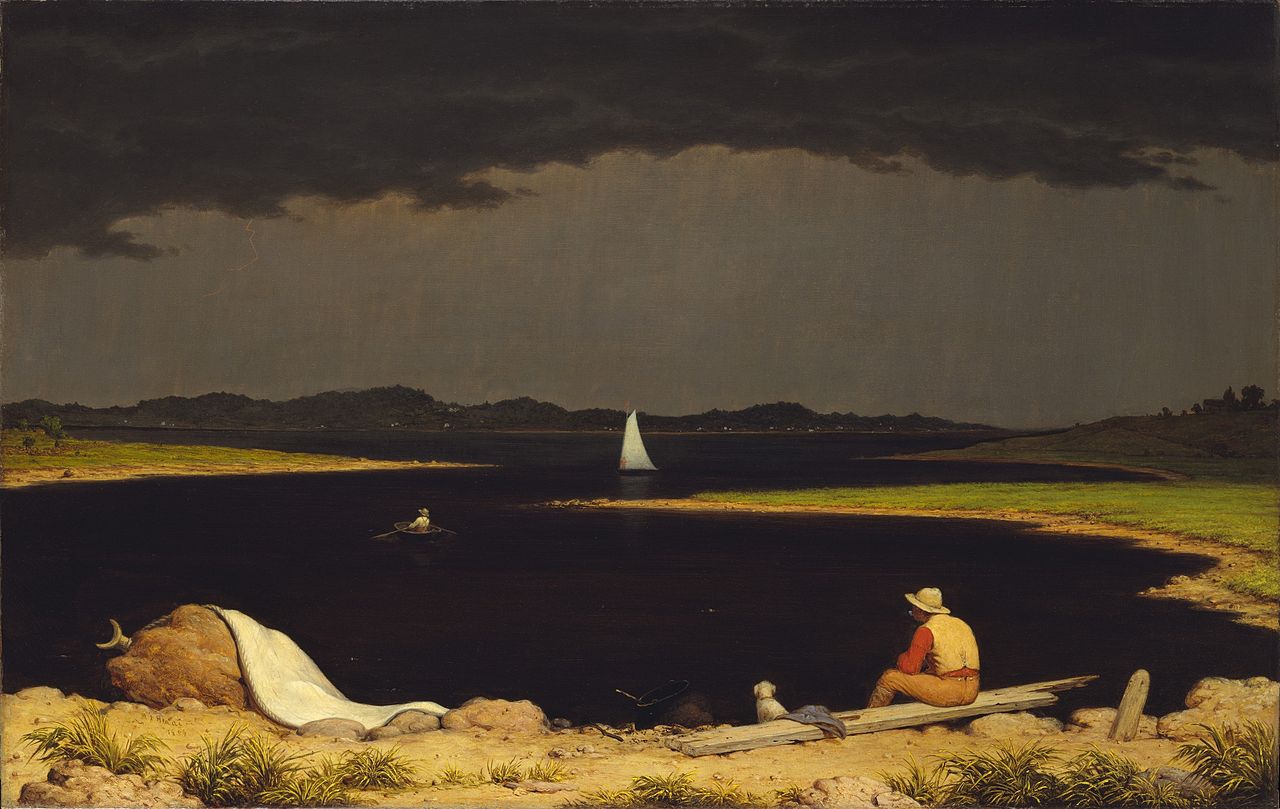
“Heade’s calm is unsteady, storm-stirred; we respond in our era to its hint of the nervous and the fearful. His weather is interior weather, in a sense, and he perhaps was, if far from the first to portray a modern mood, an ambivalent mood tinged with dread and yet imbued with a certain lightness.The mood could even be said to be religious: not an aggressive preachment of God’s grandeur but a kind of Zen poise and acceptance, represented by the small sedentary or plodding foreground figures that appear uncannily at peace as the clouds blacken and the lightning flashes.”
― John Updike, Still Looking: Essays on American Art
********************
I don’t think I’ve ever mentioned Martin Johnson Heade here. This is really an oversight on my part as some of his work was really influential on the direction of my work early on, even though to the casual observer it may not seem apparent. After all, our styles and methods of painting were wildly different. The intensity of the color and contrast in his paintings of the floral subjects and tropical birds that he completed during his long and prolific career (born 1819 and died in 1904) really made me want to push my own color ahead. There is a site, Martin Johnson Heade- The Complete Works, that has his complete works online where you can see the great quality of his color and use of contrast.
But the painting shown at the top, Approaching Thunderstorm, from the Metropolitan Museum is my favorite Heade painting. The forms of the black water of the lake set against the vibrant color of the shoreline is striking and a most ominous storm cloud churns toward the boaters who have not yet fully heeded the signs of the oncoming storm.
It was painted in 1859, in the years before our country exploded in civil war. This painting was part of a cultural movement of the time that depicted the tension gripping our nation in metaphorical terms. The metaphor is strong and obvious in this painting with the dark band of the river symbolizing the division between the pro-slavery/states rights factions and the abolitonist/republican side. Several prominent abolitionist preachers of the era owned versions of this painting, many often referring to this coming storm in their sermons.
Knowing this makes me appreciate the painting on a different level. But it is still about the sheer emotional impact of the color and forms that hit me long before I knew its history. There is a tension and that feeling of stillness that occurs in the moment just before action occurs, something I have tried to capture in my own work at times. I still find this piece brilliant and inspiring.
I love color. It must submit to me. And I love art. I kneel before it, and it must become mine. Everything around me glows with passion. Every day reveals a new red flower, glowing, scarlet red. Everyone around me carries them. Some wear them quietly hidden in their hearts. And they are like poppies just opening, of which one can see only here and there a hint of red petal peeking out from the green bud.
–Paula Modersohn-Becker
++++++++++++++++++
.
Paula Modersohn-Becker (1876-1907) is yet another artist that is unknown to most of us. I know she was not known to me and as I was going through the images of her paintings from her tragically short career, I feel selfishly saddened for the loss of what more she might have had in store for us.
.
Born in Germany, her actual artistic career lasted less than a decade but her work had great influence in the European art world of the early 20th century. Perhaps a leading edge of the Modernist movement to come, she worked only in tempera with a limited palette of colors and worked with simplified forms, sometimes scratching the painted surface to create her distinct textures.
.
She died at the age of 31 from a post partum embolism.
.
I love her quote at the top, how we all carry colorful red flowers with us. Some of us hide our flowers and others wear them for all to see. The artist’s chore – or gift- is to discover and express that red flower.
.
Take a look below at some of the paintings from Paula Modersohn-Becker.
There’s a tombstone in a local cemetery that we walk by nearly every day. I look at it nearly every time we pass and it always makes me smile. Below the name and the dates of his lifespan are the words Grade A Milkman. All I can think is what great pride this man took in his job before he passed away at an early age. It reminds me of a post from several years back that I ran for the Labor Day weekend. It fits here for this Grade A Milkman.
A little postscript: After years of walking by this grave, a bit of research revealed that this fellow was my mother’s 3rd cousin. Makes me smile even a little more.
Here’s the post from back in 2013:
***********************
If a man is called to be a street sweeper, he should sweep streets even as Michelangelo painted, or Beethoven composed music, or Shakespeare wrote poetry. He should sweep streets so well that all the hosts of heaven and earth will pause to say, here lived a great street sweeper who did his job well.
–Martin Luther King, Jr.
**********************
Another Labor Day weekend is here. On this blog in the past I have bemoaned how the general public has forgot how much it owes to the labor movement, how the middle class that was the pride of this country during the middle of the last century was a direct result of hard fought gains from workers who banded together and stood against social injustice. But today I just want to speak briefly about taking pride in one’s job, the same sentiment reflected in the quote above from Martin Luther King, Jr.
When I was a waiter in a pancake house, even after I had started showing my work in several galleries, I was always a waiter first when I was at my job. Never a painter-slash-waiter, a title which served no purpose. Circumstances had put me in this place at this time and I had determined that if I had to be there I would give it my complete attention and effort. I would make it my own. If I disliked it so much that it made me miserable, I would do something about changing my job when my day there was done and the task before me was complete.
But while I was there, I treated it as though it were my destiny because, who knew, maybe it was. I took great pride in being good at that job and some other jobs that I’ve done that could be classified as menial. What was the cost in doing this? If I had to be there then I would rather be recognized for my excellence than for my displayed misery.
Simply put, take pride in the task before you, however menial you see it. Find pride in the toil and treat it as your destiny because, in that very moment, it is.
Have a great Labor Day weekend and remember what the day stands for.
Today is the last day to get into the West End Gallery to see The Rising.
Many thanks to those of you who were able to stop in and take a look. The response has been fantastic and the feedback I have received provides me a lot of inspiration going forward. That’s a big thing for me and for any artist.
Thanks as always to Jesse and Linda at the gallery for all the work they do for my work. I know it’s a lot and I truly appreciate it.
Hope you can make it into the West End Gallery today. Thank you!
I was not sure where I was going, and I could not see what I would do when I got there. But you saw further and clearer than I, and you opened the seas before my ship, whose track led me across the waters to a place I had never dreamed of, and which you were even then preparing to be my rescue and my shelter and my home.
― Thomas Merton, The Seven Storey Mountain
+++++++++++++++++++++
Well, my annual show at the West End Gallery comes down in just a few days. This year’s edition is called The Rising and Thursday is the last day to see the show.
It is a show in which I feel a real sense of pride. When I am prepping for a show, my goals for it are often vague and undefined. I feel that I want certain things for it and from it but when I try to verbalize these goals, the words evade me. I find myself like the sailor in the Thomas Merton quote above: I was not sure where I was going, and I could not see what I would do when I got there.
I knew it was going somewhere. I just didn’t know where. I let intuition and reaction guide me and it often worked out fine.
But this show, much like my June show at the Principle Gallery, felt more preordained and focused and less haphazard in it’s final edited version, the one that hit the walls of the galleries. I still allowed for the role of intuition and the unconscious in the process of painting each piece. That is a necessity.
But where I could make conscious decisions, I did just that. I chose to simplify forms and chop out the fussiness of detail. Deepened colors. As much as I like them and appreciate their popularity, I reduced the number of small paintings and went with works that were a bit larger. It streamlined the look of the show on the wall, made it feel less cluttered, and gave each piece a bit more room in which to expand.
They weren’t big things but enough to make the work in the exhibit to be presented with fuller impact. I felt like this and the Principle Gallery show were my most mature and complete exhibits to date.
The response to the show has been great which is gratifying on many levels. A number of the original paintings from the show have flown the coop to their new homes but there are a few replacements that I feel fill the void they leave behind. One new piece is shown above. It’s Star Navigator, a 24″ by 8″ canvas that feels very much like it jibes with the words of Merton at the top.
I hope you can make it out to the West End Gallery in the next few days, if you haven’t had a chance to see The Rising.
Life is very short… but I would like to live four times and if I could, I would set out to do no other things than I am seeking now to do.
—William Merritt Chase
+++++++++++++++++
+
I find this to be a very interesting quote from the American master William Merritt Chase (1849-1916). I don’t think about it very often but given a choice of doing what I am doing with my life and being able to freely pursue any other life, I would continue, like Chase, on the path I am currently on.
.
I know there could be greater adventures, greater importance, greater rewards, wider travels and so on in other pursuits. But this life meshes with my character and my preferences so well that the thought of doing anything else seems almost absurd at this point. It never even enters my mind.
.
And there is something calming in the certainty of this. It’s one less thing that might gnaw at me, to make me question my own decisions. One less thing in which to find uncertainty in a world overflowing with it. When I enter my studio, I know I am in my proper place. Oh, I might question my decisions, my actions, in that space but I can no longer imagine myself being in any other place. And like Chase, I find myself wishing I could live four more of these lives.
.
And that’s a good thing.
.
Here are some more painting from William Merritt Chase. Hope his words somehow apply to you. Have a great day.
I read an interesting article in The Atlantic by Eliot Cohenthis week that has stuck with me for the past few days. It parallels the possible fall of the current administration to that of Shakespeare’s Macbeth. How fitting that the Scottish play, as it is often called, might mirror the fall of a man with a Scottish ancestry.
The end may be brought about by those he has freely abused and those around him who serve him not from admiration or love but from fear and the self-serving nature of the position, things that will no doubt soon fall away as the downward spiral hastens and his true nature of this utterly selfish person becomes apparent to even those who still follow him with fervor.
As Cohen writes:
…his spirit remains tyrannical—that is, utterly self-absorbed and self-concerned, indifferent to the suffering of others, knowing no moral restraint. He expects fealty and gives none. Such people can exert power for a long time, by playing on the fear and cupidity, the gullibility and the hatreds of those around them. Ideological fervor can substitute for personal affection and attachment for a time, and so too can blind terror and sheer stupidity, but in the end, these fall away as well.
Who will be Macduff, the one who ends the reign of the tyrant, in this version of the play is yet to be determined. But the last words of Macduff before he is urged by Macbeth to Lay on, Macduff should be remembered:
Then yield thee, coward, And live to be the show and gaze o’ the time: We’ll have thee, as our rarer monsters are, Painted on a pole, and underwrit, ‘Here may you see the tyrant.’
In case you don’t know the play, it doesn’t end well for Macbeth.
For this week’s Sunday morning music I have chosen a nice collaboration of a song from the great American songbook from Elvis Costello and the late great Chet Baker. The title fits well with an article about a man who demands love and loyalty but offers none in return: You Don’t Know What Love Is.
 +++++++++++++++++




 Redtree Times